
30-Day SAT Study Plan 2026: 4-Week Step-by-Step Guide
Miyagi Labs ·
30-Day SAT Study Plan 2026: 4-Week Step-by-Step Guide

TLDR: A 30-day SAT study plan is a short-term system for finding and fixing the mistakes costing you the most points before test day. It starts with a Bluebook diagnostic, uses an error log to identify weak skills, and builds toward timed practice and a full-length simulation. Thirty days is enough time for meaningful score gains if you focus on high-value weaknesses instead of studying everything equally.
Quick Answer
If you have only 30 days before the SAT, spend the first week identifying weaknesses with a full Bluebook diagnostic test, the next two weeks repairing your highest-impact Reading/Writing and Math skills through targeted practice, and the final week taking timed practice tests while reviewing mistakes. Most students benefit more from studying weak areas every day than from taking repeated full-length tests.
30-Day Priority Checklist
Priority | Action |
|---|---|
Day 1 | Take a full Bluebook diagnostic |
Week 1 | Build an error log |
Week 2 | Fix highest-frequency mistakes |
Week 3 | Timed module practice |
Week 4 | Full simulation + light review |
Final 24 Hours | Rest and logistics |
What Is a 30-Day SAT Study Plan?
A 30-day SAT study plan is a one-month preparation schedule for students who have roughly four weeks before test day. It is not a full SAT curriculum. It is a triage system.
The goal is straightforward: take a diagnostic test, find the question types costing you the most points, fix the ones you can fix in time, practice under timed conditions, and walk into test day comfortable with the format. College Board says Bluebook practice tests are the most accurate way to measure your knowledge of the skills on the actual SAT, which makes Bluebook the right starting point for any short-term plan.
A good 30-day plan has six parts:
A baseline diagnostic test
An error log that categorizes every miss
Targeted practice on weak skills
Timed module drills
At least one full-length simulation
Final-week review and rest
If building this kind of schedule from scratch feels overwhelming, a platform with a built-in diagnostic and study path can handle the planning for you.
Start with a personalized SAT plan
Is This 30-Day SAT Study Plan Right for You?
This study plan works best if:
You have approximately four weeks before your SAT.
You can study at least 30 to 90 minutes most days.
You already know most SAT fundamentals but need a structured review.
You want to improve your score through targeted practice instead of relearning every topic.
You may need a longer study plan if:
You are starting more than 200 points below your goal.
You struggle with foundational Algebra or reading comprehension.
You have not yet completed Algebra II.
You can only study once or twice each week.
Is 30 Days Enough to Improve Your SAT Score?
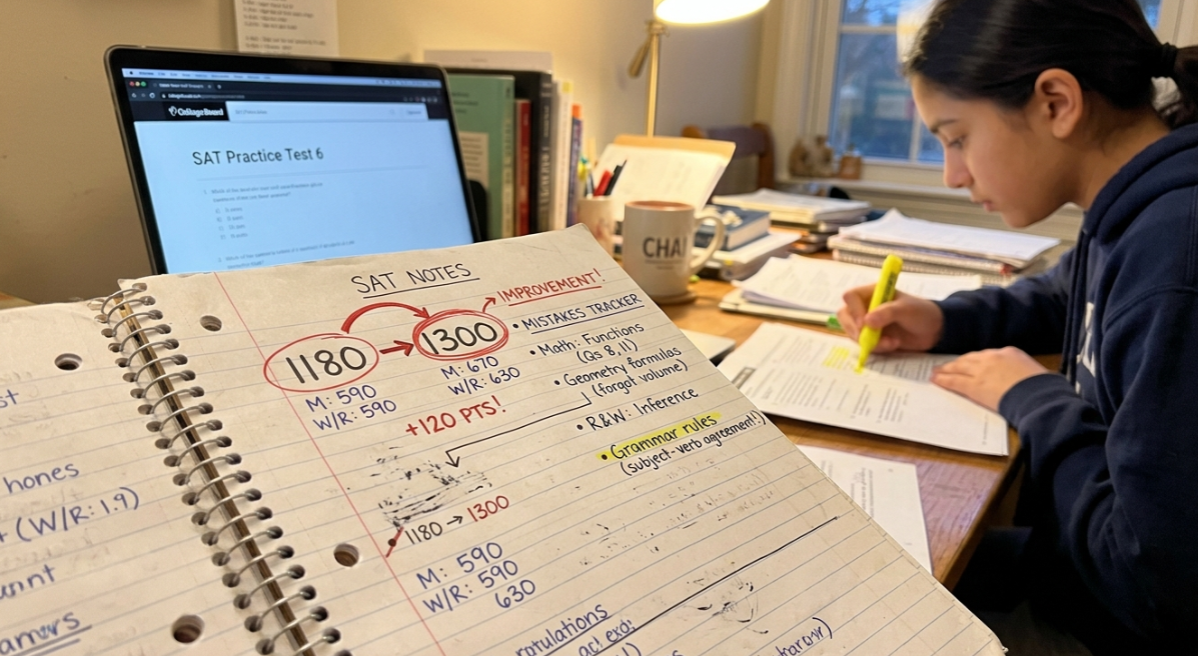
Yes. But the honest answer depends on where you start, where you want to be, and what is causing your missed points.
A student who loses points to fixable issues (grammar rules, Algebra setup errors, pacing, careless mistakes) can see real improvement in 30 days. A student who is missing years of foundational math will have a harder time closing a large gap in one month. Both students benefit from a structured plan, but the realistic outcomes differ.
College Board reported that 20 hours of personalized Official SAT Practice on Khan Academy was associated with an average 115-point score gain. That study is correlational and from an older SAT version, but it supports a clear principle: focused practice produces results. Peterson’s claims most students using a structured four-week SAT study plan see a 50 to 150 point increase.
Practitioners on Reddit report a wide range of outcomes. One student described going from roughly 1130 to 1360 after a month of weekday study. Another thread about jumping from 1280 to 1500+ received blunt feedback that such a jump is unlikely if fundamental gaps exist. The common advice across these threads: stop doing random review, find your weak points, and grind those.
Score-Gap Matrix
Gap from your goal | Is 30 days enough? | Best approach |
|---|---|---|
0 to 50 points | Very realistic | Fix careless errors, pacing, and one or two repeated weak skills |
50 to 100 points | Realistic with daily work | Full diagnostic, error log, targeted drills, one to two simulations |
100 to 150 points | Possible but demanding | Daily study, high-yield topic repair, timed modules, strict review |
150 to 200 points | Difficult | Works best when gaps are specific, not broad |
200+ points | Uncommon in one month | Possible in individual cases, but plan for a retake if needed |
If you want a data-backed read on where you stand, a SAT score predictor can help you estimate your trajectory and identify which sections are holding you back.
Know the Digital SAT Format Before You Plan
Before building your 30-day SAT study plan, understand what you are preparing for. The digital SAT is structurally different from the old paper test, and many popular guides still reference outdated formats with separate reading, writing, no-calculator math, and an optional essay. None of those exist anymore.
Current Structure
The digital SAT has two sections: Reading and Writing, and Math. Each section has two modules. The total test takes 2 hours and 14 minutes with 98 questions.
Reading and Writing: 64 minutes, two 32-minute modules, 54 questions
Math: 70 minutes, two 35-minute modules, 44 questions
Break: 10 minutes between sections
Why the Adaptive Format Matters
Each section starts with a Module 1 containing a mix of easy, medium, and hard questions. Your performance on Module 1 determines whether Module 2 is harder or easier. This means accuracy on early questions has outsized importance. Your first priority should be avoiding easy and medium misses in Module 1. Your second priority should be managing time and composure in a potentially harder Module 2.
Timing Benchmarks
According to College Board’s assessment framework, the average time per question is about 71 seconds for Reading and Writing and about 95 seconds for Math. Some questions take 20 seconds, others take two minutes. Knowing these averages helps you decide when to flag a question and move on.
Domain Breakdown
Reading and Writing:
Craft and Structure: about 28%
Information and Ideas: about 26%
Standard English Conventions: about 26%
Expression of Ideas: about 20%
Math:
Algebra: about 35%
Advanced Math: about 35%
Problem-Solving and Data Analysis: about 15%
Geometry and Trigonometry: about 15%
Algebra and Advanced Math together account for roughly 70% of SAT Math. That makes them the highest-priority math domains for most students working with limited time.
The 30-Day SAT Study Plan at a Glance
Here is the four-week overview. Each week has a clear purpose. Do not skip straight to taking practice tests.
Week | Goal | Main work |
|---|---|---|
Week 1 | Diagnose and prioritize | Full Bluebook test, error log, identify top 3 weak areas |
Week 2 | Build accuracy | Targeted practice, grammar and math concept repair, Desmos basics |
Week 3 | Add timing pressure | Timed modules, pacing drills, flagging strategy, mixed practice |
Week 4 | Simulate and rest | Full practice test, final weak spots, logistics, rest |
This follows College Board’s own guidance: take a full-length Bluebook test early, use the results to target study, then take another simulation at least two weeks before test day.
30-Day SAT Study Calendar
Day | Focus |
|---|---|
1 | Bluebook Diagnostic |
2 | Review mistakes |
3 | Build error log |
4 | Reading practice |
5 | Math practice |
6 | Mixed review |
7 | Rest |
8–13 | Target weak skills |
14 | Timed module |
15–20 | Mixed drills |
21 | Full review |
22 | Timed practice |
23 | Reading review |
24 | Math review |
25 | Full-length practice test |
26 | Analyze mistakes |
27 | Weakest topics |
28 | Light review |
29 | Logistics |
30 | Test Day |
Week 1: Take a Diagnostic and Find Your Point Leaks
The first week of a 30-day plan is not about doing the most questions. It is about finding the right questions.
Day 1: Take a full-length Bluebook practice test under realistic conditions. Sit in a quiet space, use a timer, take the 10-minute break, and do not check answers between modules.
Day 2: Review every missed, guessed, and slow question. Do not just check which ones were wrong. Ask why each one was wrong. Was it a content gap, a misread, a trap answer, a pacing issue, or a careless mistake?
Day 3: Build your error log and choose your top three “point leaks,” the skills or question types costing you the most points.
Days 4 and 5: Begin studying your weakest Reading and Writing domain and your weakest Math domain. Use College Board’s Student Question Bank to filter by domain, skill, and difficulty.
Day 6: Do targeted practice focused on your three priority areas from the error log.
Day 7: Light review or rest. Confirm your priority list for Week 2.
A pro tutor on Reddit put it simply: the most important step after a practice test is answering why each wrong answer happened. The post tells students to review every wrong question and identify what they did not understand, not just count the number of misses.
Take a full-length practice exam to establish your baseline before starting targeted work.
Week 2: Build Accuracy in High-Value Skills
Now that you know where your points are leaking, spend this week repairing the highest-value skills. Accuracy comes before speed.
Reading and Writing Priorities
Start with Standard English Conventions (grammar, punctuation, sentence structure) and Transitions. These are rule-based topics where consistent study produces fast gains. Practitioners on Reddit consistently recommend grammar, Desmos practice, and focused weak-point drilling as the quickest wins in a one-month SAT study plan.
Then move to Command of Evidence and Words in Context, which require more practice and pattern recognition.
Math Priorities
Focus on Algebra and Advanced Math first, unless your diagnostic reveals a different severe weakness. Linear equations, systems of equations, quadratics, and functions form the foundation of SAT Math.
Start Learning Desmos
The digital SAT includes a built-in Desmos graphing calculator for every Math question. SAT tutor Katya Seberson notes on LinkedIn that students should first know the content, then decide whether a problem is faster on paper or in Desmos. Do not treat Desmos as a replacement for understanding. Use it as a speed tool after you know what the question is asking.
Another tutor, Jaclyn Caruana, argues on LinkedIn that many students still treat Desmos as a last resort even though the digital SAT includes it on purpose. Students who learn to graph systems and check answer choices in Desmos can solve faster and avoid algebra errors. Systems of equations, quadratics, function intersections, and answer verification are all prime Desmos territory.
Daily Practice Structure
For each weak skill this week:
Do 10 to 20 targeted questions (untimed is fine)
Review every explanation, right or wrong
Redo missed questions without looking at the answer
Write a one-line rule for each recurring mistake
Drill weak skills with SAT problem sets filtered by domain and difficulty to keep every session focused.
Week 3: Practice Timing and Digital Modules
By Week 3, you should have patched the biggest content gaps. Now add the pressure of a clock.
Timed module practice: Complete one 32-minute Reading and Writing module and one 35-minute Math module at least three times this week. The goal is building comfort with the pace, not perfection.
Flagging strategy: Practice flagging questions that feel hard or slow. Come back to them after finishing the easier questions in the module. This “two-pass” approach prevents you from burning three minutes on one hard question while leaving easy points untouched.
Review slow-but-correct answers: If you got a question right but spent too long on it, that is still a problem. Find a faster method.
Mixed practice: Do sets that combine skills instead of drilling one topic at a time. Test day will not sort questions by topic for you.
Students on Reddit report that Bluebook is the best tool for pacing and format familiarity, but some note that practice scores can vary from their real score by 20 to 50 points due to nerves, test-day timing, or Module 2 difficulty. Use Bluebook for simulation, but do not treat a single practice score as a precise prediction.
Build speed on remaining weak areas with targeted SAT practice organized by skill and difficulty.
Week 4: Simulate Test Day and Polish
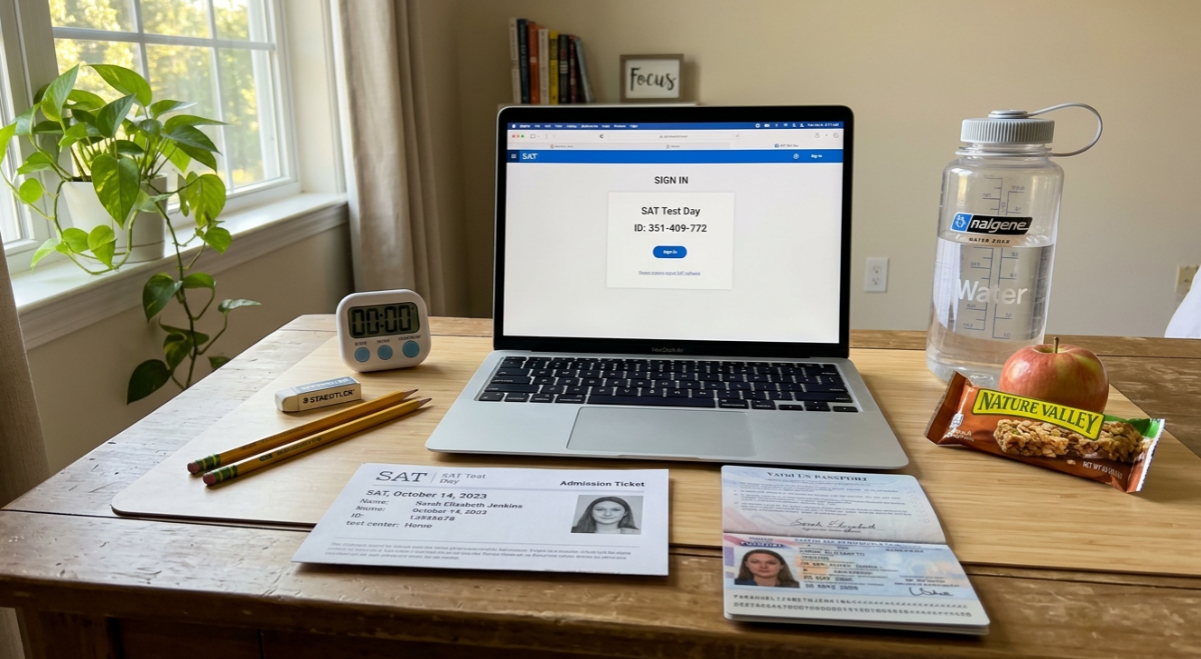
This is your final week. The work shifts from learning to confirming.
Early in the week: Take one full-length practice test under test-day conditions. Time yourself, take the break, and sit in a quiet or unfamiliar spot if possible.
Within 24 hours: Review the full test. Sort every miss into your error log.
Pick three final priorities. One Reading and Writing skill, one Math skill, one strategy or pacing habit. That is all. Do not start new material.
Example final-week triage:
R&W: Punctuation boundaries (semicolons, commas with dependent clauses)
Math: Systems and quadratics with Desmos
Strategy: Flag after 90 seconds if there is no clear path forward
Two days before the test: Do light review only. Look through your error log. Read your one-line rules.
The day before: Prepare your device, admission ticket, photo ID, snacks, and route. Confirm your testing center address. Go to bed at a normal time.
Stop heavy studying at least 24 hours before the test. Final-day cramming adds stress and rarely adds points.
How Many Hours Should You Study Each Day?
A 30-day SAT study plan works at different intensity levels. Match your study time to your schedule and score gap.
Busy Version: 30 to 45 Minutes per Day
Best for students balancing school, sports, work, or other commitments.
5 minutes: Review yesterday’s error log
20 minutes: Targeted practice on one weak skill
10 minutes: Review explanations
5 minutes: Update error log
Standard Version: 60 to 90 Minutes per Day
This is the sweet spot for most students. It provides enough time for real skill-building without burnout.
10 minutes: Review old errors
35 to 45 minutes: Targeted practice
20 minutes: Explanation review
10 minutes: Redo missed questions
Intensive Version: 2 to 3 Hours per Day
Best for summer, school breaks, or students with large score gaps.
45 minutes: Reading and Writing
45 minutes: Math
30 minutes: Review and error log
30 minutes: Timed module or Desmos drill
One important caution: do not schedule full-length tests so often that you have no time to learn from them. A practice test is data collection. Score improvement comes from reviewing and repairing the data, not from taking another test.
What Improvement Can You Expect Each Week?
Week | Goal |
|---|---|
Week 1 | Understand weaknesses |
Week 2 | Improve accuracy |
Week 3 | Improve timing |
Week 4 | Build confidence |
Best SAT Study Resources for a 30-Day Plan
Resource | Best For |
|---|---|
Bluebook | Official practice tests |
Khan Academy | Learning concepts |
College Board Question Bank | Targeted practice |
Desmos | SAT Math solving |
Error Log | Tracking improvement |
How Your Starting SAT Score Changes Your 30-Day Plan
Starting Score | Main Focus |
|---|---|
Under 1000 | Learn core Math and grammar |
1000–1200 | Repair weak domains |
1200–1350 | Accuracy and pacing |
1350–1450 | Advanced questions |
1450+ | Eliminate careless mistakes |
What to Practice First in a 30-Day SAT Plan
When time is short, prioritize the topics with the highest return.
Fastest Reading and Writing Wins
Standard English Conventions: Punctuation rules, sentence boundaries, subject-verb agreement. These are learnable rules, not subjective reading skills.
Transitions: Choosing the right connecting word between ideas. A small set of patterns covers most questions.
Command of Evidence: Supporting claims with textual evidence. Practice identifying what the passage actually says versus what it implies.
Words in Context: Vocabulary in passage. Repeated exposure builds this skill.
Fastest Math Wins
Linear equations and systems: High-frequency and often solvable quickly with Desmos.
Quadratics and nonlinear functions: Core Advanced Math territory.
Percentages, ratios, rates, and units: Common in Problem-Solving and Data Analysis.
Geometry formulas: The reference sheet is provided on test day, but knowing when and how to apply formulas saves time.
Desmos setup: Practice typing equations, finding intersections, and checking answer choices by graphing.
The Error Log: Your Most Important Tool
A 30-day SAT study plan without an error log is just a calendar. The error log turns test-taking into actual improvement.
After every practice session, log each miss with these columns:
Date | Source | Section | Skill | Error type | Why I missed it | Correct rule or strategy | Redo date |
|---|---|---|---|---|---|---|---|
Aug 5 | Bluebook PT | Math | Systems | Strategy | Solved by hand, too slow | Graph both in Desmos, find intersection | Aug 8 |
Aug 6 | Question Bank | R&W | Boundaries | Content gap | Did not know semicolon rule | Semicolon joins two independent clauses | Aug 9 |
Aug 7 | Timed module | R&W | Transitions | Trap answer | Chose “however” when relationship was additive | Read the sentence before and after the blank | Aug 10 |
Error Type Categories
Error type | What it means | How to fix it |
|---|---|---|
Content gap | You did not know the rule or concept | Learn the concept, then drill 10 to 20 targeted questions |
Misread | You understood the topic but answered the wrong question | Underline the task; reread the final sentence in Math problems |
Trap answer | You chose an answer that sounded right but was unsupported | Write why each wrong choice is wrong |
Pacing | You ran out of time or rushed | Practice timed modules and flagging |
Careless | Arithmetic, sign, punctuation, or copy error | Slow down on easy and medium questions; check before moving on |
Strategy | You used a slow method | Learn Desmos, elimination, or two-pass solving |
A Reading and Writing prep thread on Reddit recommends recording not just the missed problem but the fundamental reason for the mistake. Over time, you start seeing patterns, the same two or three error types appearing again and again, and those patterns tell you exactly where to focus next.
Common Mistakes to Avoid in a 30-Day SAT Plan
Taking Tests Without Reviewing Them
A full-length test only improves your score if it changes what you study next. One Reddit user asked whether doing Khan Academy for three days and then taking Bluebook tests nonstop until exam day would work. A commenter responded that if you do not know certain topics, you need to learn them first, otherwise you are collecting the same wrong answers repeatedly.
Studying Strengths Because They Feel Good
Students under time pressure often gravitate toward topics they already know. That feels productive, but it is not. Protect your strengths briefly, then spend the majority of study time on recurring weak skills.
Ignoring the Digital Tools
Bluebook includes highlighting, option elimination, a line reader, annotation, and flagging. These tools exist to help you, but only if you practice with them before test day.
Treating Desmos as an Emergency-Only Tool
SAT tutors make a strong case that Desmos should be a primary solving tool for many math questions, not a last resort. Systems of equations, quadratics, and function intersections are all faster in Desmos once you know how to use it.
Starting New Material in the Final 48 Hours
If you have not learned a concept by Day 28, it is better to consolidate what you know than to panic-learn something new.
Leaving Questions Blank
There is no guessing penalty on the digital SAT. College Board says it is better for students to guess than to leave a question blank, especially after eliminating one or two choices. Never leave a question unanswered.
Frequently Asked Questions
Can I really raise my SAT score in 30 days?
Yes. The likely gain depends on your starting score, target, available study time, and the types of mistakes you are making. A 50 to 100 point improvement is a reasonable target for students who study consistently. Larger gains are possible when weaknesses are clear and specific, but no plan can guarantee a particular number.
How many practice tests should I take in 30 days?
For most students, one diagnostic and one or two full simulations are enough. More tests are only useful if you have time to deeply review each one. The “test, diagnose, drill, retest” cycle matters more than the raw number of tests.
What is the best first step?
Take a full-length Bluebook diagnostic. It gives the closest experience to the real digital SAT and provides score reports you can use to target your weakest areas.
Should I use Khan Academy, Bluebook, or a question bank?
Use all three for different purposes. Bluebook gives you realistic full-length practice. Khan Academy offers concept lessons when you need to relearn a topic. A question bank lets you filter practice by skill and difficulty for targeted drills. For a guided version that combines diagnostics, practice, and AI explanations, explore SAT study resources.
Should I guess on the SAT?
Always. There is no penalty for wrong answers. If you can eliminate even one choice, your odds improve. If you cannot eliminate any, guess anyway.
What should I do the day before the SAT?
Light review only. Flip through your error log and one-line rules. Prepare your device, admission ticket, ID, snacks, and route. Avoid heavy studying, new topics, and late-night sessions.
Is a 30-day plan different for someone scoring 1100 versus 1400?
The structure is the same, but the content inside each week shifts. A student at 1100 likely has more content gaps and should prioritize learning core rules and concepts. A student at 1400 is more likely losing points to trap answers, pacing, or a small number of advanced topics, and should focus on error analysis and timed practice.
Still deciding between the SAT and ACT?
If you have not committed yet, try both formats with practice tests before locking in your study plan. The best test is the one where your strengths align with the format. You can try ACT practice questions to compare.
A 30-day SAT study plan is not about learning everything on the test. It is about finding the highest-value mistakes and fixing them before they cost you points on test day. Start with a diagnostic, build an error log, focus your energy on the skills that matter most, and walk into the test feeling prepared.
Start your SAT prep with a diagnostic, AI-guided practice, and progress tracking to make the most of your 30 days.