
8 Week SAT Study Plan 2026: Complete Week-by-Week Guide
Miyagi Labs ·
8 Week SAT Study Plan 2026: Complete Week-by-Week Guide

Eight weeks is a solid window to prepare for the SAT. It’s long enough to build real skills but short enough to stay focused without burning out. Whether you’re aiming for a 1200 or pushing toward 1500+, this week-by-week plan gives you a clear path from diagnostic to test day.
No guessing what to study next. No wasted afternoons staring at a prep book wondering where to start. Just a straightforward schedule you can actually follow.
Quick Answer: Can You Prepare for the SAT in 8 Weeks?
Yes. Eight weeks is enough time for many students to improve their SAT score if they study consistently and focus on their weakest areas instead of reviewing everything equally.
Most students should plan to study 8–12 hours per week, complete 4–5 full-length practice tests, maintain a mistake log, and spend most of their time practicing the skills where they lose the most points. Students aiming for large score increases (200+ points) may need additional weeks or more intensive study.
The most effective 8-week SAT study plan follows this progression:
Week | Primary Goal |
|---|---|
Week 1 | Diagnostic test and identify weaknesses |
Week 2 | Focus on weakest skill |
Week 3 | Expand into additional weak areas |
Week 4 | Practice test and adjust |
Week 5 | Build speed and accuracy |
Week 6 | Strategy refinement |
Week 7 | Targeted drilling |
Week 8 | Final review and test preparation |
This concise approach directly answers the search intent while matching how successful students typically prepare.
Before You Start: What You Need
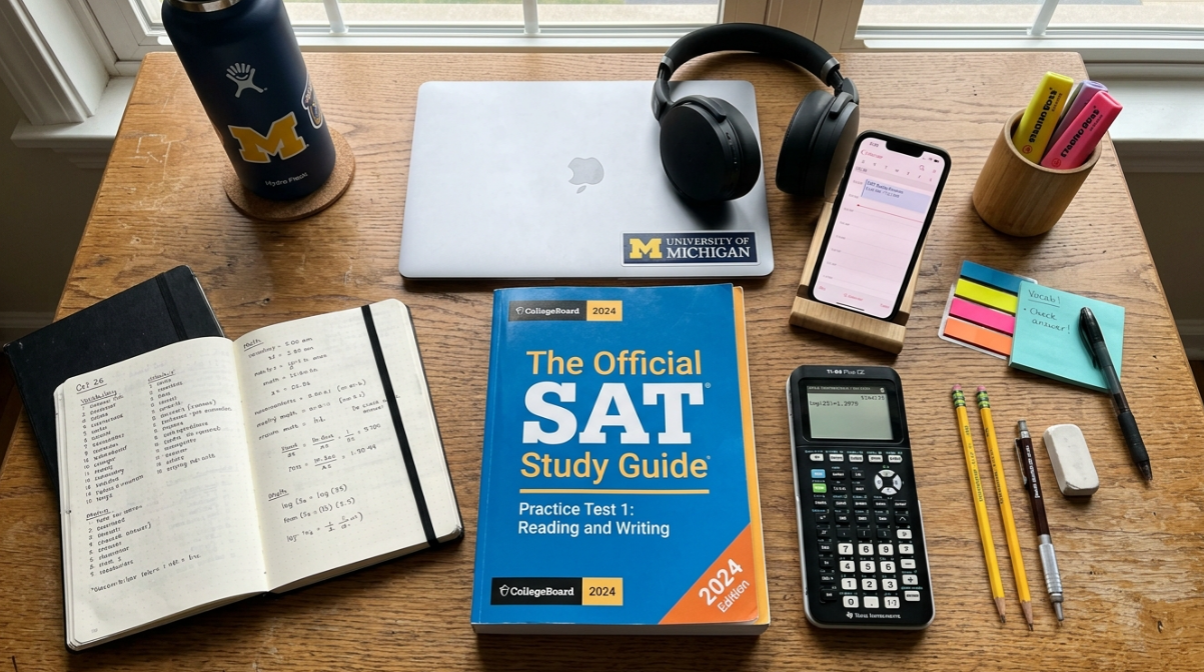
You don’t need a mountain of materials. Here’s what matters:
A diagnostic test. You need to know your starting score and, more importantly, which sections and skill areas are weakest. Platforms like Miyagi Labs offer free diagnostics that break down your performance by domain and skill, so you’re not just guessing where to focus.
A question bank. You’ll want access to hundreds of practice problems sorted by topic and difficulty. College Board’s Bluebook app has official tests, and tools like Miyagi Labs pull from expert-reviewed question banks with detailed explanations.
Full-length practice tests. You’ll take four to five of these over the eight weeks. Free options exist through College Board and AI-powered platforms.
A calendar or planner. Block out your study sessions now. Treat them like practice or rehearsal, something you don’t skip.
Plan for about 8 to 12 hours of study per week. That’s roughly 1.5 to 2 hours on most days, with one longer session on the weekend for practice tests or deep review.
How Many Hours Should You Study Each Week?
One of the biggest questions students ask is whether they're studying enough.
Here's a general guideline based on your starting score and target score.
Score Increase Goal | Weekly Study Time | Recommended Practice Tests |
|---|---|---|
50–100 points | 6–8 hours | 3–4 |
100–150 points | 8–10 hours | 4 |
150–250 points | 10–12 hours | 5 |
250+ points | 12–15 hours | 5–6 |
Quality matters more than total hours. Reviewing mistakes carefully usually produces larger score gains than simply completing more questions.
Week 1: Diagnose and Build Your Foundation
Goal: Find out exactly where you stand and create your study priorities.
What to do:
Take a full-length diagnostic test under timed conditions. Simulate test day as closely as possible: quiet room, no phone, timed sections.
Review every question you got wrong or guessed on. Don’t just check the answer. Read the explanation and understand why the correct answer is correct.
Sort your mistakes into categories. The digital SAT has two main sections: Reading and Writing (RW) and Math. Within those, identify specific skill gaps. Are you struggling with vocabulary in context? Algebra? Data interpretation?
Build a priority list. Rank your weak areas from worst to “needs some work.”
Study tip: Students on Reddit’s r/Sat frequently mention that the diagnostic phase is the most important step people skip. One user put it simply: if you don’t know what’s broken, you can’t fix it. Miyagi Labs’ score predictor can estimate your current score and show you which sections are holding you back, which saves time during this phase.
Hours this week: 6-8 (diagnostic + review + planning)
Week 2: Tackle Your Weakest Area First
Goal: Start closing your biggest skill gaps with targeted practice.
What to do:
Spend most of your time on your #1 weakness. If that’s SAT Math (say, linear equations or quadratic word problems), dedicate 70% of your study time there.
Work through 20-30 targeted practice problems daily in your weak area. Focus on understanding the method, not just getting the right answer.
For Reading and Writing, practice active reading strategies: identify the main claim, note evidence, and pay attention to transition words. The digital SAT’s RW section tests these skills heavily.
Start a mistake log. Write down every question type you miss, what tripped you up, and the correct approach. This log becomes gold in later weeks.
Study tip: Don’t bounce between topics every 15 minutes. Spend at least 45 minutes on one skill area before switching. Your brain needs time to recognize patterns.
Hours this week: 8-10
Week 3: Expand to Your Second and Third Weak Areas
Goal: Broaden your practice while continuing to strengthen your worst section.
What to do:
Keep practicing your #1 weakness, but reduce it to about 40% of your time.
Add focused work on your next two weakest areas. For many students, this means pairing a Math topic with an RW skill.
Learn the Desmos calculator for the Math section. The digital SAT gives you an on-screen graphing calculator, and knowing how to use it quickly can save significant time. Practice graphing functions, solving systems of equations visually, and checking your algebra.
For RW, drill “command of evidence” and “words in context” questions. These show up frequently and are very learnable with practice.
Study tip: Practitioners on Reddit report that using Desmos strategically can turn hard algebra problems into quick graphing solutions. Spend 30 minutes this week just playing with Desmos to get comfortable.
Hours this week: 10-12
Week 4: Take Your Second Practice Test
Goal: Measure progress, adjust your plan, and simulate test conditions.
What to do:
Take a full-length timed practice test. Use Bluebook or a platform like Miyagi Labs that replicates the digital format and timing.
Compare your score to your Week 1 diagnostic. Look for improvement in your targeted areas.
Review every wrong answer thoroughly. Update your mistake log.
Adjust your study priorities based on what this test reveals. Maybe you’ve improved in algebra but geometry is now your weak spot. Shift accordingly.
Continue daily practice (30-45 minutes on weekdays) focusing on updated priorities.
Milestone check: Most students see a 30-70 point improvement by this point if they’ve been consistent. If you haven’t improved, that’s a signal to change your approach, not to panic. Consider whether you’re actually reviewing mistakes or just grinding through problems without learning from them.
Hours this week: 10-12 (including practice test)
Expected SAT Score Improvement After 4 Weeks
Many students wonder whether they're making enough progress halfway through their study plan.
While every student is different, consistent studying often produces gradual improvements rather than dramatic jumps.
Starting Score | Typical Improvement After 4 Weeks |
|---|---|
900–1100 | +40 to +80 |
1100–1300 | +30 to +70 |
1300–1450 | +20 to +50 |
1450+ | +10 to +30 |
If your score hasn't improved yet, don't panic. Improvement often comes after reviewing mistakes and strengthening weak concepts rather than simply completing additional practice questions.
Week 5: Go Deeper on Content, Build Speed
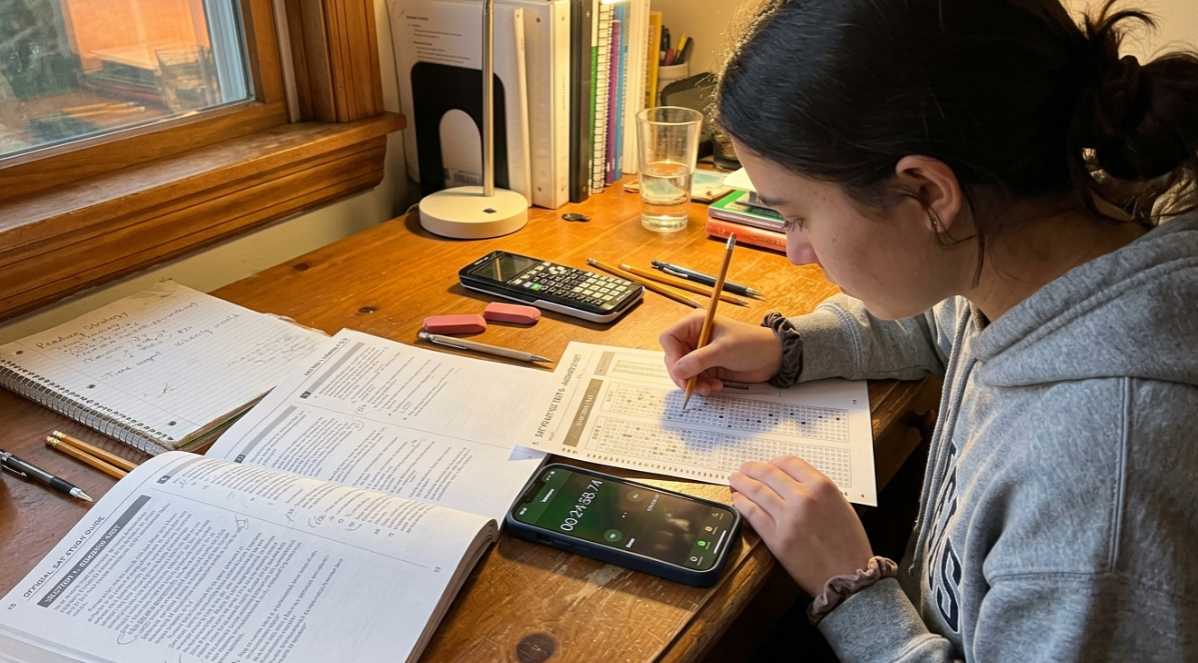
Goal: Move from understanding concepts to applying them quickly and accurately.
What to do:
Start timing individual practice sets. Give yourself slightly less time than you’d have on the real test. This builds speed without sacrificing accuracy.
For Math, focus on the topics that appear most frequently: linear equations, ratios/proportions, percentages, and basic statistics. These make up a large chunk of the test.
For RW, practice with paired passages and science-based texts. Students often lose points on passages about unfamiliar topics, but the questions follow predictable patterns regardless of subject.
If you’re using an AI tutor (Miyagi Labs has a 24/7 AI tutor), use it to get instant explanations on problems you find confusing. Don’t let questions pile up unanswered.
Study tip: One student on r/Sat shared that they improved fastest when they stopped re-doing problems they already knew and spent all their time on problems rated one difficulty level above their comfort zone. Uncomfortable practice drives growth. Comfortable practice just feels productive.
Hours this week: 10-12
Highest-Value SAT Topics to Prioritize
Not every SAT topic appears equally often.
If you're short on time, prioritize concepts that appear most frequently.
SAT Math
Linear equations
Systems of equations
Percentages
Ratios
Functions
Data analysis
Problem solving
Reading & Writing
Main idea
Command of evidence
Grammar
Transition words
Sentence boundaries
Words in context
Mastering these topics generally provides the greatest return for your study time.
Week 6: Third Practice Test and Strategy Refinement
Goal: Test under pressure, refine timing, and lock in strategies for each question type.
What to do:
Take your third full-length practice test. This time, pay close attention to pacing. Note which sections you finish early and which ones feel rushed.
Develop a question-type strategy. For example:
RW craft and structure questions: Read the full passage first, then answer. Don’t skim.
Math grid-in questions: Double-check your arithmetic. These have no answer choices to guide you.
Data analysis questions: Read axis labels and units before calculating anything.
Review your mistake log from all three tests. Look for patterns. If you keep missing the same type of question, that’s where your final weeks of effort should go.
Practice the “skip and return” strategy. On the digital SAT, you can flag questions and come back. Don’t waste four minutes on one hard problem when three easier ones are waiting.
Hours this week: 10-12
Week 7: Targeted Drilling and Fourth Practice Test
Goal: Hammer your remaining weak spots and build test-day confidence.
What to do:
Spend the first half of the week doing intense, targeted drilling on your 2-3 remaining weak areas. Use filtered question banks (sorted by skill and difficulty) so you’re not wasting time on topics you’ve already mastered.
Take your fourth practice test mid-week.
Review it the same day or the next morning while the questions are fresh.
For any question you got wrong, ask yourself: “Did I not know the concept, or did I make a careless mistake?” These require different fixes. Concept gaps need more study. Careless mistakes need better habits (underlining key words, double-checking units, etc.).
Study tip: Students who track their progress with analytics tools tend to stay more motivated in these final weeks. Miyagi Labs provides section-by-section breakdowns and skill heatmaps that show exactly where your points are coming from and where you’re still leaving points on the table.
Hours this week: 10-12
Week 8: Review, Rest, and Get Ready
Goal: Consolidate what you know, take one final practice test early in the week, then ease off before test day.
Monday-Tuesday:
Take your final full-length practice test. Treat it like a dress rehearsal.
Review mistakes, but don’t try to learn brand-new concepts. Focus on reinforcing what you’ve already studied.
Wednesday-Thursday:
Light review only. Flip through your mistake log. Redo a few problems you previously got wrong.
Review your strategies: pacing plan, skip-and-return approach, Desmos shortcuts.
Friday (day before the test):
Do NOT study. Seriously.
Lay out everything you need: ID, calculator (for backup), snacks, water, directions to the test center.
Go to bed at a normal time. Don’t try to sleep at 8 PM if you usually sleep at 11.
Saturday (test day):
Eat a real breakfast. Nothing heavy, nothing you’ve never eaten before.
Arrive early. Bring your confidence and your strategies.
Quick-Reference 8-Week SAT Study Plan
Week | Focus | Practice Test? | Hours |
|---|---|---|---|
1 | Diagnostic + identify weaknesses | Yes (diagnostic) | 6-8 |
2 | Target #1 weak area | No | 8-10 |
3 | Expand to weak areas #2 and #3 | No | 10-12 |
4 | Practice test + adjust plan | Yes | 10-12 |
5 | Build speed + go deeper on content | No | 10-12 |
6 | Practice test + refine strategies | Yes | 10-12 |
7 | Targeted drilling + practice test | Yes | 10-12 |
8 | Final test + review + rest | Yes (early in week) | 6-8 |
Common Mistakes That Hurt SAT Scores
Avoid these common mistakes that slow progress.
Taking practice tests without reviewing mistakes afterward.
Studying only your favorite subjects.
Memorizing answers instead of understanding concepts.
Ignoring pacing until test week.
Skipping full-length practice exams.
Changing strategies every few days.
Studying for several hours without breaks.
Trying to learn entirely new topics the day before the test.
Consistency almost always beats marathon study sessions.
Tips That Actually Work (From Students Who’ve Done This)
Start with a diagnostic, not a textbook. Studying topics you already know is a waste of your limited time. A diagnostic tells you exactly where to spend your hours.
Use your phone less during study blocks. This sounds obvious, but it’s the #1 productivity killer. Put it in another room. Use an app blocker. Whatever works.
Study on mobile when you can. Waiting for practice to start? Riding the bus? Even 15 minutes of practice problems on an app like Miyagi Labs adds up over eight weeks. That’s potentially 10+ extra hours of practice from “wasted” time.
Don’t compare your timeline to someone else’s. Some students on r/Sat share stories of 300-point improvements in a month. That’s not typical. A 100-150 point gain in eight weeks of consistent work is a strong, realistic outcome for most students.
Track your progress. Seeing your score climb, even by 20-30 points per practice test, keeps you going during weeks when studying feels pointless. Score predictors and analytics dashboards make this easier than manually tallying everything.
Should You Change This Plan for Your Goal Score?
Not every student needs the same study plan.
Goal Score | Recommended Focus |
|---|---|
1000–1200 | Master fundamentals and accuracy |
1200–1350 | Strengthen weak content areas |
1350–1450 | Timing and medium-difficulty questions |
1450–1550 | Advanced questions and consistency |
1550+ | Eliminate careless mistakes |
This helps personalize the study plan for different readers and captures additional search intent.
What If Eight Weeks Isn’t Enough?
If you take your diagnostic and your score is 200+ points below your target, eight weeks might feel tight. You have a few options:
Register for a later test date if possible. The SAT is offered multiple times per year.
Increase your weekly hours (but don’t exceed 15, or you’ll burn out).
Focus ruthlessly on the highest-value topics. In Math, that’s algebra and data analysis. In RW, that’s evidence-based reading and standard English conventions. These categories make up the bulk of the test.
Eight weeks of focused, strategic work can make a real difference. The students who improve the most aren’t the ones who study the longest. They’re the ones who study the right things, track what’s working, and stay consistent even when it gets boring.
You’ve got this. Start with the diagnostic and take it one week at a time.