
10 Best ACT Prep Resources (2026): Free & Paid Tools
Miyagi Labs ·
10 Best ACT Prep Resources (2026): Free & Paid Tools

TL;DR
The best ACT prep resources for 2026 depend on your budget, study style, and whether you need official practice questions, targeted practice, adaptive learning, or live instruction. Start with ACT's free official practice materials for the most authentic test experience, then add a question bank, AI-powered study platform, prep course, or tutor if you need more structure.
For most students, a practical ACT prep stack includes:
Official ACT practice: Free practice tests and questions from ACT.org
Targeted practice: A question bank such as UWorld or another ACT-specific platform
Personalized study: An adaptive or AI-powered platform such as Miyagi Labs
Structured instruction: Kaplan, Princeton Review, PrepScholar, or live tutoring
Budget-friendly practice: Official ACT materials plus free supplemental resources
The Enhanced ACT has three required sections: English, Math, and Reading. The core test contains 131 questions and takes 2 hours 5 minutes. Science and Writing are optional, so your prep materials should match the version and sections you plan to take.
Choosing an ACT prep resource in 2026 is less about finding one universally “best” program and more about matching the resource to your starting score, budget, study habits, and target test date.
The Enhanced ACT changed the preparation equation. The required test now consists of English, Math, and Reading, with 131 questions completed in 2 hours and 5 minutes. Science and Writing are optional, so students should make sure their practice materials reflect the current format rather than an older 215-question version of the ACT.
This guide compares 10 ACT prep resources across several categories: official ACT practice, AI-powered apps, question banks, adaptive courses, free resources, and paid instruction. Each resource is evaluated by price, practice volume, current ACT alignment, explanations, personalization, full-length testing, and the type of student it suits best.
If you are starting from scratch, begin with an official ACT practice test to establish a baseline. Then add a supplemental resource only where you need more practice, explanations, personalization, or accountability.
Explore AI-powered ACT prep with a diagnostic test and personalized study path at Miyagi Labs ACT Prep.
What Changed on the Enhanced ACT in 2026?
The Enhanced ACT is the current ACT format for 2026. The required test has three sections: English, Math, and Reading. Science and Writing are optional. The core ACT contains 131 questions and takes 2 hours and 5 minutes.
Section | Questions | Time | Required? | Counts toward Composite? |
|---|---|---|---|---|
English | 50 | 35 min | Yes | Yes |
Math | 45 | 50 min | Yes | Yes |
Reading | 36 | 40 min | Yes | Yes |
Science | 40 | 40 min | Optional | No |
Writing | 1 essay | 40 min | Optional | No |
The biggest preparation changes are the shorter core test, more time per question, four answer choices on Math instead of five, and the move of Science from a required section to an optional section.
What this means when choosing ACT prep materials
Look for resources that explicitly support the Enhanced ACT. Older books and question banks can still be useful for learning underlying English, Math, Reading, or Science concepts, but they should not be your only source of current-format practice.
For full-length simulations, prioritize materials that match the current section lengths, question counts, timing, and optional-section structure.
If you’re also weighing the SAT, the decision between tests is worth exploring separately. Our best SAT prep resources guide covers that side of things.
How We Evaluated These ACT Prep Resources
We evaluated each ACT prep resource using the factors that matter most when choosing a preparation system in 2026:
Evaluation factor | What we looked for |
|---|---|
Current ACT alignment | Whether the resource reflects the Enhanced ACT format |
Official questions | Whether it uses authentic ACT questions or third-party questions |
Practice volume | Number and variety of available questions and tests |
Explanations | How thoroughly incorrect answers and concepts are explained |
Personalization | Diagnostics, adaptive practice, study plans, and progress tracking |
Full-length practice | Availability of timed tests that simulate the current ACT |
Cost | Starting price and what is included at that price |
Mobile access | Whether students can study through a mobile app or responsive platform |
Instruction | Self-paced lessons, live classes, tutoring, or AI assistance |
Best use case | The type of student most likely to benefit from the resource |
Prices and features can change, so verify the current plan and pricing on each provider's website before purchasing. Score guarantees also have eligibility requirements and should be evaluated based on the provider's current terms rather than the headline claim alone.
Best ACT Prep Resources at a Glance
Resource | Price | Main Strength | Practice | Personalization | Full Tests | Best For |
|---|---|---|---|---|---|---|
Miyagi Labs | Free/paid plans | AI-guided personalized prep | ACT question bank | High | Yes | Students who want guided, adaptive practice |
Free | Official ACT materials | Official questions | Low | Yes | Authentic baseline practice | |
Official ACT Prep Guide | Paid | Authentic official tests | 4 full-length tests | Low | Yes | Students who prefer books |
UWorld | From $99 | Detailed explanations | 2,500+ questions | High | Yes | Students who want detailed question review |
Magoosh | Paid | Affordable self-study | 1,750+ questions | Medium/High | Yes | Budget-conscious self-studiers |
Kaplan | Paid | Structured prep + official questions | 2,000+ questions | Medium | Yes | Students wanting structured self-study |
Princeton Review | Paid | Classes and premium instruction | 2,700+ questions | Medium/High | Yes | Students wanting instructor support |
PrepScholar | $397+ | Adaptive preparation | 3,000+ questions | High | Yes | Students wanting an adaptive course |
Khan Academy | Free | General academic skills | SAT-focused | High | No ACT-specific tests | Students strengthening foundational skills |
Varsity Tutors | Free/paid | Diagnostics and live learning | ACT practice | Medium | Yes | Students exploring free resources |
Important: Question counts, prices, guarantees, and included tests can change. Check the provider's current plan before purchasing.
Which ACT Prep Resource Do You Need?
The right ACT prep resource depends on what is limiting your score. You do not necessarily need an expensive course if your main problem is a lack of realistic practice questions.
If you need... | Look for... |
|---|---|
Authentic ACT practice | Official ACT tests and materials |
More practice questions | A large ACT question bank |
Help understanding mistakes | Detailed answer explanations |
A personalized study plan | Adaptive or AI-powered prep |
Accountability | Live classes or tutoring |
Flexible study | Self-paced online prep |
Free preparation | ACT.org plus supplemental free resources |
Paper-based practice | The Official ACT Prep Guide |
Mobile study | A dedicated ACT prep app |
Help deciding what to study next | Diagnostic testing and progress analytics |
A useful approach is to combine resources instead of expecting one platform to do everything. For example, an official ACT practice test can provide the baseline, while a third-party question bank can provide additional targeted practice.
Best ACT Prep Apps (For On-the-Go Study)
1. Miyagi Labs
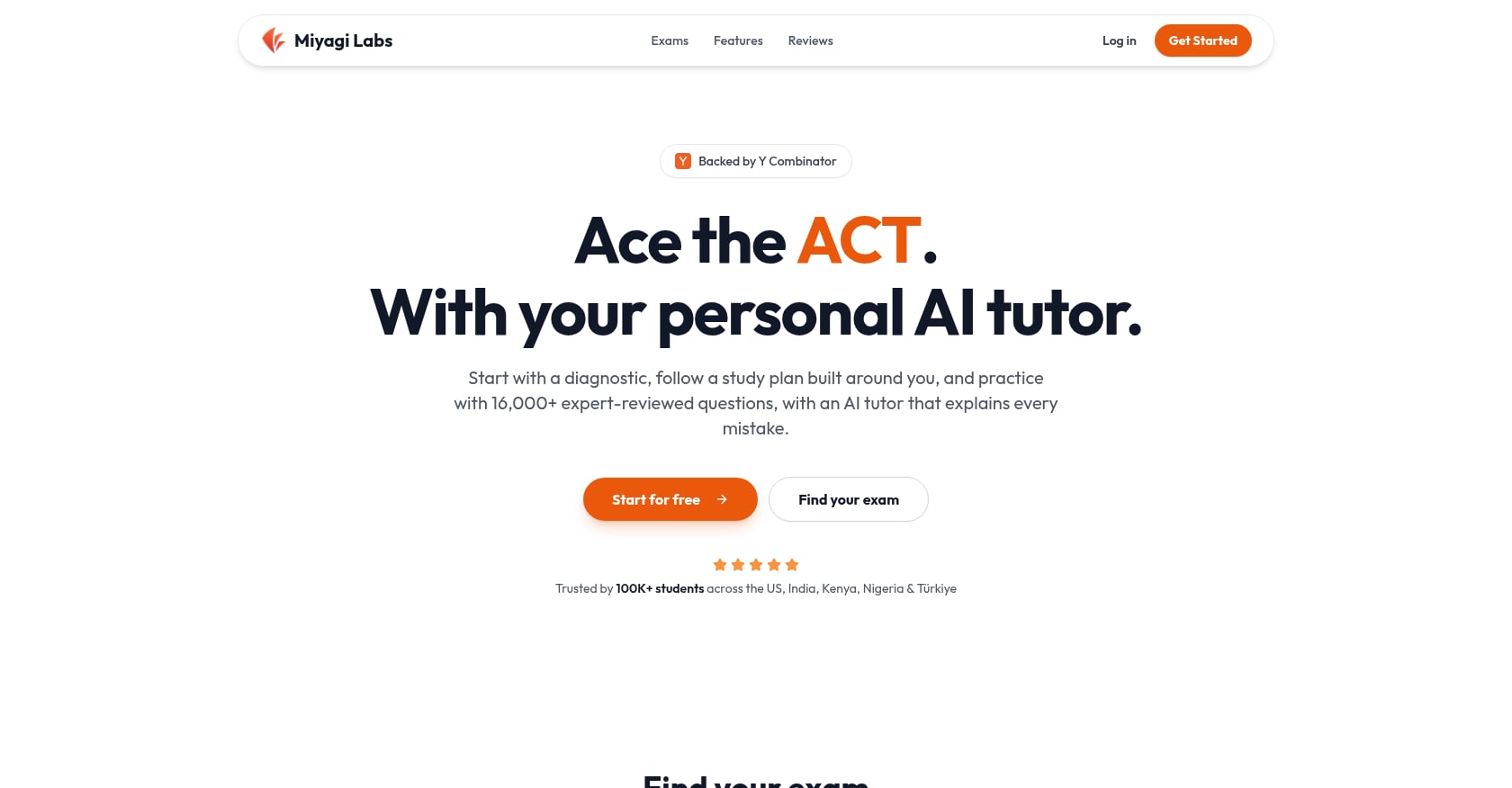
Best for: AI-driven, mobile-first ACT prep with a personalized study path
Miyagi Labs takes an AI-first approach to ACT preparation, running students through a diagnostic test that identifies strengths and weaknesses, then building a personalized study path from there. The platform includes a 24/7 AI tutor for on-demand explanations, full-length timed practice exams (available free), a score predictor, and progress analytics with skill heatmaps.
Price: Free trial available (auto-converts to paid subscription if not cancelled); iOS in-app purchases at $14.99 and $39.99 for Unlimited Access
Key features:
Diagnostic test that pinpoints weak areas
ACT question bank with detailed explanations
Full-length timed ACT practice exams (free)
24/7 AI tutor for guided explanations
Score predictor to estimate where you stand
Progress analytics and skill heatmaps
Gamification (streaks, achievements) to maintain consistency
Available on iOS, Android, and web
Enhanced ACT ready: Yes
Limitation: Smaller public review base than legacy competitors. Some Reddit users have debated question fidelity, with one calling certain questions “AI slop,” though other r/ACT users recommend “spamming Miyagi problem sets for English/Reading.” Mixed community feedback is normal for newer platforms building their question libraries.
Students on Miyagi Labs report score gains in the 6 to 9 point range. On Reddit’s r/ACT, one user reported achieving a 36 on ACT Math while using the platform. The low price point relative to incumbents like Kaplan or Princeton Review makes it worth testing, especially since the practice exams are free.
The AI tutor is the standout feature here. Rather than just showing you why an answer is correct, it walks through your reasoning process and identifies where your thinking went wrong. For students who can’t afford a human tutor, this fills a real gap.
2. UWorld ACT Prep
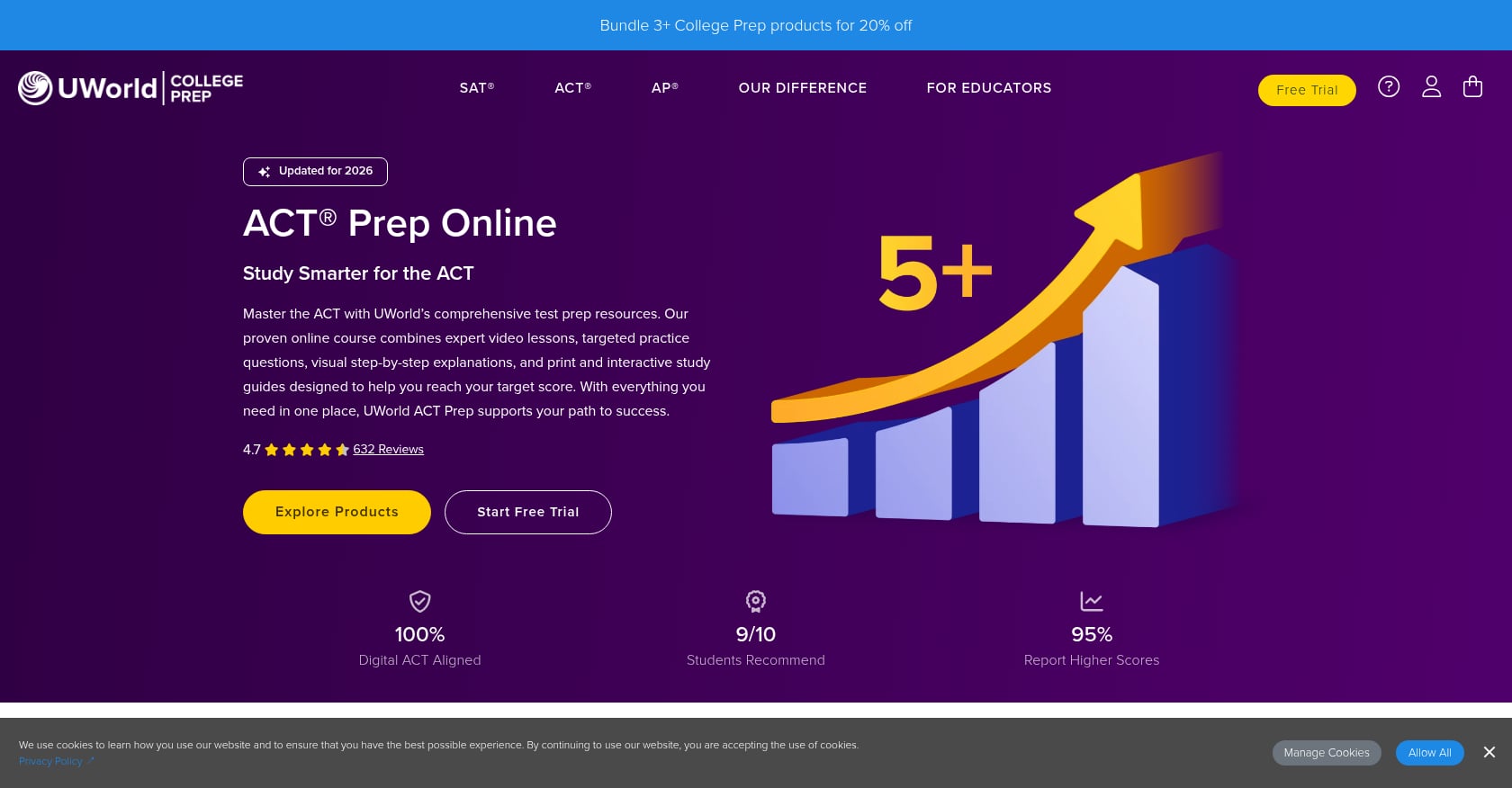
Best for: High-quality question bank with detailed visual explanations
UWorld built its reputation in medical education, where question accuracy is taken extremely seriously. That same standard has been applied to their ACT content, and it shows. The explanations are notably thorough, with colorful illustrations and diagrams that break down exactly why each answer choice is right or wrong.
Price: $99 to $249 for the QBank only; $299 for 30-day course access, $449 for 360-day access
What you get: 2,500+ practice questions, illustrated explanations, a score-predicting mock test
User rating: 4.7 stars from 632 reviews, with 95% reporting higher scores
Enhanced ACT ready: Yes (updated materials)
Limitation: Only one full-length mock test included. All prep is completely self-paced, with no live instruction or one-on-one tutoring. The pricing for course access (especially the 30-day tier at $299) is steep relative to what you get.
If your weakness is understanding why you’re getting questions wrong rather than a lack of practice volume, UWorld is hard to beat. The explanations alone are worth the QBank price for many students.
3. Magoosh ACT Prep
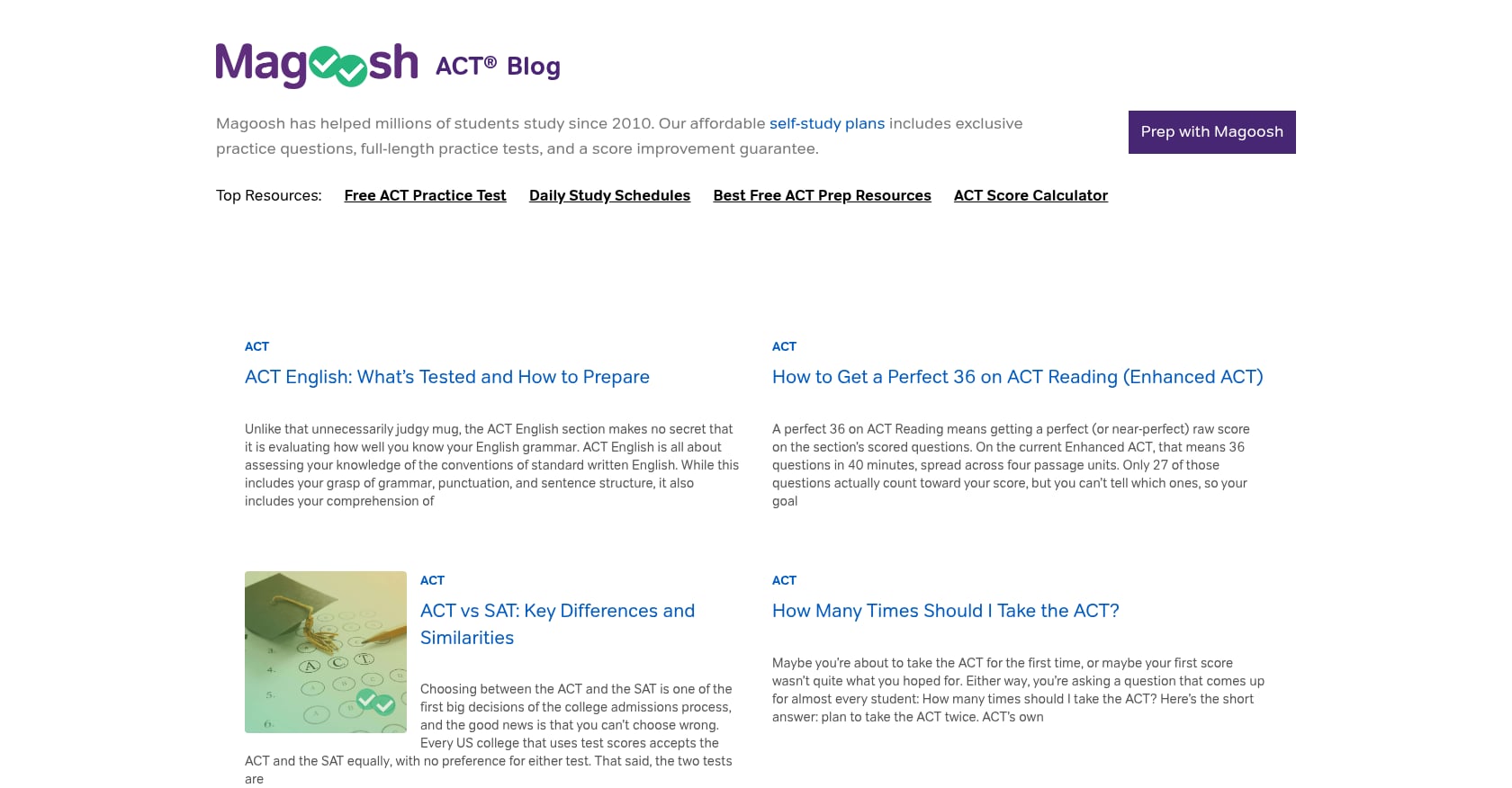
Best for: Budget-conscious self-studiers who want a complete platform
Price: Premium Plan at $129 for 12 months (1,750+ questions, 200+ video lessons); Premium Plan + On Demand Classes at $399 for 12 months
Score guarantee: +4 points improvement on your previous ACT score
Free trial: 7-day free trial for both SAT and ACT prep
Enhanced ACT ready: Yes
Limitation: Questions are slightly less ACT-realistic than UWorld’s or official materials. Best suited for students who are independent and self-directed, as there’s no live instruction in the base plan.
One reviewer called Magoosh “one of the best budget ACT self-paced courses on the market, especially for students who are effective self-studiers.” That’s a fair summary. At $129 per year, it undercuts nearly every competitor while still delivering a solid question bank, video lessons, and a score guarantee.
The mobile app is a genuine advantage over Kaplan and Princeton Review, neither of which offers a dedicated mobile experience. For students who study during commutes or between classes, that accessibility matters.
Official ACT Resources (The Foundation Everyone Needs)
1. ACT.org Official Free Resources
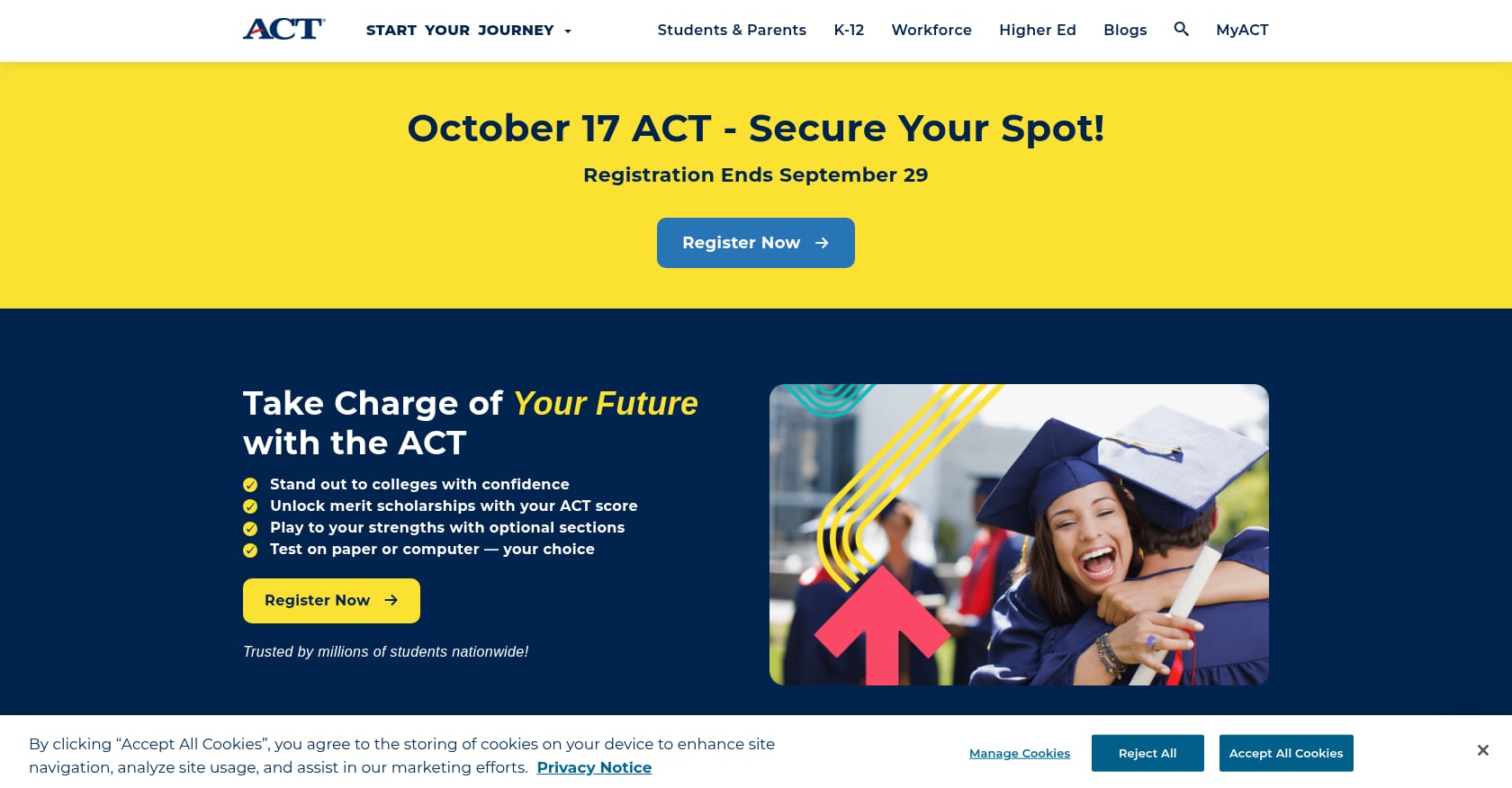
Best for: Baseline testing and the most accurate practice questions available
Every experienced ACT tutor and Reddit commenter lands on the same conclusion: start here. ACT.org offers five free official practice tests built from retired questions off actual past exams, including two specifically designed for the Enhanced ACT format. No third-party resource can match the fidelity of questions written by the test maker itself.
Price: Free (requires a free MyACT account)
What you get: 5 full-length practice tests, QuizMe subject-specific quizzes, a Question of the Day feature
Enhanced ACT ready: Yes, 2 of the 5 tests are in the new format
Limitation: No adaptive learning, no AI tutoring, no progress analytics beyond raw scoring
Practitioners on Reddit are emphatic about this resource’s importance. One tutor wrote that official tests are “the single most important piece of ACT prep material that exists. Every other tool on this list is a complement to these.” Another noted that “practice questions written by anyone other than ACT, Inc. are subtly different from real ACT questions in ways that matter on test day.”
The lack of analytics is a real drawback, though. You’ll get a score, but you won’t get skill-level breakdowns showing where your points are hiding. That’s where supplementary tools come in.
Official ACT Questions vs. Third-Party Practice Questions
Official ACT questions and third-party practice questions serve different purposes.
Official questions are most useful for learning the ACT's actual wording, structure, difficulty, timing, and question style. They should be prioritized when taking full-length practice tests or calibrating your expectations.
Third-party questions are useful when you need more practice than the official test maker provides. Large question banks can also make it easier to target specific skills, review mistakes, and practice repeatedly.
A practical strategy is:
Use an official ACT practice test to establish your baseline.
Identify the sections and skills where you are losing points.
Use a third-party question bank or adaptive platform for targeted practice.
Return to official ACT tests periodically to measure progress.
Use your final official practice test to rehearse the exact timing and format you expect on test day.
The goal is not to choose between official and third-party materials. The two types can serve different roles in the same ACT prep plan.
2. Official ACT Prep Guide (The Red Book)
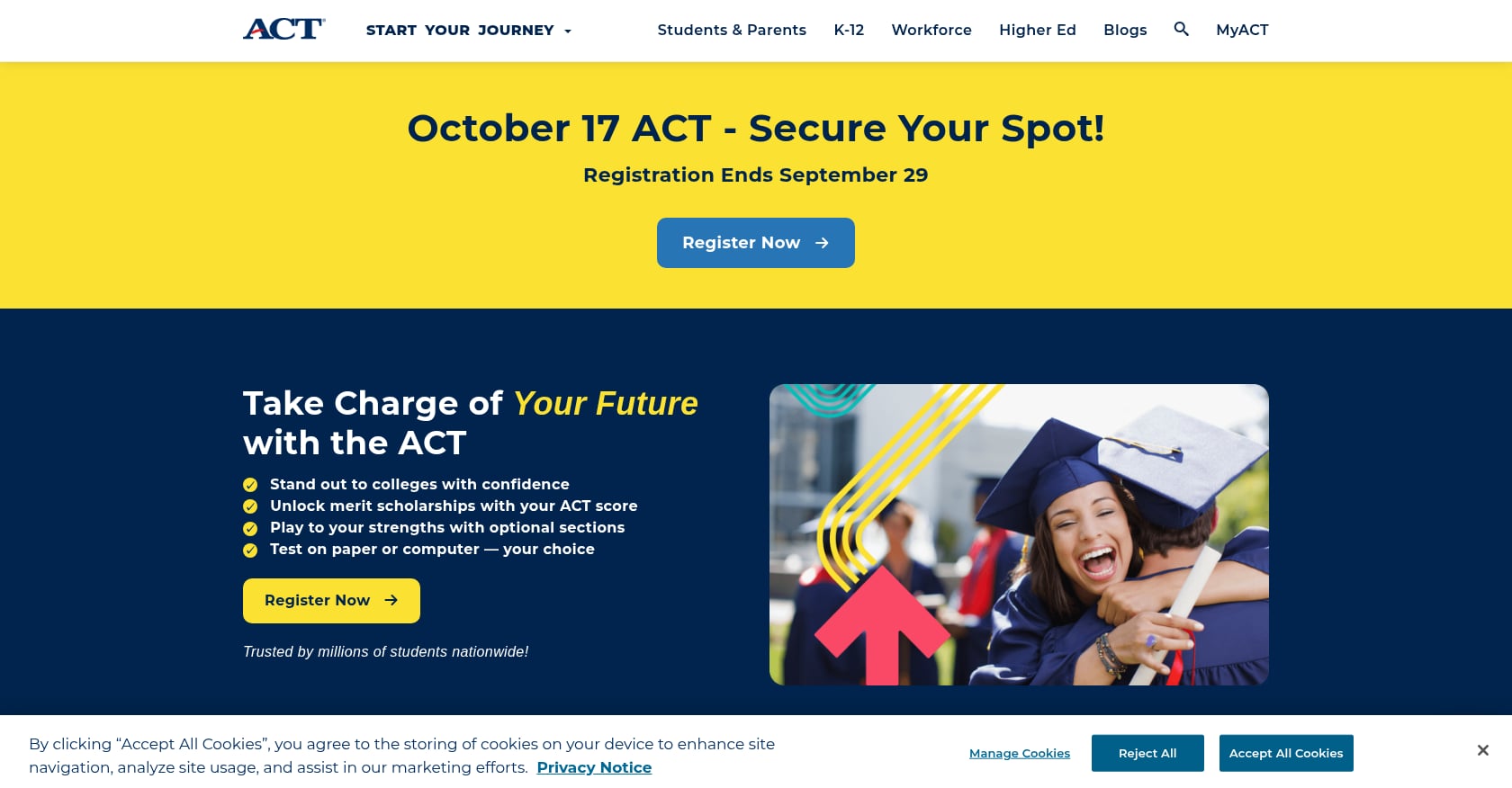
Best for: Offline study and additional official practice tests
Price: ~$24 to $37 depending on edition
What you get: The 2026-2027 edition includes four full-length ACT practice tests with essay prompts, plus answer explanations written by the test makers
Enhanced ACT ready: Yes (current edition)
Limitation: Paper-based only, no digital practice simulation, no adaptive feedback
The Red Book is universally recommended across Reddit’s r/ACT community. The thread currently ranking #4 on Google for this query specifically calls it “a really good resource.” It’s particularly valuable for students who retain information better when they can annotate, highlight, and flip pages.
The four tests in this book are different from the five free tests on ACT.org, so buying it effectively gives you nine official practice tests total. That’s a meaningful library for the price of a pizza dinner.
Best Paid ACT Courses (For Structured Learners)
1. Kaplan ACT Prep
Best for: Access to real, retired ACT questions through an exclusive official partnership
Kaplan holds an exclusive partnership with ACT.org that lets them include real, retired ACT questions in their question bank. This is a significant edge, since most competitors rely on simulated practice items that approximate but don’t perfectly match the real thing.
Price: $119 for 6-month self-paced access; $650 for 16 hours of live online instruction; $749 for the online tutoring package (self-paced course + 5 hours of tutoring)
What you get: 2,000+ practice problems in the question bank, 4+ full-length tests, on-demand video content
Score claim: Students who complete the program raise their score by an average of 4 points
Enhanced ACT ready: Yes, updated in 2025 for the new format
Limitation: No mobile app. The self-paced course is solid for the price, but the jump to live instruction or tutoring packages is substantial.
The $119 self-paced tier is genuinely competitive. You’re getting official ACT questions (not simulations) at a price point lower than many competitors’ basic offerings. The lack of a mobile app is a real miss, though, especially for students who study on their phones.
2. Princeton Review ACT Prep
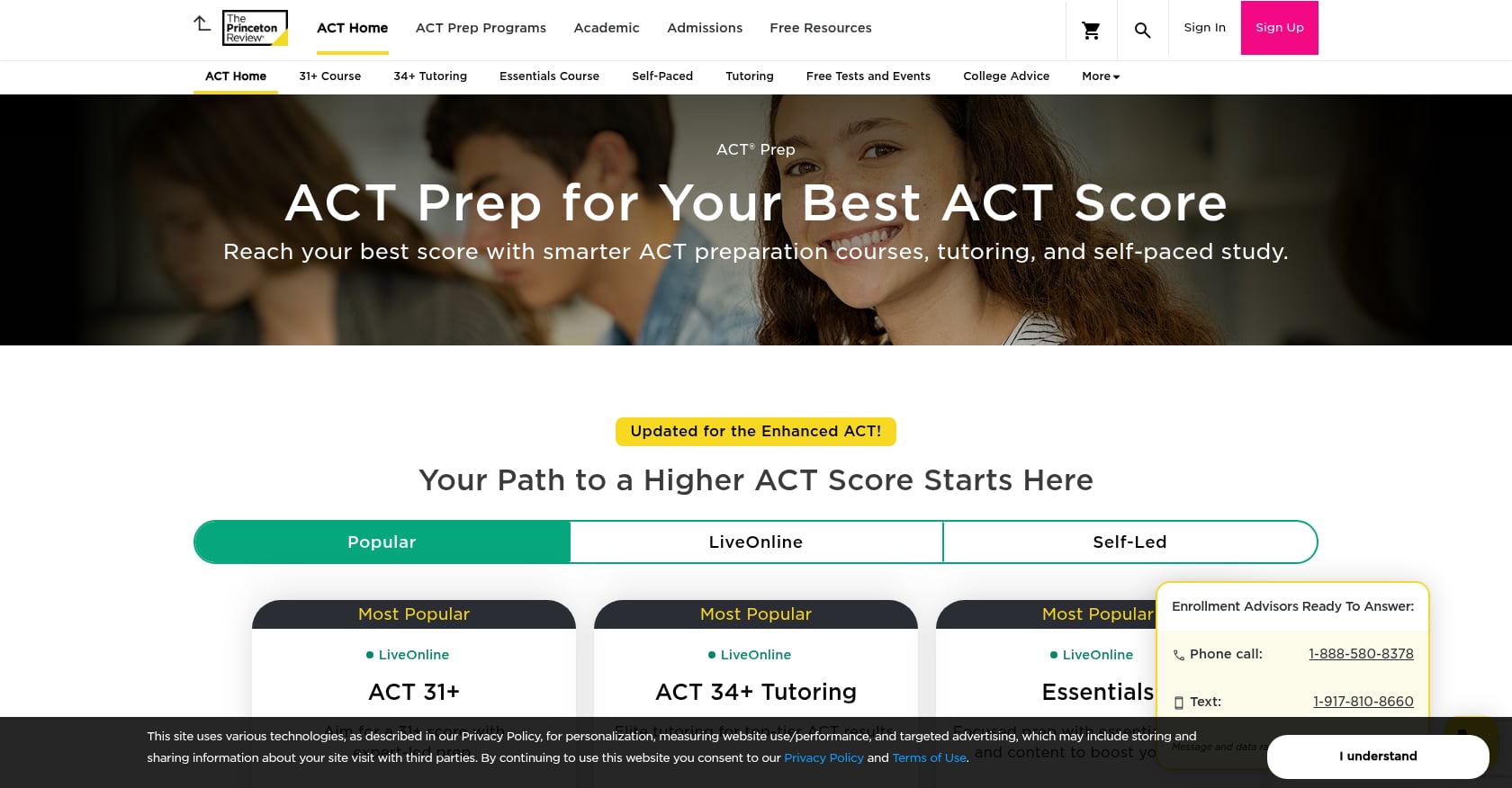
Best for: Live classes and aggressive score guarantees for high-score targets
Princeton Review positions itself at the premium end of ACT prep, and its pricing reflects that. The Self-Paced course starts at just under $300, the popular Essentials course runs around $950, and the 31+ course tops out around $2,200.
Price: ~$300 (self-paced) to ~$2,200 (31+ course)
What you get: 100+ video lessons, 2,700+ practice problems, several full-length tests in the self-paced tier; live instruction and tutoring in higher tiers
Score guarantee: For the 31+ course, students starting below a 26 composite get a guaranteed 5-point increase; those starting at or above 26 are guaranteed at least a 31
Enhanced ACT ready: Yes
Limitation: No mobile app. Significantly more expensive than competitors for comparable features at the self-paced level.
The 31+ guarantee is meaningful for students targeting elite scores, but the price tag is hard to justify for most families. One prep industry reviewer observed that “the expensive ones aren’t 4x better than the free ones, they’re 1.2x better with a lot more accountability.” That framing applies directly to Princeton Review’s upper tiers.
3. PrepScholar ACT Prep
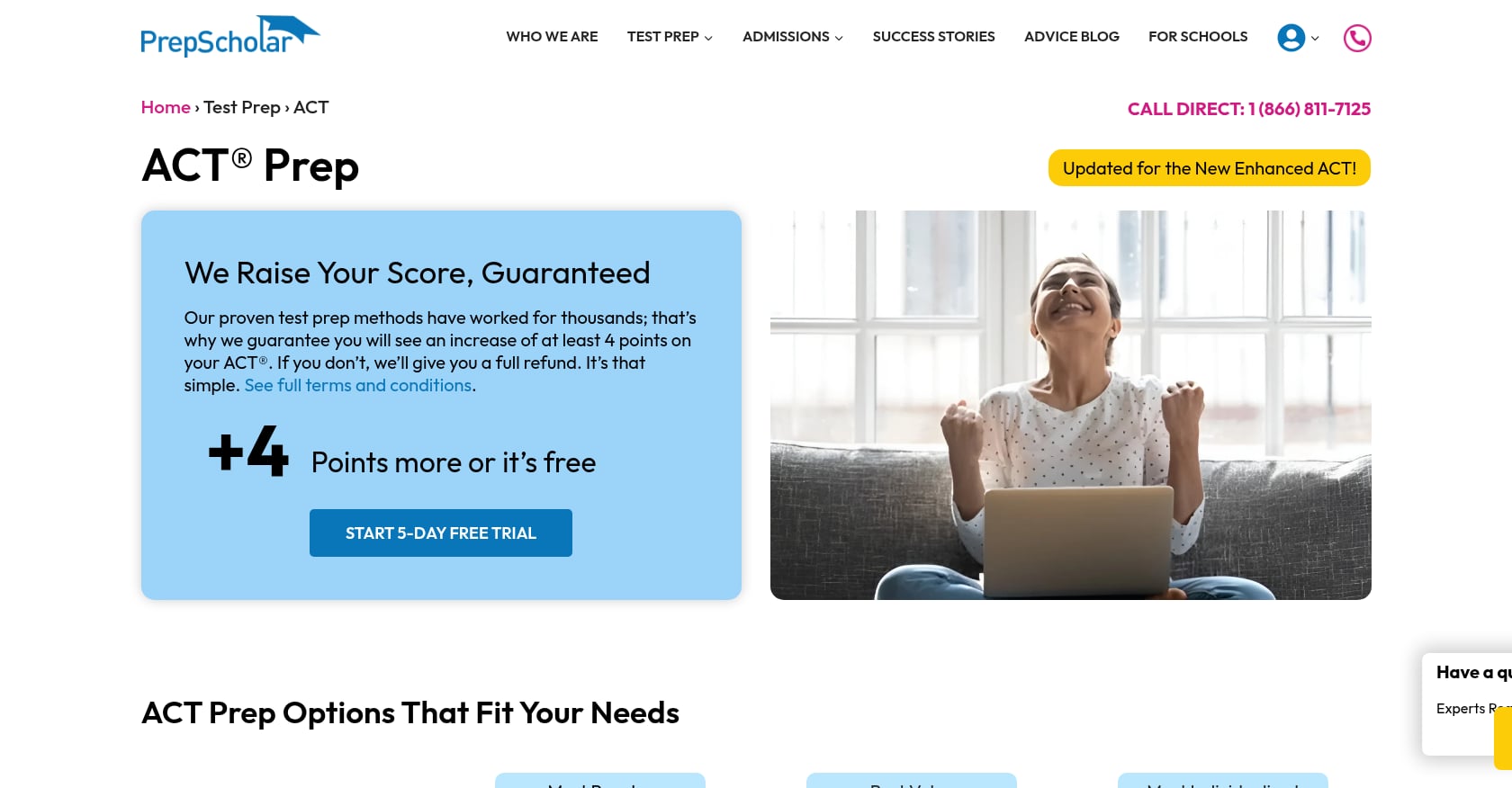
Best for: Adaptive learning with a specific, published score guarantee
PrepScholar claims to be “the only option that combines a specific, published point guarantee (4+ points, up to a 34) instead of a vague ‘higher score’ promise” along with 99th-percentile tutors.
Price: ~$397 for the self-paced Complete Course; ~$900 with live classes
What you get: Adaptive learning engine, personalized study plan, multiple full-length tests
Score guarantee: +4 points, up to a maximum of 34
Enhanced ACT ready: Yes. PrepScholar has rebuilt their ACT prep from the ground up for the Enhanced ACT, rather than simply tweaking the old program
Limitation: Mid-range price with no free tier. No mobile app. The company’s marketing relies heavily on its own comparison blog, which makes independent evaluation harder.
The full rebuild for the Enhanced ACT is worth noting. Many competitors updated their existing programs rather than starting fresh. Whether that translates to a meaningfully better experience depends on execution, but the commitment to the new format is real.
Best Free ACT Resources (For $0 Budgets)
1. Khan Academy
Best for: Free math and reading skill-building (not ACT-specific)
This one requires a big caveat. Khan Academy has an exclusive partnership with the College Board (the organization behind the SAT), making it the official free SAT prep platform. It does not offer ACT-specific content.
If someone tells you to “just use Khan Academy for the ACT,” they’re either confusing the SAT with the ACT or they don’t realize the platform doesn’t cover it. This misconception is extremely common, and it costs students time.
Price: Free
What’s useful for ACT: All the SAT Math practice and general math sections directly help with ACT Math. The “Writing and Language” SAT prep is good practice for ACT English.
What’s missing: No ACT-specific timing practice, no ACT format simulation, no Science coverage
Enhanced ACT ready: N/A (not ACT-specific)
Khan Academy remains excellent for building foundational math and grammar skills. If you’re scoring below a 20 on ACT Math, spending time on Khan’s algebra and geometry modules will help. But you’ll need a separate, ACT-specific tool for timing practice and format familiarity. For a deeper breakdown of Khan Academy’s limitations for test prep, see our Miyagi vs. Khan Academy comparison.
2. Varsity Tutors
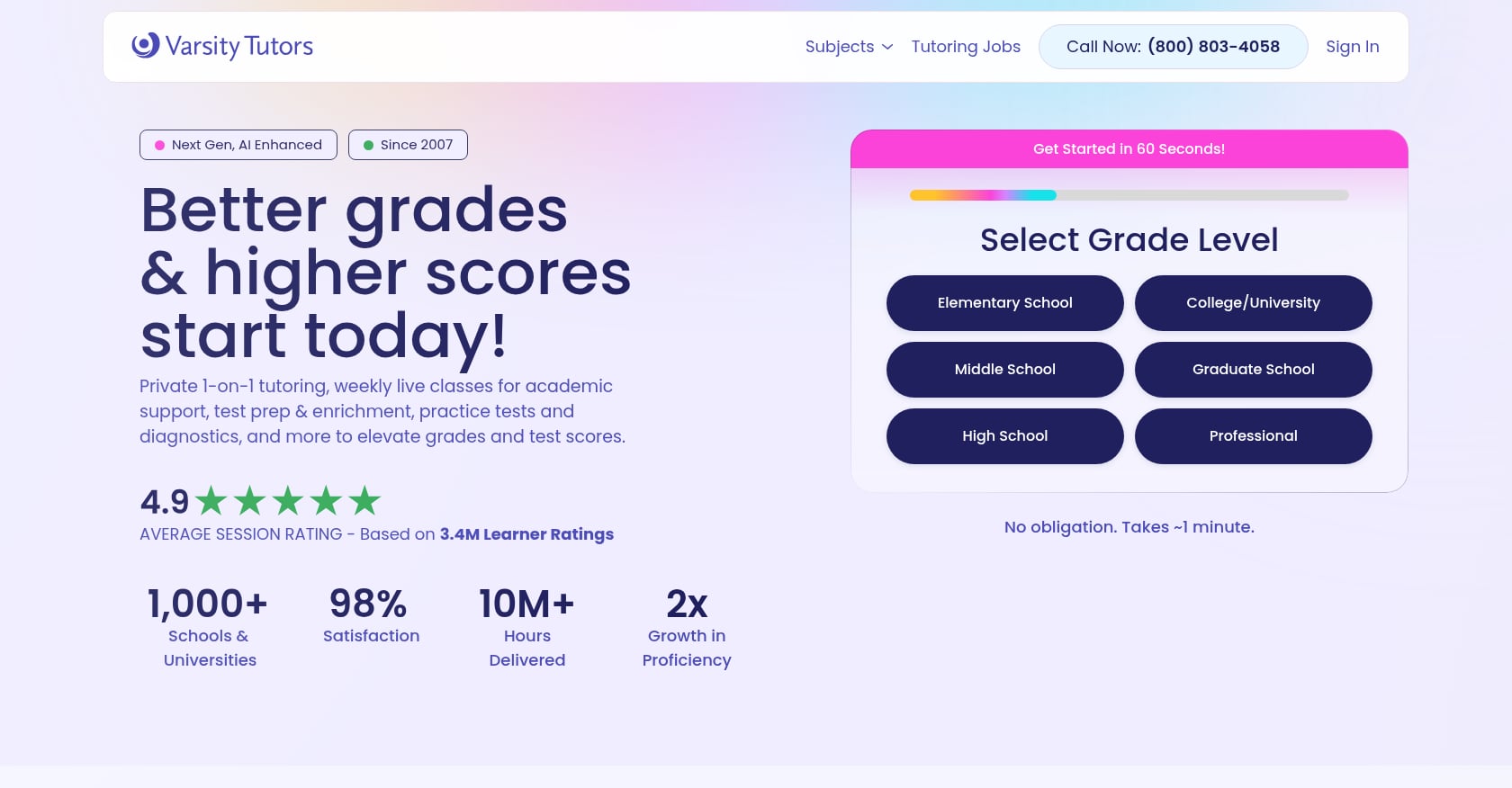
Best for: Free diagnostics, practice exams, and live class samples
Price: Free for core practice resources
What you get: ACT-specific diagnostic tests, full-length practice exams, a flashcard system, and free live class sessions with real tutors (described as “a $50 value for $0”)
Enhanced ACT ready: Check current availability
Limitation: No adaptive algorithm tracking progress over time. You won’t receive personalized guidance or feedback using the free options.
Varsity Tutors stands out as the most complete free option after ACT.org itself. The live class sessions are a particularly nice touch for students who want a taste of instructor-led learning before committing to a paid course. The diagnostic test is useful for establishing a baseline, though the lack of ongoing adaptive tracking means you’ll need to pair it with another tool for sustained study.
How Many ACT Prep Resources Do You Actually Need?
Most students do not need five or six ACT prep subscriptions. A simple three-part system is usually easier to manage:
1. One official source: Use ACT.org practice tests to understand the real exam.
2. One learning or practice platform: Add a question bank, adaptive platform, or course that addresses your weaknesses.
3. One tracking system: Record practice scores, recurring mistakes, timing problems, and section-level progress.
If your chosen platform already provides diagnostics, targeted practice, explanations, full-length tests, and progress tracking, you may not need several additional subscriptions.
More questions are not automatically better preparation. The value comes from identifying mistakes, understanding them, and changing your approach on subsequent questions.
Choosing ACT Prep Based on Your Starting Score
Your starting score can help determine what type of preparation you need.
Starting point | Main priority | Useful resources |
|---|---|---|
Below 20 | Content fundamentals + basic test familiarity | Official ACT materials + foundational lessons |
20–24 | Skill gaps + timing | Targeted question bank + structured practice |
25–29 | Weak-skill targeting + pacing | Adaptive platform + full-length tests |
30–32 | Precision + recurring mistakes | Official tests + targeted question bank |
33+ | Fine-tuning + test simulation | Official tests + highly targeted practice |
These ranges are a study-planning framework, not a prediction of how much any individual student will improve. Your diagnostic results should determine which subjects and skills deserve the most attention.
How to Build Your ACT Prep Stack
No single resource does everything well. The smartest approach is to combine tools based on your budget and study style. ACT research shows that students who used structured prep saw greater score gains than those who didn’t, with the most improvement occurring in the first seven hours of study. That means choosing the right resources early matters more than grinding for months with mediocre ones.
Here are three budget-tier stacks, each built to cover official practice, supplementary drilling, and progress tracking.
The $0 Stack
ACT.org for official practice tests (start with the 2 Enhanced ACT tests)
Khan Academy for math and grammar foundation building
Varsity Tutors for diagnostic testing and additional practice
Miyagi Labs free practice exams for timed full-length tests with section breakdowns
This stack covers the basics. You’ll get official questions, skill-building content, and realistic timed practice without spending a dollar.
The Under-$150 Stack
Everything in the $0 stack, plus:
Official ACT Prep Guide (~$24 to $37) for four additional official tests you can annotate on paper
Magoosh Premium ($129/year) for 1,750+ questions, video lessons, and a score guarantee, OR Miyagi Labs paid plan ($14.99+) for AI tutoring, personalized study paths, and topic-specific problem sets
This is the sweet spot for most students. You get official materials plus a structured, adaptive platform to guide your study.
The Under-$500 Stack
Everything above, plus:
UWorld QBank ($99 to $249) for 2,500+ questions with exceptional explanations, OR Kaplan self-paced ($119) for access to real retired ACT questions
Budget remaining for a retake fee ($68) since students who take the ACT multiple times score an average of nearly 3 points higher
At this tier, you’re matching or exceeding what $2,000+ courses deliver in terms of content coverage, with more flexibility in how you study.
Tips for Getting the Most from Your ACT Prep
Take a diagnostic first. Before you open a single prep book, take a full-length timed practice test. Your score breakdown tells you where to focus. A student scoring 32 in English but 22 in Math has a completely different study plan than someone scoring evenly across sections. Check your predicted ACT score to set a realistic target.
Practice under timed conditions. One practitioner on Reddit noted that “ACT prep is more about pacing and pattern recognition than the SAT, and the apps that work best reflect that.” The Enhanced ACT gives you less time pressure than the old version (131 questions instead of 215), but pacing still determines whether you finish each section. Every practice test should simulate real timing.
Review every wrong answer. This sounds obvious, but most students skip it. The learning happens in understanding why the correct answer is correct and why your chosen answer was wrong. Resources with detailed explanations (UWorld, Miyagi Labs’ AI tutor) earn their value here.
Don’t over-invest in Science prep unless you’re opting in. With Science now optional on the Enhanced ACT and excluded from the Composite score, students who aren’t pursuing science-heavy programs may want to redirect that study time toward English, Math, or Reading.
Plan to retake. Students who took the ACT multiple times scored an average of nearly 3 points higher than single-sitters. Build your timeline with at least two test dates in mind.
Ready to start preparing? Take a free diagnostic and get a personalized ACT study plan at Miyagi Labs ACT Prep.
FAQ
Is Khan Academy good for ACT prep?
Not directly. Khan Academy partners exclusively with the College Board for SAT prep and does not offer ACT-specific content. Its math and grammar modules help build foundational skills that transfer to the ACT, but you won’t find ACT-format questions, timing practice, or Science section coverage. You’ll need a dedicated ACT tool alongside Khan Academy.
How much does ACT prep cost?
Anywhere from $0 to over $2,200. ACT.org’s official practice tests are free. Apps like Miyagi Labs start at $14.99 for unlimited access. Mid-range courses like Kaplan’s self-paced plan run $119, while premium options like Princeton Review’s 31+ course reach $2,200. Research from prep industry reviewers suggests the expensive options are roughly “1.2x better” than free ones, not 4x better, so budget constraints shouldn’t prevent effective preparation.
What’s the best free ACT prep resource?
ACT.org’s official practice tests are the undisputed starting point, offering five full-length tests (two in the Enhanced ACT format) built from retired real questions. Supplement with Varsity Tutors’ free diagnostics and Miyagi Labs’ free practice exams for additional timed tests with score breakdowns.
Has ACT prep changed for 2026?
Yes, significantly. The Enhanced ACT launched in 2025 and is now the only version of the test. It’s shorter (131 core questions instead of 215), Science is optional, and Math questions have four answer choices instead of five. Any prep resource that hasn’t been updated for this format may mislead you on pacing and section structure.
How many hours should I study for the ACT?
ACT’s own research shows the most significant score gains occur in the first seven hours of structured study. Beyond that, consistent practice over 4 to 8 weeks (roughly 30 to 60 total hours) is a common recommendation for students targeting meaningful improvement. The key is quality over quantity: focused, timed practice with thorough review beats passive reading every time.
Should I take the optional Science section on the Enhanced ACT?
It depends on your goals. Since Science no longer affects your Composite score, it’s only worth taking if your target colleges specifically request or recommend it, or if you’re applying to science-heavy programs. The optional section costs just $4 extra, so the financial barrier is minimal, but the preparation time is a real consideration.
Can I use SAT prep materials for the ACT?
Partially. Math concepts overlap substantially between the two tests, and reading comprehension skills transfer well. But the ACT’s format, pacing, and question style differ enough that you need ACT-specific practice. If you’re deciding between the SAT and ACT, take a practice test for each and compare your scores before committing to one.
What score improvement can I realistically expect from ACT prep?
Most structured prep courses guarantee 4 to 5 points of improvement. Students who combine official practice tests with a paid course or app and take the test more than once typically see gains in that range. Individual results vary widely based on starting score, study consistency, and how effectively you target your weak areas. Miyagi Labs users have reported gains of 6 to 9 points according to student results on the platform.