
How Long to Study for SAT: 2026 Hours & Timelines Guide
Miyagi Labs ·
How Long to Study for SAT: 2026 Hours & Timelines Guide

TL;DR
Most students need 40 to 100+ hours of focused SAT prep spread over two to four months. College Board data shows that just 20 hours of practice is associated with a 115-point average score gain. Your actual study time depends on three things: your starting score, your target score, and whether you’re spending those hours on the right stuff.
Direct Answer: How Long Should You Study for the SAT?
Most students should study 40 to 100 hours over 2 to 4 months for the SAT. Students seeking a 50 to 100-point improvement often need around 20 to 60 hours, while a 200-point increase usually requires 80 to 150+ hours of focused practice. The exact number depends on your baseline score, target score, study quality, and consistency—not simply the number of weeks before test day.
If You... | Recommended Study Time |
|---|---|
Have never taken the SAT | 60–100 hours |
Need under 50 points | 10–20 hours |
Need 100 points | 40–60 hours |
Need 200 points | 80–120 hours |
Are retaking the SAT | 20–40 additional hours |
Have 1 month | 3–4 hours/day |
Have 3 months | 5–8 hours/week |
Have 6 months | 3–5 hours/week |
The Quick Answer: SAT Study Time at a Glance
The single most cited data point comes from College Board itself: 6 to 8 hours of practice on Official SAT Practice is associated with a 90-point score increase, and 20 hours is associated with a 115-point gain. Out of nearly 250,000 test takers studied, more than 16,000 gained 200 points or more.
For larger score jumps, practitioners consistently recommend more hours. PrepScholar’s widely referenced benchmark suggests around 80 hours for a 200-point improvement. Spread over three months, that works out to about five hours a week, which is manageable for most students.
Here’s a consolidated table you can use to estimate how long to study for the SAT based on your score improvement goal:
Score Improvement Goal | Estimated Hours | Typical Timeline |
|---|---|---|
0 to 50 points | 10 to 20 hours | 2 to 4 weeks |
50 to 100 points | 40 to 60 hours | 4 to 8 weeks |
100 to 200 points | 80 to 120 hours | 8 to 16 weeks |
200+ points | 150+ hours | 3 to 6 months |
The first step before plugging anything into your calendar is figuring out where you stand right now.
Take a free SAT diagnostic to find your baseline before planning your study time.
Notice the table measures hours, not weeks. That distinction matters more than most students realize. Two people can both “study for three months” and get completely different results because one put in 10 focused hours a week while the other did 3 unfocused hours. As one test prep analysis from ScoreSmart puts it: “Most students think about SAT prep in terms of weeks. The right way to think about it is in terms of hours.”
Key SAT Study Time Terms You Should Know
Understanding how long to study for the SAT requires understanding the vocabulary around it. These are the terms that come up repeatedly in every prep plan, coaching blog, and student forum. Each one directly affects how you calculate your timeline.
Baseline Score (Diagnostic Score)
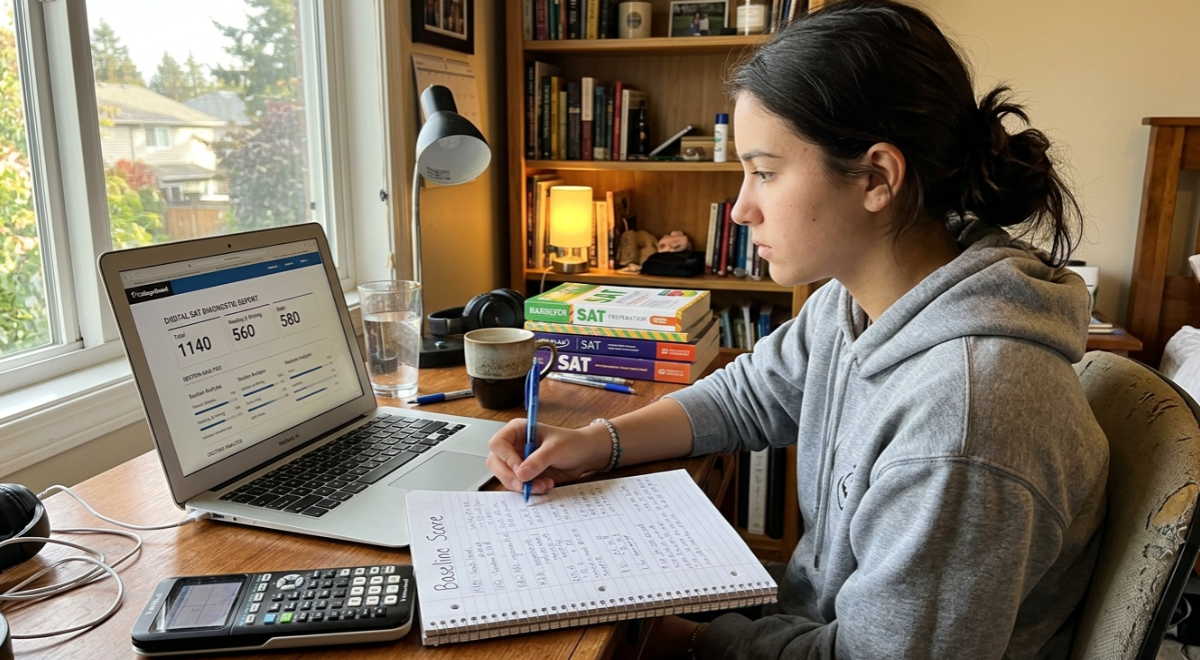
Your starting score on a full-length practice test taken under timed, realistic conditions before any prep begins. This is the single most important input for planning how long to study for the SAT. Without it, you’re guessing. Every expert source, from College Board to private tutors, agrees on this point: take a diagnostic before doing anything else. McMillan Education recommends taking your first diagnostic 3 to 6 months before the real exam, ideally in the summer before junior year.
You can establish your baseline with free SAT practice exams that simulate real test conditions.
Score Gap
The difference between your baseline score and your target score. If you scored 1050 on your diagnostic and need a 1300, your score gap is 250 points. The score gap is what determines how many hours you need, not the calendar date of your test.
Target Score
The SAT score you need for your goal schools. Check each college’s middle-50% admitted student range. A common benchmark is aiming at or above the 25th percentile of admitted students. Setting this number before you start studying prevents both under-preparation and wasted effort.
Focused Study Hours
Time spent on deliberate, targeted activities: drilling weak question types, reviewing errors, working through timed practice sections. This is the opposite of passive hours (rereading notes, watching videos without practicing, scrolling through flashcards on autopilot). Twenty hours of unfocused review is not the same as twenty hours of targeted, strategic practice. The students who see the biggest gains aren’t necessarily the ones who study the longest. They’re the ones who study most effectively.
Adaptive Testing (Digital SAT)
The Digital SAT uses multistage adaptive modules. Your performance on Module 1 determines the difficulty of Module 2. The entire test is 2 hours and 14 minutes: Reading and Writing (64 minutes, 54 questions) and Math (70 minutes, 44 questions) with a calculator permitted throughout. This format means you should practice under adaptive conditions, not just work through static question sets. A Desmos graphing calculator is built into the Math section, which is another skill worth practicing before test day.
Diminishing Returns
Each additional hour of study produces smaller score gains as you approach higher scores. Students below 1200 see the fastest gains per hour invested. Students above 1400 see the slowest. Piqosity’s analysis illustrates this clearly: instead of studying 7 hours to go from 1350 to 1400, you might need 10 or 12 hours, because you’ve already picked all the low-hanging fruit. Data from MentoMind reinforces this: students below 800 improved by an average of 224 points, while students already above 1400 saw slight drops on retakes.
Error Log
A record of every missed question that includes: the type of error (content gap, careless mistake, timing issue), the correct reasoning, and a plan to prevent recurrence. Practitioners on Reddit’s r/Sat community (which has over 1 million members) consistently point to error logs as a common trait among students who self-report 1500+ scores. It is widely cited as the single highest-return study habit.
Score Plateau
When practice test scores stop improving despite continued study. This commonly happens in the 1300 to 1400 range. It usually signals that you’ve moved past content gaps and need to shift toward strategy and precision. As one analysis from MYLS.ai explains, many students “complete large volumes of questions without understanding why errors occur. Mistakes are labeled as ‘careless’ instead of being traced to recurring decision patterns.”
Spaced Practice
Distributing study sessions across many days rather than cramming everything into marathon blocks. Evidence strongly supports this approach. Studying 90 minutes four times a week is more effective than a single six-hour session, because your brain consolidates and retains learning between sessions.
SAT Score Predictor
A tool that estimates your likely SAT score based on practice performance and trends. Useful for tracking whether your study hours are actually converting to score gains, which is how you know if your timeline is on track. You can try an SAT score predictor to monitor your progress as you study.
How These SAT Study Estimates Were Calculated
The study-hour recommendations in this guide are based on multiple sources, including:
College Board Official SAT Practice research
Khan Academy practice data
Published analyses from established SAT prep providers
Trends reported by experienced tutors
Aggregate student score improvement data
Community discussions from high-performing SAT students
Rather than relying on a single study, the estimates combine multiple datasets to provide practical ranges that reflect real student experiences.
Factors That Affect How Long You Need to Study
Not every student improves at the same pace. Your timeline depends on several factors beyond your starting score.
Previous SAT Experience
Students taking the SAT for the first time often need additional hours simply to become familiar with the exam format.
Math vs. Reading Weaknesses
Students struggling in one section can usually improve faster than students needing balanced improvement across both sections.
Study Consistency
Studying five hours every week is generally more effective than studying twenty hours once a month.
Quality of Practice
Official SAT questions typically produce better preparation than generic question banks because they closely match the real exam.
Time Until Test Day
Students with longer timelines can use spaced repetition, which generally leads to stronger long-term retention than cramming.
Study Time by Starting Score: What the Data Shows
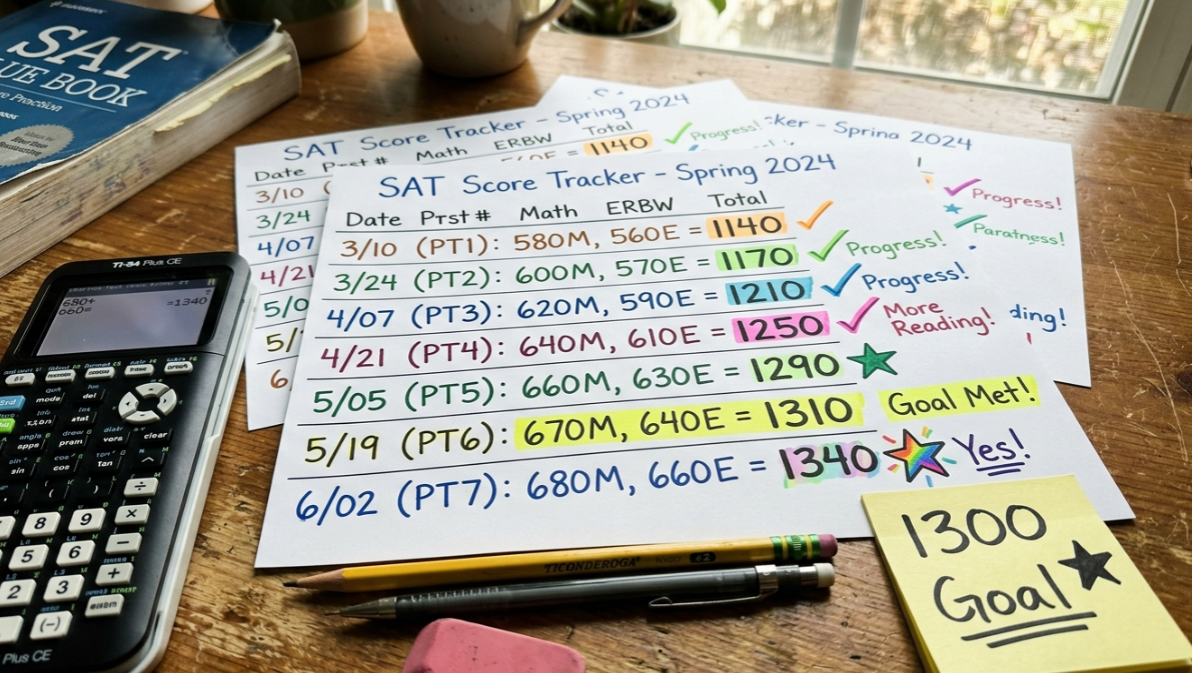
How long to study for the SAT varies dramatically depending on where you’re starting. A student at 1050 and a student at 1350 need fundamentally different approaches, even if they’re both aiming for a 1400. Here’s what the data suggests for each score band.
Below 1000
Expect 60 to 100+ hours over 3 to 6 months. Students in this range typically have significant content gaps in both Reading/Writing and Math. Month one should focus almost entirely on building foundational skills: algebra, grammar rules, reading comprehension strategies. MentoMind’s data shows students below 800 improved by an average of 224 points, which is the largest average gain of any score band. The opportunity here is enormous, but so is the required investment.
1000 to 1200
Plan for 40 to 80 hours over 2 to 3 months. This is the “sweet spot” where focused prep yields the biggest return on time invested. Students here often know the basics but make frequent errors from shaky fundamentals or poor test-taking habits. Targeted SAT practice questions matched to your weak areas will produce faster gains than generic studying.
1200 to 1400
Budget 40 to 80 hours over 2 to 4 months. The shift here is from content learning to strategy and error correction. You probably know most of the material. What’s holding you back are specific patterns: misreading certain question types, running out of time on one section, making avoidable calculation errors. AdmitStudio estimates that moving from 1200 to 1300 typically requires 8 to 12 weeks of structured error correction.
1400 and Above
Set aside 30 to 60+ hours over 2 to 4 months, but expect diminishing returns. The goal here is precision: eliminating 3 to 5 specific recurring mistake patterns. Going from 1400 to 1500 often requires 16+ weeks and may not be achievable for every student. Each point gets more expensive in time. Piqosity’s research suggests that at the top 10%, you might need to spend 10 to 12 hours for a 50-point gain that would have taken 7 hours at a lower score level.
Timeline Options: 1 Month, 3 Months, 6 Months
The 1-Month Plan
Realistic for 50 to 100 point gains. Requires 3 to 4 hours daily, which is a significant commitment for a high school student juggling classes and extracurriculars.
The structure is simple because it has to be. Week one: take a diagnostic, identify your top 3 weakest areas. Weeks two and three: drill those areas relentlessly with timed practice sections. Week four: take two full-length practice tests with thorough error review between each.
Prep Expert makes an interesting case here: a focused six-week plan often beats a vague half-year plan because it gives every study session a purpose. If you only have a month, that urgency can work in your favor, as long as you’re focused.
The 3-Month Plan (Most Recommended)
Realistic for 100 to 200+ point gains. This is the timeline that College Board, Khan Academy, and most independent tutors recommend. Five to ten hours per week is sustainable for most students.
A solid three-month breakdown:
Month 1: Diagnostic test, then concept learning. Work through fundamentals untimed. Build the knowledge base. Follow guided SAT lessons to stay organized.
Month 2: Timed sections and strategy work. Start doing problems under test conditions. Begin your error log. Take a full-length practice test at the end of the month.
Month 3: Full-length tests every weekend or every other weekend. Targeted drill on remaining weak spots. Final two weeks: simulate test day conditions exactly.
The 6-Month Plan
Best for sophomores or students starting far below their target. This timeline works well for students aiming at 200+ point gains from a low baseline.
The risk with six months is losing focus. Students on r/Sat who report studying for 6+ months without structure frequently describe plateau frustration. They put in the time but stopped improving because their practice wasn’t targeted. The fix is structuring the six months in distinct phases, with clear goals for each phase and regular practice tests to measure whether those goals are being met.
Use analytics tools and SAT problem sets organized by skill and difficulty to keep each phase focused.
What Counts as “Good” Study Time
Not all study hours are created equal. This is the part that separates students who improve 200 points in three months from students who grind for six months and plateau.
Good study time means:
Targeted question practice with error review beats passive reading every time. Do a set of 15 problems, then spend twice as long reviewing the ones you missed as you spent answering them. Identify whether each error was a content gap, a strategy mistake, or a timing issue.
Timed sections under test conditions beat untimed browsing. The Digital SAT is 2 hours and 14 minutes with adaptive modules. If you never practice under those conditions, test day will feel foreign.
Diagnostic-driven study plans beat generic syllabi. Your time should be spent on the topics where you lose the most points, not on whatever chapter comes next in a textbook.
Spaced sessions beat marathon cramming. Four 90-minute sessions across a week will produce better retention than one 6-hour Sunday session. Your brain needs time between sessions to consolidate what you’ve learned.
To explore resources that support this kind of structured practice, check out SAT study resources that can help build a focused plan.
Signs Your SAT Study Plan Is Working
Your study plan is probably on track if you notice several of these improvements:
Practice test scores increase every few weeks.
Your error log shows fewer repeated mistakes.
Timing improves without sacrificing accuracy.
Weak topics become consistent strengths.
Confidence increases under timed conditions.
You can complete adaptive practice tests without fatigue.
If none of these are happening after several weeks, it may be time to adjust your study strategy rather than simply increasing study hours.
Signs You Need More SAT Prep
Consider extending your study plan if:
Your score has plateaued for three or more practice tests.
You consistently run out of time.
You still miss the same question types.
Your target colleges require significantly higher scores.
You haven't completed multiple full-length adaptive practice exams.
Common Mistakes That Waste Study Time
Knowing how long to study for the SAT is only half the equation. You also need to avoid the traps that eat study hours without producing score gains.
Skipping the diagnostic. Without a baseline, you’re studying blind. You’ll spend hours on topics you already know while ignoring the areas that actually cost you points.
Over-practicing strengths. It feels good to nail questions you’re already good at. It doesn’t move your score. Spend 80% of your time on weaknesses.
Taking too many practice tests without reviewing them. A common pattern on r/Sat: students take a practice test every weekend but spend 15 minutes reviewing errors. The review is where the learning happens. One practice test with a thorough two-hour review is worth more than three tests with no review.
Using low-quality question banks. On r/Sat, some users describe non-official third-party materials as not matching the real test’s style and difficulty. Stick to official College Board Bluebook tests and question banks with strong fidelity to the real exam.
Cramming too many hours into too few weeks. Tutor Doctor warns that packing 150+ hours into a single month risks burnout and actually decreases performance. Spread the work out.
Studying without tracking. If you aren’t keeping an error log and reviewing analytics, you have no way to know whether your study plan is working. Students who post “progress journals” on r/Sat, tracking weekly practice test scores and weak areas, consistently report better outcomes than those who study without structure.
Planning for a Retake
If your first SAT score falls short, most students benefit from 4 to 8 weeks of additional targeted prep before a retake. The College Board offers the SAT multiple times per year (typically in March, May, June, August, October, November, and December). When building a retake plan, review your score report to identify the specific question types and skills where you lost the most points, then dedicate your retake prep almost exclusively to those areas.
The common mistake with retakes is changing nothing about your approach and hoping for a better result. If your first round of prep was unfocused, a retake without a different strategy will likely produce a similar score.
FAQ
Is 1 month enough to study for the SAT?
For a small to moderate score gain of 50 to 100 points, yes, if you already have a solid foundation and can commit 3 to 4 hours daily. It’s not enough time for a 200+ point improvement. A focused one-month plan with a clear diagnostic, targeted drilling, and practice tests can produce real gains, but you need to be realistic about the ceiling.
How many hours a week should I study for the SAT?
Most experts recommend 4 to 10 hours per week spread across 3 to 5 sessions. College Board suggests a minimum baseline of 15 to 30 minutes a few days per week. The right number for you depends on your score gap and timeline. A student aiming for a 200-point gain in three months needs roughly 7 to 10 hours per week.
Can you study too much for the SAT?
Yes. Overstudying without targeted review leads to burnout and diminishing returns. Cramming 150+ hours into a single month is counterproductive. Quality matters more than volume. If you’re studying 4+ hours daily and your practice test scores have stopped improving, you likely need to change what you’re studying, not how much.
When should I start studying for the SAT?
Ideally 3 to 6 months before your test date. Take a diagnostic at the very beginning. If you’re a sophomore, a light start in the summer before junior year gives you a long runway without needing to commit heavy hours early on. The key is starting with a plan, not just starting early.
How many practice tests should I take?
Most successful students take 4 to 8 full-length practice tests over their prep period. One every 2 to 3 weeks is a good rhythm, with thorough error review between each. Taking more tests without reviewing them doesn’t help. Taking fewer tests with deep analysis of each one does.
Does the Digital SAT format change how long you need to study?
The format itself doesn’t dramatically change the total hours needed, but it changes what you practice. The Digital SAT is 2 hours and 14 minutes with adaptive modules and a built-in Desmos calculator. You need to practice under these specific conditions, including the adaptive difficulty shift between Module 1 and Module 2, to build familiarity. Students who only practice with static question sets sometimes struggle with the pacing differences on test day.
Do SAT prep apps reduce the study time needed?
AI-driven tools with diagnostics, personalized study plans, and targeted drills can make each study hour more efficient by focusing only on your weak areas. They don’t eliminate the need for study time, but they can compress the timeline by cutting out wasted effort on topics you already know.
Start your SAT prep with a diagnostic and personalized study plan to make every study hour count.