
How to Improve SAT Score by 200 Points: 5-Step 2026 Plan
Miyagi Labs ·
How to Improve SAT Score by 200 Points: 5-Step 2026 Plan

TLDR
A 200-point SAT increase is realistic for many students, especially those starting below 1300 who have clear content gaps in math or grammar. It does not come from taking practice tests on repeat. The proven path is to take a diagnostic, identify the specific domains costing you points, drill those skills with focused practice, keep an error log, and retest every one to two weeks. Most students need 8 to 12 weeks of consistent work, though shorter timelines can work for students with obvious, fixable gaps.
A 200-point SAT improvement means raising your total score by 200 points on the 400 to 1600 scale. Going from 1100 to 1300, or from 1280 to 1480. That kind of jump is far beyond normal test-day variation, which College Board puts at roughly plus or minus 40 points on the total score. So a 200-point gain is not luck. It is the result of structured work.
The good news: it happens. A 2017 College Board and Khan Academy study found that more than 16,000 students gained 200 or more points through personalized official practice. Twenty hours of focused practice was associated with a 115-point average increase. Some students report gains in the 90 to 200 point range from SAT practice alone.
The catch: how to improve your SAT score by 200 points depends almost entirely on where you start, what is actually costing you points, and whether you study the right things.
If you want a structured starting point, take a free diagnostic to see where your score stands right now.
Quick Answer: How Can You Improve Your SAT Score by 200 Points?
A 200-point SAT increase is achievable for many students, especially those scoring below 1300. The fastest improvements come from identifying weak content areas instead of repeatedly taking practice tests. Most students need 8–12 weeks of focused study, regular full-length Digital SAT practice tests, an error log, and targeted review of Math and Standard English Conventions. Students already scoring above 1400 usually see slower gains because they must eliminate small mistakes rather than learn new concepts.
Key Takeaways
Goal | Recommendation |
|---|---|
Raise score by 200 points | Plan for 8–12 weeks |
Best place to gain points | Algebra + Grammar |
Biggest mistake | Taking practice tests without reviewing mistakes |
Best study tool | Official Bluebook practice tests |
Full-length tests | Every 1–2 weeks |
Daily study | 45–90 minutes |
Track progress | Maintain an error log |
What Does a 200-Point SAT Increase Actually Mean?
The SAT total score is the sum of two section scores. Reading and Writing ranges from 200 to 800, and Math ranges from 200 to 800, giving a total range of 400 to 1600. A 200-point total increase usually comes from gains across both sections. Maybe +120 in Math and +80 in Reading and Writing. Maybe +100 in each. The split depends on where your weaknesses are.
The digital SAT is 2 hours and 14 minutes long. It includes 54 Reading and Writing questions and 44 Math questions, split into two modules per section. The second module adjusts in difficulty based on how you performed in the first. This adaptive structure matters for prep because doing well on Module 1 gives you access to harder (and higher-scoring) questions in Module 2.
Here is a quick way to think about what a 200-point gain looks like at different starting points:
Current Score | Target Score | What It Means |
|---|---|---|
900 | 1100 | Building core SAT skills and test stamina |
1050 | 1250 | Fixing major math and grammar gaps |
1200 | 1400 | Adding hard-question accuracy and error review |
1300 | 1500 | Precision work and fewer careless mistakes |
1400 | 1600 | Extremely difficult, near-perfect performance required |
The mean SAT score for the class of 2025 was 1029, with mean section scores of 521 in Reading and Writing and 508 in Math. Only 39% of test takers met both college readiness benchmarks. For most students scoring around or below the mean, a 200-point improvement is within reach with the right approach.
Is a 200-Point SAT Increase Realistic?

Yes, but the difficulty varies enormously by starting score.
Below 1200: This is where the biggest gains happen fastest. Students at this level often have broad content gaps, things like forgotten algebra rules, shaky grammar foundations, or unfamiliarity with the test format. Filling those gaps can produce dramatic score jumps because each fixed gap eliminates multiple missed questions.
1200 to 1350: Still very realistic. The work shifts from “learning basics” to “targeted practice plus timing.” Students in this range usually know most of the content but make mistakes under pressure, misread questions, or run out of time on harder modules.
1350 to 1450: This is where improving your SAT score by 200 points gets genuinely hard. You are no longer fixing content gaps. You are eliminating careless errors, mastering the hardest question types, and performing at near-ceiling accuracy on easy and medium questions. Practitioners on Reddit note that gains become significantly harder above the 1400s, and CollegeConfidential users make the same observation about the difference between reaching 1390 and reaching 1540.
1450 and above: A full 200-point increase may be mathematically impossible because the SAT caps at 1600. At this level, target section-specific marginal gains instead.
One student shared on LinkedIn about going from 1350 to 1550 in roughly 50 days. Their approach: focused topic practice, flashcards, not burning through all practice tests too quickly, starting vocabulary work 2 to 3 months early, and avoiding multi-day study gaps. That lines up with what works at higher baselines, where consistency and precision matter more than volume.
How Much Can Your SAT Score Improve Based on Your Starting Score?
One of the biggest factors affecting improvement is your starting score. Students with lower scores usually improve faster because they have more foundational concepts to learn, while high-scoring students must eliminate increasingly smaller mistakes.
Starting Score | Typical Improvement Potential | Difficulty |
|---|---|---|
Below 1000 | 200–400 points | Moderate |
1000–1150 | 150–300 points | Moderate |
1150–1300 | 150–250 points | Moderate |
1300–1450 | 80–200 points | Difficult |
Above 1450 | 20–120 points | Very Difficult |
How Long Does It Take to Raise Your SAT Score by 200 Points?
There is no universal answer, but there are realistic ranges.
Timeline | What to Expect |
|---|---|
1 week | Possible small gain. A 200-point jump is unlikely unless your baseline was artificially low. |
10 days | Ambitious. PrepScholar’s cram plan compresses about 54 hours into 10 days and calls it ambitious. Not ideal if you have more time. |
4 to 6 weeks | Possible for students with clear math and grammar gaps who can practice daily. |
8 to 12 weeks | The best practical window for a 200-point goal. Enough time for diagnosis, content review, error correction, and multiple practice tests. |
3+ months | Strongest window for durable improvement, especially for Reading and Writing gains and high-score targets. |
The College Board and Khan Academy data showed that 20 hours of personalized practice was associated with a 115-point average increase, but that is an average across a large study, not an individual guarantee. Community examples on Reddit range from 50 to 150 hours for major gains. The variation makes sense: a student closing basic algebra gaps needs fewer hours than someone trying to master hard Module 2 questions.
A score predictor can help you estimate whether your current pace is on track for your target score.
Why Students Fail to Improve Their SAT Scores
Many students study for months without seeing meaningful improvement because they spend time on activities that feel productive instead of fixing the actual reasons they lose points.
Common causes include:
Taking practice tests without reviewing mistakes
Using random worksheets instead of targeted practice
Ignoring weak subject areas
Memorizing answers instead of learning concepts
Never practicing under timed conditions
Studying inconsistently
Skipping official Digital SAT practice tests
Not learning how adaptive modules affect scoring
Research consistently shows that feedback and deliberate practice outperform repetitive testing alone.
The 5-Step Plan to Improve Your SAT Score by 200 Points
Step 1: Take a Full-Length Digital Diagnostic
Before you study anything, you need to know what is actually costing you points. Take a full-length, timed digital SAT practice test using Bluebook or a realistic simulation that matches the digital format.
Record everything:
Total score, Reading and Writing score, Math score
Domain-level performance (which content areas were strongest and weakest)
Pacing notes (did you run out of time?)
Easy questions you got wrong versus hard questions you got wrong
College Board recommends full-length practice tests to understand strengths, weak areas, and test-day pacing.
The easy misses matter most. Getting a hard question wrong is expected. Getting an easy question wrong means there is a fixable gap, and that is where points come from fastest.
Step 2: Build a Point Map
Now figure out where 200 points will actually come from. The SAT tests eight content domains. Four in Reading and Writing: Information and Ideas, Craft and Structure, Expression of Ideas, and Standard English Conventions. Four in Math: Algebra, Advanced Math, Problem-Solving and Data Analysis, and Geometry and Trigonometry.
Look at your diagnostic results by domain. Where did you miss the most questions? That is your point source map.
Current Score | Target | Main Source of Points |
|---|---|---|
1050 | 1250 | Math basics + grammar rules + timing |
1180 | 1380 | Algebra/Advanced Math + Standard English Conventions + practice test review |
1280 | 1480 | Harder Module 2 math + evidence questions + careless mistake reduction |
1380 | 1580 | Extremely hard; needs near-perfect execution across all domains |
Step 3: Fix Content Gaps Before Taking More Tests
This is where most students go wrong. They take another practice test before they have actually learned anything new. A tutor-like reply in one of the top Reddit threads on this topic puts it bluntly: simply taking practice tests over and over trains you to keep getting the same score.
Think of it as “practice test debt.” Every unreviewed miss becomes a repeated miss. If you miss systems of equations every time, another full-length test will not fix systems of equations. You need a focused lesson, then a set of similar questions, then a delayed redo of those questions a few days later.
This approach is backed by learning science. A major review of study techniques rated practice testing and distributed practice (spacing out study sessions) as high-utility techniques that work across ages and learning conditions.
Work through targeted SAT problem sets organized by domain and difficulty to close gaps efficiently.
Step 4: Keep an Error Log
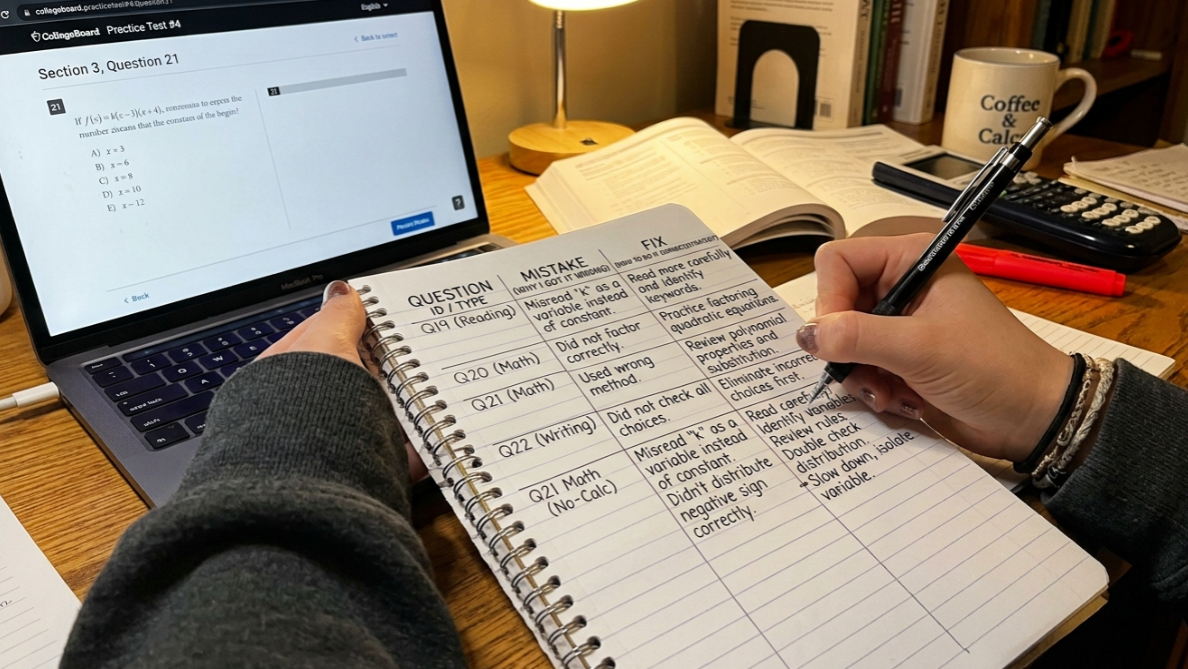
An error log is the difference between “studying a lot” and “studying the right thing.” Every time you miss a question, write down why.
Question | Section | Domain | Why I Missed It | Correct Concept | Faster Method | Redo Date |
|---|
Categorize your misses. Not all wrong answers are the same:
Content gap: You did not know the rule or formula.
Setup error: You knew the concept but set up the problem wrong.
Misread: You answered a different question than what was asked.
Timing error: You could solve it untimed but not under pressure.
Tool error: Desmos, annotation, or answer elimination would have helped.
Careless mistake: Your process was correct but execution was sloppy.
Strategy error: You chose a slow path when a faster method existed.
Reddit users in recent threads explicitly recommend this kind of categorization. One commenter described sorting errors by concept gap, careless error, timing issue, misreading, and strategy problem as a turning point in their prep. This mirrors what College Board’s My Practice review and domain reports are designed to help with.
Step 5: Retest, but Not Too Often
Full-length practice tests are checkpoints, not the workout itself. Here is a reasonable cadence:
8 to 12 week plan: Full practice test every 2 weeks
4 to 6 week plan: Full practice test every 1 to 2 weeks
Last 10 days: One full test early, targeted review after, no exhausting marathon the day before
College Board recommends taking a full-length practice test about two weeks before test day and reviewing every question and explanation afterward. The goal is to confirm that your targeted practice is working and to identify any remaining weak spots.
A practitioner on LinkedIn made a useful observation: digital SAT prep often breaks down after practice tests because students see their score but do not know what to fix next. The fix is turning every mock test into an action plan, not just a number.
Which SAT Section Is Easiest to Improve?
Not every SAT section offers the same opportunity for improvement.
SAT Area | Difficulty to Improve | Typical Speed |
|---|---|---|
Algebra | Easy | Fast |
Grammar | Easy | Fast |
Problem Solving & Data Analysis | Medium | Moderate |
Geometry & Trigonometry | Medium | Moderate |
Reading Comprehension | Hard | Slower |
Vocabulary in Context | Hard | Slow |
What Should You Study First for the Fastest 200 Points?
Not all SAT content is equally improvable. Prioritize the areas where gains come fastest.
1. Math content gaps. If you are missing questions in Algebra, Advanced Math, or Problem-Solving and Data Analysis, these are often the fastest points available. Math rules are concrete, and once you learn them, they stick. Practitioners on Reddit repeatedly identify math as the quickest path to points, especially for students around the 1100 to 1200 range.
2. Standard English Conventions. Grammar and punctuation rules are learnable and repeatable. Sentence boundaries, subject-verb agreement, modifier placement, punctuation. These show up in a defined portion of every Reading and Writing section. Drilling them is high return.
3. Transitions and rhetorical synthesis. The Expression of Ideas domain tests revision, transitions, and rhetorical goals. These question types follow predictable patterns and respond well to targeted practice.
4. Desmos and digital tools. College Board tells students to learn the built-in Desmos calculator and practice with it. Reddit users describe Desmos mastery as a quick math-score lever, though higher-score commenters warn that hard Module 2 questions still require flexible algebra and concept knowledge. Learn Desmos because it is a real test-day tool, but do not use it as a substitute for understanding the math.
5. Vocabulary and reading stamina. College Board’s Craft and Structure domain includes high-utility words and phrases in context. A self-described SAT tutor on Reddit advises students below 650 to 700 in Reading and Writing to read more, study vocabulary, and use spaced repetition. This is the slowest area to improve, which is why starting early matters.
For daily SAT practice by domain, focus on the areas your error log flags most often.
Sample 8-Week SAT Study Plan for a 200-Point Increase
This schedule assumes 45 to 90 minutes of practice most days. Adjust based on your starting score and available time.
Week | Focus |
|---|---|
1 | Diagnostic test. Build error log. Identify your top 3 weak domains. |
2 | Math gap #1 + grammar gap #1. Daily 30 to 60 minute drills. |
3 | Math gap #2 + Reading and Writing evidence questions. Timed mini sets. |
4 | Full practice test. 2-hour review session. Update your point map. |
5 | Harder math topics + Desmos workflows + Standard English Conventions. |
6 | Reading and Writing weak domains + timed modules. Redo old misses from error log. |
7 | Full practice test. Simulate test-morning routine. Patch remaining errors. |
8 | Light review. Redo error log highlights. Lock in sleep schedule. Final pacing plan. |
Compressed 4-Week Plan
Week | Focus |
|---|---|
1 | Diagnostic + content triage. Identify biggest gaps. |
2 | Daily targeted practice. Math and grammar priority. |
3 | Full test + deep review. Hard-question and pacing practice. |
4 | Final test early in the week. Redo misses. Light review before test day. |
10-Day Emergency Plan
Use this only if you have no other option. Even PrepScholar, which publishes a 10-day cram plan, frames it as ambitious.
Day 1: Full diagnostic
Days 2 to 4: Biggest math and grammar gaps
Day 5: Timed modules
Day 6: Second full test
Days 7 to 8: Review errors and redo missed question types
Day 9: Light mixed practice, no marathon
Day 10: Rest and test logistics
Common Mistakes That Keep Students from Improving
Taking practice tests without reviewing them. This is the single most common mistake. One Reddit commenter described it perfectly: repeating practice tests without analyzing mistakes just trains you to get the same score. Every test you take without deep review is wasted.
Studying what feels comfortable. It is tempting to spend time on topics you already know because it feels productive. The top-ranking Reddit thread on this topic warns against wasting time reviewing already-strong areas. Your error log should dictate what you study, not your comfort level.
Ignoring the digital format. The SAT is now adaptive by module. Students can move within a module, but once it ends, the next begins. If your prep does not include the digital tools (Desmos, annotation, mark-for-review, answer eliminator), you are leaving points on the table. One practitioner on LinkedIn argues that understanding the adaptive test mechanics matters more than brute-force volume.
Using low-fidelity practice questions. An SAT tutor reviewing third-party digital SAT practice materials on LinkedIn noted that many are not very accurate compared to official questions. Official College Board materials should be your benchmark. Third-party tools can add volume and explanations, but watch for question styles that do not match the real test.
Not sleeping enough. The American Academy of Sleep Medicine recommends that teenagers get 8 to 10 hours of sleep per night. Test-day exhaustion can erase weeks of gains. This applies to practice sessions too. Studying tired is practicing being tired.
Do You Need a Tutor or Prep Tool?
Not always. A tutor on Reddit’s r/digitalSATs advises that many students can self-study effectively with official materials, the right direction, and sufficient practice. The key phrase is “the right direction.” Self-study works when you can diagnose your own mistakes.
A tutor, AI tutor, or structured prep platform becomes more valuable when:
You cannot figure out why you are missing questions
Your score has plateaued after 2 to 3 full practice tests
You keep repeating the same error types
Your target is high (for example, 1400 to 1550)
Your test date is close and you need help prioritizing
An AI tutor can fill the gap between official materials and expensive private tutoring by providing instant explanations and guided practice on demand. The important thing is that whatever tool you use, it should help you identify and fix weaknesses, not just generate more practice volume.
Start with a free SAT diagnostic to see exactly where your points are hiding.
How to Know If Your Study Plan Is Working
A study plan should produce measurable progress over time. Rather than focusing only on total SAT score, monitor several indicators each week.
Metric | Healthy Progress |
|---|---|
Accuracy | Increasing |
Time per question | Decreasing |
Repeated mistakes | Declining |
Easy-question accuracy | Above 90% |
Practice test scores | Trending upward |
If these metrics remain unchanged after two or three weeks, adjust your study plan rather than simply increasing study hours.
Frequently Asked Questions
Can I improve my SAT score by 200 points in a month?
Possible, but ambitious. It is more realistic if you are starting below 1200 and have obvious math or grammar gaps that can be fixed quickly. Students starting above 1300 will find a one-month timeline much harder for a full 200-point gain.
Can I improve by 200 points in one week?
Technically possible but very unlikely. A week is enough to learn test format, fix a few obvious content gaps, and reduce test anxiety. But 200 points in seven days requires everything to go right, and that is not a plan you should count on.
How many hours does a 200-point SAT increase take?
There is no guaranteed number. The College Board and Khan Academy study found 20 hours was associated with a 115-point average increase, while 6 to 8 hours was associated with 90 points. Anecdotal examples on Reddit range from 50 to over 150 hours for large gains. The quality of those hours matters more than the quantity.
Is math easier to improve than Reading and Writing?
For most students, yes. Math content gaps are easier to isolate and drill because the rules are concrete. If you cannot solve systems of equations, you learn systems of equations and then you can. Reading and Writing improvement, especially vocabulary and passage comprehension, tends to build more slowly because it depends on broader skills like reading fluency and contextual reasoning.
Should I use only official SAT practice materials?
Official materials should be your benchmark because College Board writes the SAT, and Bluebook practice tests simulate the real digital format. Third-party tools can help with additional volume and explanations, but always verify that the question style matches the actual test. Browse additional SAT resources that complement official practice.
Do I need a tutor to improve by 200 points?
Not necessarily. Official resources, a strong error log, and consistent targeted practice may be enough. A tutor or AI tutor is most useful when you cannot identify why you are missing questions, when your score has plateaued, or when you have a short timeline and need someone to prioritize your study plan.
Is a 200-point SAT improvement guaranteed?
No. Anyone who guarantees a specific point increase is overpromising. What the data shows is that structured, focused practice consistently produces score gains, and that 200-point improvements are common enough (over 16,000 students achieved it in one study) to be a realistic goal for many students. But individual results depend on starting score, study consistency, content gaps, and time invested.
What if my score stops improving?
A plateau usually means one of three things: you are studying the wrong topics, you are not reviewing mistakes deeply enough, or you are at a score level where gains require precision rather than volume. Revisit your error log, shift to harder question types, or consider whether switching to a different format might help. Some students find that trying ACT practice reveals a better fit for their strengths.