
How to Study for the Digital SAT: 6-Step Guide (2026)
Miyagi Labs ·
How to Study for the Digital SAT: 6-Step Guide (2026)

TLDR
The best way to study for the Digital SAT is not to grind through endless practice tests. Start with one full-length Bluebook diagnostic, review every missed question using a structured error log, drill your weakest skills by domain, and master the Bluebook interface (especially Desmos, Mark for Review, and the Option Eliminator). Practice tests measure your readiness. Score gains come from the targeted work you do between them.
Most students studying for the Digital SAT hit the same wall early: they know Bluebook exists, they have heard of Khan Academy, they have maybe seen the Question Bank mentioned on Reddit, and they have no idea what order to use any of it. The vocabulary alone is confusing. Adaptive modules, active questions, content domains, score ranges. Every resource uses these terms like you should already know them.
This guide fixes that. It defines the Digital SAT terms you keep seeing, explains what each one means for your study plan, and gives you a practical system for turning practice into actual score improvement.
Before anything else, understand the core principle: a practice test tells you what broke. It does not fix it. The fix happens in the work between practice tests, when you classify mistakes, drill weak skills, and learn the digital tools that are now part of the exam itself.
Take a free Digital SAT practice exam to establish your baseline before reading further.
Quick Answer: How Should You Study for the Digital SAT?
The most effective Digital SAT study plan is to take one official Bluebook practice test, identify your weakest content domains, review every mistake using an error log, practice those skills with Khan Academy and the College Board Student Question Bank, then retest every 2–3 weeks. Most students improve faster by reviewing mistakes than by taking more practice tests. Learning the Bluebook interface—including Desmos, Mark for Review, and the Option Eliminator—is also an essential part of preparation because these tools are available during the real exam.
Who This Guide Is For
This guide is designed for:
First-time SAT students who don't know where to begin
Students switching from the paper SAT
Students retaking the SAT after a disappointing score
Students targeting competitive college admissions
Students studying independently without a tutor
If you already have a structured SAT study plan, you can jump directly to the glossary or study schedules.
What Makes the Digital SAT Different?
The Digital SAT is shorter than the old paper SAT, but “shorter” does not mean “easier to prepare for.” The format demands a different set of habits.
Here is what changed:
The test runs through College Board’s Bluebook app, not a paper booklet.
There are two sections: Reading and Writing, then Math.
Each section is split into two modules. Performance on Module 1 determines whether you get a harder or easier Module 2.
Built-in tools include a Desmos graphing calculator, Mark for Review, Option Eliminator, highlights, notes, a line reader, and a timer. These are available inside Bluebook for every test taker.
Reading and Writing passages are shorter. Each question typically has its own short passage.
The total test time is 2 hours and 14 minutes: 64 minutes for Reading and Writing and 70 minutes for Math.
The format shift means that studying for the Digital SAT requires three layers of preparation, not just one. You need content knowledge (grammar rules, algebra, reading comprehension), format understanding (adaptive modules, timing, question types), and interface fluency (knowing how to actually use the Bluebook tools under pressure).
Practitioners on LinkedIn have made this point directly: tutors who focus only on content while ignoring Bluebook tools like Desmos, annotation, and flagging are leaving points on the table. The interface is part of the test now.
Digital SAT Format at a Glance
Section | Modules | Questions | Time | Time per Question |
|---|---|---|---|---|
Reading and Writing | 2 (32 min each) | 54 | 64 minutes | ~1 min 11 sec |
Math | 2 (35 min each) | 44 | 70 minutes | ~1 min 35 sec |
Total | 4 | 98 | 2 hr 14 min | — |
The total score ranges from 400 to 1600, with each section scored from 200 to 800. There is a 10-minute break between the two sections.
The Digital SAT Study Loop
Before jumping into glossary terms, here is the study system that should organize everything you do. Think of it as a loop you repeat, not a checklist you finish once.
Diagnose. Take one full-length Bluebook practice test under real timing.
Decode. Break your misses into domain, skill, and error type.
Drill. Practice targeted skills with Khan Academy, the Question Bank, or targeted SAT problem sets.
Explain. Write why each wrong answer was tempting and why the right answer works.
Retest. Take another timed section or full test after enough study.
Adjust. Move your study time toward the skills with the highest score payoff.
College Board research found that completing Bluebook full-length practice tests is associated with higher SAT scores: about 25.7 points higher for one test, 45.5 for two, and 61.4 for three or more, compared with similar students who completed none. The study cautions these estimates are not causal, but the pattern is clear. Practice matters, and more structured practice matters more.
How Much Can Your SAT Score Improve?

Actual score improvement depends on your starting score, consistency, and the quality of your review.
Starting Score | Typical Improvement After Structured Study |
|---|---|
900–1100 | 150–300 points |
1100–1300 | 80–180 points |
1300–1450 | 40–120 points |
1450+ | 20–70 points |
Students who consistently review mistakes, study weak domains, and take periodic official practice tests generally improve more than students who simply take repeated practice exams.
Glossary of Digital SAT Study Terms
This is the core of the guide. Each entry defines a term, explains why it matters, and tells you how to study with it.
Digital SAT
The current SAT format, administered digitally through College Board’s Bluebook app. It replaced the paper SAT and uses shorter sections, adaptive modules, and built-in tools. Do not rely on old paper SAT habits. Practice inside Bluebook and learn the interface before test day.
Bluebook
College Board’s digital testing app for the SAT, PSAT-related assessments, and some AP Exams. Bluebook is where you take official full-length practice tests and where you will take the real SAT. Use the Test Preview feature before your first full test. Take full-length practice tests under realistic timing. Review results in My Practice.
Test Preview
An untimed Bluebook feature with a short set of questions that lets you experience the digital format and tools without score pressure. It does not provide scores or feedback. Use it once before your diagnostic to lower interface anxiety. Do not count it as content study.
Full-Length Practice Test
A timed practice SAT inside Bluebook that simulates the full Digital SAT experience and produces a score. About 64% of SAT takers used full-length practice tests, and 93% of those users found them helpful, according to the same College Board research brief. Take one as a diagnostic, then retest only after targeted review. Do not stack practice tests back to back without studying in between.
Diagnostic Test
Your first realistic practice test, used to find your baseline score and weak skills. Without a diagnostic, students often waste time studying topics they already know. Take one Bluebook full-length practice test under real timing and conditions, then build an error log from the results.
Baseline Score
The score you earn before serious prep, usually from your diagnostic. It tells you how far you are from your target score and how aggressive your timeline needs to be. A student going from 1050 to 1250 needs a fundamentally different plan than one going from 1400 to 1500.
Target Score
The SAT score you are aiming for, based on your college list, scholarship goals, or personal benchmark. A “good SAT score” depends on where you are applying. Set a target total score and section scores. If your target is 1450 and your diagnostic is 1320, break the 130-point gap into Math and Reading/Writing priorities.
Check your predicted SAT score to see where you stand and which sections need the most work.
Adaptive Testing
A test design where the difficulty of later modules changes based on earlier performance. On the Digital SAT, performance on Module 1 determines whether Module 2 is more difficult or less difficult. Take Module 1 seriously. Accuracy early in each section matters because it affects routing.
Module 1
The first half of each section. Module 1 contains a broad mix of easy, medium, and hard questions. Your performance here determines which version of Module 2 you receive. Prioritize clean accuracy. Avoid careless mistakes. Use the final minutes to check flagged questions.
Module 2
The second half of each section, routed based on Module 1 performance. A harder Module 2 can feel intimidating, but it likely means you did well on Module 1. Do not waste mental energy during the test trying to figure out which route you got. Practice harder timed sets during prep so a difficult Module 2 does not create panic.
Content Domain
A broad category of skills tested on the SAT. College Board breaks each section into domains with approximate weightings, which helps you prioritize study time. Tag each missed question by domain. If most of your misses are in Standard English Conventions or Advanced Math, that becomes your study priority.
Skill
A narrower tested ability within a domain, such as Boundaries, Words in Context, Systems of Equations, or Nonlinear Functions. Skills are more actionable than broad sections. “Improve Math” is vague. “Practice nonlinear functions and systems” is specific. Use Khan Academy or the Question Bank to drill one skill at a time.
Student Question Bank
College Board’s official practice question tool, which lets you filter SAT questions by section, domain, skill, and difficulty. It is one of the best sources for targeted official practice after a diagnostic. Use it after reviewing a Bluebook test. Filter to your weak skills instead of randomly grinding questions.
Active Questions
Questions in the Student Question Bank that are also included in currently active official full-length practice tests. If you see these questions before taking a Bluebook practice test, your practice score can become inflated because you have already seen the answers.
This is a real concern. Practitioners on Reddit repeatedly discuss the overlap problem and recommend using the “Exclude Active Questions” filter when available. One thread specifically asked whether doing Question Bank questions before Bluebook tests makes scores inaccurate, and replies confirmed that repeated exposure can skew results. If you want clean practice-test scores, take at least one diagnostic before heavy Question Bank drilling.
Khan Academy Official Digital SAT Prep
Free official SAT prep created in partnership with College Board. It includes practice questions, videos, lessons, hints, and strategies. Use Bluebook for diagnostics and full-test simulation. Use Khan Academy to learn and drill skills between tests. Khan Academy explicitly notes that Bluebook is useful for practice tests and format familiarity but is not designed to teach all tested content by itself.
Desmos
The built-in graphing calculator available through Bluebook on the SAT. Desmos changes Digital SAT Math strategy because it can graph functions, find intersections, check roots, and support tables and regressions. One Reddit user reported jumping from a March 1450 to a June 1540, attributing the Math improvement largely to using Desmos for systems and similar problems, which left more time for harder questions and checking work.
But Desmos is a tool, not magic. A tutor on LinkedIn made a useful point: students should not jump into Desmos strategy before learning the content. Once you know the math, then decide whether a problem is faster by hand or with the calculator.
Mark for Review
A Bluebook tool that lets you flag questions to revisit within the same module. It helps with pacing and prevents one hard question from wrecking an entire module. Use a rule: if a question is not moving after 60 to 90 seconds, make your best guess, mark it, and return if time remains.
Option Eliminator
A Bluebook tool that lets you cross out answer choices you think are wrong. It makes guessing more strategic and reduces the chance of re-reading choices you already rejected. Practice eliminating obviously wrong choices on Reading and Writing questions before choosing between the final two.
Error Log
A record of missed, guessed, and slow questions, including why the mistake happened. The error log turns practice into learning. More on how to build one in the review section below.
Score Range
A range shown on College Board score reports that indicates how much a score might vary across different administrations under identical conditions. It prevents overreacting to one practice score. Watch trends over several tests and sections, not one number.
A Reddit thread of 1500+ scorers showed wide variation between practice and real scores. One user got 1390 on Practice Test 6 shortly before test day and 1520 on the actual June SAT. Another listed practice scores of 1590/1580/1590, then scored 1450 in March and 1540 in June. Treat a practice score as a readiness estimate, not a promise.
Student-Produced Response
A Math question where you type in your own answer instead of choosing from multiple-choice options. These questions remove the option of backsolving from answer choices, so you need clean setup and checking. Practice entering exact values, decimals, and fractions carefully. Use Desmos to verify when useful.
Exam Setup
The Bluebook process you complete before test day to prepare your registered SAT on your testing device. College Board says registered SAT Weekend students should complete exam setup 1 to 5 days before test day. Do not leave this for the morning of the test.
Device Lending
College Board’s process for students who need to borrow a testing device for SAT Weekend. You must request a device at least 30 days before test day, and approval is not guaranteed. Device planning belongs in your study calendar, not the final week.
How to Take Your First Diagnostic
The diagnostic is the most important single step in learning how to study for the Digital SAT. Everything else depends on it.
Here is the process:
Download Bluebook.
Complete the Test Preview to learn the interface.
Take one full-length Bluebook practice test under real conditions: timed, no pausing, quiet room, on the device you plan to test on if possible.
After the test, review your results in My Practice.
Record these details from your diagnostic:
Total score and section scores
Domain-level performance (which domains had the most misses)
Every question you missed
Every question you guessed on
Every question where you were slow or unsure
Any interface mistakes (forgot to use Desmos, ran out of time, did not use Mark for Review)
This data drives everything that follows.
How to Review a Digital SAT Practice Test
Most guides say “review your mistakes.” That is too vague to be useful. Here is a system that actually works.
Every wrong or slow question goes into one of four buckets:
Content gap. You did not know the grammar rule, math concept, word meaning, or reading skill. Fix: learn the concept, then drill similar questions.
Process error. You knew the concept but used the wrong method, skipped steps, failed to check units, or chose the slow path. Fix: practice the right approach on similar problems until it becomes automatic.
Reading/wording trap. You missed a word like “not,” “least,” “best supported,” “per,” or “which choice completes the text.” Fix: slow down on prompts and train yourself to underline key words.
Pacing/interface error. You ran out of time, failed to flag and return, lost track of modules, used Desmos inefficiently, or did not use the eliminator tools. Fix: timed Bluebook rehearsal with deliberate tool use.
Here is what an error log entry looks like:
Question | Section | Domain | Skill | Error Type | Fix |
|---|---|---|---|---|---|
RW M1 Q14 | Reading/Writing | Standard English Conventions | Boundaries | Content gap | Review independent/dependent clauses |
Math M2 Q18 | Math | Advanced Math | Nonlinear functions | Process error | Practice graphing + algebraic check |
RW M2 Q22 | Reading/Writing | Information and Ideas | Inference | Wording trap | Re-read exact claim before choosing |
Math M1 Q10 | Math | Algebra | Systems | Interface error | Use Desmos intersection next time |
Different errors need different fixes. A content gap needs a lesson. A process error needs repeated similar problems. A wording trap needs slower reading. A pacing error needs timed rehearsal. If you do not classify mistakes, you will study the wrong things.
A Reddit user who reported a 1600 on their first attempt said they took Bluebook practice tests, reviewed every missed question, figured out why they missed it, and wrote down unfamiliar vocabulary. A commenter summarized the real lesson well: the process of taking notes earned the score, not the notes themselves. Do not ask for someone else’s notes before you have made your own. The learning happens when you explain your own mistakes.
How to Use Bluebook, Khan Academy, and the Question Bank Together
These three official tools serve different purposes. Using them in the wrong order or without a plan is one of the most common mistakes when studying for the Digital SAT.
Tool | Best For | Not Best For | When to Use |
|---|---|---|---|
Bluebook | Full-length timed tests, format familiarity, score check | Teaching concepts from scratch | Diagnostic, periodic retests, final rehearsal |
Khan Academy | Learning skills, video explanations, guided practice | Full-test simulation | Between practice tests, after identifying weak skills |
Student Question Bank | Targeted drills by domain, skill, difficulty | Learning a concept for the first time | After a diagnostic, when you know what to target |
The recommended workflow:
Bluebook Test Preview (learn the interface)
Bluebook diagnostic (find your baseline)
My Practice review (identify weak domains and skills)
Khan Academy lessons for weak skills
Question Bank targeted drills (filtered by your weak areas)
Timed mixed SAT practice sessions for pacing
Bluebook retest after enough study
Protect your official practice tests. If you plan to take multiple Bluebook tests over a prep period, be careful about seeing active questions in the Question Bank before you take those tests. Take at least one diagnostic before heavy Question Bank use, and use the “Exclude Active Questions” filter when it is available. Students on Reddit repeatedly warn about this overlap inflating practice scores.
How to Study for Digital SAT Reading and Writing
Reading and Writing has four content domains. Here is what each one covers and how to approach it, based on College Board’s domain breakdowns.
Information and Ideas (about 26%)
This domain tests central ideas, supporting details, evidence, inferences, and interpreting graphs or tables within passages. Study by practicing how to prove answers directly from the text. If you cannot point to specific words or data that support your choice, you are probably guessing.
Craft and Structure (about 28%)
This covers vocabulary in context, text structure, author purpose, and cross-text connections. For vocabulary, study context clues more than giant word lists. The test asks you to figure out meaning from the passage, not recall memorized definitions.
Expression of Ideas (about 20%)
This domain focuses on transitions and rhetorical synthesis. For rhetorical synthesis questions (the ones with bullet-point notes), identify the stated goal before reading the notes. The goal sentence tells you what the correct answer must accomplish.
Standard English Conventions (about 26%)
This is grammar: sentence boundaries, punctuation, subject-verb agreement, pronoun clarity, modifier placement, and verb tense. For grammar, learn the rules first, then drill. Random practice without understanding the underlying rule is low-value.
High scorers on Reddit emphasize careful reading of prompts, last sentences, answer choices, and tiny details as the final improvement strategy. The last 20 to 40 points in Reading and Writing often come from not misreading the question, not from learning new content.
How to Study for Digital SAT Math
Math has four content domains, with Algebra and Advanced Math together making up about 70% of the section. Here is the breakdown from College Board’s Math alignment.
Algebra (about 35%)
Linear equations, linear functions, systems of linear equations, and inequalities. This is the highest-yield domain for most students below 650 in Math. Master slope-intercept form, point-slope form, and system-solving (substitution, elimination, and graphing with Desmos).
Advanced Math (about 35%)
Quadratics, exponentials, polynomials, nonlinear functions, equivalent expressions, and rational/radical expressions. If you are scoring above 650 and want 700+, this domain is usually where the hardest questions live.
Problem-Solving and Data Analysis (about 15%)
Ratios, percentages, units, probability, data interpretation, scatterplots, margins of error, and study design. These questions reward careful reading and unit tracking more than advanced math skills.
Geometry and Trigonometry (about 15%)
Area, volume, lines, angles, triangles, right triangles, basic trig, and circles. This domain is smaller but can be a fast point source if you know the formulas. Bluebook provides a reference sheet with common formulas.
How to Use Desmos Without Overusing It
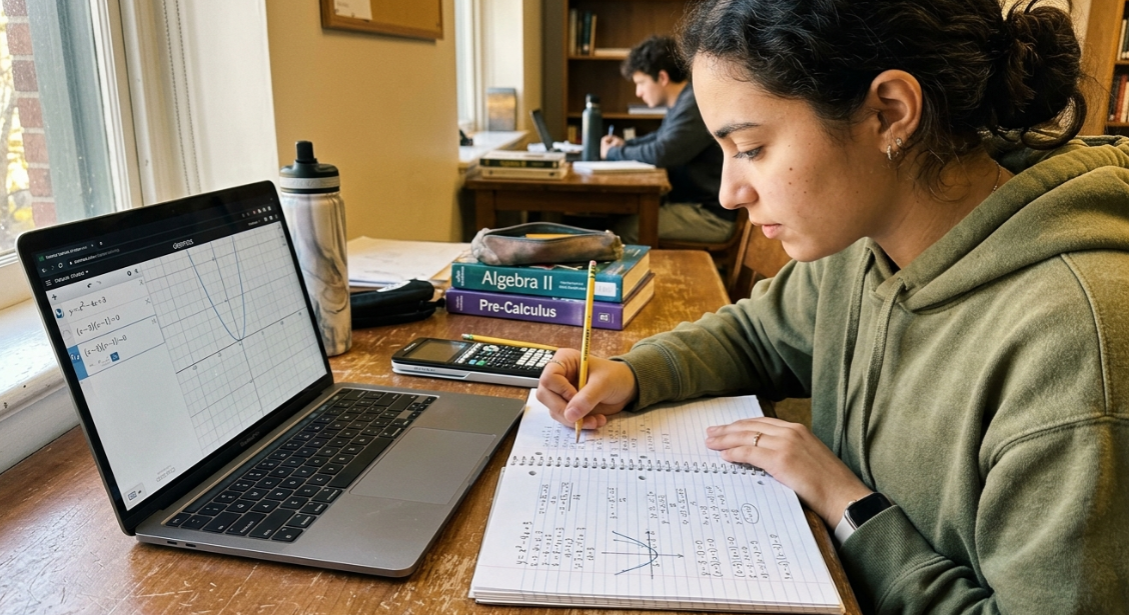
Desmos is available on every Math question in Bluebook. But knowing when to use it matters more than knowing how.
Problem Type | Use Desmos? | Why |
|---|---|---|
Systems of equations | Yes | Graph both lines and find the intersection |
Quadratics/functions | Often | Find roots, vertex, or intersections visually |
Tables and regression | Often | Desmos tables and regressions are fast |
Checking answer choices | Yes | Plug in values for quick verification |
Inequality regions | Yes | Graph and shade to confirm |
Simple one-step algebra | Usually not | Mental math or by-hand is faster |
Geometry/trig reasoning | Usually not | Conceptual setup matters more than graphing |
Word problems where modeling is the hard part | Usually not | You still need to build the equation first |
The practical rule: if Desmos saves time and reduces errors, use it. If it becomes a typing detour, solve by hand and use Desmos only to check. Learn Desmos during regular Math drills, not the night before the test.
How Often Should You Take Practice Tests?
This depends on how much time you have and where you are starting.
Time Until Test Day | Full-Length Test Cadence | Main Focus |
|---|---|---|
2 to 3 weeks | 1 diagnostic + 1 final | Review, top weak skills, pacing |
4 to 6 weeks | Every 1 to 2 weeks | Skill repair + timed sections |
8 to 12 weeks | Every 2 to 3 weeks | Foundations, drills, periodic retests |
Already 1450+ | Fewer full tests | Hard questions, careless errors, timing precision |
Below 1200 | Fewer tests at first | Content foundations and accuracy building |
Most students benefit from four to six full-length exams spread across their prep period. Princeton Review suggests most students take 4 to 12 weeks to prepare and should put in at least 30 minutes per day.
Taking a test without reviewing it is low-value. Reviewing one test deeply is more useful than taking three tests passively.
How Many Hours Should You Study for the Digital SAT?
Rather than focusing only on weeks until test day, consider your total study hours.
Starting Score | Target Score Increase | Recommended Study Hours |
|---|---|---|
Small (under 50 points) | 20–30 hours | |
Moderate (50–120 points) | 35–60 hours | |
Large (120–200 points) | 60–100 hours | |
Major (200+ points) | 100–150+ hours |
Quality matters more than quantity. One focused hour reviewing mistakes is usually more valuable than several hours of passive practice.
Digital SAT Study Plans by Timeline
3-Week Plan
You do not have time for a complete overhaul. Focus on stabilizing your score and fixing the highest-yield gaps.
Week 1: Bluebook diagnostic, full review with error log, identify top 3 weak skills
Week 2: Targeted drills on those skills, Desmos practice, one timed section or full test
Week 3: Final Bluebook test early in the week, error-log review, no brand-new content in the final 48 hours
This mirrors the kind of realistic 3-week plan students discuss on Reddit: one Bluebook test, a missed/slow question log, targeted weak-skill work, a second Bluebook test, and last-week review.
6-Week Plan
Enough time to build a weekly rhythm and see real improvement.
Week 1: Diagnostic + error log
Week 2: Reading/Writing weak domains + grammar foundations
Week 3: Math weak domains + Desmos workflows
Week 4: Practice test + deep review
Week 5: Hard-question drills + pacing practice
Week 6: Final practice test + test-day setup
10-Week Plan
This is where genuine score growth happens, especially for students with gaps of 150+ points to close.
Weeks 1 to 2: Foundations and diagnostic
Weeks 3 to 6: Skill-by-skill study, one domain block at a time
Weeks 7 to 9: Timed mixed sets and full-length tests every 2 to 3 weeks
Weeks 10 to 12: Precision work, pacing drills, test-day rehearsal
Explore more SAT prep resources for additional study materials organized by topic.
Sample Weekly Digital SAT Study Schedule
Day | Focus |
|---|---|
Monday | Reading and Writing weak skills |
Tuesday | Algebra and Advanced Math |
Wednesday | Student Question Bank drills |
Thursday | Grammar review + timed Reading module |
Friday | Desmos practice + Math review |
Saturday | Full Bluebook practice test or timed sections |
Sunday | Error log review and planning |
A balanced weekly schedule prevents burnout while keeping every tested domain fresh.
Final-Week Checklist
The final week before the SAT is not the time to learn new content. It is the time to consolidate what you know and eliminate logistical surprises.
Review your error log, focusing on your most common mistake patterns
Practice a few Desmos workflows on problem types you have struggled with
Take one final timed section (or a full test) early in the week, not the night before
Complete Bluebook exam setup 1 to 5 days before test day
Check your device, charger, photo ID, and admission ticket
If you need a loaned device, you should have requested it at least 30 days ago
Sleep. Seriously.
How Do You Know Your Study Plan Is Working?
Don't judge progress using only total scores.
Positive signs include:
fewer repeated mistake types
improved timing
higher accuracy on weak domains
reduced careless errors
increased confidence using Bluebook tools
Score improvements usually follow these changes rather than appearing immediately.
Common Digital SAT Study Mistakes
Taking practice tests too often. Tests measure progress. They do not create it. Review first, retest after targeted work.
Studying “Math” or “English” too broadly. Study by domain and skill. “I need to improve Reading and Writing” is not a plan. “I need to practice Standard English Conventions, specifically boundaries” is a plan.
Ignoring Bluebook tools. Mark for Review, Option Eliminator, the timer display, and Desmos are all part of the test experience. Practice with them.
Spoiling official practice tests. Be careful with Question Bank active questions if you want clean Bluebook scores.
Treating practice scores as guarantees. Use score trends and error patterns, not one number.
Learning Desmos too late. Practice Desmos during regular Math drills throughout your prep period.
No device plan. Prepare your device early. Know the 30-day borrowing rule if you need a loaned device.
Not building an error log. Taking a test and moving on without reviewing it is the fastest way to waste a practice test. Classify your mistakes so you know what to fix.
Best Official Digital SAT Study Resources
Resource | Best Use |
|---|---|
Bluebook | Official practice tests |
Khan Academy | Skill lessons |
Student Question Bank | Targeted drills |
College Board Score Reports | Performance analysis |
Desmos Calculator | Math efficiency |
Error Log | Long-term improvement |
Do You Need an SAT Tutor?
Not necessarily.
Many students reach competitive scores using official College Board resources alone.
A tutor is often most useful if:
your score has plateaued
you struggle to identify recurring mistakes
you're aiming for highly selective universities
you need accountability
If you're improving consistently using your error log and official resources, self-study may be enough.
FAQ
How long should I study for the Digital SAT?
Most students should plan for 4 to 12 weeks, depending on their baseline score and target. Students with large score gaps may need several months of consistent work. Students already near their target may need only a shorter precision phase focused on pacing and hard questions.
What is the best first step when studying for the Digital SAT?
Download Bluebook, complete the Test Preview to learn the interface, then take one full-length practice test as a diagnostic. Everything else, your study plan, your skill priorities, your timeline, flows from the diagnostic results.
Is Bluebook enough to study for the Digital SAT?
No. Bluebook is best for official practice tests and format familiarity. Khan Academy notes that Bluebook is not designed to teach all tested content. Pair it with lessons, skill practice, and targeted drills from Khan Academy, the Question Bank, or another structured source.
Should I use the Question Bank before taking Bluebook practice tests?
Use it carefully. If you want clean practice-test scores, take at least one Bluebook diagnostic first. When using the Question Bank afterward, use filters to exclude active questions when possible so you do not accidentally see questions that appear on future practice tests.
Is Desmos allowed on all Digital SAT Math questions?
Yes. Bluebook provides a Desmos calculator for the entire Math section. You should learn it before test day, but remember that not every problem is faster with Desmos. Simple algebra and concept-heavy geometry are often better solved by hand.
How many practice tests should I take?
Enough to diagnose, practice timing, and measure progress, but not so many that you skip review. Most students use 4 to 6 over a longer prep period. Students with less time should prioritize review and targeted drills over test volume.
Are Digital SAT practice scores accurate?
Practice scores are useful estimates, not promises. College Board score reports include a score range that reflects natural variation. Your trend across multiple tests, your error patterns, and your timing behavior tell you more than any single number.
What should I do the day before the SAT?
Review your error log briefly. Check that your device is set up and charged. Pack your ID, admission ticket, and any allowed items. Do not take a full practice test late at night. Rest matters more than last-minute cramming.
Studying for the Digital SAT is a system: diagnose, review, drill, retest, adjust. If building that system from scratch feels overwhelming, a structured prep platform can handle the workflow for you, combining diagnostics, personalized study paths, practice questions with explanations, full-length exams, and score analytics in one place.
Start your Digital SAT prep with a diagnostic, a study plan, and practice built around how you actually learn.