
Is Khan Academy Enough for SAT in 2026? A Complete Guide
Miyagi Labs ·
Is Khan Academy Enough for SAT in 2026? A Complete Guide

TL;DR: Khan Academy is a strong, free, official SAT prep resource, but it is not usually enough as your only study tool. A complete prep plan should also include Bluebook full-length practice tests, the College Board Student Question Bank, Desmos practice, and structured mistake review. Whether Khan Academy is enough for the SAT depends on your starting score, your target score, and how well you review what you miss.
Quick Answer: Is Khan Academy Enough for the SAT?
Usually not by itself.
For most students in 2026, Khan Academy should be the foundation—not the entire study plan.
The highest-scoring students typically combine:
- Khan Academy for learning concepts
- Bluebook for full-length adaptive practice tests
- College Board Student Question Bank for targeted drills
- Desmos calculator practice
- Detailed mistake review after every practice test
If your target score is under 1300, Khan Academy may be enough when paired with official practice tests.
If your goal is 1400+, 1500+, or admission to highly selective colleges, Khan Academy should be one part of a broader study system.
Is Khan Academy Enough for SAT Prep? When It Works and When It Doesn’t
Khan Academy is enough to start SAT prep. It is not usually enough as your entire SAT prep plan.
The platform is free, officially built with College Board, and genuinely useful for learning the concepts the digital SAT tests. But “enough” means more than learning concepts. It means handling timed adaptive testing, drilling weak skills with realistic questions, mastering the Desmos calculator, and reviewing every mistake until your score actually moves.
Whether Khan Academy is enough for the SAT depends on three things: where you are starting, what score you need, and whether you are willing to supplement Khan with the other free official tools that exist alongside it. The real question is not “Khan Academy vs. paid prep.” It is “Khan Academy alone vs. the complete free SAT prep system.”
What “Enough” Actually Means for SAT Prep
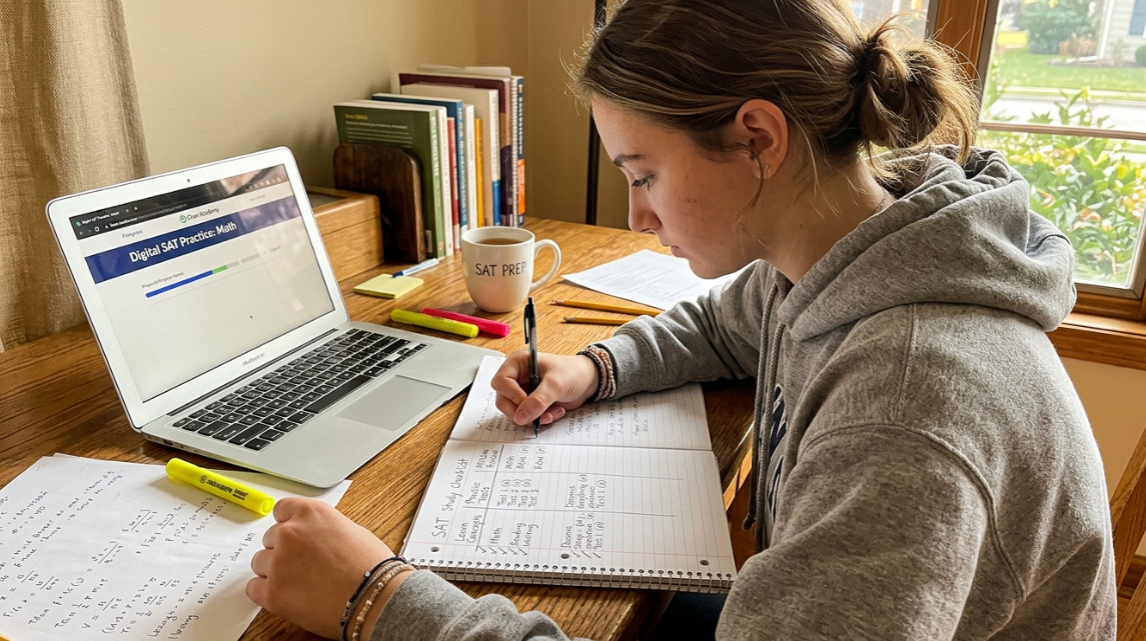
Before deciding if Khan Academy is enough, define what a complete SAT prep plan requires:
Learn every tested concept
Practice realistic questions under timed conditions
Experience the digital SAT’s adaptive format
Review mistakes and understand why correct answers are correct
Improve across multiple full-length practice tests
Reach your target score before test day
Khan Academy handles the first requirement well and partly addresses the second. It does not fully cover the rest on its own.
A quick self-check: Khan Academy is enough for you right now if your Bluebook practice test scores are improving, you can explain every wrong answer, and your remaining mistakes are shrinking by skill area. If your score is flat and you keep missing the same question types, Khan is no longer enough by itself.
Who Should Use Khan Academy?
Student | Recommendation |
|---|---|
First-time SAT student | Excellent starting point |
Budget-conscious student | Best free option available |
Student below 1100 | Usually enough initially |
Student aiming for 1300 | Pair with Bluebook |
Student aiming for 1450 | Add Question Bank and Desmos |
Student aiming for 1500+ | Use Khan only for weak areas |
Student retaking SAT | Focus on official practice tests more than lessons |
What Khan Academy Does Well
Khan Academy deserves real credit. The platform is built in partnership with College Board, and the course content covers every tested skill at three levels: Foundations, Medium, and Advanced. That official alignment matters. You are not studying random content that might appear on the test. You are studying what College Board says is tested.
Khan is especially strong for grammar drilling and core math concepts. Practitioners on Reddit report that Khan “contains all the content you need” and pairs well with practice tests, particularly for learning rules and building a foundation. For students who struggle with algebra, Standard English Conventions, transitions, or data analysis, the leveled structure lets them work through progressively harder content at their own pace.
The price is hard to beat. College Board itself says students do not need to pay for SAT tutors or preparation materials because free tools exist. Khan Academy is the centerpiece of that argument.
Khan is also practical for short study sessions. Unlike committing to a two-hour practice test, you can spend 15 minutes on a skill unit during a break. For students rebuilding fundamentals or starting from scratch, this flexibility adds up over weeks.
What Khan Academy Does NOT Include
Khan Academy covers SAT content well, but it does not include every tool students need for top scores.
Missing features include:
Full adaptive practice testing
Advanced timing strategies
Personalized study plans
Detailed analytics across multiple tests
Desmos calculator tutorials
Advanced second-module practice
Test-day pacing strategies
Accountability and coaching
Many students assume Khan Academy includes these features because it is the official free partner. It does not.
Where Khan Academy Falls Short
Khan Academy is good. It is not complete. The gaps become more visible the higher your score goal climbs.
No full-length adaptive practice tests
The digital SAT uses a two-stage adaptive design. Each section has two separately timed modules, and the difficulty of the second module depends on how you perform in the first. Reading and Writing has 54 questions in 64 minutes. Math has 44 questions in 70 minutes.
Khan Academy teaches through skill-based practice. It does not simulate the adaptive testing experience. For that, students need Bluebook practice tests, College Board’s app for timed, scored digital SAT practice.
The evidence here is strong. College Board’s May 2025 research found that completing full-length Bluebook tests was associated with meaningfully higher scores: roughly 25 points for one test, 45 for two, and 60 for three or more, compared with similar students who took none. The most evidence-backed action is not watching more Khan videos. It is taking full-length tests and reviewing them deeply.
If you want additional SAT practice exams beyond Bluebook’s offerings, a guided platform can fill that gap with realistic timing and scoring.
No Desmos calculator strategy
College Board explicitly recommends learning the built-in Desmos calculator for the digital SAT. This is one of the biggest practical gaps in Khan’s SAT prep. One Reddit user said Khan helped them, but “the only problem is they don’t show you how to use the DESMOS calculator.” Other threads recommend YouTube channels or dedicated Desmos walkthroughs for boosting math scores.
Khan teaches math concepts. The digital SAT also rewards Desmos execution speed, and that takes separate practice.
Can feel too basic for higher scorers
Students on Reddit consistently describe a ceiling with Khan Academy. Comments like “good until 1300,” “for under 1100s range, yes,” and “if you aim 1500s it probably not enough” show up in multiple recent threads. This pattern makes sense. Khan’s Foundations and Medium units cover what lower-scoring students need to learn. Once a student scores above 1300, the bottleneck often shifts from “I don’t know this concept” to “I can’t execute under time pressure on hard second-module questions.” Khan does not solve that second problem well.
Weak on accountability
Free self-study platforms struggle with follow-through. The 2020 OSP technical report found that only about 10% of linked students practiced six or more hours on Official SAT Practice. Most students used the platform for relatively little time, regardless of their intentions.
If staying consistent is a challenge, Khan alone probably will not fix it. A study group, a scheduled bootcamp, or a practice leaderboard can add the external pressure some students need to keep showing up.
Explanations sometimes fall short
Khan offers text and video explanations, but not every explanation clicks for every student. When a concept does not land the first time, students need a second source: a tutor, a peer, an AI chatbot, or a YouTube walkthrough. Reddit users note that Khan explains topics but not necessarily every question type that shows up on test day. For students who cannot figure out why they missed a question, one explanation format is not always enough.
Khan Academy Alone vs. the Free Official SAT Prep Stack
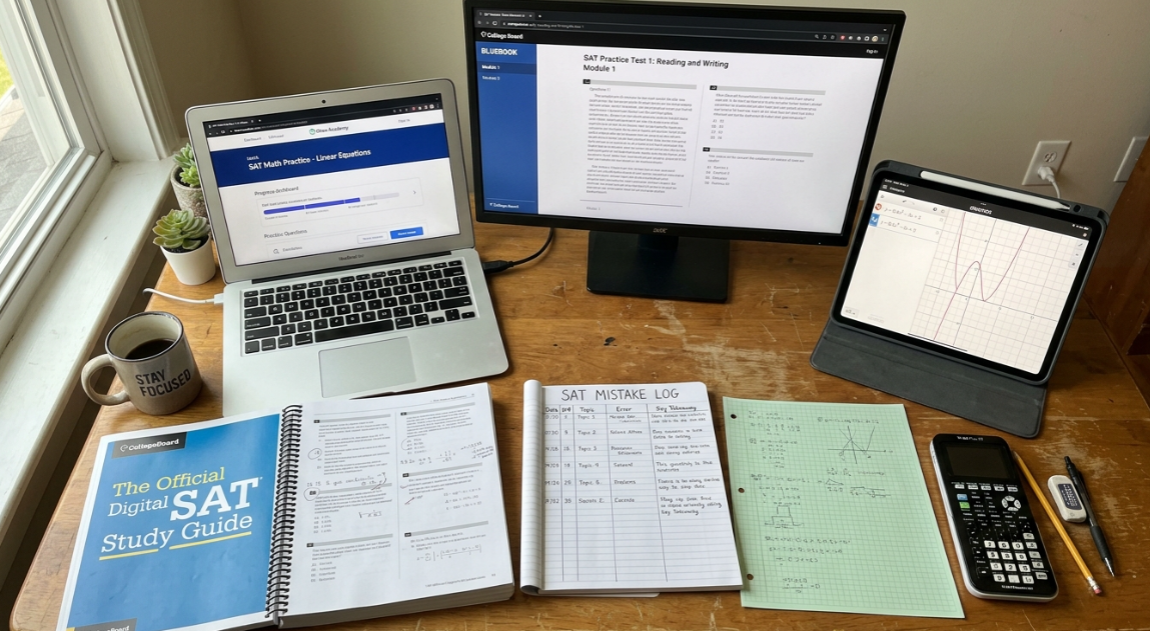
Most articles frame the question as “Khan vs. paid prep.” That is the wrong comparison. The better framing is Khan alone versus the full free official system that now exists.
Resource | Best use | What it does not solve alone |
|---|---|---|
Khan Academy | Learn concepts, practice by skill, review foundations | Adaptive testing, timing simulation, advanced strategy |
Bluebook | Full-length timed digital practice tests | Not enough targeted drilling by itself |
Student Question Bank | Target weak domains and skills with official questions | Requires self-diagnosis and review discipline |
My Practice | Review Bluebook score details and explanations | Does not generate a study plan |
Schoolhouse.world | Free live peer tutoring and structured bootcamps | Peer tutors vary; not the same as expert 1:1 tutoring |
YouTube / Desmos videos | Calculator shortcuts and visual walkthroughs | Quality varies widely |
Many competitor articles miss a major 2026 update. College Board and Schoolhouse.world launched free peer tutoring worldwide, with structured 4-week bootcamps led by tutors who scored in the 95th percentile or above on the section they teach. If Khan alone is not enough, the next step does not have to be paid prep.
For a broader look at free and guided options, see this collection of SAT prep resources.
Is Khan Academy Enough by Score Goal?
Whether Khan Academy is enough for the SAT depends heavily on what score you need. Here is a practical breakdown.
Student type | Is Khan enough? | What to add |
|---|---|---|
Starting below 1100 | Often yes as a starting resource | Khan Foundations and Medium units, then a Bluebook test to check progress |
Aiming for 1200 to 1350 | Often enough if paired with Bluebook | Khan for content gaps; Bluebook and question bank for timing and format |
Aiming for 1350 to 1450 | Khan alone is risky | Question-bank drilling, timed sections, Desmos practice, 2 to 3 Bluebook tests |
Aiming for 1500+ | Usually not enough alone | Hard official questions, Bluebook adaptive tests, deep mistake review |
Weak self-discipline | Probably not enough alone | Schedule, bootcamp, AI tutor, or external accountability system |
The numbers tell the story. A 1400 already represents roughly the 97th nationally representative percentile. A 1500 is around the 99th. The jump from “solid” to “elite” is not linear, and the prep required at each level is qualitatively different.
Aiming for 1400
Khan Academy can carry much of the work if you start below 1200 and combine it with Bluebook tests and the question bank. But if your baseline is already 1300, you need precision and pacing, not just concept review. Use Khan only for specific weak skills and shift quickly to timed official practice.
One LinkedIn student post describes earning a 1530 after a focused strategy built around Bluebook mock tests, weak-point review, Khan Reading and Writing practice, and repeated testing. The pattern is clear: Khan was part of the plan, not the whole plan.
Aiming for 1500+
Khan is a supplement at this level, not the core engine. Reddit users who report 1500+ scores using free resources almost always describe a broader stack: Bluebook, the official question bank, YouTube, and careful mistake tracking, not Khan alone.
Stop watching foundation videos if you already score high. Instead, track why each miss happened. Was it a content gap, a trap answer, time pressure, a careless error, or a Desmos opportunity missed? That diagnosis drives the real improvement.
A SAT score predictor can help you assess whether your current trajectory is realistic or whether you need to change your approach.
The Khan Ceiling and the Three-Test Rule
There is a useful concept worth naming: the Khan ceiling. It is the point where Khan Academy stops being the limiting factor and the student’s real bottleneck becomes something else entirely. That something might be timing under test conditions, hard second-module questions, weak error review, inability to recognize trap answers, slow Desmos execution, or simple lack of accountability.
Before concluding that Khan Academy is not enough for the SAT, apply a three-test rule:
Baseline test. Take a full Bluebook practice test before starting heavy prep.
Checkpoint test. Take a second test after 2 to 3 weeks of Khan plus targeted drilling.
Validation test. Take a third test after focused review of checkpoint mistakes.
If scores are rising and your mistakes are explainable, Khan plus the free official stack may genuinely be enough. If scores plateau across two tests and the same gaps keep appearing, you need a different layer.
One important practical detail most articles miss: Reddit users warn against “spoiling” Bluebook tests by browsing through question-bank items that overlap with active practice tests. If you have already seen the questions, your practice-test scores will be inflated and useless. Exclude active Bluebook items when using the question bank for drilling.
The Ideal Free SAT Study Plan (2026)
Week | Focus |
|---|---|
Week 1 | Bluebook baseline test |
Week 2 | Khan weak skills |
Week 3 | Question Bank practice |
Week 4 | Bluebook Test #2 |
Week 5 | Mistake review |
Week 6 | Desmos practice |
Week 7 | Mixed drills |
Week 8 | Final Bluebook test |
How to Use Khan Academy the Right Way
Khan works best as part of a structured system, not an aimless grind through every available unit.
Step 1: Take a Bluebook baseline first. Find your real starting score and weak domains. Do not guess where your gaps are. Let the data show you.
Step 2: Use Khan for weak concepts only. If your baseline reveals weak algebra, grammar, or data analysis, Khan’s leveled lessons are the right tool. Do not spend weeks grinding through units you already understand.
Step 3: Drill official questions by skill. Use the College Board Student Question Bank to filter by section, domain, and difficulty. This bridges the gap between “I learned a concept on Khan” and “I can answer this exact question type under pressure.” For more structured drilling, SAT problem sets organized by topic can also help.
Step 4: Review every wrong answer. For each miss, record the skill, why you chose the wrong answer, why the right answer is right, and what you will do differently next time. The 2020 OSP report found that best-practice behaviors, like leveling up skills and following recommendations, were associated with higher scores than simply logging hours.
Step 5: Retest and adjust. Take another Bluebook test after targeted review. If the score rises, keep going. If it plateaus, add a new layer: Desmos videos, Schoolhouse bootcamp, or targeted SAT practice with analytics and AI explanations.
Mistake Log Template
Whether you use Khan or anything else, keeping a mistake log is one of the highest-value study habits. Here is a simple format:
Question | Skill | Why I missed it | Correct rule or strategy | Next step |
|---|---|---|---|---|
RW Q12 | Transitions | Chose “however” (contrast) instead of “therefore” (cause-effect) | Identify the logical relationship before choosing a transition word | Review transition logic rules |
Math Q28 | Systems of equations | Ran out of time solving algebraically | Could have graphed both equations in Desmos in seconds | Practice Desmos for systems |
RW Q31 | Vocabulary in context | Guessed between two close answers | Reread the full sentence for tone before choosing | Slow down on vocabulary questions |
Students who review mistakes systematically outperform students who just do more questions. Khan provides some review support, but it does not force the habit. That part is on you.
When to Add Guided Prep
Khan, Bluebook, and the question bank form a strong free foundation. But free tools have limits when the bottleneck is no longer content knowledge.
Consider guided prep when:
Your score has plateaued after two full-length tests
You cannot identify why you keep missing certain questions
Timing is your main problem, not content knowledge
You keep repeating the same mistake patterns
You want a personalized study path, not a generic checklist
You need score predictions and progress analytics to stay on track
A LinkedIn practitioner discussing SAT prep tools argued that tutoring and guided platforms add strategy, time management, test anxiety support, and accountability, things that free content libraries do not always replace on their own.
International students often feel this gap more acutely. A LinkedIn commenter on the Schoolhouse/College Board partnership noted that students in countries like Pakistan depend heavily on free resources like Khan Academy and YouTube because local SAT tutoring supply is limited. For those students, understanding exactly when free tools are enough (and when guided prep fills a real gap) matters even more.
Khan Academy is not bad. It is just not the finish line. If it is no longer moving your score, something else should be.
Try diagnostic-driven SAT prep
Is Khan Academy Better Than Paid SAT Prep?
Feature | Khan Academy | Guided Platform |
|---|---|---|
Cost | Free | Paid |
Official Content | Yes | Varies |
Full Practice Tests | No | Often |
Analytics | Limited | Better |
Accountability | No | Yes |
Study Plan | Limited | Personalized |
AI Feedback | No | Usually |
Frequently Asked Questions
Is Khan Academy good for SAT prep?
Yes. It is free, official, and built with College Board. It covers every tested skill at three difficulty levels. For learning core concepts, grammar rules, and foundational math, it is one of the best starting points available.
Is Khan Academy enough for the digital SAT by itself?
For most students, no. The digital SAT uses an adaptive format that Khan’s skill practice does not simulate. A complete plan should include Bluebook full-length practice tests, College Board Question Bank drilling, Desmos practice, and structured mistake review alongside Khan lessons.
Can I get a 1400 using only Khan Academy?
Possibly, if you start well below 1400 and combine Khan with Bluebook tests and the question bank. A 1400 is around the 97th nationally representative percentile, so reaching it usually requires more than concept review alone. Targeted practice and deep error analysis matter at this level.
Can I get a 1500+ using only Khan Academy?
It is unlikely with Khan alone. Students who report 1500+ scores using free resources almost always describe a broader stack: Bluebook, the official question bank, YouTube walkthroughs, and careful mistake tracking. Khan is useful for filling specific gaps, but the core work at this level is hard-question execution and precision under time pressure.
How many hours should I spend on Khan Academy for the SAT?
College Board has reported that 20 hours of Official SAT Practice was associated with a 115-point average score gain, and six hours with a 90-point gain. These are associations, not guarantees. How you practice matters more than how long you practice. Students who level up skills, take practice tests, and follow recommendations see better outcomes than those who merely log hours.
What should I use alongside Khan Academy?
Use Bluebook for full-length practice tests, My Practice for score review, the College Board Student Question Bank for targeted drilling, Desmos practice for calculator strategy, and Schoolhouse.world for free live peer tutoring. If you need more structure, consider a guided SAT platform with diagnostics, AI tutoring, and progress analytics.
What is the biggest mistake students make with Khan Academy?
Completing lessons passively without ever taking a timed full-length test or reviewing wrong answers. Khan teaches content. Turning content knowledge into SAT performance requires practice under real test conditions and honest mistake analysis.
Is paid SAT prep always better than Khan Academy?
No. College Board says students do not need to pay for SAT prep materials. Free tools can take many students far. Paid or guided prep becomes more valuable when a student’s bottleneck is strategy, accountability, personalized feedback, or advanced score targeting rather than basic content knowledge.