
Free SAT Diagnostic Test
Find Out Where You Stand Before You Start Studying
Take a Digital SAT diagnostic test to estimate your current level, identify your strongest and weakest skills, and understand where to focus your preparation.
Instead of guessing what to study, start with data.
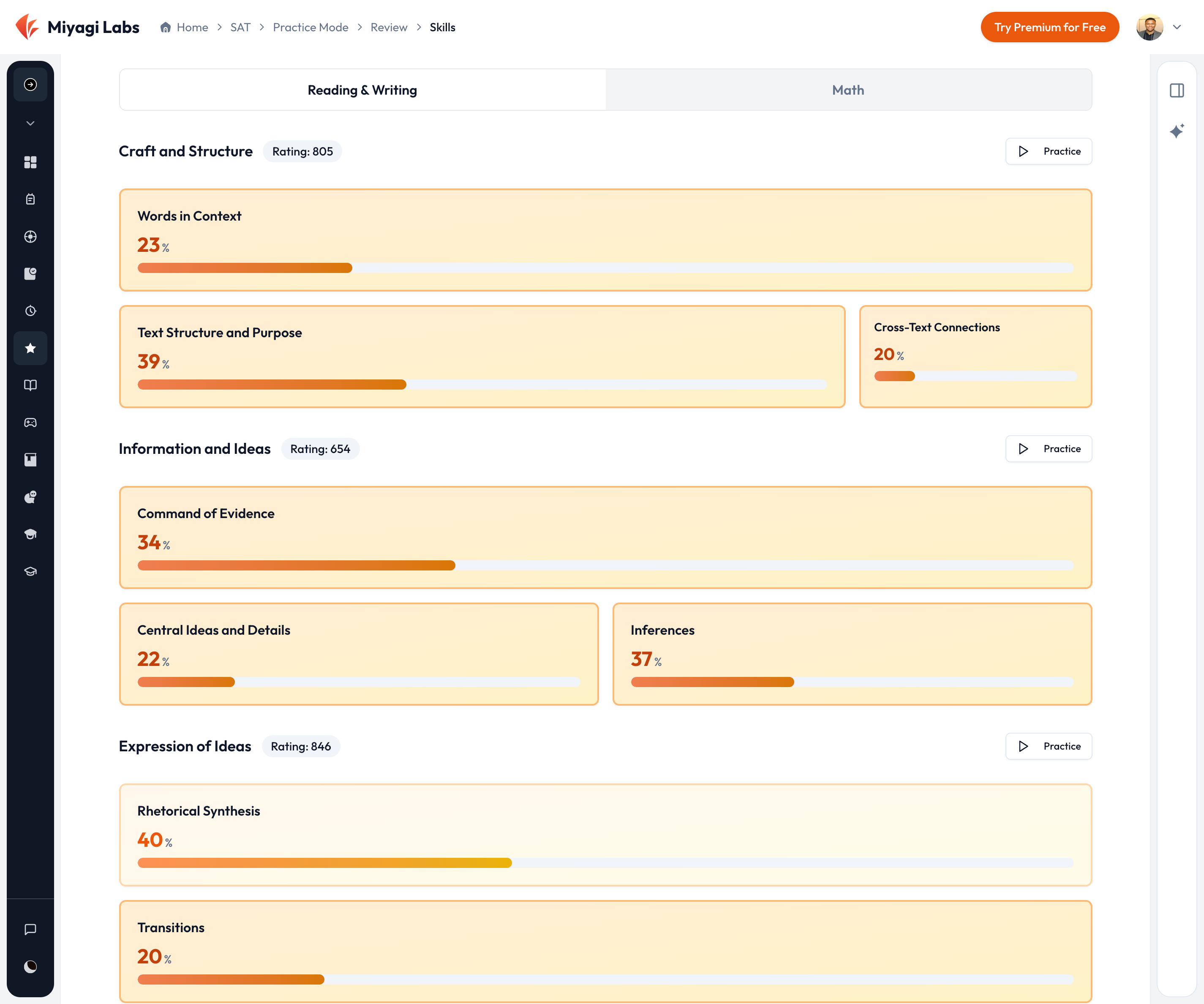
Know Your Starting Point
A study plan works better when it starts with an accurate picture of what you already know.
The Miyagi Labs SAT diagnostic runs 12 adaptive questions per section. Each answer changes what you see next, so a short test can place you far more precisely than a fixed quiz of the same length.
- Your estimated SAT score range
- Strongest Math skills
- Weakest Math skills
- Reading and Writing strengths
- Reading and Writing weaknesses
- Question types that cause the most difficulty
- Areas where targeted practice may have the greatest impact
What Happens After the Diagnostic
- 1
Complete the assessment
Work through a representative set of adaptive Digital SAT questions in Math and Reading and Writing. No time limit, so answer the way you actually think.
- 2
Review your performance
See how you performed by section, skill and question type, with a question-by-question breakdown of what went wrong and why.
- 3
Identify weak areas
Understand which concepts deserve the most attention and which apparent weaknesses were really just one careless mistake.
- 4
Build your next steps
Move into personalized practice, the question bank and study planning built around your results rather than a generic syllabus.
Who Should Take an SAT Diagnostic Test?
A diagnostic can be useful if you are:
- Just starting SAT preparation
- Unsure what score you might currently earn
- Returning to SAT prep after a break
- Preparing for a retake
- Trying to decide where to focus your study time
- Building a personalized SAT study schedule
What the Diagnostic Looks At
Math
Four domains, each reported separately.
- Algebra
- Advanced Math
- Problem-Solving and Data Analysis
- Geometry and Trigonometry
Reading and Writing
Four domains, each reported separately.
- Information and Ideas
- Craft and Structure
- Expression of Ideas
- Standard English Conventions
Turn Your Results Into a Study Plan
Your diagnostic should not end with a score. The score is only useful if it changes what you do the next day.
Identify weak skills
Start from the domains where the diagnostic found the largest gap rather than the ones you enjoy practicing.
See your skill breakdownPractice those skills
Work targeted question sets in the exact domains the diagnostic flagged, then review every explanation.
Practice weak skillsTake a full-length practice test
Once the weak skills have had real attention, measure timing and endurance across a complete exam.
Take a practice testRetest and measure progress
Come back to the diagnostic later in your preparation and compare. That comparison is the real measure of whether your plan is working.
Retake the diagnosticFrequently asked questions
Is the SAT diagnostic test free?
Yes. You can start the diagnostic for free. A free account lets you save your results, revisit the question-by-question breakdown and receive practice recommendations based on what the diagnostic found.
How long does an SAT diagnostic test take?
The diagnostic runs 12 adaptive questions per section, Math and Reading and Writing, and there is no time limit. You can complete one section in a single sitting and come back for the other. Answer naturally rather than rushing: response time is one of the inputs to the estimate.
Is a diagnostic test the same as a full SAT practice test?
No. A diagnostic is designed to identify your current level and skill gaps quickly. A full-length practice test is the better tool for testing timing, endurance and complete exam performance. Most students use the diagnostic first and a full-length test later.
When should I take an SAT diagnostic?
Ideally before you begin a serious study plan, so the plan is built around real weaknesses, and then again later in your preparation to measure whether those weaknesses have actually closed.
What should I do after the test?
Use your results to focus practice on the skills where improvement is most likely. The breakdown shows which domains cost you the most points, and those are the ones worth attacking first.
How accurate is the estimated score?
It is an estimate, not an official College Board score. A short adaptive diagnostic gives you a reliable starting range and a clear picture of your weak skills, which is what a study plan needs.
Start With Your Current Score
You do not need to know exactly what to study before you begin. Take the diagnostic, understand your starting point and build your SAT preparation around the areas that need the most work.