
ACT Math Formulas: 40+ Must-Know Equations (2026 Guide)
Miyagi Labs ·
ACT Math Formulas: 40+ Must-Know Equations (2026 Guide)

TL;DR
The ACT does not provide a formula sheet, so every math formula must come from memory. This guide covers 40+ formulas organized by topic and ranked by how often they appear on the 2026 Enhanced ACT. Algebra and geometry formulas alone cover roughly 70% of the math section. Focus your memorization there first, then layer in coordinate geometry, trigonometry, and the rare advanced formulas only if you’re chasing a top score.
The Enhanced ACT gives you 45 math questions in 50 minutes. That’s about 67 seconds per question. There is no formula sheet. Unlike the digital SAT, which hands you a reference sheet of geometry formulas, the ACT expects everything to come from your head.
This matters more now than it used to. On the Enhanced ACT (the only version available as of 2026), Math is one of just three scored sections, meaning it accounts for 33% of your Composite score instead of the old 25%. A weak math section hurts more than ever.
Below is every ACT math formula worth memorizing, grouped by topic and ranked by how frequently each one actually shows up on test day. If you want to build a study plan around these formulas, explore ACT prep options that include diagnostics and targeted practice.
What Math Formulas Do You Need to Know for the ACT?
The ACT does not provide a general math formula sheet, so students should memorize the essential formulas before test day. The most useful formulas cover algebra, geometry, coordinate geometry, trigonometry, statistics, and probability. Start with the quadratic formula, slope formula, exponent rules, Pythagorean theorem, area and volume formulas, and basic trigonometric ratios. Then review less common topics, such as logarithms, matrices, and combinations, based on your strengths and target score.
Use this guide as a reference: learn what each formula means, practice recognizing when to apply it, and solve timed questions to build recall.
ACT Math Formula Cheat Sheet
Use this quick-reference table to review the core ACT math formulas before working through the detailed explanations below.
Topic | Formula | What it helps you find |
|---|---|---|
Slope | m=y2−y1x2−x1m=\frac{y_2-y_1}{x_2-x_1} | Steepness of a line |
Slope-intercept form | y=mx+by=mx+b | Equation of a line |
Quadratic formula | x=−b±b2−4ac2ax=\frac{-b\pm\sqrt{b^2-4ac}}{2a} | Solutions to a quadratic equation |
Exponent product rule | aman=am+na^m a^n=a^{m+n} | Simplifying powers |
Pythagorean theorem | a2+b2=c2a^2+b^2=c^2 | Finding a missing side of a right triangle |
Triangle area | A=12bhA=\frac12 bh | Area of a triangle |
Circle area | A=πr2A=\pi r^2 | Area of a circle |
Circumference | C=2πrC=2\pi r | Distance around a circle |
Distance formula | d=(x2−x1)2+(y2−y1)2d=\sqrt{(x_2-x_1)^2+(y_2-y_1)^2} | Distance between two points |
Midpoint formula | M=(x1+x22,y1+y22)M=\left(\frac{x_1+x_2}{2},\frac{y_1+y_2}{2}\right) | Midpoint between two points |
Sine | sinθ=oppositehypotenuse\sin\theta=\frac{\text{opposite}}{\text{hypotenuse}} | Right-triangle trigonometry |
Cosine | cosθ=adjacenthypotenuse\cos\theta=\frac{\text{adjacent}}{\text{hypotenuse}} | Right-triangle trigonometry |
Tangent | tanθ=oppositeadjacent\tan\theta=\frac{\text{opposite}}{\text{adjacent}} | Right-triangle trigonometry |
Probability | P(E)=favorable outcomestotal equally likely outcomesP(E)=\frac{\text{favorable outcomes}}{\text{total equally likely outcomes}} | Probability of an event |
Mean | Mean=sum of valuesnumber of values\text{Mean}=\frac{\text{sum of values}}{\text{number of values}} | Average of a data set |
This is a starting list, not a complete substitute for the topic-by-topic guide. Review the full sections for additional formulas, special cases, and explanations of when each equation applies.
Does the ACT Give You a Formula Sheet?
No. The ACT does not provide any formula reference. This is the single biggest difference between ACT math and SAT math for students deciding between the two tests.
Here’s the comparison:
ACT Math (2026) | SAT Math (2024+) | |
|---|---|---|
Formula sheet provided | No | Yes (geometry formulas) |
Questions | 45 | 44 |
Time | 50 minutes | 70 minutes |
Answer choices | 4 | 4 |
Trigonometry | Yes (dedicated category) | Minimal |
Logarithms | Yes | No |
Matrices | Yes | No |
The ACT also tests topics the SAT skips entirely: logarithms, matrices, law of sines and cosines, and more trigonometry. If you’re weighing which test to take, our SAT vs ACT comparison breaks down the full picture.
One reassurance: if a question requires a truly obscure formula, the ACT typically provides it within the problem itself. You won’t need to memorize the volume of an oblate spheroid. But the standard formulas below? Those are on you.
ACT Math Content Breakdown
The Enhanced ACT Math section contains 45 questions to be completed in 50 minutes. The official content framework groups higher-level math into five reporting categories: Number & Quantity, Algebra, Functions, Geometry, and Statistics & Probability. It also assesses essential skills and mathematical modeling.
Here is the official distribution for the higher-math reporting categories:
Reporting category | Approximate share |
|---|---|
Number & Quantity | 10–12% |
Algebra | 17–20% |
Functions | 17–20% |
Geometry | 17–20% |
Statistics & Probability | 12–15% |
The ACT also reports Integrating Essential Skills as approximately 20% and Modeling as at least 20%. These are overlapping reporting dimensions, so they should not be added to the five categories as if all percentages represented separate portions of the test.
For studying, use these categories as a guide rather than a guarantee of how many questions will test a specific formula. Your best priorities are to master foundational algebra, functions, geometry, and essential arithmetic skills before spending extensive time on less familiar advanced topics.
Important: Coordinate geometry is not a separate official reporting category in this framework. Its skills overlap with algebra, functions, and geometry.
Algebra Formulas
Algebra accounts for roughly 11 questions. These formulas are the backbone of ACT math.
Lines and Slope
Formula | Expression | Priority |
|---|---|---|
Slope-intercept form | y = mx + b | Must Know |
Point-slope form | y − y₁ = m(x − x₁) | Must Know |
Standard form of a line | Ax + By = C | Should Know |
Slope formula | m = (y₂ − y₁) / (x₂ − x₁) | Must Know |
Slope-intercept form is probably the single most useful formula on the ACT. You’ll use it to interpret graphs, write equations, and identify parallel or perpendicular lines (same slope = parallel, negative reciprocal slopes = perpendicular).
Quadratics
Formula | Expression | Priority |
|---|---|---|
Quadratic formula | x = (−b ± √(b² − 4ac)) / 2a | Must Know |
Discriminant | D = b² − 4ac | Should Know |
Vertex of a parabola | x = −b / 2a | Should Know |
Difference of squares | a² − b² = (a + b)(a − b) | Must Know |
Perfect square trinomials | a² ± 2ab + b² = (a ± b)² | Should Know |
The discriminant tells you how many real solutions a quadratic has: positive means two, zero means one, negative means none. The ACT loves asking this.
Exponent Rules
These get overlooked on most formula lists but show up repeatedly in pre-algebra and algebra questions.
Rule | Expression | Priority |
|---|---|---|
Product rule | a^m × a^n = a^(m+n) | Must Know |
Quotient rule | a^m / a^n = a^(m−n) | Must Know |
Power rule | (a^m)^n = a^(mn) | Must Know |
Negative exponent | a^(−n) = 1 / a^n | Must Know |
Fractional exponent | a^(m/n) = ⁿ√(a^m) | Should Know |
Zero exponent | a⁰ = 1 (a ≠ 0) | Must Know |
Sequences
Formula | Expression | Priority |
|---|---|---|
Arithmetic sequence | aₙ = a₁ + (n − 1)d | Should Know |
Geometric sequence | aₙ = a₁ × r^(n−1) | Should Know |
The variable “d” is the common difference (add the same number each time), and “r” is the common ratio (multiply by the same number each time). The ACT frequently asks you to find the nth term or identify the pattern.
For practice applying these algebra formulas under timed conditions, the ACT question bank lets you filter by topic and difficulty.
Geometry Formulas
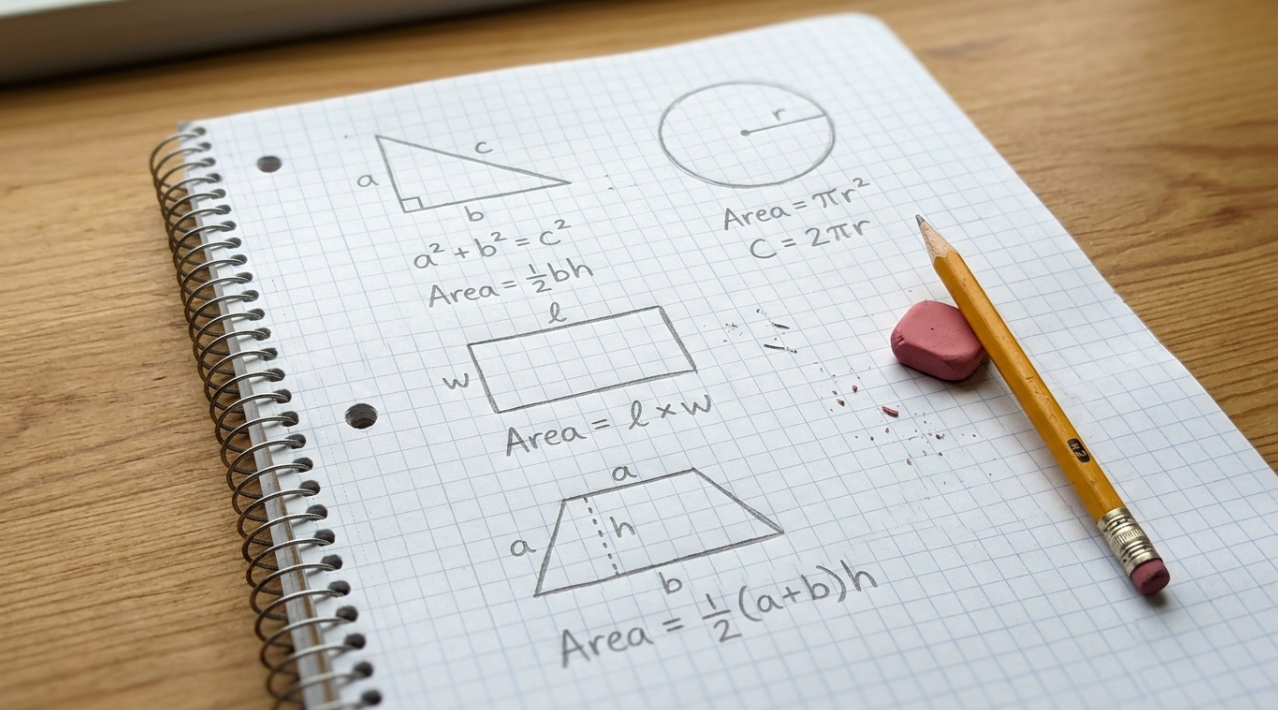
Geometry also accounts for about 11 questions. This is where the lack of a formula sheet hurts the most, because there are more formulas to memorize here than in any other category.
Area Formulas
Shape | Formula | Priority |
|---|---|---|
Triangle | A = ½bh | Must Know |
Rectangle | A = lw | Must Know |
Parallelogram | A = bh | Should Know |
Trapezoid | A = ½(b₁ + b₂)h | Should Know |
Circle | A = πr² | Must Know |
The Pythagorean Theorem and Its Friends
Formula | Expression | Priority |
|---|---|---|
Pythagorean theorem | a² + b² = c² | Must Know |
45-45-90 triangle | sides in ratio 1 : 1 : √2 | Must Know |
30-60-90 triangle | sides in ratio 1 : √3 : 2 | Must Know |
Common triples | 3-4-5, 5-12-13, 8-15-17, 7-24-25 | Should Know |
The Pythagorean theorem might be the single most tested formula on the entire ACT. Special right triangles save you time because you can skip the calculation entirely when you recognize the ratio. The 3-4-5 triple (and its multiples like 6-8-10 and 9-12-15) appears constantly.
Circles
Formula | Expression | Priority |
|---|---|---|
Circumference | C = 2πr (or C = πd) | Must Know |
Arc length | L = (θ/360) × 2πr | Should Know |
Sector area | A = (θ/360) × πr² | Should Know |
Volume
Shape | Formula | Priority |
|---|---|---|
Rectangular prism | V = lwh | Must Know |
Cylinder | V = πr²h | Must Know |
Cone | V = ⅓πr²h | Good to Know |
Sphere | V = (4/3)πr³ | Good to Know |
Surface Area
Shape | Formula | Priority |
|---|---|---|
Rectangular prism | SA = 2(lw + lh + wh) | Should Know |
Cylinder | SA = 2πr² + 2πrh | Good to Know |
Sphere | SA = 4πr² | Good to Know |
Polygon Angles
Formula | Expression | Priority |
|---|---|---|
Interior angle sum | (n − 2) × 180° | Should Know |
Each interior angle (regular polygon) | [(n − 2) × 180°] / n | Should Know |
Concepts That Replace Formulas
Here’s a memorization shortcut that practitioners on Reddit and prep forums frequently recommend. Some “formulas” are really just concepts:
Perimeter is not a formula you need to memorize separately for each shape. Perimeter just means “add up all the sides.” Whether it’s a triangle, rectangle, pentagon, or irregular polygon, you’re doing the same thing. PrepScholar makes this same point: understanding a concept can eliminate the need to memorize multiple formulas.
Surface area works similarly. It’s the total area of all the faces of a 3D shape. If you can find the area of each face and add them up, you don’t strictly need the surface area formulas above (though knowing them saves time).
Coordinate Geometry Formulas
Coordinate geometry covers about 7 questions. These formulas connect algebra to the coordinate plane.
Formula | Expression | Priority |
|---|---|---|
Distance formula | d = √[(x₂ − x₁)² + (y₂ − y₁)²] | Must Know |
Midpoint formula | M = ((x₁ + x₂)/2, (y₁ + y₂)/2) | Must Know |
Equation of a circle | (x − h)² + (y − k)² = r² | Should Know |
Equation of an ellipse | (x − h)²/a² + (y − k)²/b² = 1 | Good to Know |
The distance formula is just the Pythagorean theorem in disguise. If you forget it, draw a right triangle on the coordinate plane, find the horizontal and vertical legs, and apply a² + b² = c². Same answer.
The equation of a circle typically appears as just one question per test. The center is (h, k) and the radius is r. Watch for the signs: (x − 3)² + (y + 2)² = 25 means the center is (3, −2) and the radius is 5.
Desmos and Coordinate Geometry
If you’re taking the digital ACT, you get access to a built-in Desmos graphing calculator during the math section. This changes the game for coordinate geometry. Desmos can graph circle equations, find intersections of lines, and solve systems of equations visually. You still need to recognize what equation form you’re looking at, but the computation side gets easier.
Note that Desmos is only available on the digital ACT. Paper test-takers need their own approved calculator. And the ACT’s version of Desmos disables some advanced functions (sec, cot, arcsec, statistical functions like mad and cov), so don’t count on it for trigonometry shortcuts. For more on graphing calculator strategy, our Desmos tips for the SAT covers transferable techniques.
Trigonometry Formulas
Trigonometry accounts for about 3 to 4 questions out of 45, roughly 7% of the math section. The good news: most of those questions test the same handful of formulas.
Core Trig Ratios (SOHCAHTOA)
Ratio | Definition | Priority |
|---|---|---|
Sine | sin θ = opposite / hypotenuse | Must Know |
Cosine | cos θ = adjacent / hypotenuse | Must Know |
Tangent | tan θ = opposite / adjacent | Must Know |
Reciprocal Functions
Function | Definition | Priority |
|---|---|---|
Cosecant | csc θ = 1 / sin θ | Should Know |
Secant | sec θ = 1 / cos θ | Should Know |
Cotangent | cot θ = 1 / tan θ | Should Know |
Identities and Laws
Formula | Expression | Priority |
|---|---|---|
Pythagorean identity | sin²θ + cos²θ = 1 | Must Know |
Radian-degree conversion | 180° = π radians | Should Know |
Law of Sines | a/sin A = b/sin B = c/sin C | Good to Know |
Law of Cosines | c² = a² + b² − 2ab cos C | Good to Know |
The Pythagorean identity (sin²θ + cos²θ = 1) is the most important trig identity on the ACT. If you only memorize one trig identity, make it this one.
Trig Graph Parameters
When the ACT gives you y = A sin(Bx + C) + D:
Amplitude = |A|
Period = 2π / |B|
Phase shift = −C / B
Vertical shift = D
Priority: Should Know. These show up once or twice per test, and the ACT often asks you to identify the amplitude or period from a graph.
Special Angle Values
Angle | sin | cos | tan |
|---|---|---|---|
0° | 0 | 1 | 0 |
30° | 1/2 | √3/2 | √3/3 |
45° | √2/2 | √2/2 | 1 |
60° | √3/2 | 1/2 | √3 |
90° | 1 | 0 | undefined |
Priority: Should Know. These values come directly from the 30-60-90 and 45-45-90 triangles you already memorized. If you know those triangles, you can derive this entire table on test day.
For extra trig practice, working through ACT practice questions by topic helps you see which formula each question type requires.
Statistics and Probability Formulas
Statistics and probability account for about 4 questions. Most of these are straightforward.
Formula | Expression | Priority |
|---|---|---|
Mean (average) | Sum of values / number of values | Must Know |
Median | Middle value when data is ordered | Must Know (concept) |
Mode | Most frequently occurring value | Must Know (concept) |
Probability | P = favorable outcomes / total outcomes | Must Know |
Percent change | ((new − old) / old) × 100 | Should Know |
Combinations | nCr = n! / (r!(n − r)!) | Good to Know |
Permutations | nPr = n! / (n − r)! | Good to Know |
Median and mode aren’t really “formulas” but rather concepts. Median is the middle value after sorting. Mode is whichever value appears most often. The ACT tests these almost every time.
Combinations and permutations are rare, probably appearing on one test out of three. The key distinction: combinations are for when order doesn’t matter (choosing a committee), permutations are for when order matters (assigning first, second, third place).
Advanced and Low-Frequency Formulas
These formulas appear 0 to 2 times per test. As one popular prep guide puts it, “if you feel overwhelmed with formula lists, don’t worry about these, it’s only one question.” Memorize them only if you’re aiming for a 30+ and have the core formulas locked down.
Logarithms
Formula | Expression | Priority |
|---|---|---|
Log definition | log_b(a) = c means b^c = a | Good to Know |
Product rule | log_b(xy) = log_b(x) + log_b(y) | Good to Know |
Quotient rule | log_b(x/y) = log_b(x) − log_b(y) | Good to Know |
Power rule | log_b(x^n) = n × log_b(x) | Good to Know |
Change of base | log_b(a) = log(a) / log(b) | Good to Know |
The ACT Math Section will usually feature one or two logarithm problems. Understanding the definition (converting between log and exponential form) solves most of them.
Matrices
Operation | What to Know | Priority |
|---|---|---|
Addition | Add corresponding entries | Good to Know |
Scalar multiplication | Multiply every entry by the scalar | Good to Know |
2×2 multiplication | Row × column, sum products | Good to Know |
Matrices fall within the Number & Quantity domain, which represents about 10% to 12% of the enhanced ACT. But that domain also covers complex numbers, exponents, vectors, and numerical reasoning, so a given test may contain very few actual matrix questions.
Other Advanced Formulas
Formula | Expression | Priority |
|---|---|---|
Complex numbers | i² = −1 | Good to Know |
Simple interest | I = Prt | Good to Know |
Absolute value equation | x |
How to Memorize ACT Math Formulas
Knowing which formulas exist is step one. Actually remembering them under pressure is step two. Here’s what works.
Prioritize by Frequency
PrepScholar puts it well: “Sometimes you don’t have the time to memorize all formulas, and that’s OK. You can still be well-prepared for the majority of math questions by memorizing half or even fewer.”
The algebra and geometry formulas tagged “Must Know” above cover approximately 70% of the math section. Start there. If you only have two weeks, that’s where your time goes.
Learn Concepts Where Possible
Not every formula needs to be memorized as a formula. The perimeter example is the clearest case: instead of memorizing separate perimeter formulas for rectangles, triangles, and parallelograms, just remember that perimeter means “add all the sides.” Surface area works the same way: “add the areas of all the faces.”
This concept-over-formula approach reduces your memorization load while actually improving your flexibility on unfamiliar shapes.
Use Spaced Repetition
Flashcards work, but only if you space them out. Review new formulas daily for the first week, then every other day, then twice a week. Apps like Anki automate this. The goal is to move formulas from short-term to long-term memory before test day.
Practice Under Timed Conditions
Memorizing a formula in your bedroom is different from recalling it with a clock ticking. Practitioners on r/ACT consistently recommend “spamming problem sets” as the best way to cement formulas. The act of retrieving a formula under time pressure builds the kind of recall you need on test day. ACT practice tests that simulate real timing are the best way to test whether your memorization is holding up.
Know Your Score Target
If you’re aiming for a 25, the “Must Know” and “Should Know” formulas are enough. The advanced formulas (logarithms, matrices, law of cosines) matter only if you’re pushing for 30+. Students who reported scores in the 33-36 range on r/ACT generally say they had every formula on this page committed to memory, but they also spent months building that foundation.
Wondering where you currently stand? The ACT score predictor can help you identify which categories need the most attention.
A 14-Day ACT Math Formula Study Plan
If you have two weeks to prepare, use this schedule to build formula recall while practicing how to apply each equation.
Days | Focus | What to do |
|---|---|---|
1–2 | Algebra fundamentals | Review slope, linear equations, quadratic equations, and exponent rules. |
3–4 | Geometry | Practice triangle, circle, area, volume, and Pythagorean formulas. |
5–6 | Coordinate geometry and functions | Review slope, distance, midpoint, graph interpretation, and function notation. |
7–8 | Trigonometry | Practice SOHCAHTOA, special right triangles, and essential identities. |
9–10 | Statistics and probability | Review averages, probability, percent change, and counting principles. |
11 | Additional topics | Review logarithms, matrices, and other specialized material relevant to your practice results. |
12 | Mixed practice | Solve questions that require you to choose the appropriate formula without being told which one to use. |
13 | Timed practice | Complete a timed math practice section and record errors. |
14 | Final review | Revisit missed questions, test your recall, and review formulas you still confuse. |
Daily routine: Spend a short session recalling formulas from memory, another session solving problems, and a final session reviewing mistakes. Adjust the time you spend on each topic based on your performance rather than trying to memorize every formula equally.
The goal is not simply to recite equations. It is to recognize the right formula, apply it accurately, and solve the problem within the available time.
ACT Math Formulas vs. SAT Math Formulas
Many students prep for both tests or switch from one to the other. Here’s how the formula requirements differ.
Factor | ACT | SAT |
|---|---|---|
Formula sheet provided | No | Yes (geometry basics) |
Trigonometry | Full category (SOHCAHTOA, identities, laws, graphs) | Minimal (basic ratios only) |
Logarithms | Yes (1-2 questions) | No |
Matrices | Yes (rare) | No |
Law of Sines / Cosines | Yes | No |
Sequences | Arithmetic and geometric | Mostly arithmetic |
Complex numbers | Yes | Rare |
Time per question | ~67 seconds | ~95 seconds |
The shared territory is large: slope, quadratic formula, Pythagorean theorem, area and volume formulas, exponent rules, and basic probability all appear on both tests. If you’ve been prepping for the SAT, you already know most of the “Must Know” ACT formulas. The gaps are in trigonometry, logarithms, and matrices.
For students comparing the two tests, our detailed SAT vs ACT guide covers timing, scoring, and content differences beyond just formulas. And if you want to see the SAT formula list for comparison, the SAT math formulas guide has the full breakdown.
Frequently Asked Questions
Does the ACT give you a formula sheet?
No. The ACT does not provide any formula reference sheet. The SAT provides a short geometry reference, but the ACT expects every formula to come from memory. If a question requires an unusually advanced formula, it will typically be given within the question itself.
How many formulas do you need for the ACT?
About 30 to 40 core formulas cover the vast majority of questions. The “Must Know” tier (roughly 20 formulas) handles about 70% of the math section. Add the “Should Know” tier and you’re prepared for nearly everything.
What is the most important ACT math formula?
The Pythagorean theorem (a² + b² = c²) is arguably the most tested single formula. Close runners-up include the slope formula, the quadratic formula, and the area formulas for triangles and circles. These five formulas alone touch dozens of questions across the test.
Are ACT math formulas the same as SAT formulas?
There’s significant overlap in algebra and geometry, but the ACT tests additional topics the SAT does not cover at all: trigonometric identities and graphs, logarithms, matrices, law of sines, and law of cosines.
Has the Enhanced ACT changed which formulas I need?
The format changed (45 questions in 50 minutes, 4 answer choices, Math is 33% of Composite), but the math content itself hasn’t shifted. You still need the same formulas. The stakes are just higher per question because each one represents a larger share of your score.
Can Desmos replace formula memorization on the digital ACT?
Partially. The built-in Desmos calculator on the digital ACT can graph functions, find intersections, and solve systems visually. This reduces your reliance on some coordinate geometry and algebra computations. But Desmos won’t help with most geometry, trigonometry identities, or logarithm rules. It’s a tool, not a substitute for knowing your formulas.
How should I study ACT math formulas if I only have two weeks?
Focus exclusively on the “Must Know” formulas in algebra and geometry. Use flashcards with spaced repetition, and spend most of your time doing timed practice problems rather than just reviewing the formula list. Applying formulas under time pressure is what builds real recall.
Is it worth memorizing logarithm and matrix formulas?
Only if you’re aiming for a 30+ score. Logarithm questions appear once or twice per test, and matrix questions are even rarer. If you’re feeling overwhelmed, skip these and lock down the high-frequency formulas first.
How many math formulas should I memorize for the ACT?
There is no official number of formulas every student must memorize. Start with foundational algebra, geometry, coordinate geometry, and trigonometry formulas, then review statistics, probability, and other topics covered by the test. Focus on understanding when and how to apply each formula instead of memorizing a fixed number without practicing.
What is the hardest ACT math formula to remember?
There is no single hardest formula for every student. Some students struggle with the quadratic formula, trigonometric identities, or the laws of sines and cosines, while others find coordinate geometry more challenging. Identify your weak areas through practice questions and prioritize formulas you frequently forget or apply incorrectly.
Can I pass ACT Math without memorizing every formula?
You do not need to memorize every mathematical formula that could possibly appear in a problem. The ACT provides formulas within certain questions when a complex or unfamiliar relationship is required. However, you should know foundational formulas and concepts well enough to recognize common problem types and solve them efficiently. The ACT does not provide a general math formula sheet.
Ready to put these formulas to the test? Start your ACT prep with a diagnostic that identifies exactly which formulas and skills you need to focus on, then build a personalized study plan from there.