
SAT Math Formulas: Complete 2026 Guide + Printable PDF
Miyagi Labs ·
SAT Math Formulas: Complete 2026 Guide + Printable PDF

TL;DR
The Digital SAT Math section gives you an official reference sheet with key geometry, triangle, circle, and volume formulas, but it does not provide a complete formula sheet for Algebra, Advanced Math, or Problem-Solving and Data Analysis. Those three domains make up approximately 85% of SAT Math, so knowing the most important formulas and relationships beyond the reference sheet can save time and prevent avoidable mistakes.
This guide covers the SAT Math formulas worth knowing in 2026, including which formulas are provided on test day, which ones you should memorize, when to use them, common mistakes, and where Desmos can make certain calculations faster.
Practice these formulas with SAT-style questions in a filtered question bank.
What SAT Math Formulas Do You Need to Know?
The SAT provides several geometry and measurement formulas on the official Math reference sheet, including circle area and circumference, triangle area, the Pythagorean theorem, special right triangles, and volume formulas. However, the reference sheet does not give you a complete set of formulas for Algebra, Advanced Math, or Problem-Solving and Data Analysis.
For the formulas you should know beyond the reference sheet, prioritize:
Slope: m = (y₂ − y₁)/(x₂ − x₁)
Slope-intercept form: y = mx + b
Point-slope form: y − y₁ = m(x − x₁)
Quadratic formula: x = (−b ± √(b² − 4ac))/(2a)
Discriminant: b² − 4ac
Vertex form: y = a(x − h)² + k
Exponent rules
Exponential growth and decay
Mean, median, and range
Percent change
Ratios and proportions
Probability and conditional probability
Equation of a circle: (x − h)² + (y − k)² = r²
Distance and midpoint formulas
Right-triangle trigonometric ratios: sine, cosine, and tangent
You do not need to memorize every formula equally. The highest priority is understanding the formulas and relationships that are not supplied on test day, while learning to recognize when the reference sheet or Desmos can do the calculation for you.
How the Digital SAT Math Section Works
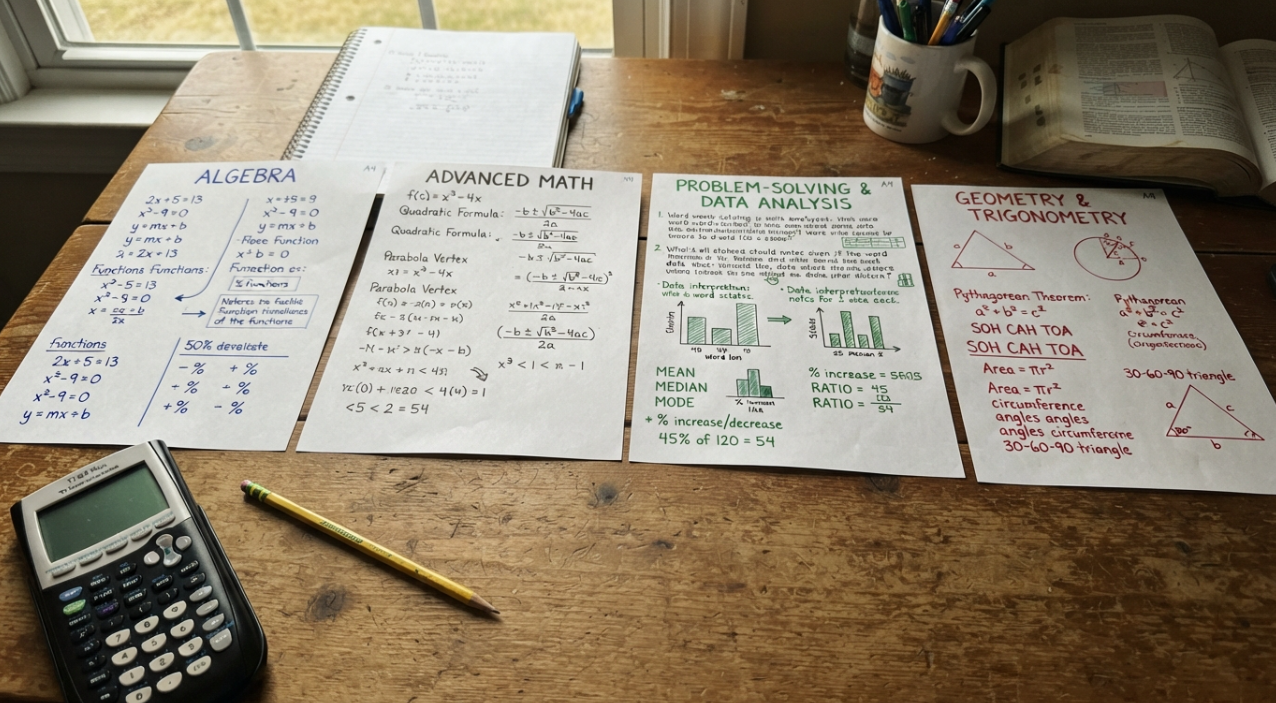
The Digital SAT Math section contains 44 questions divided between two adaptive modules. Each module gives you 35 minutes, for 70 minutes total. Calculator use is permitted throughout the Math section, and the Bluebook testing app includes a built-in calculator.
College Board divides SAT Math into four content domains:
SAT Math Domain | Approx. Share | What to Know |
|---|---|---|
Algebra | 35% | Linear equations, functions, systems, and inequalities |
Advanced Math | 35% | Quadratics, exponentials, polynomials, radicals, and nonlinear functions |
Problem-Solving & Data Analysis | 15% | Ratios, percentages, statistics, probability, and data |
Geometry & Trigonometry | 15% | Area, volume, triangles, trigonometry, and circles |
Algebra and Advanced Math together account for approximately 70% of SAT Math, while all four domains appear across the Math section.
That distribution is important when deciding what to memorize. Do not spend all your study time memorizing geometry formulas that are already available in the reference information. Instead, prioritize the formulas, relationships, and concepts that you must recall or recognize yourself.
For a full breakdown of the test structure, see this guide on the digital SAT format.
SAT Math Formulas Provided on Test Day
Topic | Formula or Relationship | Memorize? |
|---|---|---|
Circle area | A = πr² | Know what it means |
Circle circumference | C = 2πr | Know what it means |
Rectangle area | A = lw | Know what it means |
Triangle area | A = ½bh | Know what it means |
Pythagorean theorem | a² + b² = c² | Know how to use it |
30-60-90 triangle | x : x√3 : 2x | Recognize it |
45-45-90 triangle | x : x : x√2 | Recognize it |
Rectangular prism volume | V = lwh | Use the reference sheet |
Cylinder volume | V = πr²h | Use the reference sheet |
Sphere volume | V = 4/3πr³ | Use the reference sheet |
Cone volume | V = 1/3πr²h | Use the reference sheet |
Pyramid volume | V = 1/3lwh | Use the reference sheet |
Circle angle measure | 360° = 2π radians | Understand the relationship |
Triangle angle sum | 180° | Know how to apply it |
The SAT reference information is intended to help with these calculations, so you do not need to spend most of your memorization time reproducing formulas that will already be available during the test.
Section 1: Formulas the SAT Reference Sheet Gives You
The official SAT math reference sheet appears in both modules of the Digital SAT. You can access it at any time through the Bluebook app. It contains 12 geometry formulas and 3 mathematical facts.
Here is every formula on the reference sheet:
Circle Formulas
Area of a circle: A = πr²
Gives you the area enclosed by a circle with radius r. Shows up on questions about circular gardens, plates, wheels, or any “area of a round region” scenario.
Circumference of a circle: C = 2πr
The distance around a circle. Appears in questions about fencing a circular area, the distance a wheel travels in one rotation, or track problems.
Area Formulas
Area of a rectangle: A = lw
Length times width. Straightforward, but often embedded in multi-step problems involving floors, walls, or fields.
Area of a triangle: A = ½bh
Base times height, divided by two. The height must be perpendicular to the base, which is where students get tripped up on non-right triangles.
The Pythagorean Theorem
a² + b² = c²
Relates the sides of a right triangle, where c is always the hypotenuse (the longest side, opposite the right angle). This formula is everywhere on the SAT: distance problems, coordinate geometry, and of course direct triangle questions.
Special Right Triangles
45-45-90 triangle: sides in the ratio x : x : x√2
An isosceles right triangle. When you see a square’s diagonal or a 45-degree angle, think of this ratio.
30-60-90 triangle: sides in the ratio x : x√3 : 2x
Shows up in equilateral triangle problems (cutting one in half creates a 30-60-90) and in questions paired with trigonometry.
Volume Formulas
Rectangular prism (box): V = lwh
Cylinder: V = πr²h
Sphere: V = (4/3)πr³
Cone: V = (1/3)πr²h
Pyramid: V = (1/3)lwh
Three Mathematical Facts
A circle contains 360 degrees
A circle contains 2π radians
The angles in a triangle sum to 180 degrees
A Word About the Reference Sheet
Having these formulas available is nice, but navigating to the reference sheet on every question eats into your 35 minutes per module. Practitioners on Reddit consistently recommend memorizing circle area, triangle area, and the Pythagorean theorem regardless, since they come up so frequently that looking them up every time becomes a real time drain. Save the reference sheet for the volume formulas you use less often (sphere, cone, pyramid).
Section 2: Algebra Formulas to Memorize (~35% of SAT Math)
Algebra is the backbone of the Digital SAT. These formulas appear constantly, and none of them are on the reference sheet. If you’re going to prioritize one section of SAT math formulas for memorization, start here.
Slope Formula
m = (y₂ − y₁) / (x₂ − x₁)
Calculates the steepness of a line between two points. The SAT loves giving you two points and asking for the slope, or giving you the slope and one point and asking for the other.
Common pitfall: Mixing up the order of subtraction. Always subtract in the same direction for both x and y coordinates.
Slope-Intercept Form
y = mx + b
The most common form of a linear equation on the SAT. Here, m is the slope and b is the y-intercept (where the line crosses the y-axis). When a question asks “what does the number 3 represent in the equation,” they’re testing whether you can identify slope vs. intercept in context.
Point-Slope Form
y − y₁ = m(x − x₁)
Useful when you know a point on the line and the slope. The SAT often gives you a table of values and a slope, expecting you to construct the equation. This form is faster than slope-intercept when you don’t know the y-intercept.
Standard Form of a Line
Ax + By = C
Less intuitive but shows up regularly, especially in systems-of-equations problems. To find the slope from standard form: m = −A/B.
Parallel and Perpendicular Lines
Parallel lines have identical slopes.
Perpendicular lines have slopes that are negative reciprocals of each other (if one slope is 2/3, the perpendicular slope is −3/2).
Trigger pattern: When the SAT says “perpendicular to” or “parallel to,” it’s almost always testing these relationships. Flip and negate for perpendicular. Copy for parallel.
Systems of Linear Equations
Two equations, two unknowns. Solve by substitution or elimination.
One solution: The lines intersect (different slopes)
No solution: The lines are parallel (same slope, different y-intercepts)
Infinite solutions: The lines are identical (same slope, same y-intercept)
Trigger pattern: When the SAT asks for “a value of a such that the system has no solution,” set the slopes equal and the y-intercepts unequal.
Desmos shortcut: Graph both equations and read the intersection point. This is often faster than algebra, especially on messy numbers. Learn how in this Desmos systems lesson.
Linear Inequalities
The rules are the same as equations with one critical exception: flip the inequality sign when multiplying or dividing by a negative number. Students forget this under time pressure more than almost any other rule.
Section 3: Advanced Math Formulas to Memorize (~35% of SAT Math)
Advanced Math requires the most formula memorization of any domain, with roughly 17 formulas covering quadratics, exponents, polynomials, and functions. As one SAT tutor charging $285/hr noted on Gumroad, “The SAT is becoming more and more conceptual, rewarding understanding over memorization.” True, but you still need the formulas as tools for that understanding.
The Quadratic Formula
x = (−b ± √(b² − 4ac)) / 2a
For any quadratic equation in the form ax² + bx + c = 0, this formula gives you the solutions (also called roots or zeros).
Common pitfall: Sign errors. The formula has a negative b up front, a subtraction inside the square root, and a 2a in the denominator (not just 2). Write it out carefully every time.
Desmos shortcut: Type the quadratic into Desmos and read the x-intercepts directly. For a walkthrough, see this lesson on finding zeros with Desmos.
The Discriminant
D = b² − 4ac
This is the expression under the square root in the quadratic formula, and it tells you how many real solutions exist:
D > 0: two distinct real solutions
D = 0: exactly one real solution (a repeated root)
D < 0: no real solutions
Trigger pattern: Whenever the SAT asks “how many solutions does the equation have” or “for what value of k does the equation have no real solutions,” go straight to the discriminant. This is one of the highest-frequency formulas on the entire test.
Vertex Form
y = a(x − h)² + k
The vertex of the parabola is at the point (h, k). If a is positive, the parabola opens upward and k is the minimum value. If a is negative, it opens downward and k is the maximum.
Common pitfall: The formula says (x − h), so if you see y = (x + 3)², the vertex is at x = −3, not x = 3.
You can also read the vertex from Desmos graphs by clicking on the turning point of the parabola.
Factoring Patterns
Difference of squares: a² − b² = (a + b)(a − b)
Perfect square trinomials: a² + 2ab + b² = (a + b)² and a² − 2ab + b² = (a − b)²
These save enormous time. When you see x² − 49, recognize it instantly as (x + 7)(x − 7) instead of using the quadratic formula.
Exponent Rules
Rule | Formula |
|---|---|
Product rule | xᵃ · xᵇ = xᵃ⁺ᵇ |
Quotient rule | xᵃ / xᵇ = xᵃ⁻ᵇ |
Power rule | (xᵃ)ᵇ = xᵃᵇ |
Negative exponent | x⁻ᵃ = 1/xᵃ |
Fractional exponent | x^(a/b) = ᵇ√(xᵃ) |
These rules appear in roughly a third of Advanced Math questions. The fractional exponent rule is especially important because the SAT likes to present expressions like x^(3/2) and ask you to rewrite them as radical expressions, or vice versa.
Exponential Growth and Decay
y = a(1 + r)^t (growth) or y = a(1 − r)^t (decay)
Where a is the initial amount, r is the rate (as a decimal), and t is time.
Trigger pattern: “A population increases by 5% each year” translates to y = a(1.05)^t. “A car loses 12% of its value annually” becomes y = a(0.88)^t.
Compound Interest
A = P(1 + r/n)^(nt)
P = principal, r = annual rate, n = times compounded per year, t = years. This is a specific application of exponential growth. The SAT tests it in word problems about savings accounts or investments.
Function Notation
f(x) just means “the output when you plug x into function f.” Composition, written as f(g(x)), means you plug g(x) into f. The SAT tests this in both abstract and real-world contexts.
Polynomial Remainder Theorem
If you divide a polynomial f(x) by (x − a), the remainder is f(a). This means that if f(a) = 0, then (x − a) is a factor of the polynomial.
Trigger pattern: “What is the remainder when f(x) is divided by (x − 3)?” Just calculate f(3).
Section 4: Problem-Solving & Data Analysis Formulas (~15% of SAT Math)
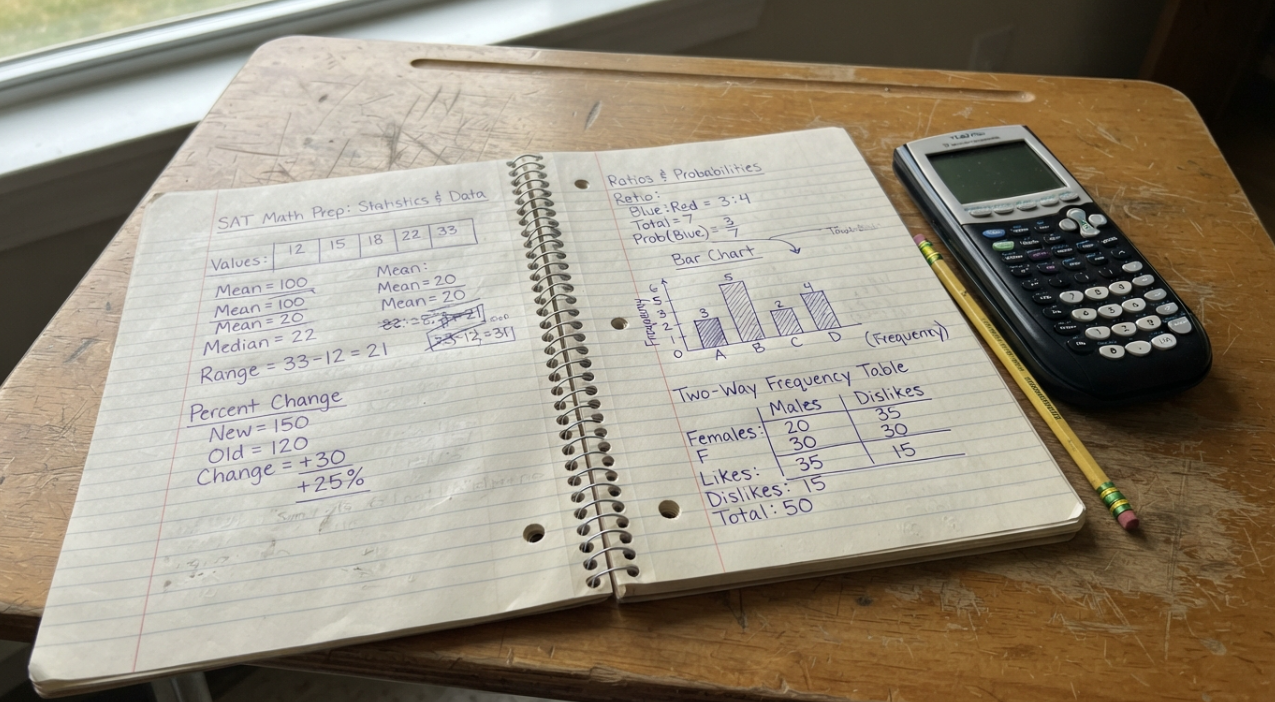
This domain covers statistics, probability, ratios, and real-world quantitative reasoning. It accounts for a smaller share of questions but represents some of the easiest points on the test if you know the formulas.
Mean (Average)
Mean = sum of values / number of values
Rearranged: sum = mean × count. This rearranged form is what the SAT actually tests. “If the average of 5 numbers is 12, what is their sum?” Answer: 60.
Median
The middle value when data is ordered from least to greatest. For an even number of values, average the two middle numbers.
Desmos shortcut: Type your data as a list [3, 7, 2, 9, 5] and use median() and mean() functions to compute both instantly. This is covered in the Desmos list statistics lesson. Practitioners on Reddit note that finding a value that makes the mean equal the median is “a bit tedious with algebra but a snap with Desmos.”
Range
Range = maximum value − minimum value
Simple but often asked alongside mean and median in combined data-interpretation questions.
Standard Deviation
You will not need to calculate standard deviation on the SAT. You need to understand the concept: it measures how spread out data is from the mean. A larger standard deviation means more spread. The SAT asks comparison questions (“Which data set has a greater standard deviation?”) rather than calculation questions.
Percent Change
Percent change = ((new − old) / old) × 100
Common pitfall: Dividing by the new value instead of the old value. Always divide by the original.
Ratios and Proportions
a/b = c/d, solved by cross-multiplication: ad = bc.
Shows up in scale drawings, similar figures, and unit rate problems.
Probability
Probability = favorable outcomes / total outcomes
The SAT often presents two-way frequency tables and asks for conditional probability: “Given that a person is male, what is the probability they prefer brand A?” Restrict your total to only males, then count the favorable outcome.
Unit Conversion and Rates
Rate = distance/time or amount/time
The SAT loves multi-step unit conversion problems. Use dimensional analysis: set up fractions so units cancel. For example, converting miles per hour to feet per second requires multiplying by (5280 ft / 1 mile) and (1 hour / 3600 seconds).
Section 5: Geometry & Trigonometry Formulas Beyond the Reference Sheet (~15% of SAT Math)
The reference sheet covers basic geometry, but several critical SAT math formulas for this domain are missing from it. These you have to memorize.
Equation of a Circle
(x − h)² + (y − k)² = r²
Center at (h, k), radius r. The SAT frequently gives you a circle equation in expanded form (like x² + y² + 6x − 4y = 12) and expects you to complete the square to find the center and radius.
Common pitfall: Forgetting to square the radius. If the equation shows (x − 3)² + (y + 1)² = 25, the radius is 5, not 25.
Desmos shortcut: Type the equation directly into Desmos and it graphs the circle. You can read the center and estimate the radius visually. See the Desmos circle lesson for more.
Arc Length
Arc length = (θ/360) × 2πr (using degrees)
The fraction of the circle’s circumference covered by a central angle θ.
Sector Area
Sector area = (θ/360) × πr²
Same logic, but applied to area. Both arc length and sector area questions require you to think proportionally: what fraction of the full circle does the angle represent?
Similar Triangles
If two triangles are similar, their corresponding sides are proportional. Set up a proportion: side₁/side₂ = side₃/side₄.
Trigger pattern: When you see two triangles sharing an angle, or a line parallel to one side of a triangle, think similar triangles.
Midpoint Formula
Midpoint = ((x₁ + x₂)/2, (y₁ + y₂)/2)
Averages the coordinates. Simple, but frequently tested in coordinate geometry problems.
Distance Formula
d = √((x₂ − x₁)² + (y₂ − y₁)²)
This is really just the Pythagorean theorem applied to a coordinate plane. If you forget the distance formula, you can always draw a right triangle between the two points and use a² + b² = c².
SOH-CAH-TOA
sin(θ) = opposite / hypotenuse
cos(θ) = adjacent / hypotenuse
tan(θ) = opposite / adjacent
These trigonometric ratios apply to right triangles. The SAT nearly always presents these in a right-triangle context, though occasionally in word problems involving angles of elevation.
Complementary Angle Identity
sin(x) = cos(90° − x)
If two angles add up to 90°, the sine of one equals the cosine of the other. This shows up as a direct question (“If sin(30°) = 0.5, what is cos(60°)?”) or embedded in more complex problems.
Radian-Degree Conversion
degrees × (π/180) = radians
radians × (180/π) = degrees
Key benchmarks to memorize: 180° = π radians, 90° = π/2, 60° = π/3, 45° = π/4, 30° = π/6.
How to Study SAT Math Formulas Effectively
Knowing what the formulas are is step one. Actually retaining them under test-day pressure is step two. Here’s what works.
Prioritize by Domain Weight
Start with algebra and advanced math formulas. They cover 70% of all questions and the reference sheet won’t help you with a single one. Magoosh’s prep team puts it well: “Spend your memorization energy where there is no net.” The geometry formulas on the reference sheet are your safety net. Focus your limited study time on the domains where that net doesn’t exist.
Use the Triage Method
Princeton Review recommends categorizing formulas into tiers: “Must Understand” (formulas that make questions possible to solve) vs. “Nice to Understand” (formulas that provide another approach alongside tools like Desmos). This prevents you from spending equal time on every formula when some appear ten times more often than others.
For students scoring around 600 who want to break 700, the highest-impact formulas to lock in are slope-intercept form, the discriminant, percent change, and the quadratic formula. Students already in the 700s pushing for 800 should focus on the less common formulas: polynomial remainder theorem, sector area, and the complementary angle identity.
Daily Flashcards Beat Cramming
With consistent flashcard practice, most students can memorize all essential SAT math formulas in about two weeks. The key is daily review. Fifteen to twenty minutes per day is far more effective than a four-hour cram session the weekend before the test. Space out your repetitions and focus on the formulas you keep getting wrong.
Use Desmos Strategically
The built-in Desmos graphing calculator can effectively replace memorization for certain formula applications. Systems of equations? Graph both lines and read the intersection. Quadratic zeros? Type the equation and tap the x-intercepts. Mean and median? Use the list functions.
That said, Desmos is a supplement, not a substitute for understanding. Knowing the formulas helps you set up the Desmos input correctly and interpret the output.
Practice Under Timed Conditions
Memorizing formulas in isolation is different from applying them under a 35-minute clock. Take full-length practice exams to find out which formulas you actually fumble during real test conditions. Those are the ones to drill harder.
For a complete study roadmap, check out this digital SAT study guide.
Quick-Reference Summary Table
Formula | Domain | On Reference Sheet? | Priority |
|---|---|---|---|
A = πr² | Geometry | Yes | Memorize anyway |
C = 2πr | Geometry | Yes | Memorize anyway |
A = ½bh | Geometry | Yes | Memorize anyway |
a² + b² = c² | Geometry | Yes | Memorize anyway |
45-45-90 ratios | Geometry | Yes | Review for recognition |
30-60-90 ratios | Geometry | Yes | Review for recognition |
V = lwh (prism) | Geometry | Yes | Use reference sheet |
V = πr²h (cylinder) | Geometry | Yes | Use reference sheet |
V = (4/3)πr³ (sphere) | Geometry | Yes | Use reference sheet |
V = (1/3)πr²h (cone) | Geometry | Yes | Use reference sheet |
V = (1/3)lwh (pyramid) | Geometry | Yes | Use reference sheet |
Slope: m = (y₂−y₁)/(x₂−x₁) | Algebra | No | Essential |
y = mx + b | Algebra | No | Essential |
y − y₁ = m(x − x₁) | Algebra | No | Essential |
Ax + By = C | Algebra | No | Essential |
Parallel/perpendicular slopes | Algebra | No | Essential |
Systems of equations | Algebra | No | Essential |
Quadratic formula | Advanced Math | No | Essential |
Discriminant (b²−4ac) | Advanced Math | No | Essential |
Vertex form: y = a(x−h)²+k | Advanced Math | No | Essential |
Difference of squares | Advanced Math | No | Essential |
Exponent rules (all) | Advanced Math | No | Essential |
Exponential growth/decay | Advanced Math | No | Essential |
Compound interest | Advanced Math | No | 700+ level |
Polynomial remainder theorem | Advanced Math | No | 800 level |
Mean = sum/count | Data Analysis | No | Essential |
Percent change | Data Analysis | No | Essential |
Probability | Data Analysis | No | Essential |
(x−h)²+(y−k)²=r² | Geometry/Trig | No | Essential |
Arc length and sector area | Geometry/Trig | No | 700+ level |
Distance formula | Geometry/Trig | No | Essential |
Midpoint formula | Geometry/Trig | No | Essential |
SOH-CAH-TOA | Geometry/Trig | No | Essential |
sin(x) = cos(90°−x) | Geometry/Trig | No | 700+ level |
Radian-degree conversion | Geometry/Trig | No | Essential |
Ready to find out which formula areas are holding your score back? Take a free SAT diagnostic to identify your weak spots, then drill them with targeted practice.
Frequently Asked Questions
How many formulas does the SAT give you on test day?
The official reference sheet provides 12 geometry formulas plus 3 mathematical facts (about degrees, radians, and triangle angle sums), for a total of about 13 items. These cover circles, triangles, rectangles, the Pythagorean theorem, special right triangles, and volume formulas for five 3D shapes. No algebra, advanced math, or data analysis formulas are provided.
What SAT math formulas should I memorize first?
Start with algebra and advanced math. These two domains account for about 70% of all SAT math questions and receive zero support from the reference sheet. Specifically, prioritize slope-intercept form, the quadratic formula, the discriminant, and exponent rules. These appear on nearly every test.
Can Desmos replace memorizing SAT math formulas?
Partially. The built-in Desmos calculator can solve systems of equations by graphing, find quadratic zeros and vertices visually, and compute mean and median using list functions. But you still need to know how to set up problems correctly, and some formulas (like percent change or the discriminant conditions) require conceptual understanding that Desmos can’t provide. Think of Desmos as a powerful backup, not a complete replacement.
How long does it take to memorize all SAT math formulas?
With daily flashcard practice of 15 to 20 minutes, most students can memorize all essential formulas in about two weeks. The key is consistency rather than marathon sessions. Focus each review on the formulas you’re weakest on, and test yourself under timed conditions to make sure you can recall them under pressure.
Are the SAT math formulas different for the Digital SAT vs. the old paper SAT?
The formula content is essentially the same. The reference sheet on the Digital SAT contains the same geometry formulas that appeared on the paper test. The difference is in how you access it: on the Digital SAT, the reference sheet is built into the Bluebook app and available throughout both math modules with a single click, rather than printed at the top of a section in a physical test booklet.
Which SAT math formulas do students forget most often?
Based on community discussions and tutor feedback, the three formulas students most commonly forget or misapply are the quadratic formula (sign errors with the negative b), the equation of a circle (forgetting to square the radius or misreading the signs for h and k), and the discriminant conditions (confusing which value of D corresponds to zero, one, or two solutions).
Do I need to know calculus formulas for the SAT?
No. The SAT does not test calculus. The most advanced math you’ll encounter involves quadratics, polynomials, exponential functions, and basic trigonometry. If you’ve completed Algebra II, you have the mathematical background for every formula on this list.
Is memorizing formulas enough to get a high SAT math score?
No. Memorizing formulas is necessary but not sufficient. The SAT is fundamentally a test of mathematical reasoning. Most questions require you to recognize which concept applies, translate a word problem into an equation, and then solve efficiently. Formulas are the tools, but knowing when and how to use each one is what separates a 600 from a 750.