
Best AP Study Resources (2026): 12 Tools Ranked
Miyagi Labs ·
Best AP Study Resources (2026): 12 Tools Ranked

TL;DR
About 40% of AP test-takers score a 1 or 2, earning zero college credit. The right study resources change that outcome dramatically. No single tool covers everything, so the best approach is stacking two or three resources: one for content review, one for practice questions, and one for free-response scoring. This guide breaks down 12 AP study resources by price, coverage, strengths, and honest limitations so you can build the right combination without overspending.
At-a-Glance Comparison Table
| Resource | Price | Type | Subjects | Best For | Free Option |
|---|---|---|---|---|---|
| AP Classroom | Free | Official platform | All 42 | Official practice questions | ✅ Full access with enrollment |
| Khan Academy | Free ($4/mo for Khanmigo) | Video + exercises | 12+ AP courses | Concept learning (math/science) | ✅ |
| Fiveable | $79/yr or $29/mo | All-in-one platform | All 42 | Multi-AP students, FRQ practice | Limited |
| Albert.io | $79/subject | Question bank | 30+ | School-funded drilling | Trial only |
| UWorld | $34–$169/subject | QBank + courses | 15 | Exam-difficulty STEM practice | 7-day trial |
| Princeton Review | $27.99/book | Review book + tutoring | Most subjects | Structured review + practice tests | No |
| Barron’s | ~$18–22/book | Review book | Most subjects | Deep content review | No |
| 5 Steps to a 5 | ~$21–22/book | Review book | Most subjects | Phased study plan | No |
| Knowt | Free ($1.99/mo+) | Flashcards | AP-aligned | Vocab-heavy subjects | ✅ |
| Quizlet | Free ($35.99–44.99/yr) | Flashcards | Community sets | Largest flashcard library | ✅ (limited) |
| Heimler’s History | Free | YouTube | APUSH/World/Euro/Gov | History AP review | ✅ |
| Miyagi Labs | Free trial; $14.99–$39.99 | AI-powered platform | SAT/ACT | SAT/ACT prep alongside APs | ✅ Practice tests |
How We Evaluated These Resources
Every resource in this list was assessed on six criteria: alignment to actual AP exam formats, breadth of subject coverage, transparent pricing, volume of practice questions, quality of free-response question (FRQ) support, and what real students say about using it.
The most important takeaway before reading any individual entry: you need a stack, not a single tool. AP Classroom gives you official questions but not enough of them. Khan Academy teaches concepts beautifully but doesn’t organize around exam formats. Review books provide structure but can’t grade your free responses. The best AP study resources work together. Think of it as layers: content review, question bank drilling, and FRQ feedback.
This “stack” concept echoes how effective standardized test prep works too, where a diagnostic identifies gaps and then targeted tools fill them.
Best Free AP Study Resources
1. AP Classroom (College Board)
Best for: Getting official, exam-aligned practice as your baseline starting point.
Price: Free with AP course enrollment
AP Classroom is the only source of official College Board questions, AP Daily videos, Personal Progress Checks, and released FRQs. If you’re enrolled in an AP course, you already have access. Start here because nothing else matches the exact format, wording, and difficulty calibration of the real exam.
Key features:
- Personal Progress Checks for each unit
- AP Daily video lessons aligned to the Course and Exam Description
- Released FRQs from prior years
- Topic questions and practice exams
Limitations:
- Only about 100 to 200 practice questions per AP course, which is not enough for mastery
- Progress Checks tend to be easier than the real exam
- FRQ feedback depends entirely on whether your teacher grades them and how thoroughly
- Practitioners note that AP Classroom “handles the school side of an AP course well and is usually not enough on its own for exam prep”
The question volume problem is real. If you’ve worked through every AP Classroom question for your subject by February, you still have three months of prep ahead with no new official material. That’s why supplementing is not optional for most students.
2. Khan Academy
Best for: Learning AP concepts from scratch, especially in math and science courses.
Price: Free; Khanmigo AI tutor costs $4/month or $44/year
Khan Academy partnered with the AP Program to offer free instructional videos, articles, and practice exercises for courses including AP Calculus, Statistics, US History, World History, Biology, Chemistry, Physics, and more. The instruction quality is genuinely excellent, particularly for conceptual understanding.
Key features:
- Comprehensive video lessons with worked examples
- Practice exercises with instant feedback
- Articles that break down difficult topics
- Khanmigo AI tutor for personalized help at $4/month
Limitations:
- Practice isn’t organized around the AP exam’s specific format
- No FRQ grading or rubric-based feedback
- Khanmigo is not available outside the US for family accounts
- As one tutor put it: “Use Khan to learn the concept, then practice it at exam difficulty on a site built for that”
Khanmigo deserves specific mention. In testing with students over 8 weeks, it showed a 23% improvement in concept retention. At $4 per month, it’s dramatically cheaper than human tutoring at $30 to $100 per hour. But it’s an add-on for understanding, not a replacement for exam-format drilling.
For students who also use Khan for SAT or ACT prep, it’s worth understanding where its AP instruction ends and exam-specific practice needs to begin.
3. Heimler’s History (YouTube)
Best for: Free, efficient review for AP History and Government courses.
Price: Free on YouTube
Among AP students in online communities, Heimler’s History is “basically essential for APUSH and AP World.” Created by an AP teacher, the videos are structured around the actual exam units and skills, not general history content. Students consistently trust these videos for last-minute AP Gov review and concept reinforcement.
Key features:
- Unit-by-unit video coverage for APUSH, AP World History, AP Euro, and AP Gov
- Exam-specific tips and writing frameworks
- Short, focused videos (usually under 10 minutes)
Limitations:
- Only covers history and government APs
- No practice questions or FRQ grading
- Passive watching doesn’t build exam skills without active follow-up practice
Don’t stop at Heimler. Other YouTube creators consistently outperform paid platforms for specific subjects: Tyler DeWitt and Professor Dave Explains for AP Chemistry, and Bozeman Science for AP Biology. These free resources are undervalued in most listicles about the best AP study resources, but forum discussions repeatedly cite them as more effective than expensive platforms for conceptual clarity.
4. Knowt
Best for: Active recall drilling for vocabulary-heavy AP subjects like Psychology, Biology, and History.
Price: Free version with substantial features; Plus and Ultra plans start from $1.99/month
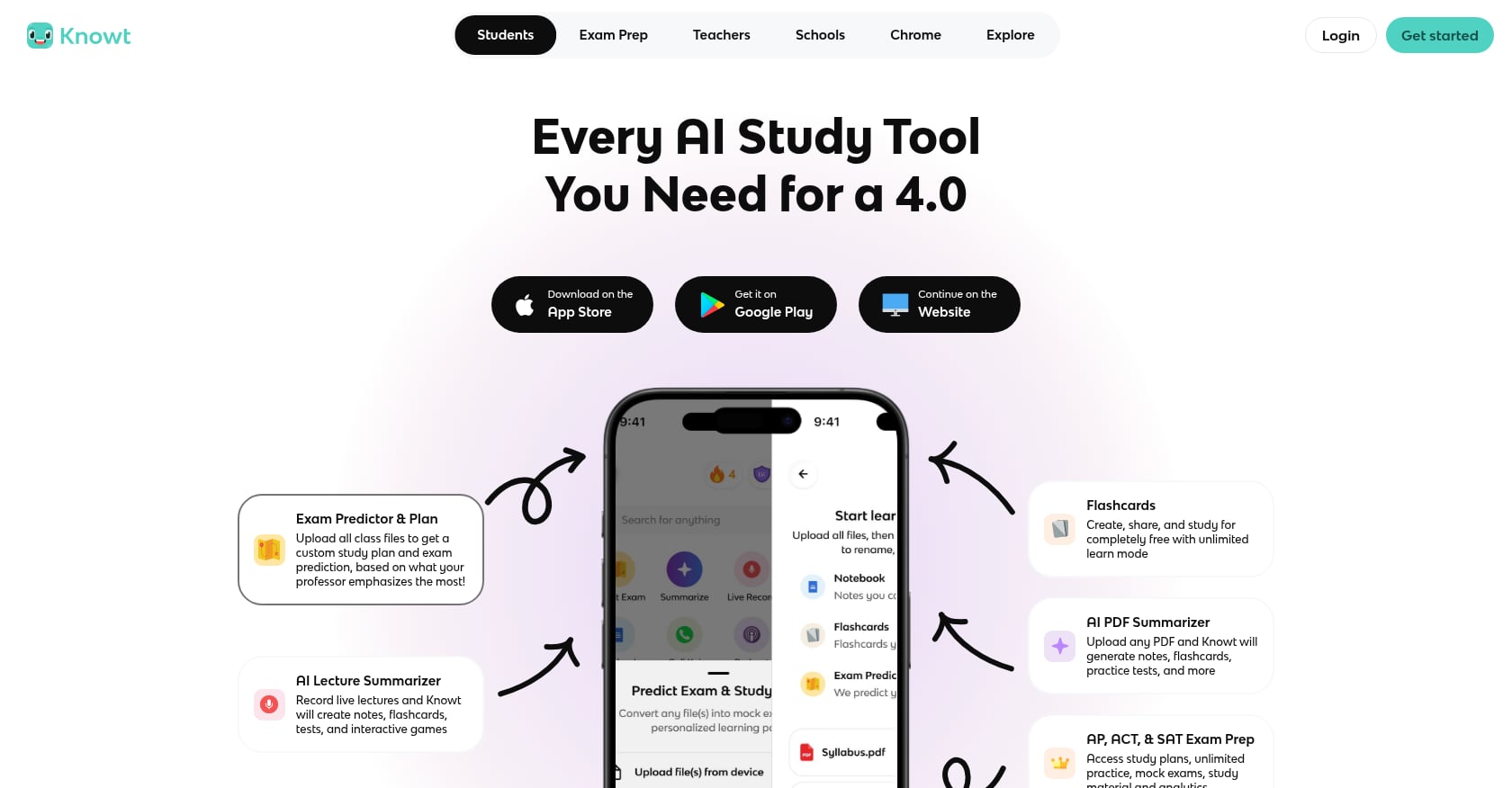
Knowt is an AI-powered flashcard app that has quietly become the go-to recommendation for AP flashcard study. It supports one-click Quizlet import (useful since Quizlet has restricted its free tier) and generates practice questions from your flashcard sets.
Key features:
- AI-generated practice questions from flashcard content
- Free Learn mode with spaced repetition
- One-click import of existing Quizlet sets
- AP-aligned study sets available
Limitations:
- It’s a flashcard tool, not comprehensive exam prep
- No FRQ practice or full-length exams
- AI-generated questions can occasionally miss nuance
Practitioners note that “Knowt is the better pick if what you need is flashcards” and “is the better option in 2026” compared to Quizlet for students on a budget.
Best Paid AP Study Platforms
This is where the best AP study resources start to diverge sharply in value depending on how many AP courses you’re taking. Pay attention to the per-subject versus all-access pricing distinction.
1. Fiveable
Best for: Students taking 2+ AP courses who want one subscription covering everything, including rubric-scored FRQ practice.
Price: $79/year or $29/month, covering all 42 AP subjects with no per-subject pricing
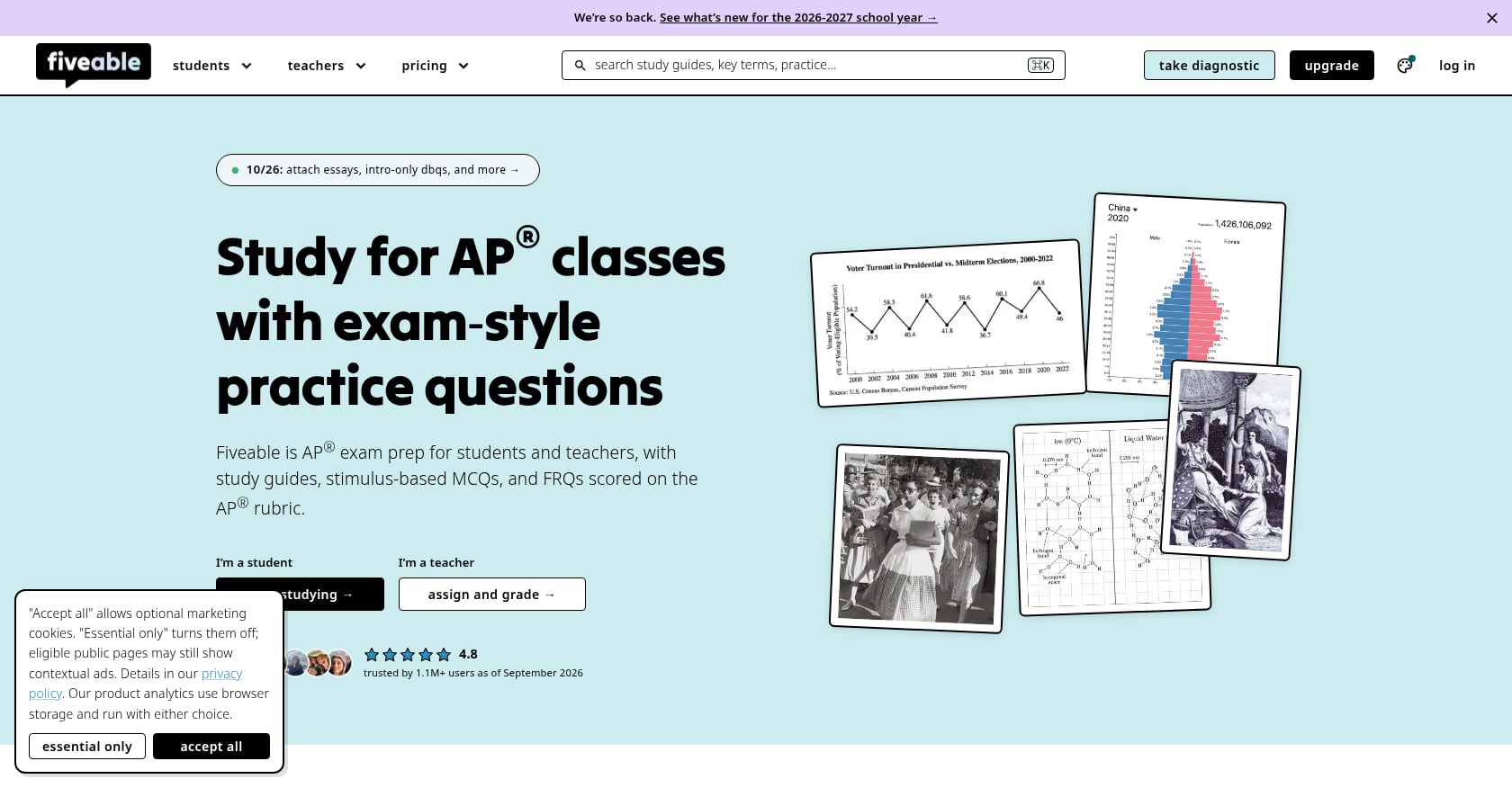
Fiveable’s value proposition is straightforward: $79 a year covers every AP subject you’re taking. If you’re juggling four AP classes, it costs the same as if you were taking one. The platform includes study guides organized by unit, practice questions, full-length practice exams, score calculators, and (critically) graded FRQs.
Key features:
- Unit-by-unit study guides for all 42 AP subjects
- Rubric-level free-response scoring
- Full-length practice exams
- AP score calculators
- Progress tracking across subjects
Limitations:
- The free tier is limited; meaningful access requires the paid subscription
- Content depth varies by subject (popular subjects like APUSH have more material than niche ones)
The FRQ scoring is what makes Fiveable stand out. A student may earn an A in class and still miss half the points on the AP free-response section because the class covered the right topics but not enough mixed, timed practice. Most tools focus on multiple choice; FRQ feedback is genuinely hard to get without a teacher or a platform built for it.
2. Albert.io
Best for: Students whose school has a site license, or students focusing on one specific AP subject where they need intensive MCQ drilling.
Price: $79 per subject for self-pay access; schools pay approximately $18 per student per year for full access
Albert has deep question banks with detailed explanations across 30+ AP subjects. The questions are demanding and well-written. The problem is purely economic.
Key features:
- Extensive question banks for 30+ AP subjects
- Detailed answer explanations
- Progress tracking and performance analytics
- Teacher assignment features (school license)
Limitations:
- At $79 per subject, a student preparing for three AP exams pays approximately $237 in subject access alone
- Practitioners on Reddit describe Albert as “horribly expensive” without institutional funding
- No FRQ grading (MCQ-focused)
- Trial access is very limited
The math here matters. Albert at $79 per subject versus Fiveable at $79 per year for all 42 subjects is a massive gap for multi-AP students. If your school has a site license, Albert is excellent and essentially free to you. If you’re self-paying for multiple subjects, the cost is hard to justify.
3. UWorld
Best for: STEM students who want exam-difficulty practice questions with thorough answer explanations.
Price: AP QBanks range from $34 (60-day) to $64 (360-day) per subject; prep books are $49/subject; full courses range from $99 (30-day) to $169 (360-day). Students save 20% when purchasing three or more QBanks.
UWorld made its name on professional exam prep (think medical boards and nursing exams), and its AP question banks follow the same philosophy: hard multiple choice questions with rationales that walk through the reasoning on every answer choice, including why wrong answers are wrong.
Key features:
- Exam-difficulty questions that often exceed the real test’s difficulty level
- Detailed explanations for every answer choice
- Performance tracking and analytics
- Video lessons and digital study guides
- 7-day free trial available
Limitations:
- Only 15 AP subjects (no languages, arts, Physics C, or AP Precalculus)
- Per-subject pricing adds up for students taking many APs
- Overkill for subjects where conceptual review matters more than question drilling
If you’re taking AP Calculus, AP Biology, AP Chemistry, or AP Physics and want to be over-prepared for the multiple choice section, UWorld is the strongest question bank available.
Best AP Review Books
Review books remain relevant in 2026 because they offer something digital platforms don’t: a single, structured path from content review through practice exams, organized for offline study. The three major series each serve a different study style.
1. Princeton Review Premium Prep
Best for: Students who want the most practice tests per book and a structured review plan.
Price: $27.99 per book; AP Self-Paced Study Hub at $299; AP 5 Tutoring at $250/hour with a score guarantee
Princeton Review books typically include 5 to 7 practice tests per subject, online flashcard access, and suggested study plans. The content review is solid if not exhaustive.
Key features:
- 5-7 practice tests per subject (including online)
- Content review with strategy tips
- Online flashcards and supplementary materials
- Score-5 guarantee tutoring option (full refund if you score 3 or below, 25% refund for a score of 4)
Limitations:
- Books alone won’t provide FRQ feedback
- The guarantee tutoring at $250/hour is prohibitively expensive for most families
- Some subjects have thinner coverage than others
2. Barron’s
Best for: Students who want the deepest, most exhaustive content review in a single volume.
Price: Approximately $18 to $22 per book
Barron’s study manuals are known for their breadth and depth. They go deeper into content than Princeton Review, sometimes covering edge cases that other books skip. The tradeoff is that they can feel dense.
Key features:
- Comprehensive content review that goes beyond exam basics
- 3-6 practice tests per book (including online)
- Detailed answer explanations
- Strong reputation in STEM subjects
Limitations:
- Dense writing style that can overwhelm some students
- Less emphasis on test-taking strategy compared to Princeton Review
- No digital platform or interactive features
3. 5 Steps to a 5 (McGraw-Hill)
Best for: Students who want a defined, phased study plan from September through exam day.
Price: Approximately $21 to $22 per book
The organizing principle here is the five-step progression: set up your study program, determine your readiness, develop strategies, review the knowledge, and build your confidence. Its staged organization works well for students who prefer a defined progression rather than jumping between chapters.
Key features:
- Five-phase study plan with clear milestones
- Content review organized by exam weight
- Practice tests with scoring guides
- Digital flashcards
Limitations:
- Content review is less thorough than Barron’s
- The phased approach doesn’t help students who start late
- Practice test volume is lower than Princeton Review
Best Flashcard and Community Tools
1. Quizlet
Best for: Students who want access to the largest library of community-made AP study sets.
Price: Free plan available; paid plans at $35.99 to $44.99/year
Quizlet still has the largest library of user-created flashcard sets for AP subjects. In March 2026, Quizlet integrated with ChatGPT, allowing users to generate study materials from notes, conversations, or recorded lectures. That’s a meaningful upgrade.
Key features:
- Millions of community-created AP study sets
- ChatGPT integration for generating custom study materials
- Learn mode with AI-powered study tools
- Multiple study modes (flashcards, tests, matching)
Limitations:
- Quality varies dramatically by set creator (some community sets contain errors)
- Free tier has increasingly restrictive limits on study modes
- More expensive than Knowt for similar core functionality
Best AI-Powered Study Tools for AP Students
1. Miyagi Labs
Best for: AP students who are simultaneously preparing for the SAT or ACT and want AI-guided practice that adapts to their skill level.
Price: Free practice tests and trial available; Unlimited Access tiers at $14.99 and $39.99
Here’s something most AP study resource guides ignore: the vast majority of AP students are also preparing for the SAT or ACT. The content overlap is substantial. AP English Language work directly strengthens SAT Reading and Writing performance. AP math courses cover ground that appears on both the SAT and ACT. AP science knowledge gives you a real advantage on ACT Science.
Miyagi Labs is built around an AI-first workflow: take a diagnostic, get a personalized study path, practice with 10,000+ expert-reviewed questions, use a 24/7 AI tutor for explanations, and track improvement with score prediction analytics. That diagnostic-to-practice loop is the same approach that works for AP prep.
Key features:
- Diagnostic tests that identify specific strengths and weaknesses
- Personalized study paths based on diagnostic results
- 10,000+ expert-reviewed SAT/ACT questions
- 24/7 AI tutor for on-demand explanations
- Full-length timed practice exams
- Score predictor and progress analytics
Limitations:
- Focused on SAT/ACT, not AP-specific content
- Some users in Reddit discussions have noted question accuracy concerns for certain sections
- Relatively new platform compared to established incumbents
If you want to see how your AP coursework has already strengthened your standardized test readiness, take a free SAT diagnostic to identify exactly where you stand.
How to Build Your AP Study Stack (by Budget)
No single resource among the best AP study resources covers everything. Here’s how to combine them at four budget levels.
The $0 Stack (Free)
AP Classroom + Khan Academy + Heimler’s History (or subject-specific YouTube) + Knowt flashcards. This covers official practice, concept instruction, video review, and active recall. The gap: limited FRQ feedback and not enough practice questions for mastery.
The $80/Year Stack
Everything above + Fiveable ($79/year). This adds rubric-scored FRQ practice, 42-subject coverage, and full-length practice exams. For most students taking 2 to 5 APs, this is the sweet spot.
The $150/Year Stack
Everything above + one UWorld QBank for your hardest AP subject (~$39) + one Princeton Review or Barron’s book (~$22). This gives you exam-difficulty drilling where you need it most, plus a structured offline review resource.
The Premium Stack
Add Khanmigo ($44/year) for AI-powered concept help + Miyagi Labs for SAT/ACT practice tests and diagnostics. This stack addresses both AP exams and standardized tests.
Cost Comparison: 3 APs on Different Platforms
| Approach | Cost for 3 APs |
|---|---|
| Free stack only | $0 |
| Fiveable (all-access) | $79 |
| Albert.io (self-pay) | $237 |
| UWorld (3 QBanks, 360-day) | $154 (with 20% multi-purchase discount) |
| 3 Princeton Review books | $84 |
The difference is stark. A student who doesn’t research pricing could easily spend over $300 on Albert alone, while Fiveable covers all 42 subjects for $79.
Why Your AP Prep Also Helps Your SAT/ACT Score
This connection is real but rarely discussed in AP study guides. AP English Language and Composition builds exactly the reading comprehension and rhetorical analysis skills tested on the SAT Reading and Writing section. AP Calculus and Statistics cover math concepts that appear on both the SAT and ACT. AP Biology, Chemistry, and Physics develop the data interpretation skills that drive ACT Science scores.
The overlap means your AP study hours aren’t just earning you college credit. They’re also raising your standardized test ceiling. The catch is that AP courses teach content while standardized tests reward format-specific strategy and pacing. You need both.
If you want to understand exactly where your current knowledge leaves gaps, a personalized SAT study plan can map your strengths to the specific sections where more practice will gain you the most points. For students deciding between the two major tests, our breakdown of SAT vs. ACT differences helps identify which exam plays to your strengths.
Why AP Pass Rates Make Resource Choice Critical
Consider the 2026 College Board data. AP Calculus AB has a 65% pass rate. AP Statistics sits at 62%. AP Biology comes in at 71%, while AP Chemistry hits 75%. AP Calculus BC leads core subjects at 82%, with 46% of students scoring a 5.
But the headline number is this: roughly 40% of students who take AP exams score a 1 or 2, earning no college credit at all. That’s nearly half of all test-takers walking away empty-handed.
The difference between a 2 and a 3 often comes down to FRQ performance. A student may earn an A in class and still miss half the points on the free-response section because the class covered the right topics but not enough mixed, timed practice. That’s the gap the right resources fill.
With College Board now offering 42 AP subjects (including the newest AP Career Kickstart courses, AP Business with Personal Finance and AP Cybersecurity, starting in 2026-27), picking the right study tools matters more than ever.
FAQ
What is the best free website for AP study?
AP Classroom is the best free starting point because it’s the only source of official College Board questions. Pair it with Khan Academy for concept instruction and Heimler’s History (YouTube) for history courses. Knowt rounds out the free stack with AI-powered flashcards. Together, these four free resources cover content review, official practice, video instruction, and active recall.
Is AP Classroom enough to get a 5?
For most students, no. AP Classroom provides roughly 100 to 200 practice questions per course, and the Progress Checks tend to be easier than the actual exam. Students aiming for a 4 or 5 typically need additional practice questions at exam difficulty and, critically, FRQ practice with rubric-based feedback that AP Classroom doesn’t provide on its own.
How much should I spend on AP prep?
You can prep effectively for free using AP Classroom, Khan Academy, YouTube creators, and Knowt. Adding Fiveable at $79/year is the highest-value paid upgrade because it covers all 42 subjects and includes FRQ scoring. A student taking 3 to 5 APs can build a strong study stack for under $100 total. Avoid per-subject pricing traps (like Albert at $79/subject) unless your school provides a site license.
Can AP study help my SAT or ACT score?
Yes, substantially. AP English builds SAT Reading and Writing skills. AP math courses cover SAT and ACT math content. AP science develops the data interpretation tested on ACT Science. The main difference is that standardized tests reward pacing and format-specific strategy, so you still need dedicated test prep. A free SAT diagnostic test can show you exactly where your AP knowledge already gives you an advantage.
What is the biggest gap in AP prep that students miss?
Free-response question practice. Most resources and most classes focus heavily on multiple choice, but FRQs make up a significant portion of AP exam scoring. Without timed, rubric-scored FRQ practice, students who know the content can still lose major points on exam day. Fiveable is currently the best platform for addressing this gap at a reasonable price.
Which AP subjects have the hardest exams?
Based on 2026 pass rates, AP Music Theory has the lowest pass rate at 59%, followed by AP Statistics at 62% and AP Calculus AB at 65%. On the other end, AP Research has a 90% pass rate and AP Calculus BC hits 82%. Difficulty varies not just by subject but by how well your resources match the exam’s specific demands.
Should I use a review book or an online platform?
Both, ideally. Review books give you structured, offline content review and practice tests. Online platforms provide adaptive question banks, progress tracking, and (in some cases) FRQ scoring that books can’t offer. The combination of a $20 review book and a $79 Fiveable subscription covers more ground than either alone.
Do I need different resources for different AP subjects?
Sometimes. For STEM subjects (Calculus, Chemistry, Physics, Biology), UWorld’s question banks and Khan Academy’s video instruction are particularly strong. For History and Government, Heimler’s History on YouTube is arguably more effective than any paid platform. For vocabulary-heavy subjects like AP Psychology, Knowt flashcards are essential. The best AP study resources for you depend on which subjects you’re taking and where your gaps are.