
How Long Is the ACT? 2026 Timing, Breaks & Test Day Guide
Miyagi Labs ·
How Long Is the ACT? 2026 Timing, Breaks & Test Day Guide

TL;DR
The Enhanced ACT takes 2 hours and 5 minutes for its three required sections: English, Math, and Reading. Adding the optional Science section increases testing time to 2 hours and 45 minutes. The optional Writing section adds another 40 minutes.
However, testing time is not the same as the time you spend at the test center. You also need to account for check-in, instructions, and scheduled breaks. Depending on which sections you take and whether you test online or on paper, your total test-day schedule will be longer.
This guide explains how long each ACT section takes, when breaks happen, when you can expect to finish, and how the Enhanced ACT compares with the legacy ACT and the SAT.
Quick answer: How long is the ACT in 2026?
The Enhanced ACT takes 2 hours and 5 minutes for English, Math, and Reading. The optional Science section adds 40 minutes, bringing testing time to 2 hours and 45 minutes. The optional Writing section adds another 40 minutes. Including check-in, instructions, and breaks, plan to spend several hours at the test center. Your exact departure time depends on your test format and the sections you take.
Before you start planning around timing, it helps to know where you currently stand. Take a free ACT practice test to see how the new pacing actually feels.
ACT Section-by-Section Time Breakdown
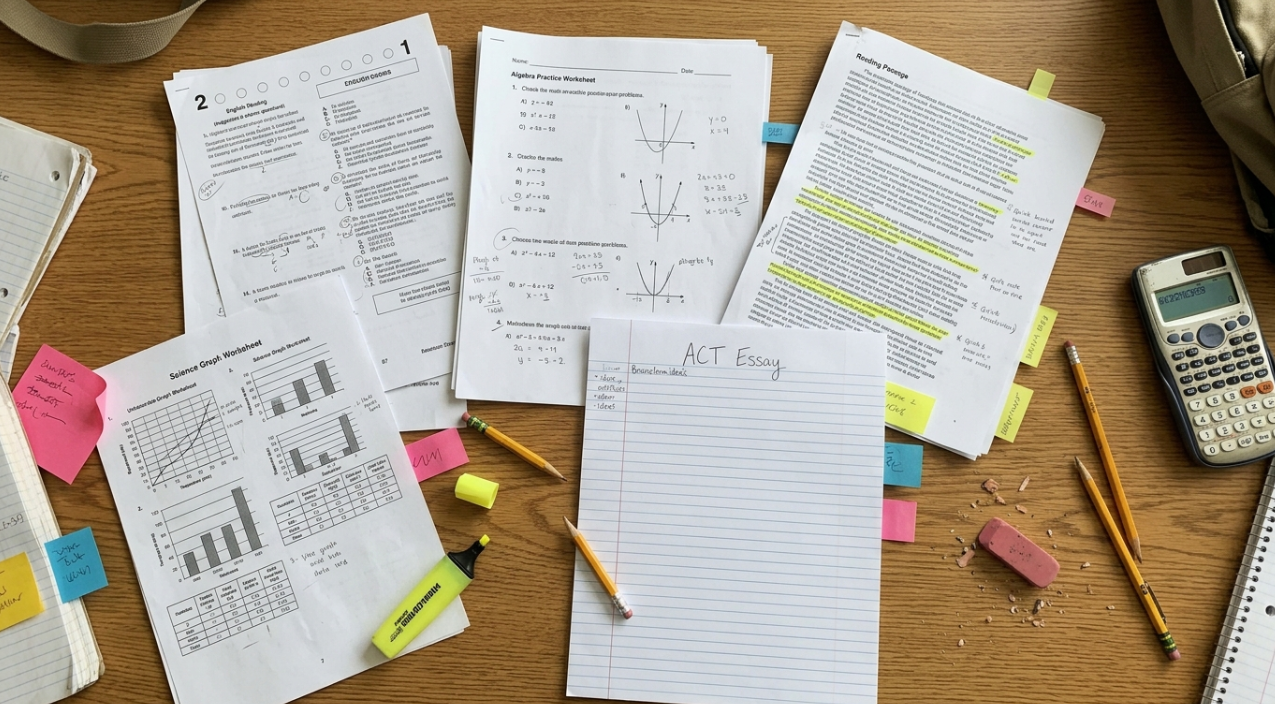
The Enhanced ACT has three required sections and two optional sections. Each section has a fixed time limit, so understanding the pacing can help you plan your preparation.
ACT section | Questions or tasks | Time limit | Average time per question | Required? |
|---|---|---|---|---|
English | 50 | 35 minutes | 42 seconds | Yes |
Math | 45 | 50 minutes | 67 seconds | Yes |
Reading | 36 | 40 minutes | 67 seconds | Yes |
Science | 40 | 40 minutes | 60 seconds | No |
Writing | 1 essay | 40 minutes | Not applicable | No |
Core ACT total | 131 | 125 minutes (2h 5m) | — | — |
Core + Science | 171 | 165 minutes (2h 45m) | — | — |
Core + Writing | 131 questions/tasks | 165 minutes (2h 45m) | — | — |
All sections | 171 questions + 1 essay | 205 minutes (3h 25m) | — | — |
Question totals include embedded field-test items that do not count toward your score. The Writing test is an essay, not a multiple-choice question.
English has the fastest average pace at approximately 42 seconds per question. Math and Reading allow about 67 seconds per question, while Science allows approximately 60 seconds.
These figures are averages, not recommended time limits for every individual question. Some questions take only a few seconds, while others require more reading or calculation. Practice with a timer to learn when to move on and when to return to a difficult question.
The ACT also includes embedded field-test questions that do not contribute to your score. You will not know which questions are experimental during the test, so answer every question as carefully as possible.
These per-question numbers matter more than the total time. Students who practice under timed conditions consistently outperform those who only do untimed review. If you want to build that pacing muscle, working through ACT practice questions section by section is the most direct way to do it.
One detail that no other timing guide mentions: roughly 17% of the items on the Enhanced ACT are experimental “field test” questions that don’t count toward your score. That means out of 171 total items (if you take Science), only about 142 are operational. You won’t know which ones are experimental, so you still need to answer everything seriously. But it does mean the ACT is testing fewer scoreable concepts than the raw question count suggests.
How Long Is the ACT With Breaks?
The ACT takes longer than its official testing time because students must complete check-in, listen to instructions, and take scheduled breaks.
The standard schedule includes a break after the second test, Math, and an additional five-minute break before Writing for students taking that optional section. ACT guidance also prohibits students from leaving the supervised test area or going to their cars during the scheduled break.
Test configuration | Testing time | What to plan for |
|---|---|---|
English, Math, and Reading | 2h 5m | Testing time plus check-in and the scheduled break |
Core ACT + Science | 2h 45m | Core schedule plus 40 minutes for Science |
Core ACT + Writing | 2h 45m | Core schedule plus 40 minutes for Writing and its additional break |
Core ACT + Science + Writing | 3h 25m | All five sections, scheduled breaks, and check-in |
Testing time does not include every part of the test-day schedule. The exact time you spend at the test center depends on whether you take the ACT online or on paper, how long check-in takes, and which optional sections you complete.
If you are deciding whether to add Science or Writing, consider both the extra testing time and the admissions requirements of your target colleges.
How Long Are You at the Test Center?
The total time you spend at the ACT test center includes check-in, identification checks, instructions, testing, and breaks. For most standard morning administrations, ACT asks students to arrive by 8:00 a.m. Late arrivals cannot be admitted.
The following published ending times illustrate how the schedule differs by test format:
Test configuration | Online testing: published end time | Paper testing: published end time |
|---|---|---|
Core ACT | 11:05 a.m. | 11:25 a.m. |
Core ACT + Science | 11:55 a.m. | 12:15 p.m. |
Core ACT + Writing | 12:00 p.m. | 12:30 p.m. |
Core ACT + Science + Writing | 1:00 p.m. | 1:30 p.m. |
These are ACT's published schedule estimates, not a guarantee of the exact time you will leave. Check your test-day instructions and follow the schedule provided by your test center.
What should you do before arriving?
Arrive by the time specified in your admission instructions.
Bring your required identification and admission information.
Eat breakfast before check-in rather than relying on a break for a full meal.
Follow the test center's rules about food, drinks, electronic devices, and restroom use.
Arrange transportation with some flexibility in case the testing session runs later than expected.
If you have not registered yet, review the ACT's official test dates and registration deadlines before choosing your test date.
If you haven’t yet registered, check our guide to ACT test dates and deadlines so you can plan around your school calendar.
Enhanced ACT vs. Legacy ACT: What Changed?
The Enhanced ACT changed the number of questions, section timing, and whether Science is required for the Composite score. These changes explain why older ACT preparation books and online guides may show different test lengths.
Metric | Legacy ACT | Enhanced ACT |
|---|---|---|
Required Composite sections | English, Math, Reading, and Science | English, Math, and Reading |
Core testing time | 2h 55m | 2h 5m |
Questions in the core Composite sections | 215 | 131 |
Science | Required for the traditional Composite | Optional |
Math answer choices | 5 per question | 4 per question |
Average time per question across the core sections | About 49 seconds | About 57 seconds |
The Enhanced ACT reduces core testing time by 50 minutes and reduces the number of questions in the core sections from 215 to 131. That is approximately 29% less testing time and 39% fewer questions.
However, the comparison needs context. The legacy ACT included Science as part of its Composite, while the Enhanced ACT uses English, Math, and Reading for its Composite. The new core-only test is therefore not a direct comparison of identical section combinations.
The Enhanced ACT still assesses college-readiness skills, but students should use current-format practice materials rather than relying exclusively on older tests with different question counts and timing.
On paper, that’s a 28% reduction in core testing time and a 39% reduction in total question count. Students get roughly 18% more time per question, about 9 extra seconds per item. Sounds great, right?
The “Shorter but Harder” Reality
Here’s what most timing guides won’t tell you. Experts at Applerouth, a well-known tutoring firm, took the Enhanced ACT firsthand and reported that “the increase in difficulty seemed to offset any advantage provided by having additional time.” The reason: ACT removed the easy warm-up questions that used to appear at the beginning of each section.
On the legacy Math section, for example, the first 15 questions were straightforward. The Enhanced ACT effectively lopped off those easy items and “shortened the on-ramp” to more advanced material. You’re dealing with harder content from the very first question.
There’s also a framing issue worth understanding. The headline “75 minutes shorter” is technically true, but only because Science moved from required to optional. Applerouth points out that when you compare the first three sections directly, the Enhanced ACT is only 15 minutes shorter. If you take the optional Science section, the total test is just 10 minutes shorter than the legacy version.
The practical takeaway: you still need serious preparation. The test is shorter, not easier. Students aiming for scores in the 30+ range should focus on targeted practice with harder questions rather than assuming the extra seconds will save them.
Build a personalized ACT study plan that accounts for the Enhanced format’s higher difficulty floor.
The Fatigue Advantage Is Real
One genuinely positive change: the shorter test reduces late-test fatigue. Practitioners at North American Tutors report that the Enhanced ACT ends before the point where the old format’s fatigue typically began affecting scores. For students in the 24 to 30 score band, fatigue on the legacy ACT often cost 1 to 2 composite points on Reading and Science. That tax is largely gone now.
As a Kaplan test prep expert put it, the ACT “won’t be quite the marathon it has been.”
Based on results from more than 100 students who took the Enhanced ACT early, Applerouth found that scores largely matched legacy ACT results with no major surprises. The format felt “familiar, smoother, and shorter, but not necessarily easier.”
ACT vs. SAT: Which Test Is Longer?

The Enhanced ACT takes 2 hours and 5 minutes for its three required sections, while the digital SAT takes 2 hours and 14 minutes. That makes the ACT nine minutes shorter in testing time, before accounting for breaks.
Metric | Enhanced ACT (core) | Digital SAT |
|---|---|---|
Testing time | 2h 5m | 2h 14m |
Total questions | 131 | 98 |
Main sections | English, Math, Reading | Reading and Writing, Math |
Average time per question across the whole test | About 57 seconds | About 82 seconds |
Scheduled break | After Math, following the first two ACT tests | 10 minutes between Reading and Writing and Math |
The SAT gives students more average time per question, but that figure does not mean every SAT question is easier or that every ACT question must be answered within the same amount of time. The exams differ in structure, content, and question types.
If you prefer working quickly through shorter questions, the ACT's pacing may suit you. If you prefer having more average time to work through each question, the SAT may be worth considering.
Neither test is automatically better for every student. Compare the subjects, question formats, and timing using official practice materials before deciding which test to take.
For a more detailed comparison of test content, scoring, and preparation, read our SAT vs. ACT guide and try our free SAT practice tests to experience the SAT's pacing.
ACT Extended Time: How Long With Accommodations?
Students approved for ACT testing accommodations may receive additional time or other adjustments based on their documented needs. The exact arrangement depends on the accommodation approved by ACT and the applicable testing procedures.
For students approved for 50% additional time on the multiple-choice sections, the standard section limits become:
ACT section | Standard time | Time with 50% extra |
|---|---|---|
English | 35 minutes | 52.5 minutes |
Math | 50 minutes | 75 minutes |
Reading | 40 minutes | 60 minutes |
Science (optional) | 40 minutes | 60 minutes |
Writing (optional) | 40 minutes | 60 minutes |
For the three required sections, 50% additional time increases total testing time from 2 hours and 5 minutes to 3 hours and 7 minutes 30 seconds. Breaks, instructions, and check-in add more time to the overall testing schedule.
How do you request ACT accommodations?
Review ACT's current accessibility and accommodations requirements.
Work with your school's designated accommodations coordinator, where applicable.
Submit the required documentation and request through the applicable ACT process.
Confirm the approved testing arrangement before test day.
Do not assume that accommodations approved for another exam automatically apply to the ACT. Confirm your eligibility, deadlines, and arrangements with ACT and your school.
Should You Take the Optional ACT Science Section?
The ACT Science section is optional in the Enhanced ACT format and adds 40 minutes of testing. Whether you should take it depends on your college plans and whether a Science score is useful for your applications.
Before deciding, consider three factors:
College requirements: Check whether your target colleges require, recommend, or consider the ACT Science score.
Your application strategy: Determine whether a Science score could provide useful additional information for your intended major or application.
Your preparation: Consider whether you have enough time to prepare for Science without compromising your performance on the required sections.
Do not assume that every college treats optional Science in the same way. Admissions policies can differ by institution and program, so verify the current requirements on each college's official admissions website.
Is the ACT Science section required for the Composite score?
No. The Enhanced ACT Composite score is based on English, Math, and Reading. Science is an optional section and does not contribute to the Composite score under the Enhanced format.
If you’re unsure where you stand, an ACT score predictor can help you estimate your composite and decide whether the optional sections are worth the additional time investment.
How to Prepare for ACT Timing
Knowing how long the ACT is only matters if you can actually perform under those time constraints. Here are concrete pacing strategies based on how the Enhanced ACT is structured.
English (42 seconds per question): This is the fastest section. You can’t afford to reread passages multiple times. Practice reading a paragraph once and answering all associated questions before moving on. If a question takes more than 45 seconds, mark it and come back.
Math (67 seconds per question): The removal of easy warm-up questions means you’ll hit medium-difficulty problems immediately. Don’t waste time on the hardest 5 to 7 questions if you’re not confident. Answer everything else first, then return. With only 4 answer choices instead of 5, your guessing odds improved from 20% to 25%.
Reading (67 seconds per question): With 36 questions across multiple passages, you have roughly 8 minutes per passage including its questions. Some students read the full passage first; others skim and refer back. Find what works for you during practice, not on test day.
Science (60 seconds per question, if taking it): Science is data interpretation, not content recall. Practice reading graphs, tables, and experimental descriptions quickly. The clock is tight, but the questions often have clear answers once you find the right data point.
For a complete study approach that covers timing, content, and score improvement strategy, our guide to studying for the ACT walks through everything step by step.
FAQs
How long is the ACT without Writing?
The ACT without Writing takes 2 hours and 5 minutes for the three required sections (English, Math, Reading). With the 10-minute break, your seat time is about 2 hours and 15 minutes. If you add optional Science but skip Writing, the total is 2 hours and 45 minutes of testing.
How long is the ACT with all sections?
Taking every section (English, Math, Reading, Science, and Writing) requires 3 hours and 25 minutes of testing time. With breaks, expect about 3 hours and 40 minutes of seat time. Including check-in and administrative overhead, plan for roughly 5 hours at the test center.
Is the ACT shorter than the SAT?
Yes, by 9 minutes of total testing time (2h 5m vs. 2h 14m for core sections). However, the SAT gives about 82 seconds per question compared to the ACT’s 57 seconds, so the SAT feels less rushed despite being slightly longer overall.
How long is the ACT with extended time?
The most common accommodation, time-and-a-half, extends the core ACT to approximately 3 hours and 8 minutes. With breaks and check-in, plan for about 4 hours at the test center. Double time requires Special Testing arrangements and may be spread across multiple days.
How many questions are on the ACT?
The three required sections contain 131 questions total: 50 English, 45 Math, and 36 Reading. Adding optional Science brings the count to 171. The legacy ACT had 215 required questions, so the Enhanced format is significantly leaner.
Is the Enhanced ACT easier because it’s shorter?
Not really. While there are fewer questions and slightly more time per question, expert tutors who took the test firsthand report that the removed questions were the easy ones. The difficulty floor is higher from the very first question. Scores from early test-takers have largely matched legacy ACT results.
What time does the ACT start and end?
Doors open by 7:45 AM and check-in closes at 8:00 AM. Testing typically begins around 8:30 AM after administrative procedures. Core-only students are usually dismissed by 11:00 AM. Students taking all sections finish around 12:30 to 1:00 PM.
Do I have to take the ACT Science section?
No. As of the Enhanced ACT (September 2025), Science is optional. Most colleges accept the composite score from just English, Math, and Reading. A small number of schools still value the Science score, so check admissions requirements for your target colleges before deciding.