
How to Study for the ACT: 2026 Complete Guide + Plan
Miyagi Labs ·
How to Study for the ACT: 2026 Complete Guide + Plan

TL;DR
Start with a full-length diagnostic test to find your baseline score, then calculate the gap between that and your target. Plan roughly 7 hours of focused study for every composite point you need to gain. Prioritize your weakest sections, use official or expert-reviewed practice materials, and build an error log that categorizes mistakes by type. The Enhanced ACT (rolled out in 2025) changed the test significantly, so make sure any study plan you follow reflects the new format.
The ACT changed more in 2025 than it had in the previous two decades. If your study guide still tells you to answer 215 questions across four mandatory sections, it is already outdated.
The Enhanced ACT dropped the question count to 131 core items, made Science optional, and restructured timing for every remaining section. That shift means old pacing strategies, old section priorities, and old score calculations no longer apply. This guide covers every concept you need to understand before you start studying, organized in the order you will actually encounter them: understanding the test, diagnosing your starting point, building a plan, mastering each section, and preparing for test day.
Start your ACT study plan with a diagnostic to see where you stand today.
Quick Answer: How Should You Study for the ACT?
The most effective ACT study plan starts with a full-length diagnostic test, identifies your weakest sections and question types, and then uses targeted practice to fix those weaknesses. Start by recording your baseline score, set a target based on your college list, calculate the score gap, and divide your available study time between content review, timed practice, and error analysis. For most students, studying consistently over several weeks or months is more useful than cramming. The current Enhanced ACT uses English, Math, and Reading for the Composite score, while Science and Writing are optional, so your study priorities should match the current test format and the requirements of your target colleges.
How to Study for the ACT: 7-Step Plan
A practical ACT study plan follows seven steps:
Take a full-length diagnostic test. Use current-format practice and realistic timing to establish your baseline.
Set a target score. Use the ACT score ranges reported by your target colleges as one input when deciding what score to aim for.
Find your biggest weaknesses. Review every missed question and categorize the error as a content gap, timing problem, or careless mistake.
Prioritize high-impact topics. Spend more study time on the skills that repeatedly cost you points.
Practice with targeted questions. Drill individual skills before returning to full-length tests.
Take periodic timed practice tests. Use them to measure progress and identify new weaknesses rather than treating them as the main form of studying.
Review and adjust before test day. Use your error log and practice scores to decide what to study next and whether another test date makes sense.
The central principle is simple: diagnose first, practice the weakest skills, review mistakes, measure progress, and repeat.
Understanding the ACT
What Is the ACT?
The ACT is a standardized college admissions test used by colleges and universities as part of the admissions process. The current ACT includes required English, Math, and Reading sections, with optional Science and Writing assessments. Section scores use a 1–36 scale, and the current Composite score is calculated from English, Math, and Reading.
About 1.4 million students in the U.S. graduating class of 2025 took the ACT at least once, and the national average Composite score was 19.4.
The Enhanced ACT: What Changed?
The ACT changed its structure beginning with the September 2025 national administration, with additional enhancements continuing into 2026. The current ACT has three required multiple-choice sections: English, Math, and Reading. Science and Writing are optional, and the Composite score is calculated from English, Math, and Reading.
Section | Questions | Time | Required? | Counts toward Composite? |
|---|---|---|---|---|
English | 50 | 35 minutes | Yes | Yes |
Math | 45 | 50 minutes | Yes | Yes |
Reading | 36 | 40 minutes | Yes | Yes |
Science | 40 | 40 minutes | Optional | No |
Writing | 1 essay | 40 minutes | Optional | No |
Math now uses four answer choices rather than five. The test also has fewer questions and more time per question than the legacy ACT. ACT says the current Composite is based on English, Math, and Reading, while students who take Science receive a separate science score and STEM score.
Because the format has changed, older ACT prep books can still be useful for learning underlying concepts, but practice tests and pacing drills should match the current format.
ACT Format at a Glance
Section | Questions | Time | Average time per question |
|---|---|---|---|
English | 50 | 35 min | 42 seconds |
Math | 45 | 50 min | 67 seconds |
Reading | 36 | 40 min | 67 seconds |
Science | 40 | 40 min | 60 seconds |
Writing | 1 essay | 40 min | — |
English, Math, and Reading are required for the current ACT Composite. Science and Writing are optional. ACT currently reports the Composite using English, Math, and Reading scores.
Core Sections vs. Optional Sections
The three core sections are English, Math, and Reading. Every student takes them. Your composite score comes from these three alone.
The two optional sections are Science and Writing. Neither affects your composite. Science is worth considering if you are applying to STEM programs or schools that specifically request it. Writing is required by a shrinking list of colleges. Check your target schools’ requirements before signing up for either.
Composite Score
Your composite score is now the average of your English, Math, and Reading section scores, each scored on a 1 to 36 scale. Because the composite is calculated from three sections instead of the old four, each section carries more weight. A weak performance in one area drags down your composite harder than it used to.
Percentile Rank
Percentile rank tells you what percentage of test-takers you scored higher than. Key benchmarks for the class of 2025:
Composite Score | Percentile |
|---|---|
19.4 (national average) | ~50th |
21 | 68th |
24 | 80th |
30 | 94th |
34+ | 99th |
The national average composite score for the class of 2025 was 19.4. By section, averages were English 18.4, Math 18.9, and Reading 20.0.
Superscoring
Superscoring means a college takes your highest section scores across multiple test dates and combines them into a new composite. Not all colleges superscore the ACT, and with the composite now based on three sections instead of four, the math behind superscoring has shifted. Check each school’s policy directly. The practical takeaway: if you crush English and Reading on one sitting but Math on another, superscoring can help. This is one reason many students take the ACT two or three times.
No Penalty for Guessing
The ACT has never penalized wrong answers. Every blank answer is a guaranteed zero, while every guess has at least a 25% chance of being correct (now that Math has moved to 4 choices). Answer every single question, even if you are running out of time and have to guess randomly on the last few.
Diagnosing Your Starting Point
Diagnostic Test
A full-length, timed diagnostic test is the non-negotiable first step of any ACT study plan. Without one, you are guessing where to spend your time, and guessing is expensive when every hour matters.
Use an official ACT practice test or an expert-reviewed alternative. Simulate real conditions: strict timing, no extra breaks, a quiet room. The goal is not to perform well. The goal is an honest snapshot of where you stand.
Take a free ACT practice exam to establish your baseline before building a plan.
Baseline Score
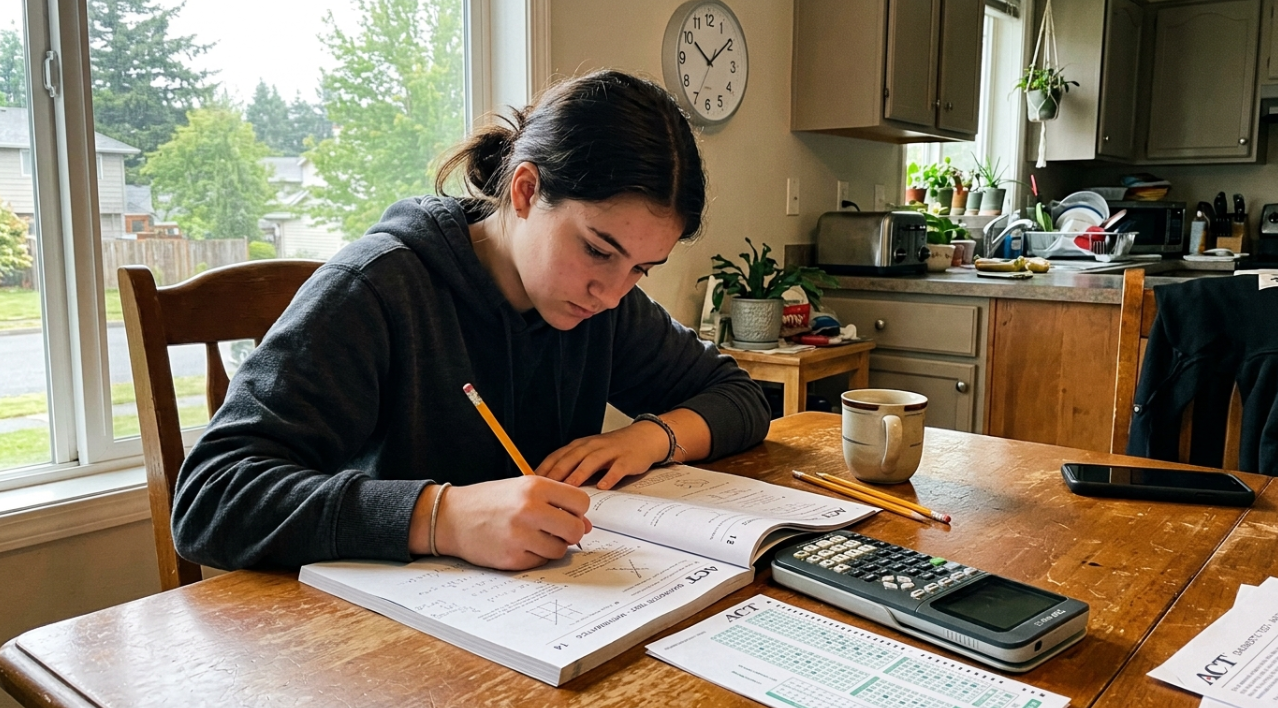
Your baseline is your diagnostic composite score. Write it down. This number is the anchor of everything that follows. A student starting at 18 needs a very different plan from a student starting at 27, even if both are aiming for 30.
Target Score
Set your target using college admissions data, not instinct. Look up the 25th and 75th percentile ACT scores for your top-choice schools. Aiming for the 75th percentile gives you a competitive edge in the applicant pool.
Score Gap
Subtract your baseline from your target. That gap, measured in composite points, determines how many hours you need and how long your study timeline should be.
For example, if your baseline is 22 and your target is 28, your score gap is 6 points. That gap is the engine that drives your entire plan.
Error Log and Error Analysis
Every top-ranking ACT study guide says “review your mistakes.” Almost none of them explain how. Here is how to actually do it.
After every practice test or problem set, categorize each wrong answer into one of three buckets:
Content gap: You did not know the rule, formula, or concept. Solution: study that specific topic.
Timing error: You knew how to solve it but ran out of time or rushed. Solution: practice pacing on that question type.
Careless mistake: You knew the material, had time, but misread the question or bubbled wrong. Solution: slow down, underline key words, double-check before moving on.
Keep a simple spreadsheet or notebook. Over time, patterns emerge. Maybe 60% of your Math errors are content gaps in trigonometry. Maybe your English errors are overwhelmingly careless. The error log tells you exactly where to aim your study hours, which brings us to the plan itself.
Building Your Study Plan
Hours Per Point
The most widely cited guideline is roughly 7 hours of quality studying per 1 composite point of improvement. This number comes from aggregated student data and appears across multiple prep research sources, but it is an average, not a guarantee.
PrepScholar’s estimates break it down further:
Point Improvement | Estimated Hours |
|---|---|
0-1 points | 10 hours |
1-2 points | 20 hours |
2-4 points | 40 hours |
4-6 points | 80 hours |
6-9 points | 150+ hours |
The critical caveat: quality matters far more than raw volume. Thirty hours of focused, strategy-driven practice can outperform 80 hours of aimless review. Students who concentrate on weak areas consistently beat the average hours-per-point estimate. Those who study passively (re-reading notes, watching videos without practicing) consistently fall short.
How Long Should You Study for the ACT?
The right ACT study timeline depends on your baseline, target score, available weekly hours, and test date. A longer schedule is generally useful when you need to learn substantial new content, while a shorter schedule can work when you mainly need to fix recurring errors.
Time available | Suggested approach |
|---|---|
2–4 weeks | Diagnostic + high-priority weaknesses + timed practice |
6–8 weeks | Content review + targeted drilling + 2–3 full tests |
10–12 weeks | Balanced content learning, drilling, and full-length testing |
3–6 months | Spaced practice, deeper content mastery, and multiple test cycles |
6+ months | Low weekly intensity with regular review and multiple checkpoints |
Your available time should determine the weekly workload. Do not wait until the final week to discover that your biggest weakness requires substantial content review.
Working Backward from Your Score Gap
Here is how to turn abstract numbers into a weekly calendar:
Calculate your score gap (target minus baseline).
Multiply by 7 to estimate total hours needed.
Decide your timeline (see below).
Divide total hours by total weeks to get weekly hours.
A student with a 5-point gap needs roughly 35 hours. Over 10 weeks, that is about 3.5 hours per week, completely doable as four 50-minute sessions.
Study Timelines
1-month sprint (4-5 weeks): Best for students with a small score gap (1-3 points) or those who procrastinated and need to make the best of limited time. Requires 8-12 hours per week. High intensity.
3-month standard (10-14 weeks): The sweet spot for most students. Enough time to learn new content, practice extensively, and take 3-4 full-length practice tests. Requires 6-10 hours per week.
6-month deep prep (20-26 weeks): Best for students starting with a large gap (6+ points) or those who want to be thorough. Lower weekly intensity (4-6 hours) with more time for spaced repetition and concept mastery.
Most students need 3 to 6 months of consistent prep at 6 to 10 hours per week to gain 4 or more composite points.
Example ACT Study Schedule
A weekly schedule should combine content learning, targeted practice, timed work, and error review. For example, a student studying about 6 hours per week could use:
Day | Study task | Time |
|---|---|---|
Monday | English grammar + targeted questions | 60 min |
Tuesday | Math concept review + practice | 60 min |
Wednesday | Reading passage practice | 45 min |
Thursday | Weakest skill from error log | 60 min |
Saturday | Timed mixed practice | 75 min |
Sunday | Review mistakes and update error log | 60 min |
The exact schedule matters less than consistency. If Math accounts for most of your missed questions, shift more of the weekly time toward Math. Your diagnostic and error log should determine the allocation.
Every 2–3 weeks, replace one targeted practice session with a full-length timed practice test.
Practice Test Cadence
Take a full-length timed practice test every 2 to 3 weeks. Each one serves two purposes: it recalibrates your score estimate, and it builds test-day stamina. Between practice tests, focus on targeted drilling in your weakest areas.
Do not take a practice test every weekend. That is like running a marathon every Saturday instead of training. The gains come from the work between tests.
Spaced Repetition vs. Cramming
Spreading your study across months beats cramming into a weekend. This is not opinion; it is established cognitive science. The spacing effect means you retain more when you revisit material at increasing intervals. A student who studies 5 hours per week for 12 weeks will almost always outscore a student who crams 60 hours into the final week.
Should You Use an ACT Score Predictor?
ACT score predictors can help estimate a likely score range from practice-test performance, but they should be treated as planning tools rather than guarantees.
Use a predictor to answer questions such as:
Am I close to my target score?
Which section is holding back my Composite?
Has my score improved consistently across several practice tests?
Am I ready to schedule another official test?
A single practice test can be noisy. Look for a pattern across multiple realistic practice sessions before making major decisions about your test date.
How Many Hours Should You Study for the ACT?
There is no reliable formula that guarantees a specific ACT score increase after a fixed number of study hours. The time required depends on your starting score, target score, content gaps, test-taking habits, study quality, and how much time you have before test day.
Instead of treating “hours per point” as a promise, use your diagnostic score and error log to estimate the workload.
Starting situation | Main study priority | Typical planning approach |
|---|---|---|
Large content gaps | Learn core concepts | Longer timeline with regular content review |
Moderate score gap | Target weak skills | Mix targeted drills and timed practice |
Small score gap | Eliminate recurring errors | Precision practice and detailed review |
30+ Composite | Reduce missed questions | Highly targeted practice and test analysis |
Use your first diagnostic to estimate how much work you actually need. Re-test periodically and adjust the schedule based on measurable progress rather than assuming that a fixed number of hours will produce a fixed number of points.
A useful rule is:
Study time should follow your weaknesses, not an arbitrary hours-per-point formula.
Section-by-Section Strategies
Which ACT Section Should You Study First?
Start with the section that combines a large score deficit with weaknesses that are realistically fixable within your timeline.
Situation | First priority |
|---|---|
Many grammar errors | English |
Algebra/functions gaps | Math |
Slow passage comprehension | Reading |
Frequent careless errors | Error-review routine |
Running out of time | Timed section practice |
Strong core scores but weak Science | Decide whether Science is needed |
Strong scores across all sections | Target recurring question types |
Your lowest section is not automatically the first priority. Compare the size of the weakness, how frequently the error occurs, and how much time you have before the test.
ACT English (50 questions, 35 minutes)
English is typically the fastest ACT section to improve, and this is not just a prep-company talking point. The reason is structural: the section tests a finite set of grammar rules, and the same 14 to 20 core rules appear on every test. Memorize them, practice applying them, and your score climbs.
Priority grammar rules to master:
Subject-verb agreement
Comma usage (especially comma splices and unnecessary commas)
Pronoun-antecedent agreement
Parallelism
Modifier placement
Apostrophe rules (its vs. it’s, possessives)
Sentence fragments and run-ons
Redundancy and wordiness
Nearly half of ACT English questions test standard English conventions, meaning grammar and punctuation. The other half test rhetorical skills (organization, style, strategy), which improve with practice but are harder to drill in isolation.
ACT English Strategy
ACT English repeatedly tests a relatively stable set of grammar, usage, punctuation, and rhetorical skills, making targeted practice particularly useful.
Prioritize:
Subject-verb agreement
Pronoun agreement and reference
Sentence boundaries
Commas and punctuation
Modifiers
Parallel structure
Verb tense and form
Apostrophes and possessives
Concision and redundancy
Organization and rhetorical purpose
Do not assume that the original wording is wrong simply because an answer choice offers a change. Conversely, do not choose the unchanged wording automatically. Identify the specific rule being tested, then compare the choices against that rule.
If you want to drill English patterns specifically, ACT practice problem sets let you target grammar topics one at a time instead of working through full tests.
ACT Math (45 questions, 50 minutes)
ACT Math covers pre-algebra, elementary algebra, intermediate algebra, coordinate geometry, plane geometry, and trigonometry. The Enhanced format’s shift to 4 answer choices (down from 5) slightly improves your odds on guesses, but more importantly, it changes elimination strategy. With only 4 options, eliminating even one wrong answer gives you a 33% chance on a guess.
Content knowledge is non-negotiable. Unlike English, where a limited grammar ruleset gets you far, Math requires genuine understanding of a wide range of topics. The good news: ACT Math rarely tests concepts at their hardest difficulty. A solid grasp of fundamentals will carry you through most questions.
Study priorities by frequency:
Algebra (linear equations, systems, inequalities)
Functions and their graphs
Geometry (area, perimeter, angles, triangles, circles)
Statistics and probability (mean, median, data interpretation)
Trigonometry (basic identities, right triangle ratios, unit circle)
You have about 67 seconds per question. For students who struggled with old-ACT pacing, this is a meaningful improvement. Use the extra time to set up problems carefully rather than rushing through calculations.
If you are also considering the SAT, the math sections overlap in content but differ in format. Our guide on improving SAT Math covers fundamentals that transfer well to ACT prep.
ACT Reading (36 questions, 40 minutes)
Reading saw the most favorable timing change on the Enhanced ACT. You now have over 66 seconds per question, compared to roughly 53 on the old test. Passages are shorter, too. This is a significant shift in strategy: you no longer need to speed-read.
Practitioners on Reddit specifically warn against speed-reading tricks. Common advice like “skim the passage and go straight to the questions” might actually hurt your score on the Enhanced ACT. With more time per question, the test now rewards careful reading and accurate comprehension over raw speed.
Active reading approach:
Read the full passage at a comfortable pace. Do not skim.
As you read, mentally note the main idea of each paragraph.
When you hit a question, go back to the relevant section and verify your answer in the text.
Wrong answers on ACT Reading are usually wrong for a specific reason: they are too extreme, they misrepresent a detail, or they address something the passage never actually says.
The four passage types remain: literary narrative, social science, humanities, and natural science. Practice all four. Most students find one type easier than others, and knowing which one is your strongest helps you decide passage order on test day.
ACT Science: A Strategic Decision
This is the section where the Enhanced ACT forces a genuine choice. Science no longer affects your composite, so the question is not “How do I study for ACT Science?” but “Should I take ACT Science at all?”
Take it if:
Your target schools specifically request or recommend it
You are applying to STEM programs and want to show science reasoning skills
You consistently score well on data interpretation and experimental design questions
Adding it costs only $4 more
Skip it if:
None of your target schools require it
Your study time is limited and better spent raising core section scores
Science was your weakest section on the old ACT
If you do take it, the Science section is almost entirely about reading graphs, tables, and experimental descriptions quickly and accurately. Very little actual science knowledge is tested. It is a reading comprehension test wearing a lab coat.
ACT Writing (Optional Essay)
The optional essay is scored on a 2 to 12 scale and is required by a declining number of colleges. Check your target schools before registering. If none require it, skip it and invest that time and energy into the core sections.
Study Methods That Actually Work
Full-Length Practice Tests

Timed, full-length practice tests under realistic conditions are the backbone of ACT prep. Use official tests or expert-reviewed alternatives. Every practice test should be followed by thorough error analysis using the three-category method described earlier.
A common mistake: treating practice tests as the study itself. Practice tests are assessments, not learning tools. The learning happens when you review what you got wrong and fix those gaps before the next test.
Question Banks and Targeted Drilling
After your diagnostic reveals weak spots, use a question bank filtered by topic and difficulty to drill those areas. This is more efficient than taking full tests repeatedly, because you get concentrated practice on the skills that matter most.
One user on r/ACT described their approach as “spamming problem sets” for English and Reading, then reviewing every wrong answer. That kind of targeted, high-volume practice with active review is exactly what the hours-per-point research supports. The ACT question bank lets you filter by section and skill for this type of focused work.
A word of caution, also from the Reddit community: question quality from third-party sources can be mixed. Some users have reported that AI-generated questions do not always match official ACT style or difficulty. Prioritize official or expert-reviewed content, especially for your full-length practice tests.
Error Review: The Three-Category Method
This bears repeating because it is the single highest-leverage study habit you can adopt. After every practice session:
Mark each wrong answer as a content gap, timing error, or careless mistake.
Tally the categories. If content gaps dominate, study new material. If timing errors dominate, practice pacing. If careless mistakes dominate, slow down and develop a checking routine.
Track trends over time. Your error log should show the careless-mistake percentage shrinking as you build better habits.
By categorizing errors this way, students can target each issue with a different strategy instead of studying everything equally. This is what separates a 40-hour plan that gains 5 points from an 80-hour plan that gains 2.
Adaptive Practice and AI Tutoring
Adaptive platforms adjust question difficulty and topic selection based on your performance, automatically steering you toward your weakest areas. This is more efficient than manually choosing what to practice, especially early in your prep when you are still learning what you do not know.
AI tutors provide on-demand explanations when you get stuck, which matters at 10 PM on a Tuesday when no human tutor is available. If you want to explore how AI-powered prep works, learn about adaptive test prep and how it fits into a study plan.
Score-Band-Specific Advice
Not all starting points require the same approach. Here is how to study for the ACT based on where you are right now.
Starting Below 20
At this level, content gaps are the primary issue. You likely have grammar rules, math concepts, or reading strategies that you have not yet learned or have forgotten.
Expected gains: 4 to 7 points with roughly 60 to 80 hours of study
Focus: Build foundational knowledge first. Master the top 15 grammar rules for English. Review core algebra and geometry for Math. Practice reading full passages carefully.
Biggest win: English, because the grammar rules are learnable in a finite amount of time
Starting at 20 to 26
You have a decent foundation but inconsistent performance. Your errors are a mix of content gaps and careless mistakes.
Expected gains: 3 to 5 points with roughly 60 to 80 hours
Focus: Use your error log to identify exactly which topics are costing you points. Eliminate content gaps first, then work on reducing careless errors through deliberate pacing practice.
Biggest win: Whichever section has the most content gaps (your error log will tell you)
Starting at 26 to 30
At this range, you know most of the content. Every additional point requires eliminating a specific error pattern rather than learning something new. Careless mistakes become the enemy.
Expected gains: 2 to 4 points with roughly 80 to 100 hours
Focus: Precision. Review every single wrong answer on practice tests. Identify your two or three most common careless-error patterns and develop specific habits to catch them (underlining key words, re-reading the question before selecting an answer, checking units in Math).
Biggest win: Error analysis and test-taking discipline, not content review
Starting Above 30
You are already in the 94th percentile or higher. Gains come from eliminating the handful of question types that still trip you up.
Expected gains: 1 to 3 points with 40 to 80+ hours (diminishing returns are real at this level)
Focus: Target the specific question types you miss. At this score range, every missed question is identifiable and fixable. Work through the hardest questions in each section.
Test Day and Beyond
Test-Day Logistics
Bring your admission ticket, a valid photo ID, several sharpened No. 2 pencils (even for digital, bring them as backup), an approved calculator with fresh batteries, a watch (no smartwatches), and a snack for breaks. Arrive early. Do not try a new strategy on test day. Stick with what you practiced.
Retesting
According to ACT, Inc., 57% of retesters improved their composite score the second time around. But the average gain for students who retake without structured prep is only about 1.14 points. The difference between the students who gain 1 point and those who gain 4 or 5 is a plan between attempts: reviewing errors, targeting weak areas, and taking additional practice tests.
Most students benefit from taking the ACT two or three times. Combined with superscoring, retesting is one of the most reliable ways to reach your target.
For a parallel perspective on the retesting decision, our guide on retaking the SAT covers how to evaluate whether another sitting is worth your time.
Score Reporting
You can send scores to up to four colleges for free on test day. Additional reports cost extra. Some colleges allow Score Choice (you pick which test dates to send), while others require all scores. Verify each school’s policy before deciding.
Putting It All Together
Here is the complete sequence for how to study for the ACT, condensed into seven steps:
Take a diagnostic. Full-length, timed, realistic conditions.
Set a target score. Use the 75th percentile ACT score at your top-choice schools.
Calculate your score gap. Target minus baseline.
Estimate total hours. Score gap multiplied by 7.
Build a weekly schedule. Divide total hours by your available weeks.
Study smart. Use your error log to focus on weak areas. Drill with targeted question banks. Take a full practice test every 2 to 3 weeks.
Retest if needed. Use the gap between attempts to fix specific weaknesses.
The Enhanced ACT is a more forgiving test than the old version in terms of pacing, but it demands more balanced performance across three sections. Students who prepare with the right structure, the right materials, and the right mindset consistently outperform those who study longer but less strategically.
Start your personalized ACT prep with a diagnostic, a study plan, and expert-reviewed practice built for the Enhanced ACT.
FAQ
How long should I study for the ACT?
Most students need 3 to 6 months of consistent prep at 6 to 10 hours per week to see meaningful improvement. A rough guideline is 7 hours of quality study per 1 composite point of improvement. A student needing a 4-point gain should plan for about 28 hours of focused work, while a student aiming for 6+ points should budget 80 or more hours.
What is the best section to study first?
English is typically the fastest section to improve because it tests a predictable set of 14 to 20 grammar rules. If your diagnostic shows English as a weak spot, start there. Otherwise, start with whichever section has the largest gap between your score and your target.
Has the ACT changed recently?
Yes. The Enhanced ACT rolled out in September 2025 with significant changes: fewer questions, more time per question, Science becoming optional, Math dropping to 4 answer choices, and composite scores now calculated from only English, Math, and Reading. Any study resources from before 2025 may not reflect the current format.
Should I take the optional Science section?
If you are applying to STEM programs or schools that specifically request a Science score, take it. It costs only $4 extra. If none of your target schools require it and your study time is limited, skip it and invest that time into raising your core section scores.
Is it better to take the ACT on paper or digitally?
The ACT offers both formats. Some students prefer the digital version for its interface and faster score delivery. Others prefer paper for the familiarity. Take a practice test in both formats if possible and go with whichever feels more natural. Your score is not affected by the format.
How many times should I take the ACT?
Two to three sittings is common and often beneficial, especially if your target schools superscore. The key is to prep between attempts. Students who retake without structured study in between gain only about 1 point on average. Those with a real plan between sittings often gain 3 to 5 points.
Can I study for the ACT and SAT at the same time?
It is possible since the two tests overlap in content, but it is not ideal. The formats, timing, and scoring differ enough that splitting your focus can dilute your preparation. Pick one test, commit to it, and switch only if your diagnostic scores strongly favor the other. Our SAT prep resources can help if you decide the SAT is a better fit.
What is the single most important study habit for ACT prep?
Reviewing your mistakes with a categorized error log. Identifying whether each wrong answer was a content gap, a timing error, or a careless mistake tells you exactly how to adjust your study plan. This one habit turns generic practice into targeted improvement.