
How to Improve SAT Math Score: Complete Guide (2026)
Miyagi Labs ·
How to Improve Your SAT Math Score: 2026 Guide

TL;DR
The average SAT Math score is 508, and even modest improvements can produce large percentile jumps. To improve your SAT Math score, start with a diagnostic test to find your weaknesses, build an error log to track recurring mistakes, prioritize Algebra and Advanced Math (which together make up about 70% of questions), and master the built-in Desmos calculator. Your strategy should differ based on your starting score, because a student at 450 needs a fundamentally different plan than a student at 700.
The SAT Math section is a 200 to 800 score that shapes college admissions outcomes, scholarship eligibility, and STEM program access. With the mean SAT Math score sitting at 508 in 2025, even a 50-point gain can vault you past thousands of other test-takers in the percentile rankings.
This guide defines every key concept, strategy, and tool you need to understand on the path to a higher score. It is not a vague list of tips. Each section explains what something is, why it matters, and exactly what to do about it. Whether you are starting in the 400s or pushing past 750, the framework here will help you study smarter.
Take a free SAT diagnostic to identify your starting point before reading further.
How to Improve Your SAT Math Score
The fastest way to improve your SAT Math score is to identify your weakest skills with an official diagnostic, track every mistake in an error log, and practice those specific skills under timed conditions. Prioritize Algebra and Advanced Math because they represent the largest share of SAT Math questions, then build fluency with the built-in Desmos calculator, Student-Produced Response questions, and time management. Your strategy should match your starting score: lower scorers should prioritize foundational math skills, while students targeting 700+ should focus on eliminating recurring mistakes, improving speed, and mastering harder questions.
In short: diagnose → identify weak skills → drill those skills → analyze mistakes → practice under time pressure → retest → repeat.
Understanding the SAT Math Section
Digital SAT Math Format
The digital SAT Math section consists of 44 questions split across two modules of 22 questions each. You get 35 minutes per module, for a total of 70 minutes of math testing time. About 75% of questions are multiple-choice with four answer options, while the remaining 25% are Student-Produced Response (SPR) questions where you type in your own answer.
A calculator is permitted on every single question. More importantly, the College Board provides a built-in Desmos graphing calculator directly within the testing interface. You can also bring your own approved calculator. For a deeper breakdown of how modules, sections, and timing work, see this explanation of the digital SAT format.
SAT Math Content Domains and Weights
SAT Math questions are organized into four content domains. The College Board's framework gives Algebra and Advanced Math the largest share of the section, so students should understand the distribution before deciding where to spend study time.
SAT Math Domain | Approx. Share | What to Study | Priority |
|---|---|---|---|
Algebra | ~35% | Linear equations, inequalities, systems, functions, equations in context | Highest |
Advanced Math | ~35% | Quadratics, nonlinear equations, polynomials, exponentials, radicals, rational expressions | Highest |
Problem-Solving and Data Analysis | ~15% | Ratios, rates, percentages, probability, statistics, data interpretation | Medium |
Geometry and Trigonometry | ~15% | Area, volume, angles, circles, coordinate geometry, right-triangle trigonometry | Medium |
Study rule: Do not automatically spend 70% of your study time on Algebra and Advanced Math. Instead, combine question frequency with your personal weaknesses. For example, a student who already scores near-perfectly in Algebra may gain more points by fixing repeated Geometry or Data Analysis mistakes.
Adaptive Testing and Module Routing
The digital SAT is multistage adaptive. SAT Math has two modules, and your performance on the first Math module helps determine which second module you receive.
The second module can be either a higher- or lower-difficulty module. This means your performance in Module 1 matters because it influences the difficulty level of the questions you see in Module 2 and therefore the scoring opportunity available to you.
However, students should not think of the test as simply having a fixed score “cap” based on getting the easier second module. The College Board's scoring model is more complex than a simple correct-answer count, and the exact relationship between individual questions, module difficulty, and scaled score can vary.
What this means for your strategy
If you are targeting a high Math score, treat Module 1 as a priority:
Read every question carefully.
Avoid rushing simply because the early questions appear easy.
Check calculations when you have time.
Do not spend several minutes on one difficult question while sacrificing easier questions later.
Practice completing Module 1 accurately under realistic time pressure.
The goal is not to obsess over guessing which module you will receive. The goal is to maximize the number of questions you answer correctly in Module 1 and then perform as strongly as possible in Module 2.
SAT Math Scoring Scale and Percentiles
Scores range from 200 to 800 in 10-point increments. The conversion from raw score (number of correct answers) to scaled score is nonlinear and adjusted for test form difficulty through a process called equating.
Here are rough percentile benchmarks to orient your goal-setting:
Scaled Score | Approximate Percentile |
|---|---|
500 | ~40th |
530 | College readiness benchmark |
600 | ~75th |
650–700 | ~85th–92nd |
750+ | ~96th+ |
A score of 530 meets the College Board’s college readiness benchmark, meaning you are statistically likely to succeed in entry-level college math. A score of 650 to 700 is considered strong and competitive at most universities. Scores of 750 to 800 are what top STEM programs at schools like MIT, Caltech, and Carnegie Mellon typically expect. For a more detailed breakdown, check out this SAT score chart with percentiles.
Diagnostic and Planning
Baseline Score and Diagnostic Testing
A baseline score is your starting point, measured by a timed, full-length practice test taken before any studying begins. Without this number, you are guessing at what to study.
The diagnostic should be taken under realistic conditions: timed, no interruptions, no phone, seated at a desk. Use official College Board Bluebook tests or a platform that simulates the adaptive format. Your baseline reveals not just a total score but domain-level weaknesses. Maybe your Algebra is solid but Advanced Math is bleeding points. Maybe you are losing questions to timing rather than knowledge.
Skip this step and you will waste weeks studying topics you already know.
Target Score
Your target score is the minimum SAT Math score that makes you competitive at your goal schools. To find it, research the middle-50% SAT score ranges for each school on your list. If your top-choice engineering program’s middle-50% math range is 720 to 790, your target should be at least 720.
The gap between your baseline and your target determines everything about your study plan: how many weeks you need, how many hours per week, and which domains to prioritize. A 50-point gap requires a different approach than a 200-point gap.
Use a score predictor tool to track whether your practice scores are trending toward your target over time.
How Many Points Can You Improve on SAT Math?
There is no fixed number of SAT Math points you can gain per week because improvement depends on your starting score, math foundation, study time, and the types of mistakes you are making. However, the size of your score gap provides a useful way to plan your preparation.
Starting Score | Example Target | Main Focus |
|---|---|---|
400–500 | 550+ | Foundational math and Algebra |
500–600 | 650+ | Algebra, Data Analysis, Advanced Math |
600–700 | 700–750 | Advanced Math, accuracy, timing, Desmos |
700–750 | 750–800 | Difficult questions and eliminating preventable errors |
A 100-point improvement usually requires more than simply completing additional practice questions. Your practice needs to identify why you are missing questions and then deliberately fix those weaknesses.
The most useful question after a missed problem is not “What was the answer?” It is “Why did I miss this question, and what will I do differently next time?”
That distinction turns practice from repetition into learning.
Error Log (Mistake Tracker)
An error log is a structured record of every question you get wrong, tagged by domain, error type, and root cause. It is, without exaggeration, the most powerful tool for improving your SAT Math score.
Here is why. Students who maintain an error log consistently and review it weekly typically identify two to four recurring error patterns within three to four full-length tests. Those patterns, not random practice, are what drive 100+ point score improvements.
Your error log should capture:
Question number and domain (Algebra, Advanced Math, etc.)
Error type (see the taxonomy below)
What you did wrong (one sentence)
What you should have done (one sentence)
Time spent (did you rush or run out of time?)
Review the log before every study session. It tells you exactly what to work on.
SAT Math Error Log Template
Use this structure every time you miss a practice question:
Question | Domain | Skill | Error Type | Why I Missed It | Correct Method | Fix |
|---|---|---|---|---|---|---|
#12 | Algebra | Linear equations | Execution slip | Distributed incorrectly | Expand carefully before combining terms | Write one extra algebra step |
#18 | Advanced Math | Quadratics | Concept gap | Did not recognize factoring pattern | Factor before using the quadratic formula | Drill factoring |
#27 | Data Analysis | Percentages | Translation error | Used the original value instead of the new value | Identify the base quantity first | Underline what the percentage refers to |
At the end of each week, count your mistakes by type and skill. Your next week's study plan should focus on the categories that appear most often.
Error Type Taxonomy
Most students describe their wrong answers as “careless mistakes.” SAT tutors push back on this hard. As practitioners on Substack and tutoring forums point out, the underlying math on missed questions is usually so simple that when students see the correct solution, they immediately understand what went wrong and dismiss it as carelessness. But these are not random slips. They are predictable, patterned errors that the test is designed to trigger.
Here are the five error types worth tracking:
Concept gap: You genuinely did not know the math required. You need to learn or relearn this topic.
Translation error: You understood the math but misread the word problem or set up the equation incorrectly. The question asked for the y-intercept and you solved for the slope.
Execution slip: You knew the method and set it up correctly but made an arithmetic or algebraic mistake midway through.
Calculator input error: You typed something wrong into Desmos or your calculator. Parentheses are the usual culprit.
Timing loss: You knew how to solve it but ran out of time or rushed and picked a trap answer.
Each error type has a different fix. Concept gaps require content study. Translation errors require slowing down to re-read. Execution slips require writing out steps instead of doing them in your head. Treating all errors as one category is like treating all injuries with the same medicine.
Building a Study Plan
A study plan is a week-by-week schedule that allocates your time based on your domain weaknesses, not your strengths. The most common study mistake, confirmed by tutors and prep communities alike, is spending time on topics you already know because they feel comfortable.
Principles for an effective plan:
Prioritize the highest-weight weak domains. If you are weak in Algebra (35% of questions) and Geometry (15%), fix Algebra first.
Alternate content study with timed practice. Learn a concept, then drill it under time pressure.
Space full-length practice tests at least two weeks apart. Taking tests too frequently without studying between them produces no improvement.
Build in rest days. Cramming for weeks without breaks leads to burnout and diminishing returns.
For a ready-made week-by-week structure, see this 8-week SAT study plan.
Math Content Domains: What to Study and Why
Algebra
Algebra is the highest-volume domain on SAT Math, accounting for roughly 35% of scored questions (13 to 15 questions per test). Topics include linear equations, linear inequalities, systems of linear equations, linear functions, and linear equations in context.
For most students, this is also the lowest-difficulty domain. The questions tend to be more straightforward than Advanced Math, which means Algebra represents the fastest available points for anyone scoring below 650. If your error log shows Algebra weaknesses, fix them first. The return on investment is the highest of any domain.
Advanced Math
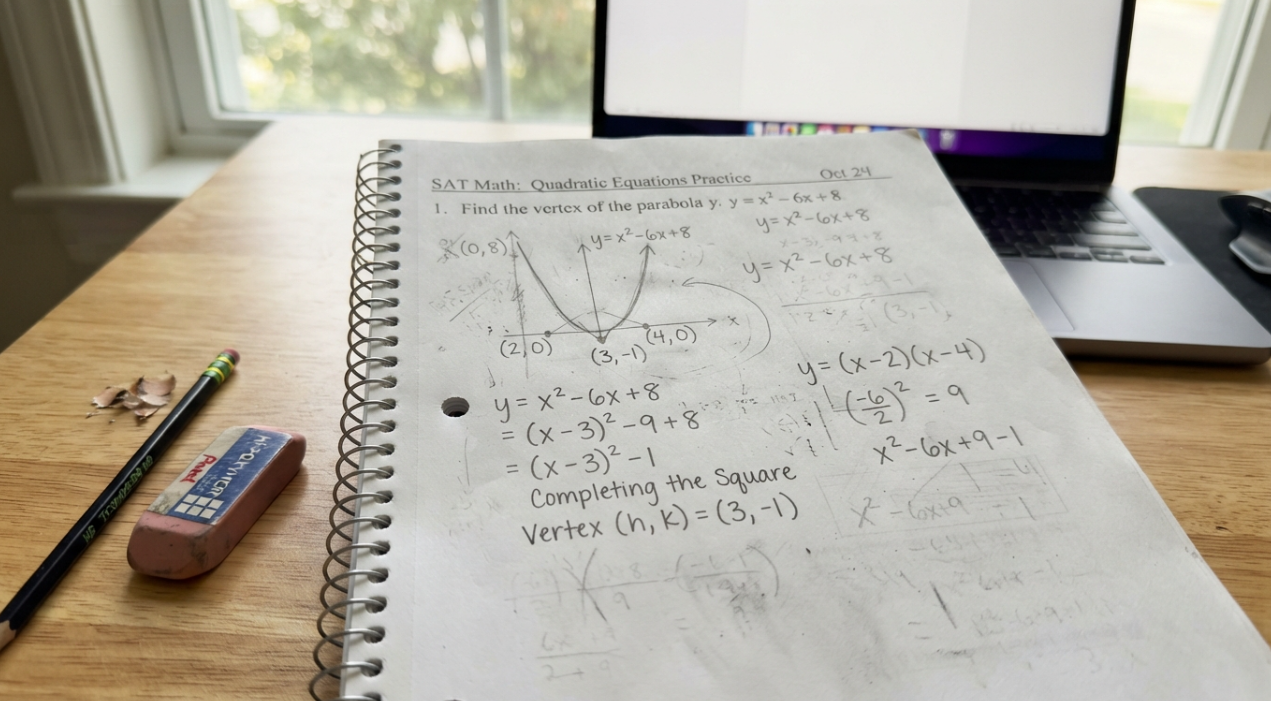
Advanced Math also represents about 35% of questions, but it skews harder. Topics include equivalent expressions, nonlinear equations, and nonlinear functions (quadratics, exponentials, polynomials, radicals, and rational expressions).
Quadratics are the single most common sub-type within this domain. If you master factoring, the quadratic formula, vertex form, and how to find zeros and intersections, you cover a disproportionate share of Advanced Math questions. Practitioners on Reddit frequently report that drilling quadratics alone produced noticeable score gains.
Problem Solving and Data Analysis
This domain covers about 15% of questions (5 to 7 per test) and emphasizes ratios, rates, percentages, proportional relationships, statistical measures, probability, and graph or table interpretation. Questions tend to be context-heavy word problems.
The math itself is often not hard. The difficulty comes from translating a paragraph of real-world context into the right equation or calculation. Students who struggle here usually have translation errors, not concept gaps. Practice reading word problems slowly, underlining what the question actually asks, and identifying the relevant numbers before touching your calculator.
Geometry and Trigonometry
Geometry and Trig accounts for roughly 15% of SAT Math, typically 5 to 7 questions. Topics include area, volume, angles, coordinate geometry, right-triangle trigonometry, and circles.
A reference sheet covering most geometry formulas is provided on the test. However, trigonometric ratios (sine, cosine, tangent) must be memorized. Students aiming for 750+ cannot afford to lose points here, but students in the 500 to 650 range should address this domain only after shoring up Algebra and Advanced Math. The volume of questions simply does not justify prioritizing it early.
Student-Produced Response Strategies
Student-Produced Response (SPR) questions require you to enter your own answer rather than select from four choices. Because there are no answer choices, techniques such as process of elimination and traditional backsolving are less useful.
For SPR questions:
Solve the problem before entering your response.
Check what quantity the question actually asks for.
Enter the answer carefully in the format permitted by the test.
Recheck decimal placement, signs, and arithmetic when appropriate.
Do not leave a question blank simply because you are unsure; use the official testing instructions to determine how responses should be entered.
Practice SPR questions separately so that you become comfortable solving without answer-choice information.
Strategy and Tool Glossary
Desmos: The Built-In Graphing Calculator
The Desmos graphing calculator is available on every SAT Math question, and it is arguably the single highest-ROI skill to develop for the digital SAT. Many students treat it as a basic calculator. That is a waste.
Desmos saves time when the graph, intersection, zero, or table is exactly what the question asks for. It wastes time when you type a long expression that could be simplified mentally in one step. The key is knowing when to use it and when not to.
Master what tutors call the “big five” Desmos skills:
Graphing equations to visualize solutions
Tables for testing values systematically
Intersections for solving systems of equations visually
Regression for fitting data to models
Inequalities for shading regions and testing solutions
For dedicated lessons on each of these skills, explore the SAT Desmos calculator guide and work through Desmos practice problems to build fluency.
Backsolving and Plugging In
Backsolving means substituting the answer choices back into the question to see which one works. It is especially useful for equations where algebraic manipulation gets messy, percent problems, and “which value satisfies…” questions.
The technique: start with the middle answer choice (often choice B or C). If it is too large, try a smaller option. If it is too small, go larger. This binary search approach narrows the answer in two steps instead of four.
Plugging in is the related strategy of choosing a convenient number for a variable, solving with that number, and then checking which answer choice matches. It works well on questions with variables in the answer choices.
Both strategies are forms of strategic laziness. They let you avoid complex algebra when a simpler path exists.
Process of Elimination (POE)
On multiple-choice questions, eliminating clearly wrong answers before solving can save significant time. The digital SAT interface lets you cross out answer choices, which helps visually.
Even narrowing four choices down to two before solving gives you a 50% chance if you run out of time and need to guess. Combined with flagging (marking questions to return to later), POE turns time pressure from an enemy into a manageable constraint.
Time Management and Question Triage
You have 35 minutes for 22 questions, which works out to roughly 95 seconds per question on average. But that average is misleading. Some questions take 30 seconds. Others take 3 minutes.
Triage means quickly categorizing each question into one of three buckets:
Solve now: You recognize the type and can finish it quickly.
Flag for later: You know how to do it but it will take time. Come back after the fast ones.
Guess and move on: You have no idea. Pick an answer, flag it, and invest your time elsewhere.
The digital SAT lets you move forward and backward within a module. Use this freedom. Students who grind on a hard question for 4 minutes early in the module often run out of time and miss easy questions at the end. That is a terrible trade.
Common study mistakes that practitioners report include only taking practice tests without reviewing errors, cramming instead of spacing study sessions, focusing on strong areas while ignoring weak ones, and never simulating real test conditions. All of these undermine time management on test day because they never forced the student to practice under genuine pressure.
Practice and Progress
Full-Length Practice Tests
A full-length practice test is a timed, adaptive simulation of the complete SAT. It is the gold standard for measuring readiness because it replicates the conditions, timing, fatigue, and adaptive routing you will face on test day.
Sources for official practice include the College Board Bluebook app. Space your practice tests at least two weeks apart. Taking one every few days without studying between them is one of the most common mistakes students make. The test does not teach you anything on its own. It only measures where you are. The learning happens between tests, when you review your error log and drill weak areas.
Access free full-length SAT practice exams to simulate test day conditions.
Question Bank Usage
A question bank is a filterable collection of SAT-style questions organized by domain, skill, and difficulty level. Unlike a full-length test, a question bank lets you do targeted practice on specific weaknesses.
The workflow is simple: your error log tells you that you keep missing questions about systems of nonlinear equations. You go to the question bank, filter for Advanced Math, and drill that specific skill until it clicks. Then you take another practice test to see if the fix held.
This targeted approach is far more efficient than grinding through random practice sets. A SAT question bank with filtering by domain and difficulty makes this process much faster.
Score Plateaus
A score plateau is when your practice scores stop improving despite continued studying. It is frustrating but common, and it almost always has an identifiable cause.
The usual culprits:
Practicing strengths instead of weaknesses. It feels productive but produces no new points.
Not analyzing errors. Taking test after test without reviewing mistakes is like running laps without fixing your form.
Test anxiety. Performance under pressure is a skill that requires separate practice.
Tool stagnation. Sometimes the platform or resource you are using has taught you what it can, and you need a different perspective.
The solution is almost always the same: return to your error log, identify which error types dominate your recent tests, and shift your study plan accordingly. If you have been using the same prep tool for months without gains, consider comparing alternatives to find a better fit.
How to Improve Your SAT Math Score by Tier
Improving from 400–500 to 550+
At this level, the problem is almost entirely concept gaps. You are missing foundational skills in arithmetic, basic algebra, and word problem comprehension.
Priority domains: Algebra and Problem Solving & Data Analysis. These two are the most approachable and represent about half of all questions.
What to do:
Rebuild arithmetic fluency: fractions, decimals, percents, order of operations
Master solving single-variable linear equations and inequalities
Practice translating word problems into equations (this is where most points are lost)
Take untimed practice first to build accuracy, then add time constraints gradually
Study consistently, 30 to 60 minutes daily, for 6 to 12 weeks
At this tier, knowledge acquisition is the primary driver of improvement. You need to learn (or relearn) core math concepts. Strategy matters less until you have the content foundation.
Improving from 550–650 to 700+
This is the tier where the nature of improvement changes. You know most of the math. Your losses come from execution errors, translation mistakes, and shaky Advanced Math skills.
Priority domains: Advanced Math (especially quadratics and functions), plus Desmos fluency.
What to do:
Build and review your error log religiously. At this level, identifying two to three recurring patterns can unlock 50+ points.
Master quadratics in all forms: standard, vertex, factored. Know how to convert between them.
Practice with the Desmos calculator until graphing an equation is as automatic as typing your name.
Focus on Module 1 accuracy. Getting routed to the harder Module 2 is non-negotiable for 700+.
Do timed practice under test conditions every session.
SAT tutors emphasize that students at this level lose points to pattern-recognition failures, not knowledge gaps. The frustrating truth about SAT Math mistakes is that knowledge does not automatically produce accuracy. Your process matters just as much. For a structured approach to large gains, see this plan to improve your SAT score by 200 points.
Improving from 700 to 750–800

The margins here are razor-thin. At the top of the scoring curve, a single missed question can cost 20 or more scaled points. There is no room for any error type.
Priority domains: All four, but especially the edge cases in Geometry & Trigonometry and the hardest Advanced Math questions.
What to do:
Drill only medium-to-hard and hard difficulty questions. Easy questions are a waste of your time at this level.
Master SPR questions, where you cannot rely on answer choices.
Optimize speed so you have time to double-check Module 1 answers. Every Module 1 question matters for routing.
Study the specific trap patterns the SAT uses: answers that result from common algebraic errors, units that switch mid-problem, questions that ask for “a” when you solved for “2a.”
Practice relaxation techniques for test anxiety. Nerves destroy accuracy on questions you know how to solve.
This tier is about elimination of all preventable errors. You are not learning new math. You are perfecting a process.
What to Do the Day Before the SAT
The day before the SAT is not the time for an intense cram session. Your goal should be to protect the skills you have already built and arrive rested.
Review your error log and look over a small number of previously missed problems. Revisit formulas, calculator techniques, and question types that you repeatedly struggle with.
Avoid taking a full-length practice test the night before the real exam. Instead, use a short, low-pressure practice session if you need to maintain your rhythm.
Before test day, confirm your testing requirements, calculator setup, admission details, and other logistics using the latest official College Board instructions.
The final night should prioritize sleep and preparation rather than trying to learn an entirely new topic.
Common SAT Math Mistakes (And What They Actually Are)
Many students believe their errors are random and careless. They are not. SAT math questions are intentionally designed to be tricky, and the most common “careless” mistakes follow predictable patterns:
Misreading the question. You solved for x when it asked for 2x + 1. Always re-read the question after solving.
Rushing through calculations. Speed without accuracy is just fast failure. Slow is smooth, and smooth is fast.
Overlooking units and labels. The question is in hours but your answer is in minutes. Check units before submitting.
Falling for trap answers. Wrong answers on the SAT are not random. They are the results you get if you make common mistakes. If your answer matches a choice suspiciously quickly, double-check it.
Poor time management. Spending 5 minutes on one hard question and running out of time for three easy ones is a net loss.
The process for fixing these is to track them in your error log by type, identify which ones show up most often, and practice specific countermeasures for those error types. For more on what goes wrong on test day and how to prevent it, read about common SAT test day mistakes.
Putting It All Together
Improving your SAT Math score is not mysterious. It follows a clear sequence:
Take a diagnostic to establish your baseline and find your weak domains.
Set a target score based on the schools you want to attend.
Build a study plan that prioritizes the highest-weight weak domains first (Algebra and Advanced Math).
Start an error log from day one and review it before every study session.
Learn the Desmos calculator well enough to use it as a genuine problem-solving tool.
Take full-length practice tests every two to three weeks to measure progress.
Adjust your plan based on your error log patterns, not your feelings about how studying is going.
The students who improve the most are not the ones who study the most hours. They are the ones who study the right things, track their mistakes, and fix recurring patterns systematically.
Start your SAT Math prep with a free diagnostic and personalized study plan to put this framework into action.
FAQ
How long does it take to improve your SAT Math score?
It depends on the gap between your baseline and your target. Students aiming for a 50 to 100 point improvement typically need 4 to 8 weeks of consistent daily practice (30 to 60 minutes per day). Larger jumps of 150+ points usually require 8 to 16 weeks. The key variable is not just time spent but how strategically you spend it, particularly whether you use an error log and target your weakest domains.
What is the fastest way to improve my SAT Math score?
Master the Desmos graphing calculator and fix your top two or three error patterns. Desmos fluency lets you solve entire categories of questions (intersections, systems, zeros) faster and more accurately. Meanwhile, your error log reveals the specific, recurring mistakes costing you the most points. Fixing those patterns produces faster results than grinding through random practice.
Is 600 a good SAT Math score?
A 600 places you around the 75th percentile, meaning you scored higher than three-quarters of all test-takers. It is above the College Board’s college readiness benchmark of 530 and competitive at many universities. However, selective schools and STEM programs often expect 700 or higher. Whether 600 is “good enough” depends entirely on your college list.
How does the SAT adaptive testing affect my Math score?
Your performance on Math Module 1 determines whether you receive an easier or harder Module 2. The harder Module 2 unlocks the full 200 to 800 scoring range, while the easier Module 2 caps your maximum score around 560 to 600. This makes Module 1 accuracy critical. Even a few extra wrong answers in Module 1 can prevent you from ever reaching 700+, regardless of how well you do in Module 2.
Should I study all four SAT Math domains equally?
No. Algebra and Advanced Math each account for about 35% of questions, together making up roughly 70% of the section. Problem Solving & Data Analysis and Geometry & Trigonometry each represent only about 15%. Prioritize your weakest areas within the heavy-weight domains first. Only shift significant time to Geometry or Data Analysis after your Algebra and Advanced Math skills are solid.
What are SPR questions and why do they matter?
Student-Produced Response (SPR) questions make up about 25% of SAT Math. Unlike multiple-choice, there are no answer choices to backsolve from or eliminate. You must calculate and type in the exact answer. SPR questions reward clean problem-solving and punish students who rely on shortcuts. Practicing these separately helps build the accuracy and confidence needed for the questions where you are on your own.
How many practice tests should I take to improve my SAT Math score?
Most successful students take 4 to 6 full-length practice tests over the course of their prep, spaced at least two weeks apart. The practice test itself is a measurement tool, not a study tool. The real improvement happens between tests when you analyze your error log, study weak content areas, and drill specific question types. Taking a test every few days without review between them produces almost no score gains.
Can the Desmos calculator really help that much?
Yes, but only if you learn to use it properly. Students who master graphing, tables, intersections, regression, and inequalities in Desmos can solve certain question types in 15 to 20 seconds that would otherwise take 2 to 3 minutes algebraically. The catch: Desmos wastes time on simple arithmetic or one-step problems. Knowing when to use it and when to solve mentally is the skill that separates high scorers from students who just click buttons.