
ACT Study Plan 2026: Step-by-Step Guide to Raise Your Score
Miyagi Labs ·
ACT Study Plan 2026: Step-by-Step Guide to Raise Your Score

TL;DR
A good ACT study plan starts with a full-length diagnostic test, sets a target score, identifies your weakest skills, and assigns specific study sessions to those weaknesses. For most students, a 4-, 8-, or 12-week plan works better than studying randomly. The longer your timeline and the larger your score gap, the more time you can devote to content review, timed practice, full-length tests, and error analysis.
The simplest ACT study plan is:
Take a timed diagnostic ACT.
Set a target score based on your goals.
Identify your lowest-performing sections and skills.
Study those weaknesses 4 to 6 days per week.
Take a full-length practice test regularly.
Review every missed or guessed question.
Adjust the next week's study schedule based on your results.
Reduce heavy studying during the final few days and prioritize sleep and test-day preparation.
If you’re starting from scratch, Miyagi Labs’ ACT prep offers a diagnostic-first workflow that builds a personalized study path automatically. But whether you use a platform or build your own plan on paper, the principles below apply.
ACT Study Plan at a Glance
The right ACT study schedule depends mainly on your starting score, target score, available time, and test date.
Timeline | Recommended Study Time | Main Focus | Practice Tests |
|---|---|---|---|
4 weeks | 5–8 hours/week | Biggest content gaps + pacing | 2–3 |
8 weeks | 5–8 hours/week | Content + targeted practice + pacing | 3–4 |
12 weeks | 4–7 hours/week | Skill building + practice + strategy | 4–6 |
16+ weeks | 3–6 hours/week | Gradual skill development + repeated testing | 5–7+ |
These are planning ranges rather than guarantees. Students starting with larger content gaps may need more total preparation, while students already close to their target score may need less.
What Is an ACT Study Plan?
An ACT study plan is a personalized schedule that tells you what to study, when to study it, how much time to spend, and how to measure progress before test day.
A useful ACT study plan connects four things:
Starting point: your diagnostic ACT score
Target: the score you want to reach
Weaknesses: the specific sections and skills costing you points
Timeline: the number of weeks remaining before your ACT date
The goal is not to complete the most practice questions. The goal is to spend your available study time on the skills most likely to improve your performance.
A practical ACT study plan follows this cycle:
Diagnose → Prioritize → Practice → Review → Retest → Adjust
That cycle should repeat throughout your preparation rather than treating your first diagnostic as a one-time event.
What Changed: The Enhanced ACT (2025)
If you’re building an ACT study plan in 2025 or 2026, you need to understand the Enhanced ACT format that rolled out in April 2025. This is the single biggest factor separating useful study plans from outdated ones.
Here’s what changed:
The ACT is now approximately 45 minutes shorter than the legacy version, with 44 fewer questions. The core test includes 131 questions across three sections: English (50 questions), Math (45 questions), and Reading (36 questions). Your composite score, still on the 1 to 36 scale, is now calculated from just these three sections.
Science and Writing are both optional. About 90% of tracked colleges are making Science optional, which means most students can safely skip it unless they have specific STEM program requirements. Students who take Science receive a separate Science score and a STEM score that averages Math and Science, but neither factors into the composite.
Other notable changes: Math answer choices dropped from 5 to 4. Reading passages are shorter but retain the same complexity. And English has shifted away from grammar-heavy Convention of Standard English questions toward more Production of Writing questions focused on rhetoric and passage organization.
One critical point that prep experts emphasize: the Enhanced ACT gives you more time per question, but the remaining questions trend harder because many easier items were removed. Don’t mistake “fewer questions” for “easier test.”
Still deciding between the SAT and ACT? Our comparison guide breaks down the key differences.
ACT Format Changes You Need to Know for Your Study Plan
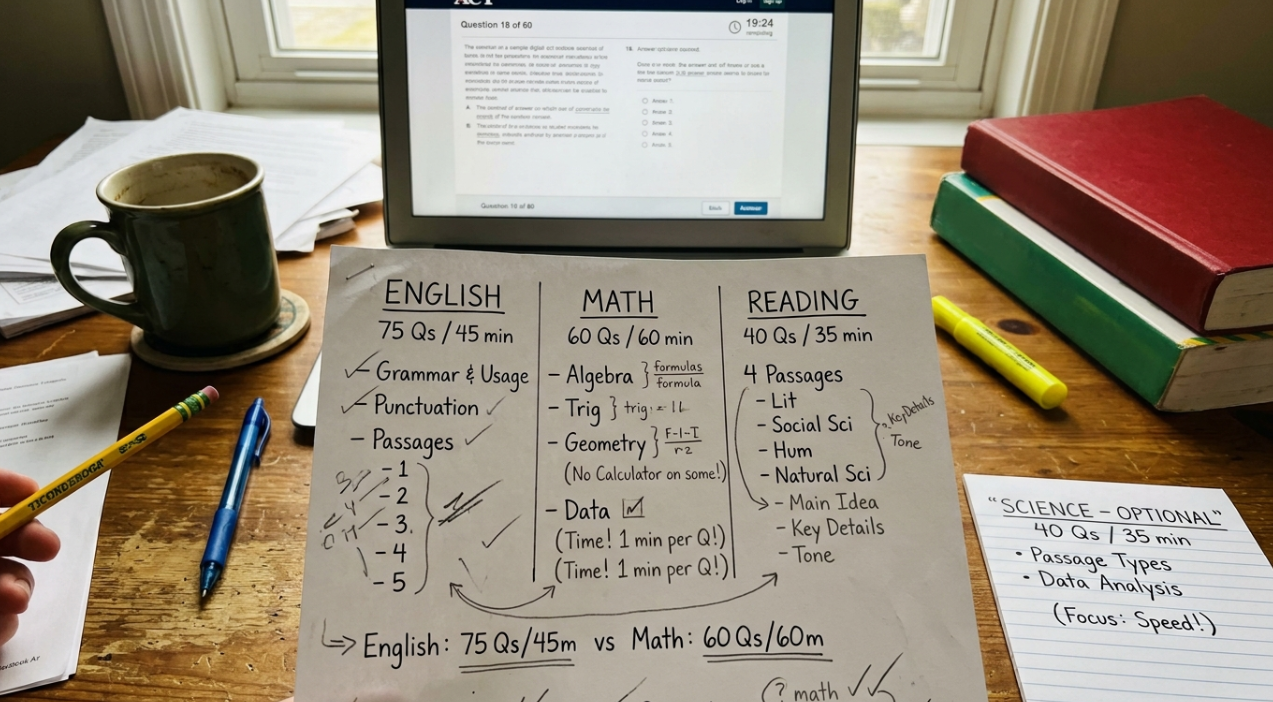
Before creating an ACT study schedule, make sure your practice materials match the version of the test you will actually take. The current ACT format differs from the legacy version in its section structure, timing, question counts, and optional Science and Writing components.
For study planning, the most important distinction is simple: English, Math, and Reading are the core sections used for the Composite score, while Science is optional.
Your study schedule should therefore be built around the sections that matter for your intended testing and college goals. If you plan to take Science, add dedicated Science practice rather than assuming your core-section preparation will automatically cover it.
Here’s a quick-reference table for the current format:
Replace it with:
Section | Questions | Time | Approx. time/question | Status |
|---|---|---|---|---|
English | 50 | 35 min | 42 sec | Required |
Math | 45 | 50 min | 67 sec | Required |
Reading | 36 | 40 min | 67 sec | Required |
Science | 40 | 40 min | 60 sec | Optional |
Important: verify these figures against the official ACT information for the testing version you're targeting before publishing.
Study priority by section
English deserves more attention than many students give it. The shift toward Production of Writing questions means you can’t just memorize comma rules and call it done. Spend time on rhetorical strategy, passage organization, and transitions. A strong ACT question bank will include these newer question types.
Math content hasn’t changed, but each question now carries more weight with fewer total items. The switch to 4 answer choices slightly reduces your ability to eliminate wrong answers, so content mastery matters more than ever.
Reading got a significant pacing improvement. You now have 67 seconds per question compared to the old 52 seconds. If pacing was your biggest Reading obstacle, the Enhanced ACT works in your favor. But the passages still demand careful analysis.
Science should only appear in your study plan if your target colleges require it or if you’re applying to STEM programs that value the STEM score. For everyone else, those study hours are better spent on the three core sections.
Practitioners on Reddit offer a useful diagnostic strategy here: take a practice test both with and without the optional Science section. If dropping Science doesn’t hurt your overall performance (and for most students it won’t), redirect that study time to your weakest core section.
How to Set Your ACT Target Score
Your ACT study plan should begin with a measurable target. Instead of choosing an arbitrary score, compare your current practice-test performance with the ACT scores reported by the colleges you are considering.
Use three numbers:
Number | What It Tells You |
|---|---|
Diagnostic score | Where you are starting |
Target score | Where you want to finish |
Score gap | How much improvement your plan needs to produce |
For example, if your diagnostic score is 25 and your target is 30, your initial score gap is 5 points.
Then break the target into section-level goals. A student might discover that English and Math need substantial improvement while Reading is already close to the desired range.
This makes the study plan more precise because you are no longer asking, “What should I study today?” You are asking, “Which skill is currently preventing me from reaching my target score?”
How Long Should You Study for the ACT?
The honest answer: it depends on the gap between where you are and where you need to be. But there’s solid data to guide you.
The hours-to-points benchmark
A widely cited baseline is that 10 hours of focused study equals roughly 1 additional composite point. This holds reasonably well for moderate improvements. Want to go up 2 to 3 points? Plan for about 20 to 30 hours. Aiming for 4 to 6 points? You’re looking at around 80 hours. Gains beyond 6 points typically require 150 or more hours of dedicated work.
Most students study somewhere in the 20 to 60 hour range total.
Timeline options
One-month plan (1 to 3 point gain): This is a sprint. It works best for students who need a modest improvement and can commit 1 to 2 hours daily. The key to a one-month plan is ruthless prioritization. Focus almost exclusively on your weakest section rather than spreading time evenly.
Plan on 4 to 8 hours per week for a one-month timeline.
Three-month plan (3 to 6 point gain): This is the most commonly recommended timeline, and for good reason. Three months provides enough time to build real skills without losing momentum. Aim for approximately 80 total study hours spread across 6 to 8 hours per week. Most students can realistically expect a 3 to 6 point composite improvement with this level of commitment.
Six-month plan (6+ point gain): A longer timeline makes sense for students starting with significant content gaps or aiming for a large improvement. Six months lets you build foundational skills, address weaknesses systematically, refine test strategies, and then practice under real conditions during the final stretch.
Regardless of timeline, consistency matters more than marathon sessions. Multiple prep experts and community members on r/ACT emphasize that several shorter timed sessions per week beat one long untimed cram because the ACT is fundamentally a pacing test.
For a deeper look at structuring your study hours, check out our complete guide to studying for the ACT.
ACT Study Plan by Timeline
Choose the schedule that matches the amount of time remaining before your ACT date.
4-Week ACT Study Plan
A four-week plan works best when you already have a reasonable foundation and need targeted improvement.
Week 1: Diagnose and prioritize
Take a full-length timed diagnostic.
Record your English, Math, and Reading scores.
Identify your five weakest skill areas.
Start an error log.
Complete targeted practice on your two weakest areas.
Week 2: Target weaknesses
Spend most study sessions on your lowest-performing skills.
Complete timed section drills.
Review every missed and guessed question.
Practice pacing at least twice during the week.
Week 3: Test and adjust
Take another full-length practice test.
Compare your results with your diagnostic.
Identify which weaknesses improved and which remain.
Focus the next study sessions on the remaining problem areas.
Week 4: Final preparation
Complete your final full-length practice test early in the week.
Review recurring mistakes.
Practice pacing and test-day routines.
Avoid trying to learn large amounts of new material immediately before test day.
Prioritize sleep and consistency.
8-Week ACT Study Plan
An eight-week plan gives you more time to separate content learning from test-taking practice.
Week | Primary Focus |
|---|---|
1 | Diagnostic + weakness analysis |
2 | English + Math content gaps |
3 | Reading + continued Math practice |
4 | Timed section practice + practice test |
5 | Weakest skills + error-log review |
6 | Mixed timed practice + practice test |
7 | Pacing + high-frequency mistakes |
8 | Final practice test + light review |
Each week should include both targeted skill practice and review of previous mistakes.
12-Week ACT Study Plan
A 12-week schedule provides enough time to build skills gradually and use practice tests as checkpoints.
Weeks | Primary Focus | Goal |
|---|---|---|
1–2 | Diagnostic + foundational weaknesses | Establish baseline |
3–4 | English + Math | Improve core skills |
5–6 | Reading + mixed practice | Build accuracy and pacing |
7–8 | Timed sections + practice test | Identify remaining gaps |
9–10 | Weakest skills | Target recurring errors |
11 | Full-test simulation | Refine pacing and strategy |
12 | Final review | Consolidate skills and prepare for test day |
The longer the timeline, the more important it becomes to revisit old mistakes rather than continuously moving to new material.
How to Build Your ACT Study Plan (Step by Step)
Step 1: Take a full-length diagnostic
Every credible ACT study plan starts here. You cannot build an effective plan without knowing your baseline score and which sections are pulling it down.
Take a full, timed ACT practice test under real conditions. That means timing each section, taking only the allowed breaks, and putting your phone in another room. Your diagnostic score is the foundation everything else builds on.
Step 2: Set your target score
Look up the middle 50% ACT score range for your target colleges. Your goal score should land in or above that range. Be realistic but ambitious. If you’re at a 24 and your dream school’s range is 30 to 34, that’s a 6 to 10 point gap that requires serious time investment.
An ACT score predictor can help you track whether your study pace is on target as you go.
Step 3: Identify Your Weakest Sections and Allocate Time Accordingly
Do not automatically divide your study time equally between English, Math, and Reading. Use your diagnostic results to decide where additional practice is most useful.
A simple starting framework is:
50% of study time: weakest section or highest-priority skills
30%: second-weakest section
20%: strongest section, mixed practice, and pacing
Treat these percentages as a starting point rather than a rule. Adjust them after each full-length practice test.
For example, if Math is significantly below your target while Reading is already near your goal, your schedule can temporarily emphasize Math until the gap narrows.
Step 4: Build a week-by-week schedule
Map out your weeks between now and test day. A solid structure looks like this:
Weeks 1 to 2: Focus on content gaps in your weakest section. Learn the rules and concepts you’re missing.
Weeks 3 to 6: Alternate between targeted practice (section-specific drills) and full-length practice tests every 2 weeks.
Weeks 7 to 10: Shift toward test-taking strategy, pacing, and harder question types. Continue full-length tests.
Final week: Light review only. No new material. No cramming. Rest.
Schedule your full-length practice tests on weekends to simulate real test conditions. Aim for at least 3 to 4 total practice tests before the real ACT. Research suggests students who hit that threshold score 2 to 3 points higher on average.
Step 5: Keep an error log
This is the single most repeated piece of advice across Reddit threads, tutor blogs, and prep guides. And it’s repeated because it works.
An error log isn’t just a list of questions you got wrong. For each missed question, record:
The question type and skill it tested
Why you got it wrong (content gap, pacing, misread the question, careless arithmetic, fell for a trap answer)
What the correct reasoning looks like
Practitioners on Reddit describe this as “forensic analysis,” where you contrast your wrong thought process with the correct ACT logic. Over time, patterns emerge. Maybe you consistently rush on the last 5 Reading questions. Maybe you always miss rhetoric questions in English. Your error log makes these patterns visible so you can fix them.
For targeted drills on specific skill areas, ACT practice questions organized by section and difficulty level help you attack weaknesses directly.
Step 6: Plan your test dates strategically
The ACT is offered on seven national test dates per year, typically in September, October, December, February, April, June, and July. Students who plan for 2 to 3 total attempts across junior and senior year give themselves the best shot at reaching their target score, especially since superscoring works across old and new formats.
Pick your first test date based on when your study plan ends, not the other way around. If you need 3 months and it’s currently March, register for the June test. Don’t cram for April just because it’s sooner.
Common Mistakes in ACT Study Plans

Knowing what to avoid is almost as valuable as knowing what to do.
Spreading time evenly across all sections. This feels fair but it’s inefficient. If your English is a 20 and your Reading is a 30, equal time allocation wastes hours on a section that’s already strong. Target your weakest areas aggressively.
Skipping timed practice tests. Untimed practice teaches content but not pacing. The ACT is as much a speed test as a knowledge test. Every practice test should be fully timed.
Reviewing answers passively. Reading the correct answer and thinking “oh, that makes sense” is not review. You need to understand why you chose the wrong answer and what thinking pattern led you astray. This is what the error log is for.
Using outdated materials. Any prep book or practice test from before 2025 that still references a 4-section composite, 5-choice Math answers, or mandatory Science is actively misleading. Check out recommended ACT prep resources that reflect the Enhanced ACT.
Ignoring pacing practice. Community contributors on r/ACT consistently describe the ACT as a “pattern recognition test rather than a content test.” Recognizing question patterns quickly is a skill you build through repetition, not just knowledge.
Cramming instead of distributing practice. An hour of daily study is more effective than a 7-hour weekend session. Spaced repetition helps your brain retain information. Consistency compounds.
Tools That Build Your ACT Study Plan for You
There’s a meaningful difference between a static study schedule (a PDF that tells you “do English on Mondays”) and an adaptive platform that adjusts your plan based on your actual performance.
The traditional approach works: print a schedule, work through a prep book, take practice tests, review errors manually. Thousands of students have improved their scores this way.
The modern approach goes further. AI-driven platforms take your diagnostic results, identify your specific skill gaps, and generate a personalized study path that adapts as you improve. Instead of guessing which topics to study next, the platform routes you to the questions and concepts where you’ll gain the most points per hour.
This is particularly valuable for students who don’t have access to a private tutor but still want the benefits of a customized plan. The diagnostic-to-plan workflow, where a platform analyzes your results and builds a schedule around your actual weaknesses, is exactly the step that’s hardest to do well on your own.
Try Miyagi Labs’ ACT prep to see how a diagnostic-first, AI-driven study plan works in practice. It includes practice exams, a question bank, and a 24/7 AI tutor, all designed to close the gap between where you are and where you need to be.
Frequently Asked Questions
How many hours should I study for the ACT?
Most students study 20 to 60 total hours. The rough benchmark is 10 hours per composite point of improvement. A student aiming for a 3-point gain should plan for about 30 hours; someone targeting 6 or more points needs 80 to 150+ hours.
Is 1 month enough to study for the ACT?
It can be, but only for modest improvements. A one-month ACT study plan works best for students targeting a 1 to 3 point gain who can commit 1 to 2 hours daily. The key is focusing almost entirely on your weakest section rather than trying to cover everything.
Should I include Science in my ACT study plan?
Probably not, unless your target colleges specifically require a Science score or you’re applying to STEM programs that value the STEM score. Since about 90% of tracked colleges are making Science optional and it no longer factors into your composite, most students’ time is better spent on English, Math, and Reading.
When should I start my ACT study plan?
Three months before your test date is the most commonly recommended starting point. This gives you enough time to build skills, take multiple practice tests, and adjust your plan based on what you learn. Students aiming for larger score gains (6+ points) should start 5 to 6 months out.
How many practice tests should I take?
At least 3 to 4 full-length, timed practice tests before the real ACT. Research indicates students who hit this threshold tend to perform 2 to 3 composite points higher on average compared to those who take fewer.
How often should I take a practice test while studying?
Once every 2 weeks is a good cadence for most study plans. This gives you enough time between tests to work on the weaknesses each test reveals without spending all your study time on full-length exams.
Can I use old ACT practice tests for the Enhanced ACT?
With caution. The content areas are largely the same, so old tests still have value for skill practice. But the timing, question count, and scoring structure are different. Always supplement with materials that reflect the Enhanced ACT format, particularly the 3-section composite and the shift in English question types.
What’s the best way to track my progress?
Combine regular practice test scores with a detailed error log. Your composite score shows the big picture, but the error log reveals the specific patterns holding you back. Together, they tell you whether your study plan is working and where to adjust. An ACT score predictor can also help you gauge whether you’re on track for your target.