
ACT Test Format 2026: Complete Guide to Timing & Sections
Miyagi Labs ·
ACT Test Format 2026: Complete Guide to Timing & Sections

TL;DR
The ACT test format changed significantly in 2025-2026. The current version, called the Enhanced ACT, has 131 core questions across three required sections (English, Math, Reading) with a total testing time of about 2 hours and 5 minutes. Science is now optional and doesn’t count toward the Composite score. All sections use 4 answer choices, and there’s no penalty for wrong answers. The scoring scale remains 1 to 36.
If you’re starting your ACT prep journey, take a free practice test to see where you stand before reading further.
What Is the ACT Test Format for 2026?
The 2026 Enhanced ACT has three required sections: English, Math, and Reading. These sections contain 131 questions and take 2 hours and 5 minutes of testing time. Science and Writing are optional add-ons. The Science section adds 40 questions and 40 minutes, while Writing adds one essay and 40 minutes. The ACT uses a 1–36 scoring scale, and the Composite score is calculated from English, Math, and Reading only. Both paper and online testing formats are available, subject to test-center availability.
ACT Test Format at a Glance
The Enhanced ACT consists of three required multiple-choice sections and two optional sections. Here is the standard timing and question count for each section.
Section | Questions | Time | Required? |
|---|---|---|---|
English | 50 | 35 minutes | Yes |
Math | 45 | 50 minutes | Yes |
Reading | 36 | 40 minutes | Yes |
Science | 40 | 40 minutes | Optional |
Writing | 1 essay prompt | 40 minutes | Optional |
The three required sections contain 131 questions and take 125 minutes (2 hours and 5 minutes) to complete. Adding Science brings the multiple-choice total to 171 questions and 165 minutes (2 hours and 45 minutes). Adding Writing contributes another 40 minutes.
The standard timed portions do not include breaks, check-in, instructions, or other test-day procedures. Confirm your specific administration's schedule with ACT before test day.
Students can register for four different configurations:
ACT Core only (English, Math, Reading): approximately 2 hours 5 minutes
ACT + Science: approximately 2 hours 45 minutes
ACT + Writing: approximately 2 hours 45 minutes
ACT + Science + Writing: approximately 3 hours 25 minutes
Adding Science costs an extra $4 at registration.
ACT Sections Explained
The test always follows the same order: English, then Math, then Reading, then Science (if chosen), then Writing (if chosen). This hasn’t changed from the Legacy format.
English (50 Questions, 35 Minutes)
The English section gives you 35 minutes to work through 50 questions spread across 6 to 7 passages. Five of those passages are operational (scored): three longer passages of roughly 340 words with 10 questions each, and two shorter passages of about 185 words with 5 questions each. The remaining 1 to 2 passages are unscored field-test items.
The section tests three categories:
Conventions of Standard English (52-55% of questions): grammar, punctuation, sentence structure
Production of Writing (29-32%): organization and topic development
Knowledge of Language (15-17%): precision, concision, style
One notable change from the old format: the Enhanced ACT English section now includes explicit question stems, prompts like “Which choice is least redundant in context?” The Legacy version relied almost entirely on underlined portions within passages. This actually makes questions clearer, since you know exactly what’s being asked.
For targeted practice on these question types, the ACT question bank lets you filter by skill and difficulty.
How to prepare for ACT English: Practice editing passages under timed conditions. Focus on grammar, punctuation, sentence structure, organization, and concise writing. When reviewing mistakes, identify whether you misunderstood a grammar rule or chose an answer that weakened the passage's clarity. This will help you distinguish content gaps from careless errors.
For more targeted preparation, use our ACT English practice questions to identify your weakest skills and build a focused study routine.
Math (45 Questions, 50 Minutes)
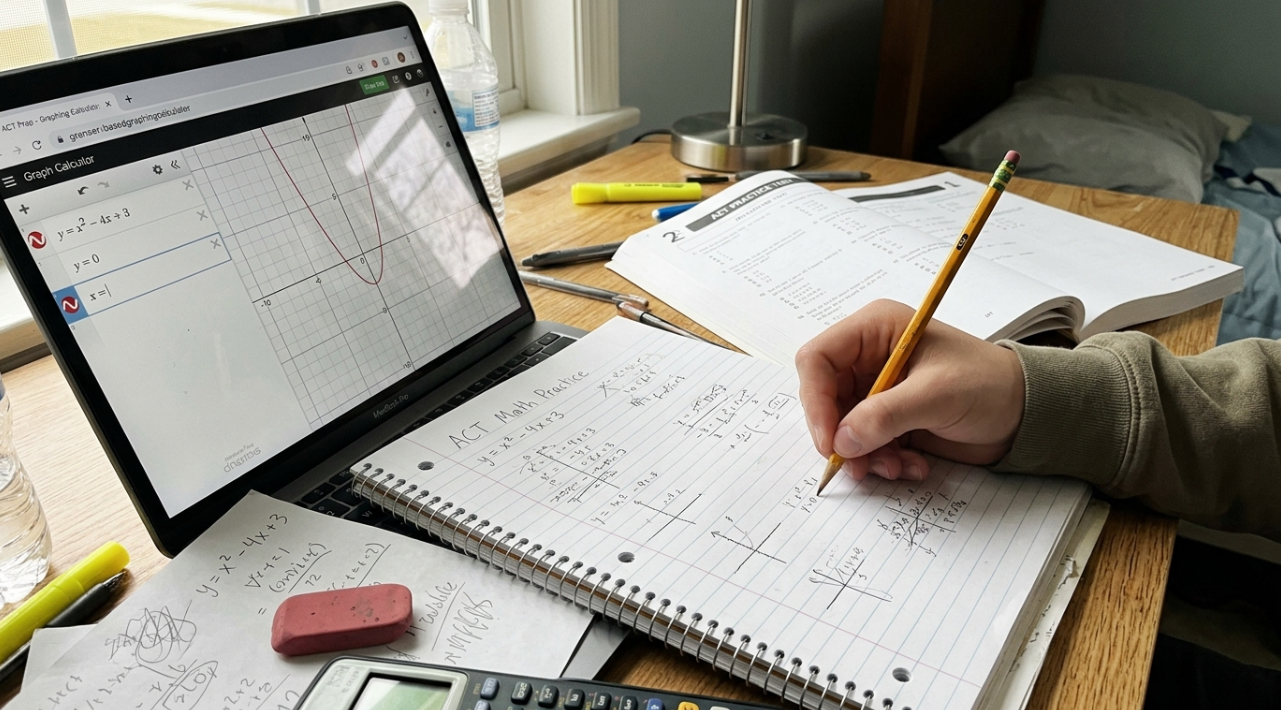
You get 50 minutes for 45 multiple-choice questions. The test is arranged by difficulty, with more straightforward problems at the beginning and the most complex questions toward the end.
Two big changes from the Legacy ACT matter here. First, answer choices dropped from 5 to 4, which slightly improves your odds on educated guessing. Second, “Integrating Essential Skills” questions (basically pre-high school math) were cut from about 40% of the test to roughly 20%. The easier questions were removed, so difficulty ramps up faster than it used to.
On the digital version, every student gets access to a built-in Desmos graphing calculator on every math question, starting with the December 2025 administration. If you’re taking the paper test, you need to bring your own approved calculator. For tips on using Desmos effectively, check out this Desmos calculator guide, which covers strategies that apply to both the SAT and ACT.
Reading (36 Questions, 40 Minutes)
Reading is arguably the section that benefited most from the format change. Students now get over a minute per question (about 67 seconds) compared to roughly 53 seconds on the Legacy ACT. That extra breathing room is significant.
The section includes three scored operational passages and one unscored field-test passage. You won’t be able to tell which passage is unscored, so treat every passage seriously.
New features in the Enhanced ACT Reading section include more paired or comparative passages, greater cultural authenticity in literary passages, and the addition of visual/quantitative information (VQI) passages that include charts or graphs alongside text.
How to prepare for ACT Reading: Practice identifying a passage's main idea, locating supporting evidence, interpreting the author's purpose, and comparing information across texts. Use timed passages to develop a pacing strategy that leaves enough time to answer every question.
During review, return to the relevant lines in the passage and explain why the correct answer is supported by the text. This builds evidence-based reasoning instead of relying on memory or intuition.
Science (40 Questions, 40 Minutes, Optional)
This is the biggest structural change in the ACT test format. Science used to be required and counted toward your Composite score. Now it’s optional and scored separately.
The section gives you 40 questions in 40 minutes across 7 passages. It may include more “background knowledge” items than before, and a new engineering design passage type has been added.
Students who take Science receive a separate Science score (1 to 36) plus a STEM score, which is the average of their Math and Science section scores.
Should you take it? According to a Spark Admissions survey, about 90% of the top 50 colleges are leaving the ACT Science section as optional. Take it if you’re applying to schools that require or recommend it (Georgetown, Boston University, Pomona, Duke, military academies), if you’re planning a STEM major, or if science happens to be a strength. Skip it if adding 40 minutes of testing time would drain your energy and hurt your core section scores.
Writing (1 Essay, 40 Minutes, Optional)
The Writing section remains a single essay completed in 40 minutes. Fewer colleges require it every year. Check your target schools’ requirements before deciding to add it.
Should you take ACT Writing? Decide based on your target colleges' current admissions requirements and recommendations. The Writing test is optional, but its relevance to your application depends on the institutions and programs you plan to apply to.
If you choose Writing, practice developing a clear position, supporting it with specific reasoning, and organizing your response within the 40-minute time limit. Review your target colleges' policies before registering.
How the ACT Is Scored
The Composite score is the number that matters most. Under the Enhanced ACT format, it’s calculated from three sections instead of the previous four:
Composite = (English + Math + Reading) ÷ 3
Each section is scored on a 1 to 36 scale. The Composite is rounded to the nearest whole number.
This formula change has a strategic implication that most students overlook. On the old ACT, each section contributed 25% of your Composite. Now each section contributes 33%. A weak section hurts more than it used to, and a strong section helps more. If you’re trying to decide where to focus your study time, consider using the ACT score predictor to see which section offers the biggest opportunity for improvement.
No penalty for wrong answers. Each correct answer earns one raw score point, and incorrect answers cost nothing. Never leave a question blank. Even a random guess gives you a 25% chance.
STEM Score: If you take the Science section, you’ll receive a STEM score that averages your Math and Science scores. According to ACT.org, a STEM score benchmark of 26 is associated with at least a 50% chance of earning a B or higher in a first-year STEM college course.
ELA Score: Separately reported, this averages your English and Reading scores.
Superscoring: Many colleges allow superscoring, where they take your best section scores across multiple test dates and combine them. The Enhanced ACT superscore formula is: add your best English, Math, and Reading scores, divide by 3, round to the nearest whole number. For a deeper look at how scoring works, read the ACT score chart guide.
Scored vs. Unscored Questions on the ACT
Not every question on the Enhanced ACT contributes to your reported section score. ACT embeds field-test questions within the test to evaluate potential questions for future use. These items do not count toward your score and are mixed in with operational questions.
Section | Total Questions | Scored Questions | Unscored Questions |
|---|---|---|---|
English | 50 | 40 | 10 |
Math | 45 | 41 | 4 |
Reading | 36 | 27 | 9 |
Science | 40 | 34 | 6 |
These figures reflect the published Enhanced ACT structure. Check the official specifications for your particular testing program and administration.
Can You Tell Which ACT Questions Are Unscored?
No. Field-test questions are integrated into the test, and students cannot reliably identify them during the exam. Treat every question as if it counts.
Do not spend time trying to guess which questions are experimental. Instead, follow your pacing strategy, answer every question, and move on when a question is taking too long.
Scored vs. Unscored Questions
Here’s a detail that surprises many students. Not every question on the ACT counts toward your score. The Enhanced ACT embeds unscored field-test items throughout each section. These experimental questions look identical to scored questions, and you won’t know which are which.
Section | Total Questions | Scored Questions | Field-Test (Unscored) Questions |
|---|---|---|---|
English | 50 | 40 | 10 |
Math | 45 | 41 | 4 |
Reading | 36 | 27 | 9 |
Science | 40 | 34 | 6 |
Test Innovators confirms the English breakdown of 40 operational and 10 field-test questions. The Math section has only 41 scored items, and Reading has 27 operational questions out of 36 total.
This matters strategically. On a 41-question scored Math test, every single question carries more weight than it did on the old 60-question test. Missing 5 questions can drop you 3 to 4 scale points. The same logic applies even more dramatically to Reading, where only 27 questions determine your score.
Since you can’t identify which questions are field-test items, the only rational approach is to treat every question as if it counts. Practice with ACT practice questions that mirror this mix of difficulty levels.
Digital ACT vs. Paper ACT

Students taking the ACT on national Saturday test dates can choose between paper and digital formats. Both test the same content and use the same scoring scale.
Here’s what differs:
Feature | Digital ACT | Paper ACT |
|---|---|---|
Calculator | Built-in Desmos + your own | Bring your own only |
Scratch work | Scratch paper provided | Write in test booklet |
Accessibility tools | Zoom, highlight, answer masking, line reader | None built in |
Practice material available | ~2 official practice tests | 30+ released tests |
Should You Take the ACT on Paper or Online?
Both paper and online testing are available for the ACT, subject to the testing program and test-center options. The best choice depends on your comfort with the format and the practice materials available for your test date.
Consider online testing if:
You are comfortable reading passages and navigating questions on a screen.
You want to practice using the built-in Desmos calculator.
You prefer digital tools such as highlighting and other supported accessibility features.
Consider paper testing if:
You prefer annotating passages and working directly in a physical booklet.
You are more comfortable managing your work on paper.
You want to practice with paper-based materials that match your chosen testing format.
Whichever format you choose, prioritize practice tests that reflect the current Enhanced ACT structure, timing, and question types. Older ACT tests can still help you review core content, but confirm that the material matches the current exam before using it to simulate test day.
Before registering, confirm which formats your selected test center offers.
How the ACT Format Changed: Legacy vs. Enhanced ACT
The Enhanced ACT introduced a shorter testing experience, fewer questions, four answer choices for Math instead of five, and an optional Science section. The Composite score also changed to use English, Math, and Reading.
Feature | Legacy ACT | Enhanced ACT |
|---|---|---|
English | 75 questions, 45 minutes | 50 questions, 35 minutes |
Math | 60 questions, 60 minutes, 5 choices | 45 questions, 50 minutes, 4 choices |
Reading | 40 questions, 35 minutes | 36 questions, 40 minutes |
Science | 40 questions, 35 minutes, required in the traditional format | 40 questions, 40 minutes, optional |
Four-section question total | 215 | 171 |
Four-section timed duration | 175 minutes | 165 minutes |
Core Composite sections | English, Math, Reading, Science | English, Math, Reading |
The Enhanced ACT reduces the four-section multiple-choice test from 215 to 171 questions, a reduction of 44 questions. The exact timing and rollout depend on the test administration.
The underlying academic skills remain broadly comparable, but students should adapt their pacing and preparation to the new section lengths, timing, and scoring structure. Legacy practice tests can help build content knowledge, but use current-format practice materials to prepare for the actual test experience.
For a complete comparison between the ACT and SAT to determine which test suits you better, see this SAT vs. ACT guide.
What Hasn't Changed on the ACT?
Although the Enhanced ACT changed the test's length, timing, and Composite calculation, several fundamentals remain:
Scoring scale: Section scores remain on a 1–36 scale.
Core skills: English, Math, and Reading continue to assess established college-readiness skills.
Guessing: There is no penalty for incorrect answers.
Superscoring: ACT continues to support superscoring, subject to score-reporting rules and college policies.
Test format options: Paper and online testing remain available where offered.
The key preparation adjustment is to use current-format practice materials and build a pacing strategy for the updated section lengths.
Practical Advice from the ACT Community
Practitioners on Reddit consistently describe the ACT as a pattern recognition test rather than a pure content test. The consensus on r/ACT is that full-length timed practice tests combined with error logs beat passive studying every time. One frequently recommended approach is to take a full practice exam, review every wrong answer, categorize mistakes by type (careless error, content gap, timing issue), and then drill the specific weak areas before taking another full test.
Experienced tutors also point out that the ACT is generally better for students who are strong readers and good at working through material quickly, while the SAT tends to favor deep thinkers and students who are further along in algebra. If you’re not sure which test fits you best, taking a diagnostic test for each exam and comparing your results is the most reliable way to decide.
Frequently Asked Questions About the ACT Test Format
How long is the ACT in 2026?
The required English, Math, and Reading sections take 2 hours and 5 minutes of timed testing. Adding the optional Science section increases the total to 2 hours and 45 minutes. Taking both Science and Writing brings the timed total to 3 hours and 25 minutes, excluding breaks and administrative time.
How many questions are on the Enhanced ACT?
The three required sections contain 131 questions: 50 English, 45 Math, and 36 Reading questions. Adding Science brings the multiple-choice total to 171 questions. The optional Writing test adds one essay prompt.
Is ACT Science optional in 2026?
Science is optional for the Enhanced ACT Composite. However, students should check their target colleges' current admissions policies to determine whether taking Science is recommended or required for their circumstances.
Is the ACT easier after the 2025–2026 changes?
The Enhanced ACT has fewer questions and provides more time per question than the traditional format. However, fewer questions and more time do not automatically make the exam easier for every student. Your results depend on your skills, preparation, and ability to manage time.
Can I take the ACT on paper in 2026?
Yes. ACT offers paper and online testing, subject to the availability of your testing program and location. Check your registration options before choosing a format.
Does the online ACT have a built-in calculator?
Yes. The online ACT provides a built-in Desmos graphing calculator during Math. Students should practice using the tool before test day and review the official calculator policy.
Does the ACT penalize wrong answers?
No. There is no penalty for incorrect answers. Answer every question, even when you are unsure of the correct choice.
How is the ACT Composite score calculated?
The Enhanced ACT Composite is calculated by averaging your English, Math, and Reading section scores and rounding to the nearest whole number. The optional Science score does not contribute to the Composite.
Are there unscored questions on the ACT?
Yes. The Enhanced ACT includes embedded field-test questions that do not count toward your score. These questions are mixed in with scored items, so you should treat every question as if it counts.
How should I start preparing for the Enhanced ACT?
Begin with a current-format practice test to establish your baseline. Review your mistakes, identify your weakest skills, and build a study schedule around those gaps. Take additional timed practice tests to track progress and improve pacing.
Ready to put your knowledge of the ACT test format into action? Start practicing with free ACT prep that includes full-length practice exams, a question bank, and AI-powered explanations for every answer.