
How Many Questions Are on the ACT? 2026 Full Breakdown
Miyagi Labs ·
How Many Questions Are on the ACT? 2026 Full Breakdown

TL;DR
The Enhanced ACT features 131 multiple-choice questions across its three required sections: English (50), Math (45), and Reading (36). Adding the optional Science section brings the total to 171 questions. The updated format introduced fewer questions, more time per question, and a composite score based on English, Math, and Reading. The transition timeline varies by administration type, so students should check the ACT format applicable to their test date.
Studying for the Enhanced ACT? Get started with free ACT practice tests that reflect the current format.
How Many Questions Are on the ACT in 2026?
The Enhanced ACT has 131 multiple-choice questions across three required sections: English (50 questions), Math (45 questions), and Reading (36 questions). Students who take the optional Science section answer 40 additional questions, bringing the total to 171. The optional Writing section consists of one essay prompt. The core ACT takes 2 hours and 5 minutes of testing time, while adding Science extends the multiple-choice testing time to 2 hours and 45 minutes.
ACT Section | Questions | Time | Required? |
|---|---|---|---|
English | 50 | 35 minutes | Yes |
Math | 45 | 50 minutes | Yes |
Reading | 36 | 40 minutes | Yes |
Core ACT total | 131 | 125 minutes | Yes |
Science | 40 | 40 minutes | No |
Total with Science | 171 | 165 minutes | Science is optional |
Writing | 1 essay | 40 minutes | No |
The question counts and section timings are based on ACT's published test structure. The question totals include embedded field-test items that do not count toward scores.
Total ACT Question Count at a Glance
The ACT underwent a major overhaul in 2025, and the question count dropped significantly. Here is the current breakdown:
Section | Questions | Time | Required? |
|---|---|---|---|
English | 50 | 35 min | Yes |
Math | 45 | 50 min | Yes |
Reading | 36 | 40 min | Yes |
Science | 40 | 40 min | No (+$4) |
Writing | 1 essay | 40 min | No (+$25) |
Core total | 131 | 125 min | — |
With Science | 171 | 165 min | — |
You can register for one of four test configurations:
ACT Core only (English, Math, Reading)
ACT + Science
ACT + Writing
ACT + Science + Writing
The core test costs $68. Adding Science is just $4 more, and the Writing section adds $25.
If you see “215 questions” cited on another website, that is the old ACT format. It no longer exists. At least one page currently ranking on Google’s first page still lists those outdated numbers, so be careful about which sources you trust.
How Much Does the ACT Cost With Optional Sections?
The cost of the ACT depends on the registration period and the test options you select. ACT's published 2026–2027 national registration fees list the core ACT at $70, the optional Science section at an additional $5, and the optional Writing section at an additional $25. Check the official ACT registration page for current fees, late-registration charges, and any applicable fee waivers before registering.
Questions Per Section (Detailed)
English: 50 Questions, 35 Minutes
The English section tests grammar, punctuation, sentence structure, and rhetorical skills. You get roughly 42 seconds per question, up from 36 seconds on the legacy ACT. Questions are passage-based: you’ll read several passages and answer questions about underlined portions of the text.
For targeted practice on this section, try working through ACT practice questions organized by skill type.
Math: 45 Questions, 50 Minutes
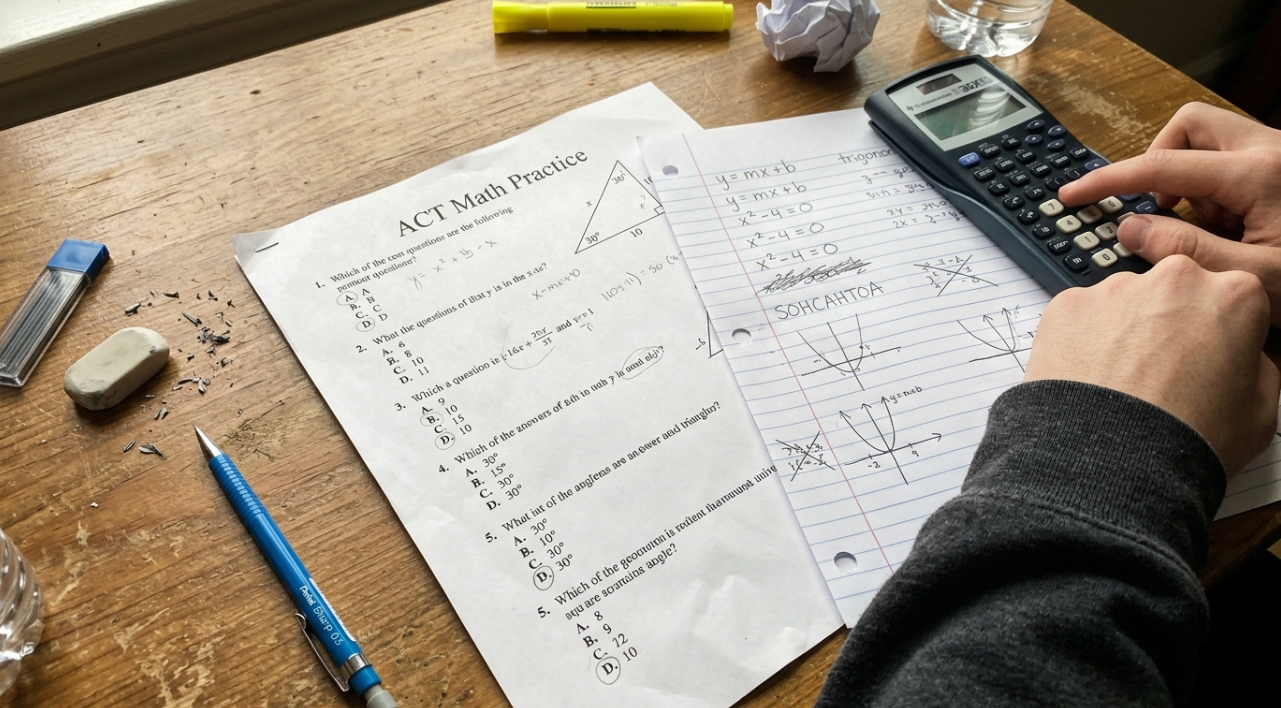
The math section gives you about 67 seconds per question. Two big changes from the old format: answer choices dropped from five to four, and the section now leans much harder on higher-level math. According to analysis from test prep tutor MathChops, roughly 80% of Enhanced ACT Math questions fall under “Preparing for Higher Math” (algebra, functions, geometry, statistics), compared to about 57-60% on the legacy test. Only 20% test foundational skills, down from 40-43%.
A calculator is permitted throughout. The difficulty ramp hits earlier than it used to, which is something practitioners have flagged. MathChops noted that ACT appears to be pulling primarily from what used to be the harder back half of the old test, making the Enhanced version feel tougher even though you technically have more time.
Reading: 36 Questions, 40 Minutes
At 67 seconds per question, the Reading section is more generous with time than the old version (which gave you 53 seconds). You’ll encounter four passage types covering prose fiction, social science, humanities, and natural science. The total question count dropped from 40 to 36, but the format of the questions themselves hasn’t changed much.
Science (Optional): 40 Questions, 40 Minutes
This section tests your ability to interpret data, evaluate experimental design, and reconcile conflicting viewpoints. It does not require deep science knowledge. You get about 60 seconds per question.
Writing (Optional): 1 Essay, 40 Minutes
The Writing section remains what it has always been: a single argumentative essay prompt. It is scored separately on a 2-12 scale and does not affect your composite score.
ACT Questions by Section: English, Math, Reading, and Science
Each ACT section has a different question count, time limit, and purpose. English and Reading assess language and comprehension skills, Math tests mathematical reasoning, and Science evaluates data interpretation and scientific reasoning.
Section | Questions | Time Limit | Approx. Time per Question |
|---|---|---|---|
English | 50 | 35 minutes | 42 seconds |
Math | 45 | 50 minutes | 67 seconds |
Reading | 36 | 40 minutes | 67 seconds |
Science (optional) | 40 | 40 minutes | 60 seconds |
The time-per-question figures are averages, not strict limits. You can spend longer on difficult questions and make up time on easier ones. The best pacing strategy depends on the section and your own strengths.
English: 50 Questions in 35 Minutes
The English section assesses grammar, punctuation, sentence structure, usage, and rhetorical skills through passage-based questions. You have approximately 42 seconds per question, so practice identifying errors and evaluating revisions efficiently.
Math: 45 Questions in 50 Minutes
The Math section covers mathematical reasoning, including algebra, functions, geometry, statistics, and other higher-math topics. You have approximately 67 seconds per question, and four answer choices are provided for each multiple-choice item.
Reading: 36 Questions in 40 Minutes
The Reading section assesses comprehension and analysis of literary and informational texts. You have approximately 67 seconds per question, so practice locating evidence, understanding context, and distinguishing main ideas from supporting details.
Science: 40 Questions in 40 Minutes
The optional Science section emphasizes interpreting data, evaluating scientific investigations, and reasoning from evidence. You have approximately 60 seconds per question. You do not need to memorize every scientific fact to answer questions that provide the relevant information in passages, charts, or experiments.
Writing: One Essay in 40 Minutes
The optional Writing section requires one essay responding to a prompt. It is scored separately and does not contribute to the ACT Composite score.
How Many Questions Actually Count? Scored vs. Field Test

This is the part most ACT prep articles skip, and it matters a lot.
The Enhanced ACT embeds unscored “field test” items throughout every section. These are experimental questions that ACT is evaluating for future exams. They look identical to real questions. You cannot tell which ones they are, so you have to treat every question as if it counts.
Here is the actual scored vs. unscored breakdown:
Section | Total Questions | Scored | Unscored (Field Test) |
|---|---|---|---|
English | 50 | 40 | 10 |
Math | 45 | 41 | 4 |
Reading | 36 | 27 | 9 |
Science | 40 | 34 | 6 |
Core total | 131 | 108 | 23 |
With Science | 171 | 142 | 29 |
On the passage-based sections (English, Reading, Science), one entire passage and its associated questions won’t count toward your score. According to ACT’s design, the first and last passages in each section will not be part of the field test, so the unscored passage is somewhere in the middle.
Why this matters: With only 108 scored questions on the core test, each correct answer carries more weight than it did when there were 215 questions. Missing a handful of scored questions can swing your section score by multiple points.
Admissions experts at Collegewise put it bluntly: “With dramatically fewer questions that count within the ACT’s main subjects, scoring will be affected in ways that most test-takers cannot immediately appreciate.”
The scoring curves confirm this. Early data from Enhanced ACT administrations shows real variability. On some test forms, missing 6 out of 41 scored Math questions still yielded a 33, while on others the same number of misses dropped students to a 31. That kind of swing means accuracy is everything.
To see how your accuracy translates to a predicted score, try the ACT score predictor.
How Many ACT Questions Are Scored?
Not every question on the Enhanced ACT contributes to your score. ACT includes embedded field-test items to evaluate questions for possible future use. These items appear within the test but do not count toward your score, and students cannot reliably identify them during the exam.
Section | Total Questions | Scored Questions | Field-Test Questions |
|---|---|---|---|
English | 50 | 40 | 10 |
Math | 45 | 41 | 4 |
Reading | 36 | 27 | 9 |
Core ACT total | 131 | 108 | 23 |
Science (optional) | 40 | 34 | 6 |
Total with Science | 171 | 142 | 29 |
The core ACT includes 108 scored items out of 131 total questions. If you take Science, the four-section test includes 142 scored items out of 171. These counts describe the test structure; they do not mean that every correct answer translates into a fixed number of points on the 1–36 score scale.
Legacy ACT vs. Enhanced ACT: What Changed
The table below shows exactly how many questions are on the ACT now compared to the old format:
Legacy ACT (Pre-2025) | Enhanced ACT (2025+) | |
|---|---|---|
English | 75 questions, 45 min | 50 questions, 35 min |
Math | 60 questions, 60 min | 45 questions, 50 min |
Reading | 40 questions, 35 min | 36 questions, 40 min |
Science | 40 questions, 35 min (required) | 40 questions, 40 min (optional) |
Total (core) | 215 questions, 175 min | 131 questions, 125 min |
Sections in composite | 4 | 3 |
That is 44 fewer core questions and 50 fewer minutes of testing. Students get roughly 18% more time per question across the board.
One common reaction from test prep professionals is that the Enhanced ACT isn’t fundamentally different in what it tests. As one admissions consultant wrote on Substack: “Functionally, the ACT a student takes in the 2025-2026 school year isn’t really different than the one students took in 2023-2024. The question types are exactly the same, and the order of sections is the same. Really, it’s just a little faster.”
The biggest structural change is that each required section now accounts for one-third of your composite score instead of one-quarter. A weakness in any single area hurts more. If you want to practice with current ACT materials, make sure they reflect the Enhanced format, not legacy tests.
Legacy ACT vs. Enhanced ACT: What Changed?
The Enhanced ACT has fewer questions than the legacy ACT and provides more time per question. Its required composite-scored sections are also different: English, Math, and Reading determine the Composite score, while Science is optional for eligible individual national testing configurations.
Feature | Legacy ACT | Enhanced ACT |
|---|---|---|
English | 75 questions, 45 minutes | 50 questions, 35 minutes |
Math | 60 questions, 60 minutes | 45 questions, 50 minutes |
Reading | 40 questions, 35 minutes | 36 questions, 40 minutes |
Science | 40 questions, 35 minutes | 40 questions, 40 minutes; optional in applicable configurations |
Core question count | 215 | 131 |
Core testing time | 175 minutes | 125 minutes |
Sections used in Composite score | English, Math, Reading, Science | English, Math, Reading |
The Enhanced ACT reduces the core question count by 84 compared with the legacy format, from 215 to 131. It also reduces core testing time by 50 minutes, from 175 to 125 minutes.
The change does not mean the exam measures entirely different academic skills. Instead, the format has fewer questions, more time per question in the required sections, and a different Composite score calculation.
Students preparing for the Enhanced ACT should use practice materials that match the format and scoring rules applicable to their test date.
ACT vs. SAT Question Count
Students deciding between tests often wonder how the question counts compare. Here’s a quick side-by-side:
ACT (Core) | ACT (With Science) | Digital SAT | |
|---|---|---|---|
Total questions | 131 | 171 | 98 |
Test time | 2 hr 5 min | 2 hr 45 min | 2 hr 14 min |
Format | Linear | Linear | Adaptive |
Sections | 3 required | 4 | 2 |
The ACT has significantly more questions than the SAT, but also provides more time per question than many people assume (especially on Math and Reading). The SAT’s adaptive format means the difficulty of your second module depends on your first-module performance, which is a completely different testing experience.
For a deeper comparison of both tests, read our SAT vs. ACT guide.
ACT vs. SAT: How Many Questions Does Each Test Have?
Students deciding between the ACT and SAT should compare more than the total number of questions. The tests differ in structure, pacing, and delivery.
Feature | Enhanced ACT Core | Enhanced ACT With Science | Digital SAT |
|---|---|---|---|
Total questions | 131 | 171 | 98 |
Core or total testing time | 2 hr 5 min | 2 hr 45 min | 2 hr 14 min |
Format | Linear | Linear | Adaptive |
Required sections or subject areas | English, Math, Reading | English, Math, Reading, Science | Reading and Writing, Math |
The ACT's core test includes more questions than the digital SAT, but question count alone does not determine which exam is easier for you. The SAT uses an adaptive format, while the ACT follows a linear testing structure.
To decide which test better suits your strengths, compare sample questions, try a timed practice test for each exam, and review the score policies of the colleges you plan to apply to.
For a deeper breakdown, read our SAT vs. ACT guide.
Should You Take the Optional ACT Science Section?
The optional ACT Science section may be useful for students applying to programs that value science reasoning or report a separate STEM score. However, whether you should take it depends on the requirements and recommendations of your target colleges.
Before registering, check each college's official admissions website for its ACT testing policy. Confirm whether the school requires Science, recommends it, accepts it as an additional score, or does not consider it. Requirements may differ by institution, program, and application cycle.
Consider three factors when deciding:
College requirements: Take Science if a school on your list requires it.
Academic goals: A Science score may provide additional information for students pursuing science, technology, engineering, or mathematics programs.
Preparation and time: The section adds 40 minutes of testing, so consider whether the additional score serves your application goals.
Do not assume that an optional section is irrelevant to every college simply because it is excluded from the ACT Composite score.
How Many Questions Can You Miss on the ACT and Still Get a Good Score?
There is no single number of questions you can miss and still earn a particular ACT score. The result depends on your performance in each section and the scoring conversion used for that test form.
For example, missing several questions in Math does not necessarily have the same score impact as missing the same number in English or Reading. Raw scores are converted into scaled scores, and the relationship varies by section and test form.
To estimate your likely result:
Take a practice test that matches the Enhanced ACT format.
Record your correct answers separately for English, Math, and Reading.
Use an appropriate ACT raw-to-scaled-score chart or scoring tool.
Identify the section where improving accuracy would most help your target score.
Repeat the process after targeted practice to track progress.
Remember that field-test items do not count toward your score, but you cannot identify them reliably during the exam. Always answer every question and focus on maximizing your overall accuracy.
Use an ACT score predictor to estimate your score, then consult an ACT score chart for further context.
How to Prepare for the Enhanced ACT
The best way to prepare for the Enhanced ACT is to understand the format, identify your weakest skills, and practice under realistic timing conditions.
Step 1: Take a Diagnostic Practice Test
Start with a practice test that matches the current ACT format. Use the results to identify which sections and question types need the most attention.
Step 2: Practice by Section and Skill
Work on specific areas such as English grammar, algebra, reading comprehension, and scientific data interpretation. Targeted practice helps you address mistakes instead of repeating them.
Step 3: Build Your Pacing Skills
Practice within the official section time limits: 35 minutes for English, 50 minutes for Math, 40 minutes for Reading, and 40 minutes for optional Science.
Step 4: Review Every Mistake
After each practice session, determine why you missed a question. Look for gaps in content knowledge, misread instructions, weak reasoning, and time-management problems.
Start with free ACT practice tests, use an ACT question bank for targeted drills, and follow a step-by-step ACT study plan to structure your preparation.
For a complete study strategy, check out our step-by-step ACT study plan.
Time Per Question: The Enhanced ACT Pacing Guide
One of the biggest benefits of the Enhanced ACT is more breathing room per question. Here is the time per question for each section, compared to the legacy format:
Section | Legacy Time/Question | Enhanced Time/Question | Change |
|---|---|---|---|
English | 36 seconds | 42 seconds | +17% |
Math | 60 seconds | 67 seconds | +12% |
Reading | 53 seconds | 67 seconds | +26% |
Science | 53 seconds | 60 seconds | +13% |
Reading got the biggest time boost. Students who previously struggled to finish passages on time may find the Enhanced format significantly more manageable.
That said, the difficulty distribution has shifted. With harder questions appearing earlier (especially in Math), the extra seconds don’t translate to an easier test. They translate to a fairer one, where time pressure is less likely to be the reason you miss questions.
Understanding How Your Composite Score Works
On the Enhanced ACT, only English, Math, and Reading count toward the 1-36 composite. Your composite is simply the average of those three section scores, rounded to the nearest whole number.
This is a change from the legacy ACT, where the composite was the average of four section scores (including Science). The shift means:
A weak section drags your composite down more (it’s one-third, not one-quarter)
Improving your lowest section by even 2-3 points has a noticeable composite impact
Science, when taken, is reported separately and does not dilute or boost your composite
If a student takes Science, that score combines with Math to produce a STEM score, which is reported alongside (but separate from) the composite. For guidance on how raw scores convert to scaled scores, see our ACT score chart.
Ready to start preparing for the Enhanced ACT? Try free ACT practice with a personalized study path, AI tutoring, and full-length timed exams that match the current format.
Frequently Asked Questions About ACT Questions
How many questions are on the ACT without Science?
The Enhanced ACT has 131 multiple-choice questions without Science: 50 English, 45 Math, and 36 Reading questions. The core test has 125 minutes of testing time.
How many questions are on the ACT with Science?
The ACT has 171 multiple-choice questions when the optional Science section is included. The four multiple-choice sections take 165 minutes in total.
How many ACT questions are scored?
The Enhanced ACT core has 108 scored questions out of 131 total questions. These include 40 English, 41 Math, and 27 Reading questions. With Science, the total is 142 scored questions out of 171.
Is the ACT still 215 questions in 2026?
The Enhanced ACT core has 131 questions, not 215. The figure of 215 refers to the legacy format with English, Math, Reading, and Science all included as required sections.
How long does the ACT take in 2026?
The core Enhanced ACT takes 2 hours and 5 minutes of testing time. Adding Science increases the multiple-choice testing time to 2 hours and 45 minutes. Optional Writing adds a further 40 minutes, excluding breaks and other test-day procedures.
How many questions are on each ACT section?
English has 50 questions, Math has 45, Reading has 36, and optional Science has 40. Optional Writing consists of one essay prompt.
Does ACT Science count toward the Composite score?
No. Under the Enhanced ACT scoring structure, the Composite score is based on English, Math, and Reading. Science is reported separately.
How much time do you get for each ACT question?
The average time per question is about 42 seconds for English, 67 seconds for Math, 67 seconds for Reading, and 60 seconds for Science. These are averages rather than fixed time limits for individual questions.
Is the ACT harder because it has fewer questions?
Not necessarily. Fewer questions do not automatically make the exam easier or harder. The Enhanced ACT has a different question count and timing structure, but students still need to demonstrate the skills assessed in each section.
Should I take the optional ACT Science section?
Check the testing policies of your target colleges and consider your academic goals. Science does not contribute to the Enhanced ACT Composite score, but some institutions or programs may value or require additional testing information. Verify current requirements directly with each institution.