
SAT Geometry Formulas 2026: Cheat Sheet + What to Memorize
Miyagi Labs ·
SAT Geometry Formulas 2026: Cheat Sheet + What to Memorize

TL;DR
The Digital SAT reference sheet gives you 12 geometry formulas and 3 angle facts, but you need to memorize roughly 12 more geometry and trig formulas that aren’t provided. Geometry and Trigonometry accounts for about 15% of SAT Math (5 to 7 questions), and it offers one of the best returns on study time of any domain. This glossary covers every SAT geometry formula you need, marks each one as provided or must-memorize, and tells you exactly when you’ll see it on test day.
SAT Geometry Formulas: What to Memorize
For the 2026 Digital SAT, Geometry and Trigonometry accounts for about 15% of Math, or approximately 5–7 questions. College Board provides a reference sheet with common area, volume, Pythagorean theorem, and special-right-triangle formulas. You should still memorize formulas and relationships that are not provided, especially the circle equation, distance formula, midpoint formula, slope, arc length, sector area, polygon angle sum, and basic right-triangle trigonometry.
The formulas worth memorizing first
Circle equation: (x − h)² + (y − k)² = r²
Distance formula: d = √[(x₂ − x₁)² + (y₂ − y₁)²]
Midpoint formula: M = ((x₁ + x₂)/2, (y₁ + y₂)/2)
Slope: m = (y₂ − y₁)/(x₂ − x₁)
Arc length: (θ/360) × 2πr
Sector area: (θ/360) × πr²
Interior angle sum: (n − 2) × 180°
SOH-CAH-TOA: sin θ = opposite/hypotenuse, cos θ = adjacent/hypotenuse, tan θ = opposite/adjacent
Pythagorean identity: sin²θ + cos²θ = 1
Complementary-angle identity: sin θ = cos(90° − θ)
The formulas on the SAT reference sheet are still worth knowing instantly, especially the Pythagorean theorem, circle area, and special right-triangle ratios, because using them from memory is faster than repeatedly opening the reference sheet.
SAT Geometry Formula Cheat Sheet
Use this table as a last-minute SAT geometry reference. "Provided" means the formula appears on the official SAT reference sheet. "Memorize" means it is not printed there and is worth knowing before test day.
Formula or concept | Formula | SAT reference sheet? | Priority |
|---|---|---|---|
Circle area | A = πr² | Provided | High |
Circle circumference | C = 2πr | Provided | High |
Rectangle area | A = lw | Provided | High |
Triangle area | A = ½bh | Provided | High |
Pythagorean theorem | a² + b² = c² | Provided | Very high |
45-45-90 triangle | x : x : x√2 | Provided | Very high |
30-60-90 triangle | x : x√3 : 2x | Provided | Very high |
Rectangular prism volume | V = lwh | Provided | Medium |
Cylinder volume | V = πr²h | Provided | Medium |
Sphere volume | V = 4/3πr³ | Provided | Medium |
Cone volume | V = 1/3πr²h | Provided | Medium |
Pyramid volume | V = 1/3lwh | Provided | Medium |
Circle equation | (x − h)² + (y − k)² = r² | Not provided | Very high |
Distance formula | d = √[(x₂ − x₁)² + (y₂ − y₁)²] | Not provided | High |
Midpoint formula | ((x₁+x₂)/2, (y₁+y₂)/2) | Not provided | High |
Slope | m = (y₂−y₁)/(x₂−x₁) | Not provided | Very high |
Arc length | (θ/360) × 2πr | Not provided | Medium |
Sector area | (θ/360) × πr² | Not provided | Medium |
Polygon interior angle sum | (n−2) × 180° | Not provided | High |
SOH-CAH-TOA | sin θ = O/H, cos θ = A/H, tan θ = O/A | Not provided | Very high |
Pythagorean identity | sin²θ + cos²θ = 1 | Not provided | Medium |
Complementary-angle identity | sin θ = cos(90°−θ) | Not provided | Medium |
Similar triangles | Corresponding sides are proportional | Concept | High |
Scale factors | Length × k, area × k², volume × k³ | Concept | High |
Tangent-radius relationship | Radius ⟂ tangent | Concept | Medium |
Inscribed angle relationship | Inscribed angle = ½ central angle | Concept | Medium |
Best strategy: Memorize the formulas marked "Very high" first. Then learn the "High" and "Medium" formulas through practice questions. You do not need to spend equal study time on every formula.
What Geometry Topics Are Tested on the SAT?
The Digital SAT Geometry and Trigonometry domain covers four major areas:
SAT Geometry Topic | What You Need to Know |
|---|---|
Area and volume | Areas, perimeters, surface areas, volumes, and scale factors |
Lines, angles, and triangles | Angle relationships, triangle properties, similarity, and proportional relationships |
Right triangles and trigonometry | Pythagorean theorem, special right triangles, sine, cosine, and tangent |
Circles | Circle equations, radius and diameter, circumference, area, arcs, sectors, and circle-angle relationships |
College Board identifies Geometry and Trigonometry as one of the four SAT Math content domains, representing approximately 15% of the Math section.
This means you should study more than isolated formulas. The SAT tests whether you can recognize which geometric relationship applies and use it in a mathematical or real-world context.
What the SAT Reference Sheet Actually Gives You
Before memorizing anything, know what’s already handed to you. The Digital SAT includes a built-in reference sheet inside Bluebook, the application College Board uses to administer the test. You can pull it up with one click at any time during both math modules.
The sheet contains about 12 geometry formulas and 3 angle/radian facts. It covers area formulas, volume formulas, the Pythagorean theorem, special right triangle ratios, and constants about degrees and radians.
Here’s what it does not contain: a single algebra formula. Not one. That matters because roughly 85% of SAT math questions fall under Algebra, Advanced Math, and Problem-Solving & Data Analysis, where zero formulas are provided. The formulas you need most are exactly the ones the test doesn’t give you.
Geometry and Trigonometry makes up about 15% of SAT Math, or 5 to 7 scored questions. That sounds small, but these questions generate outsized anxiety because they involve a wider range of formula types than any other domain. The good news? A focused two-week effort on the formulas below, combined with diagram-labeling practice, can realistically net you 3 to 4 correct answers out of the 5 to 7 geometry questions you’ll face.
If you want to find which formulas you already know (and which you don’t), take a diagnostic practice test before building your study plan.
What Geometry Formulas Are Not on the SAT Reference Sheet?
The SAT reference sheet provides many of the basic area, volume, and right-triangle formulas, but it does not provide every equation or relationship you may need.
The most important formulas and relationships to know before test day include:
Equation of a circle
Distance formula
Midpoint formula
Slope formula
Arc length
Sector area
Interior angle sum of a polygon
SOH-CAH-TOA
Pythagorean identity
Complementary-angle trigonometric relationship
Similar-triangle proportional relationships
Scale-factor relationships
Circle-angle relationships
This distinction matters because the SAT reference sheet is a tool, not a complete formula library. You should know which information is available to you and which relationships you must recall yourself.
The most important formulas to memorize
If you have limited study time, prioritize the circle equation, slope, distance and midpoint formulas, SOH-CAH-TOA, polygon angle sum, arc length, and sector area. Then practice applying them to SAT-style questions rather than simply rereading the equations.
Which SAT Geometry Formulas Should You Memorize First?
You do not need to spend the same amount of time on every formula. Prioritize formulas based on how often they can be applied and how quickly knowing them from memory can simplify a question.
Tier 1: Know Instantly
Pythagorean theorem
45-45-90 triangle ratio
30-60-90 triangle ratio
Equation of a circle
Slope
SOH-CAH-TOA
Tier 2: Memorize
Distance formula
Midpoint formula
Polygon interior angle sum
Arc length
Sector area
Similar-triangle proportions
Scale-factor rules
Tier 3: Understand
Inscribed angle theorem
Tangent-radius perpendicularity
Circle angle relationships
Triangle and parallel-line angle relationships
The formulas on the official reference sheet do not necessarily belong in the "ignore" category. You should still understand and recognize them. The goal is to avoid wasting time searching for a formula you could apply instantly.
Formulas on the SAT Reference Sheet (Provided)
Every formula in this section is printed on the official reference sheet. You don’t need to memorize them, but you should understand what they mean and when they appear. Each entry below is tagged with 🟢 Provided.
Area of a Circle
🟢 Provided
Formula: A = πr²
What it means: The area enclosed by a circle, where r is the radius (the distance from the center to any point on the circle).
When you’ll see it: A problem gives you the circumference or diameter and asks for the area. You’ll first need to find r, then plug into this formula.
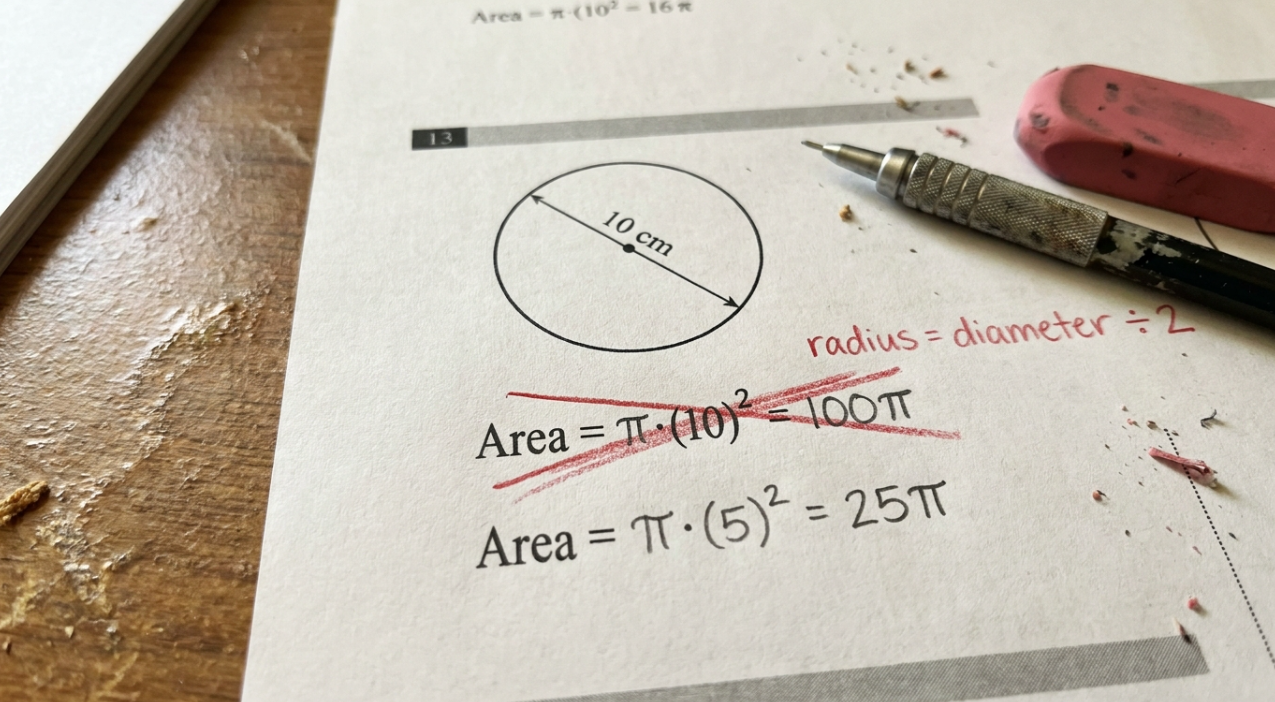
Tip: If the problem gives you the diameter, divide by 2 before squaring. This radius-vs-diameter swap is one of the most common SAT geometry traps.
Circumference of a Circle
🟢 Provided
Formula: C = 2πr
What it means: The total distance around a circle.
When you’ll see it: Problems that ask “how far does a wheel travel in one rotation” or that give you the area and ask for the circumference. You solve for r from the area formula, then plug into C = 2πr.
Tip: You can also write this as C = πd, where d is the diameter. Sometimes that’s faster.
Area of a Rectangle
🟢 Provided
Formula: A = lw
What it means: Length times width gives the space inside a rectangle.
When you’ll see it: Often embedded in word problems about rooms, gardens, or screens. The SAT rarely asks this in isolation; it usually combines with another shape.
Area of a Triangle
🟢 Provided
Formula: A = ½bh
What it means: Half the base times the height, where height is the perpendicular distance from the base to the opposite vertex.
When you’ll see it: Coordinate geometry problems where you need to find a triangle’s area from plotted vertices, or problems combining triangles with rectangles.
Tip: The height must be perpendicular to the base. If the triangle isn’t a right triangle, you may need to draw the height yourself.
Pythagorean Theorem
🟢 Provided
Formula: a² + b² = c²
What it means: In a right triangle, the sum of the squares of the two shorter sides (legs) equals the square of the longest side (hypotenuse).
When you’ll see it: Constantly. This is one of the most tested ideas in SAT geometry. Finding missing side lengths, calculating distances between points, checking whether a triangle is a right triangle.
Tip: As one Magoosh tutor puts it, “Know this cold. Be fluent at finding any missing side of a right triangle.” Don’t rely on clicking the reference sheet for this one. The time cost adds up.
Special Right Triangle: 45-45-90
🟢 Provided
Formula: Sides in ratio x : x : x√2
What it means: An isosceles right triangle. Both legs are equal, and the hypotenuse is the leg times √2.
When you’ll see it: Whenever a problem involves a square’s diagonal or a 45-degree angle in a geometric figure.
Tip: If you know one leg, you know everything. Multiply by √2 for the hypotenuse. Divide the hypotenuse by √2 for the legs.
Special Right Triangle: 30-60-90
🟢 Provided
Formula: Sides in ratio x : x√3 : 2x
What it means: The shortest side (opposite 30°) is x, the medium side (opposite 60°) is x√3, and the hypotenuse (opposite 90°) is 2x.
When you’ll see it: Equilateral triangle problems (cutting one in half creates a 30-60-90), problems involving hexagons, and questions that mention 30° or 60° angles.
Tip: The most common mistake is mixing up which side is which. The shortest side is always opposite the smallest angle. If you’re studying the format and structure of the Digital SAT, you’ll see these ratios tested in both Module 1 and Module 2.
Volume of a Rectangular Prism (Box)
🟢 Provided
Formula: V = lwh
What it means: Length times width times height. The space inside a box.
When you’ll see it: Word problems about containers, shipping boxes, or aquariums.
Volume of a Cylinder
🟢 Provided
Formula: V = πr²h
What it means: The area of the circular base (πr²) times the height. Think of stacking circles on top of each other.
When you’ll see it: Problems about cans, pipes, tanks, or anything with a circular cross-section.
Volume of a Sphere
🟢 Provided
Formula: V = (4/3)πr³
What it means: The space inside a perfectly round 3D shape. The (4/3) coefficient is unique to spheres.
When you’ll see it: Less frequently than cylinders, but it appears on harder questions, often combined with another shape.
Volume of a Cone
🟢 Provided
Formula: V = (1/3)πr²h
What it means: Exactly one-third of a cylinder’s volume with the same base and height.
When you’ll see it: Problems comparing a cone to a cylinder, or filling/draining word problems.
Tip: A Magoosh instructor suggests this memory trick: “It’s a cylinder’s volume times one-third, if that helps it stick.”
Volume of a Pyramid
🟢 Provided
Formula: V = (1/3)lwh
What it means: One-third of a rectangular prism’s volume with the same base and height. Same relationship as cone to cylinder.
When you’ll see it: Rare, but it appears on harder Module 2 questions.
Angle and Radian Facts
🟢 Provided
The reference sheet also states three facts:
A circle contains 360 degrees (or 2π radians)
A triangle’s interior angles sum to 180 degrees
There are 2π radians in a full rotation
These aren’t formulas per se, but you’ll use them constantly when working with arcs, sectors, and angle relationships.
SAT Geometry Formulas You Must Memorize
Everything in this section is tested on the SAT but is NOT on the reference sheet. You need to commit these to memory. Each entry is tagged with 🔴 Memorize.
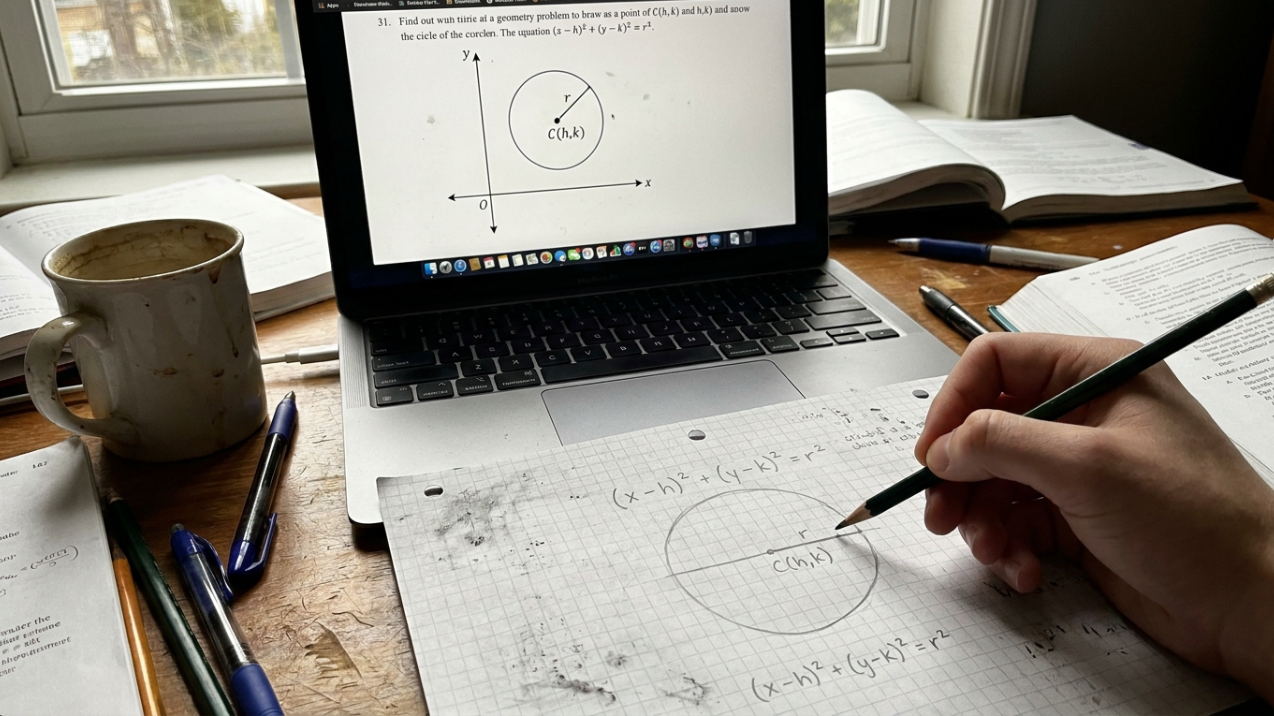
Equation of a Circle
🔴 Memorize
Formula: (x − h)² + (y − k)² = r²
What it means: This is the standard form of a circle on the coordinate plane. The center is at point (h, k), and r is the radius.
When you’ll see it: The SAT loves testing this. You’ll get an equation and need to identify the center and radius, or you’ll get a description and need to write the equation.
Tip: Watch the signs carefully. If the equation reads (x + 3)², that means the center’s x-coordinate is −3, not +3. College Board explicitly confirms this formula is not included at the beginning of the test. You can also graph circle equations in Desmos to verify your answers on test day.
Arc Length
🔴 Memorize
Formula: Arc length = (θ/360) × 2πr (degrees) or (θ/2π) × 2πr = θr (radians)
What it means: An arc is a portion of a circle’s circumference. The fraction (θ/360) tells you what fraction of the full circle your arc covers.
When you’ll see it: Problems that describe a slice of a circle, a clock face, or a sector of a pizza. The question asks for the curved distance, not the area.
Tip: Arc length is a linear measurement (like inches or centimeters). If the answer has squared units, you’ve accidentally calculated the sector area instead.
Sector Area
🔴 Memorize
Formula: Sector area = (θ/360) × πr²
What it means: A sector is a “pie slice” of a circle. This formula gives the area of that slice.
When you’ll see it: Problems that ask for the area of a shaded region that’s part of a circle.
Tip: Notice the pattern. Arc length uses the circumference formula (2πr). Sector area uses the area formula (πr²). Both multiply by the same fraction, θ/360.
Distance Formula
🔴 Memorize
Formula: d = √[(x₂ − x₁)² + (y₂ − y₁)²]
What it means: The straight-line distance between two points on a coordinate plane. It’s actually just the Pythagorean theorem in disguise: the horizontal distance is one leg, the vertical distance is the other, and the straight line between the points is the hypotenuse.
When you’ll see it: Coordinate geometry problems asking “how far apart” two points are, or problems about the length of a line segment.
Midpoint Formula
🔴 Memorize
Formula: M = ((x₁ + x₂)/2, (y₁ + y₂)/2)
What it means: The point exactly halfway between two other points. You’re just averaging the x-coordinates and averaging the y-coordinates.
When you’ll see it: Problems that ask for the center of a line segment or that give you one endpoint and the midpoint and ask for the other endpoint.
Slope
🔴 Memorize
Formula: m = (y₂ − y₁)/(x₂ − x₁)
What it means: Rise over run. How much the line goes up (or down) for every unit it moves to the right.
When you’ll see it: Everywhere in SAT math, from linear equations to parallel and perpendicular line problems. Parallel lines have the same slope. Perpendicular lines have slopes that are negative reciprocals.
Interior Angle Sum of a Polygon
🔴 Memorize
Formula: Sum of interior angles = (n − 2) × 180°
What it means: For any polygon with n sides, this formula gives the total of all interior angles. A triangle (n = 3) has 180°. A quadrilateral (n = 4) has 360°. A pentagon (n = 5) has 540°.
When you’ll see it: Problems about regular polygons asking for a single angle. Divide the sum by n to get each angle in a regular polygon.
SOH-CAH-TOA (Right Triangle Trigonometry)
🔴 Memorize
Formulas:
sin(θ) = Opposite / Hypotenuse
cos(θ) = Adjacent / Hypotenuse
tan(θ) = Opposite / Adjacent
What it means: These define the three basic trig ratios for a right triangle. “Opposite” is the side across from your angle, “adjacent” is the side next to your angle (that isn’t the hypotenuse), and the hypotenuse is the longest side.
When you’ll see it: Any problem that gives you an angle and a side length in a right triangle and asks for another side, or problems that set up a trig equation.
Tip: SAT trig is limited to right triangles. You won’t see the unit circle, the law of sines, or the law of cosines. Don’t over-study trig. Many students waste time on topics that never appear on this test.
Pythagorean Identity
🔴 Memorize
Formula: sin²θ + cos²θ = 1
What it means: For any angle, the square of its sine plus the square of its cosine always equals 1. This is a direct consequence of the Pythagorean theorem applied to a right triangle with hypotenuse 1.
When you’ll see it: Problems that give you sin(θ) and ask for cos(θ), or vice versa. Often appears in Module 2 (hard) questions.
Complementary Angle Rule
🔴 Memorize
Formula: sin(x) = cos(90° − x)
What it means: The sine of an angle equals the cosine of its complement. If two angles add up to 90°, the sine of one equals the cosine of the other.
When you’ll see it: Problems that state something like “sin(x) = cos(y)” and ask for x + y. The answer is 90°.
Similar Triangles
🔴 Memorize
Concept: If two triangles have the same angles, their corresponding sides are proportional.
What it means: You can set up a proportion: side₁/side₂ = side₃/side₄. This lets you find a missing side without knowing the actual angles.
When you’ll see it: Problems with nested triangles (a line parallel to one side of a triangle), overlapping figures, or real-world scenarios like shadows and heights.
Scaling Rules
🔴 Memorize
Formula:
If lengths scale by factor k, areas scale by k²
If lengths scale by factor k, volumes scale by k³
What it means: Double the dimensions of a shape, and its area quadruples. Triple the dimensions, and its volume increases by a factor of 27.
When you’ll see it: Problems comparing two similar figures of different sizes, or word problems asking how a change in one dimension affects the total.
Inscribed Angle Theorem
🔴 Memorize
Formula: Inscribed angle = ½ × central angle (when both intercept the same arc)
What it means: An inscribed angle is formed by two chords meeting at a point on the circle. It’s always half the central angle that covers the same arc.
When you’ll see it: Circle problems with angles drawn from different points. Less frequent than other circle topics, but it appears on harder questions.
Tangent-Radius Perpendicularity
🔴 Memorize
Concept: A radius drawn to a point of tangency is always perpendicular (90°) to the tangent line.
When you’ll see it: Problems involving tangent lines to circles, especially in coordinate geometry.
Tip: This fact lets you create right triangles in circle problems, which then opens the door to the Pythagorean theorem.
Common Mistakes That Cost Points
Knowing your SAT geometry formulas is necessary but not sufficient. The test is designed to punish careless errors, and practitioners on Reddit’s r/Sat frequently report that most geometry mistakes come from trusting a picture instead of reading the given information carefully.
Here are the traps to watch for:
Radius vs. Diameter. The SAT gives you the diameter. Your formula needs the radius. You forget to divide by 2. This single mistake probably costs more geometry points than any other.
Area vs. Perimeter vs. Volume. Read the last line of the question twice. Students solve for area when the question asks for perimeter, or find volume when it asks for surface area.
Circle Equation Signs. In (x − h)² + (y − k)² = r², the signs flip. If you see (x + 3)², the center’s x-coordinate is −3. If you see (y − 5)², the center’s y-coordinate is +5. Getting this backwards is extremely common.
Special Triangle Side Confusion. In a 30-60-90 triangle, students mix up x√3 and 2x. Remember: the shortest side is always opposite the smallest angle (30°), and the hypotenuse (opposite 90°) is always the longest.
Plugging In Too Early. As several tutors note, SAT geometry formulas matter, but the test usually checks whether you can apply them in real situations. Many mistakes happen when students jump to a formula without confirming what the diagram or wording actually represents.
Figures Are Now Drawn to Scale. On the Digital SAT, figures are generally drawn to scale unless stated otherwise. This is a change from the old paper SAT. You can use the visual as a sanity check, but never as your only method.
How to Study SAT Geometry Formulas Efficiently
Not all formulas deserve equal study time. Here’s a prioritized approach.
Tier 1: Memorize These First
These appear most frequently and form the backbone of SAT geometry:
Pythagorean theorem (yes, it’s provided, but you should know it instantly)
Slope formula
Equation of a circle
SOH-CAH-TOA
Special right triangle ratios
An IvyStrides tutor offers a useful rule of thumb: “If you need it more than twice per practice test, memorize it.” Clicking to the reference sheet breaks your rhythm and increases careless mistakes in a timed, adaptive setting.
Tier 2: Memorize Next
These appear less often but are necessary for a complete score:
Arc length and sector area
Distance and midpoint formulas
Interior angle sum
Scaling rules
Pythagorean identity and complementary angle rule
Study Tactics That Work
Active recall beats passive reading. Write all the formulas from memory on a blank sheet of paper every day. When you get stuck, that’s the formula you need to drill.
Piqosity’s scratch paper tactic is worth adopting: jot down your must-memorize formulas on scratch paper at the very start of the math section, before you see any questions. This frees your working memory for actual problem-solving.
Use practice questions to contextualize every formula. A formula in isolation is just notation. A formula applied to a tricky word problem is real SAT prep. You can filter by Geometry and Trigonometry to drill these specific formulas with SAT-style questions.
Track your progress. After each practice set, note which formulas you used correctly and which tripped you up. A score predictor can help you see where you stand and which domains need the most work.
Geometry on Hard Module 2
The Digital SAT is adaptive. Strong performance on Module 1 routes you to the harder Module 2, where the points are worth more. On Hard Module 2, geometry questions rarely test a single formula. They combine geometric reasoning with algebraic manipulation.
For example, a Hard Module 2 question might give you the equation of a circle in expanded form (x² + 6x + y² − 4y = 12) and ask for the area. You’d need to complete the square (algebra) to get it into standard form (geometry), identify the radius, then calculate the area. That’s three steps, and you need fluency in each one.
Students who know their formulas automatically can focus on the reasoning step, which is what the hard module actually tests. If you’re still hunting through the reference sheet for πr², you’ve already lost valuable seconds. Understanding how adaptive scoring works helps you appreciate why formula fluency matters even more for students aiming above 700 in math.
Using Desmos for SAT Geometry
The Digital SAT includes a built-in Desmos calculator. It’s powerful, but it doesn’t help equally with all geometry problems.
Where Desmos helps:
Graphing circle equations to visually identify the center and radius
Verifying coordinate geometry answers (distance, midpoint)
Finding intersection points between a line and a circle or between two curves
Where Desmos doesn’t help:
Area and volume calculations (just use the formula)
Angle relationships and special triangles
Arc length and sector area
For a deeper look at when to use Desmos and when to skip it, check out the Desmos SAT tips guide. The general rule: geometry problems, percent questions, and simple arithmetic are often faster with mental math or scratch work. Save Desmos for coordinate geometry and equation verification.
Putting It All Together
SAT geometry formulas reward focused preparation more than any other math domain. The combination of a limited question count (5 to 7 questions), a finite formula set, and a generous reference sheet means you can realistically master this domain in two weeks of daily practice.
Your action plan:
Print or write out every formula from this glossary
Test yourself from memory daily
Work through SAT geometry questions to see each formula in context
Note your mistakes and re-drill the formulas behind them
On test day, write your must-memorize formulas on scratch paper immediately
Start practicing with SAT geometry questions to put these formulas into action.
FAQ
How many geometry formulas are on the SAT reference sheet?
The official reference sheet contains about 12 geometry formulas (covering area, volume, the Pythagorean theorem, and special right triangles) plus 3 facts about angles, degrees, and radians. It is accessible at any time during both math modules in the Bluebook testing app.
Do I need to memorize the formulas on the SAT reference sheet?
Technically no, since they’re provided. But practically, you should know the most common ones (Pythagorean theorem, area of a circle, special right triangle ratios) by heart. Clicking to the reference sheet during a timed test breaks your rhythm and can lead to careless errors.
What geometry formulas are NOT on the SAT reference sheet?
The biggest ones missing are the equation of a circle, arc length, sector area, distance formula, midpoint formula, slope, interior angle sum, SOH-CAH-TOA, the Pythagorean identity, and the complementary angle rule. The reference sheet also contains zero algebra formulas.
How many geometry questions are on the SAT?
Geometry and Trigonometry accounts for about 15% of SAT Math, which translates to roughly 5 to 7 scored questions out of 44 total math questions.
Does the SAT test trigonometry beyond SOH-CAH-TOA?
Barely. SAT trig is limited to right triangles. You’ll need SOH-CAH-TOA, the Pythagorean identity (sin²θ + cos²θ = 1), and the complementary angle rule (sin(x) = cos(90° − x)). You will not see the unit circle, the law of sines, or the law of cosines.
Can I use Desmos for geometry problems on the SAT?
Yes, the built-in Desmos calculator is available throughout the math section. It’s useful for graphing circle equations and verifying coordinate geometry, but it won’t help with area/volume calculations or angle relationships. Those are faster by hand.
What’s the most common geometry mistake on the SAT?
Using the diameter when the formula calls for the radius (or vice versa). The SAT frequently gives you one and expects you to convert before applying the formula. Always check whether you have the radius or the diameter before plugging in.
How long does it take to memorize all SAT geometry formulas?
Most students can learn the roughly 12 must-memorize geometry formulas in one to two weeks of daily active recall practice. The key is applying them through practice problems, not just reading them repeatedly.