
SAT Grammar Rules 2026: The Complete Digital Guide
Miyagi Labs ·
SAT Grammar Rules 2026: The Complete Digital Guide

TLDR
The Digital SAT tests a narrow, repeatable set of grammar and punctuation rules under a domain called Standard English Conventions. This domain accounts for roughly 11 to 15 questions on the Reading & Writing section, split into two categories: Boundaries (punctuation and sentence structure) and Form, Structure, and Sense (agreement, verb tense, modifiers, possessives). You don’t need to memorize every English grammar rule. You need to learn the specific patterns the SAT tests, recognize them from the answer choices, and apply a rule-based process rather than guessing by ear.
What Are SAT Grammar Rules?
When students search for SAT grammar rules, they’re usually looking for something specific: which grammar and punctuation conventions does the Digital SAT actually test? The answer is more contained than most people expect.
The College Board calls this area Standard English Conventions. It lives inside the Reading & Writing section of the Digital SAT, not in a separate grammar section. These questions ask you to edit short passages (25 to 150 words) so sentences follow standard written English for sentence structure, usage, and punctuation.
A quick clarification on what “Standard English” means here. It refers to the language conventions used in school, college, and workplace writing. It is not a judgment about how people speak at home or in their communities. The College Board’s own technical manual makes this distinction, noting that vernacular dialects are not less grammatical or less communicative.
Start practicing SAT grammar with a diagnostic that shows which rules are costing you points.
How Many SAT Grammar Questions Are on the Digital SAT?
Standard English Conventions makes up approximately 26% of operational Reading & Writing questions, which translates to roughly 11 to 15 scored questions. Here’s the broader context:
The Reading & Writing section has two modules with 27 questions each (54 total, 50 scored).
You get 64 minutes total, averaging about 71 seconds per question.
Questions are grouped by domain within each module. Standard English Conventions appears after Craft and Structure and Information and Ideas, before Expression of Ideas.
Within Standard English Conventions, questions are ordered from easiest to hardest.
Grammar is not the majority of your Reading & Writing score, but it’s significant enough that weak grammar skills can hold back an otherwise strong reader. Practitioners on Reddit report exactly this pattern: one student scored 650 on Reading & Writing, doing well on comprehension questions but missing 10 to 11 grammar questions, mostly on punctuation and adverbs.
For a full breakdown of how the test is structured, see our guide to the digital SAT format.
The Two Official Types of SAT Grammar Questions
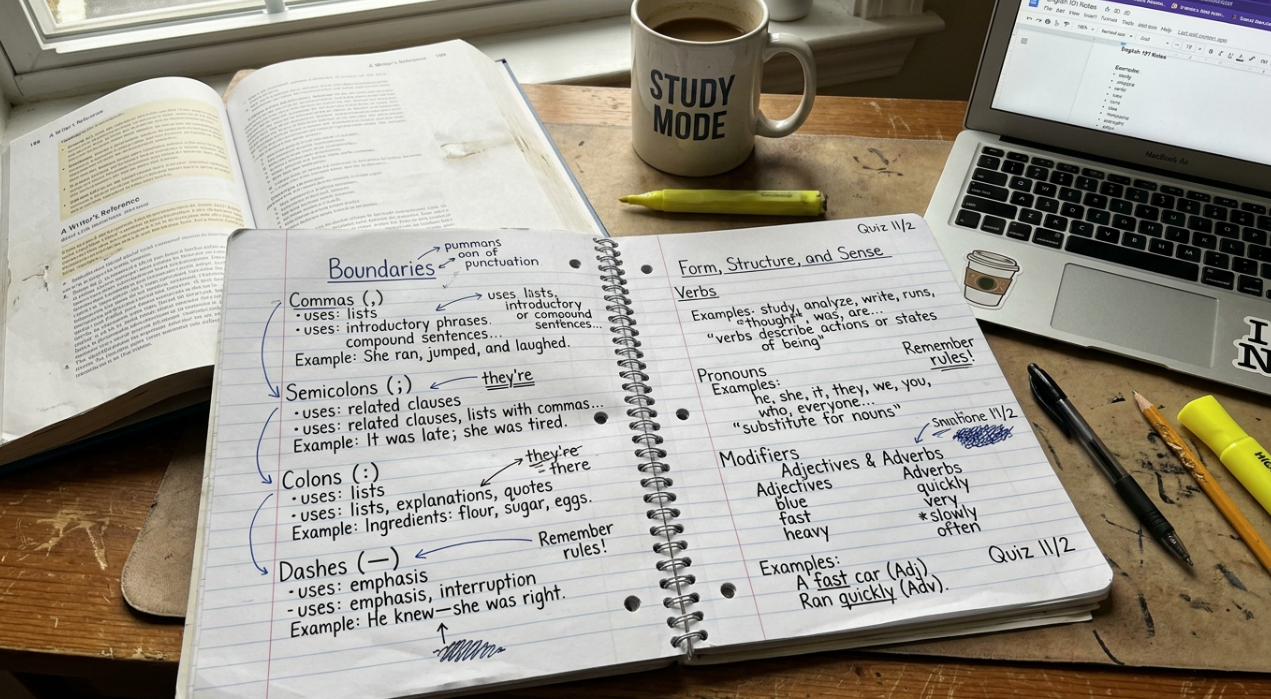
The College Board divides Standard English Conventions into two testing points. Understanding this split is the single most useful framework for studying SAT grammar rules.
Boundaries
Boundaries questions test how sentences, clauses, and phrases should be joined or separated. The answer choices typically differ by punctuation: comma, semicolon, colon, dash, period, or no punctuation at all.
These questions cover:
End punctuation (periods)
Semicolons
Colons
Dashes
Commas (with coordinating conjunctions, after introductory elements, around nonessential information)
When to use no punctuation at all
The core skill is recognizing whether each side of a punctuation mark is a complete sentence, a dependent clause, or a phrase.
Form, Structure, and Sense
Form, Structure, and Sense questions test whether the words and sentence structure make grammatical sense in context. Answer choices differ by verb form, pronoun, noun number, possessive form, modifier placement, or sentence arrangement.
These questions cover:
Subject-verb agreement
Pronoun-antecedent agreement
Verb tense and aspect
Plurals and possessives
Modifier placement
Parallel structure
Logical comparisons
The College Board’s Student Question Bank confirms this pattern: Boundaries options contain different punctuation, while Form, Structure, and Sense options contain different words or sentence structures. Both types use the same question stem: “Which choice completes the text so that it conforms to the conventions of Standard English?”
What About Transitions?
Students often lump transition questions into “grammar,” but the College Board categorizes them under Expression of Ideas, a separate domain. Transition questions ask you to choose words like “however,” “therefore,” or “for example” based on the logical relationship between ideas. They’re important, but they aren’t technically SAT grammar rules. A LinkedIn practitioner makes this point well, noting that many SAT “grammar” questions are really about relationships between ideas and signal words, which belong to a different skill category than punctuation or agreement.
SAT Grammar Rules Glossary
Before learning the rules, you need the vocabulary. When explanations mention “independent clause” or “antecedent” and those terms are fuzzy, the rules won’t stick. Here’s every term you need, defined plainly and mapped to how the SAT uses it.
Independent Clause
A group of words with a subject and verb that can stand alone as a complete sentence. “The satellite entered orbit” is an independent clause. On the SAT, you need to identify independent clauses to decide whether a semicolon, period, colon, or comma-plus-conjunction is appropriate.
Dependent Clause
A subject-verb group that cannot stand alone because it starts with a subordinating word like “although,” “because,” “when,” “while,” or “since.” Example: “Although the experiment failed” is a dependent clause. When a dependent clause comes before an independent clause, it usually needs a comma after it.
Sentence Fragment
An incomplete sentence. It might lack a main verb, a subject, or a complete thought. On the SAT, a choice that turns the sentence into a fragment is wrong.
Example of a fragment: “Because the researcher revised the design.” That group of words doesn’t finish the thought.
Run-On Sentence
Two or more independent clauses pushed together without correct punctuation or a conjunction. “The sample was small the conclusion was limited” is a run-on. The SAT fixes run-ons with semicolons, periods, or comma-plus-conjunction constructions.
Comma Splice
A specific type of run-on where two independent clauses are joined with only a comma. “The telescope was powerful, it detected distant galaxies” is a comma splice. Comma splices are always incorrect on the SAT. You can fix them with a semicolon, a period, or by adding a coordinating conjunction after the comma.
Coordinating Conjunction (FANBOYS)
The seven words that can join two independent clauses when paired with a comma: for, and, nor, but, or, yet, so. A comma plus one of these words functions like a period or semicolon for joining complete sentences.
Example: “The artist sketched the design, and the engineer built the model.”
Semicolon
Joins two closely related independent clauses. “The storm passed quickly; the roads remained flooded.” Both sides must be complete sentences. For SAT purposes, a semicolon functions identically to a period when separating independent clauses.
Colon
Used after a complete sentence to introduce an explanation, example, or list. “The team needed three tools: a compass, a map, and a radio.” The words before the colon must form a complete sentence. Putting a colon after a verb or preposition that doesn’t complete a sentence is wrong.
Dash
Can set off nonessential information or introduce an explanation after a complete sentence. If a dash opens nonessential information mid-sentence, a matching dash must close it. Practitioners on Reddit note that SAT dash questions aren’t about subjective style. If a dash is the correct answer, the other choices will be objectively wrong for a rule-based reason, not because the dash “sounds better.”
Nonessential Information
Extra information that can be removed without breaking the sentence’s grammar or core meaning. “The novel, published in 1925, remains widely read.” Remove “published in 1925” and the sentence still works. Nonessential information can be set off with two commas, two dashes, or two parentheses, but you cannot mix types (comma on one side, dash on the other).
Appositive
A noun or noun phrase that renames another noun right beside it. “Dr. Lin, a climate scientist, presented the findings.” Whether the appositive needs commas depends on whether it’s essential to identify the noun. If there’s only one Dr. Lin in context, the appositive is nonessential and gets commas.
Subject-Verb Agreement
The subject and verb must match in number. Singular subjects take singular verbs; plural subjects take plural verbs. The SAT’s favorite trap is hiding the real subject behind a prepositional phrase. “The list of materials is long,” not “are long.” The subject is “list,” not “materials.”
Pronoun-Antecedent Agreement
A pronoun must agree with the noun it refers to (its antecedent). “The museum updated its hours” (singular). “The researchers updated their notes” (plural). The SAT tests whether you can find the correct antecedent, especially when it’s buried in a complex sentence.
Antecedent
The noun a pronoun refers back to. In “Maya told Priya that she had won,” the antecedent of “she” is ambiguous. The SAT avoids ambiguous pronouns in correct answers.
Verb Tense
The time shown by a verb: past, present, or future. The SAT expects you to match tense to context clues like dates, time words, and surrounding verbs. “In 1998, the scientist discovered the pattern.” The date tells you past tense is correct.
Verb Aspect
The form of a verb that shows whether an action is completed, ongoing, or connected to another time. The difference between “studied,” “was studying,” “has studied,” and “had studied” matters on the SAT. “By the time the survey ended, researchers had collected 2,000 responses.” The past perfect “had collected” shows the collecting happened before the survey ended.
Modifier
A word or phrase that describes or limits another word. On the SAT, modifier questions usually involve an introductory phrase followed by a comma. The noun right after the comma should be the thing the phrase describes.
Dangling Modifier
A modifier that doesn’t clearly describe the noun next to it.
Incorrect: “After analyzing the data, the conclusion was revised.” (“The conclusion” didn’t analyze the data.)
Correct: “After analyzing the data, the researchers revised the conclusion.”
Parallel Structure
Items in a list or pair should use the same grammatical form. “The program teaches students to plan, draft, and revise” is parallel. “To plan, drafting, and revise” is not. The SAT tests this in lists, comparisons, and paired constructions.
Possessive
A form showing ownership. “The student’s essay” (one student). “The students’ essays” (multiple students). Key trap: “its” is possessive, while “it’s” means “it is.”
Logical Comparison
A comparison must compare like things. “Maya’s essay is clearer than Jordan” compares an essay to a person. Correct: “Maya’s essay is clearer than Jordan’s.” The SAT looks for mismatched comparison categories.
Transition
A word or phrase showing the relationship between ideas: however, therefore, moreover, for example. Remember, transitions fall under Expression of Ideas on the SAT, not Standard English Conventions. They’re worth studying alongside grammar, but they belong to a different official domain.
The SAT Grammar Rules to Learn First
Not all rules are equally common or equally learnable. Here are the highest-yield SAT grammar rules, organized by the two official categories. Master these before moving to edge cases.
Boundaries Rules (Punctuation and Sentence Structure)
Rule 1: A semicolon needs a complete sentence on both sides.
A semicolon separates two independent clauses. If either side can’t stand alone, the semicolon is wrong.
Rule 2: A comma alone cannot join two complete sentences.
This creates a comma splice, which is always wrong on the SAT. You need a comma plus a FANBOYS conjunction, or you need a semicolon or period instead.
Incorrect: “Marine biologists tracked the whale for six months, they recorded its migration route.”
Correct: “Marine biologists tracked the whale for six months; they recorded its migration route.”
Rule 3: Comma + FANBOYS can join two complete sentences.
“The fossil was fragile, so the team moved it carefully.” The comma plus “so” does the same job as a semicolon here.
Rule 4: A colon must follow a complete sentence.
“The museum displayed three artifacts: a bronze mask, a clay tablet, and a carved bowl.” The words before the colon work as a standalone sentence. “The museum displayed:” would be wrong because “The museum displayed” isn’t complete without its object.
Rule 5: Nonessential information needs matching punctuation.
Two commas, two dashes, or two parentheses. Never a comma on one side and a dash on the other.
Correct: “The rover, launched in 2020, collected images.”
Incorrect: “The rover, launched in 2020 collected images.” (Missing the closing comma.)
Rule 6: Do not put punctuation between a subject and its verb.
“The discovery of several ancient tools changed the team’s understanding.” No comma after “tools,” even though the subject is long. The College Board’s own sample Boundaries question tests exactly this principle.
Drill these punctuation rules with SAT-style questions filtered by skill.
Form, Structure, and Sense Rules (Grammar and Usage)
Rule 7: The real subject controls the verb.
Ignore prepositional phrases, appositives, and interrupting clauses between the subject and verb. “The results of the survey were surprising.” The subject is “results” (plural), not “survey.”
Princeton Review warns students specifically about words between the subject and verb that create agreement traps.
Rule 8: Pronouns must match their antecedents.
“The committee released its report.” Committee is singular. “The researchers published their findings.” Researchers is plural. Find the antecedent before choosing the pronoun.
Rule 9: Verb tense must match the time clues.
Look for dates, time expressions, and surrounding verbs. “In 1924, the composer wrote the piece.” “Since 2010, the lab has studied coral reefs.” The context tells you which tense is correct.
Rule 10: The modifier must describe the noun right next to it.
“After reviewing the manuscript, the editor found several errors.” Not “several errors were found by the editor,” because “errors” didn’t review the manuscript.
Rule 11: Items in a list should be parallel.
“The workshop teaches students to brainstorm, draft, and revise.” All infinitives. Mixing forms (“to brainstorm, drafting, and revise”) breaks parallelism.
Rule 12: Use possessives and plurals carefully.
Singular possessive: student’s. Plural possessive: students’. Plural without possession: students. And remember, “its” is possessive while “it’s” is a contraction of “it is.”
The SAT Grammar Rule Engine: A Decision Process
Most prep resources list SAT grammar rules and stop there. But knowing the rules isn’t enough if you can’t figure out which rule a question is testing. Here’s a five-step process you can apply to any Standard English Conventions question.
Step 1: Look at the Answer Choices First
The choices tell you the category before you even read the passage carefully.
If the choices differ by… | The SAT is probably testing… | Your first move |
|---|---|---|
Punctuation marks (commas, semicolons, colons, periods, dashes) | Boundaries | Check what’s on each side of the blank |
Verb endings (is/are, has/have, was/were) | Subject-verb agreement | Find the real subject |
Pronouns (it/they, its/their) | Pronoun agreement | Find the antecedent |
Verb forms (studied, was studying, has studied) | Verb tense/aspect | Look for time clues |
Whole sentence rearrangements | Modifiers, parallelism, or comparisons | Check modifier placement first |
Transition words only (however, therefore) | Expression of Ideas, not grammar | Identify the relationship between ideas |
Step 2: For Punctuation, Count Complete Sentences
This is the highest-yield move for Boundaries questions. Determine whether the text on each side of the blank is a complete sentence.
Complete sentence + complete sentence: Period, semicolon, or comma + FANBOYS.
Complete sentence + explanation or list: Colon or dash.
Dependent clause first + independent clause: Comma after the dependent clause.
Subject + verb with nothing in between: Usually no punctuation.
Practitioners on Reddit consistently advise the same approach. One well-upvoted response told a struggling student to stop listening for pauses and start checking clause structure instead.
Step 3: For Verbs and Pronouns, Find the Real Subject or Antecedent
Strip away prepositional phrases, appositives, and parenthetical asides. What’s left is usually the subject. Match the verb or pronoun to that word.
Step 4: For Modifiers, Check the Noun After the Comma
If a sentence starts with a descriptive phrase (“Walking through the archive,” “Based on years of fieldwork,”), the thing being described should appear immediately after the comma.
Step 5: If Two Choices Are Grammatically Identical, Consider Eliminating Both
A test-taking shortcut from experienced tutors: because the SAT has a single correct answer, two choices that do the exact same grammatical job (like a period and a semicolon between two independent clauses with no other differences) often cancel each other out. This isn’t an absolute law, but it’s a useful pattern when you’re stuck. Several tutors on LinkedIn and grammar forums have confirmed this approach works reliably on SAT-style questions.
Take a full-length practice test to see this decision process in action under real timing.
Grammar Rules Students Over-Study
Part of studying SAT grammar rules efficiently is knowing what not to spend time on.
Standalone spelling. The Digital SAT does not emphasize standalone spelling in Standard English Conventions. The College Board’s Assessment Framework notes that frequently confused words and conventional expression were not carried over to the digital section, partly because they were conflated with spelling.
Huge idiom lists. Older SAT and ACT resources often include long lists of idiomatic expressions. The current Digital SAT’s official Standard English Conventions description focuses on Boundaries and Form, Structure, and Sense, not idiom memorization.
The “sounds right” method. This is maybe the most common mistake. Students pick the answer that sounds natural to their ear. But informal speech and texting don’t follow written Standard English conventions. Multiple Reddit threads show debates between students who rely on absorbed patterns from reading and those who argue the Digital SAT rewards explicit rule knowledge, especially for tricky subject-verb agreement and sentence structure questions. The rule-based approach wins, particularly for students who haven’t spent years reading edited prose.
Obscure prescriptive rules. The College Board’s technical manual gives “do not split an infinitive” as an example of a prescriptive rule that’s frequently broken in Standard English without being viewed as an error. Don’t waste time memorizing rules the test doesn’t enforce.
Pure punctuation style preferences. In real writing, choosing between a dash and a colon can be a style decision. On the SAT, the answer must be objectively defensible. The test creates choices where only one option follows all required conventions, so there’s no room for “either could work.”
How to Practice SAT Grammar Rules
Knowing the rules matters, but applying them under time pressure is a different skill. Here’s a study method that works.
Learn one term at a time. Start with independent clause, dependent clause, comma splice, and subject-verb agreement. Don’t try to memorize the entire glossary in one sitting. A LinkedIn SAT prep practitioner recommends practicing one concept at a time and building speed through repetition before mixing concepts together.
Drill by rule, not by random question mix. Practice comma splices separately from modifiers. Practice subject-verb agreement separately from pronoun agreement. This targeted approach builds pattern recognition faster than mixed sets. Try focused SAT problem sets organized by individual skills.
Use official-style questions. The College Board’s Student Question Bank categorizes Standard English Conventions questions into Boundaries and Form, Structure, and Sense. Use that filter when drilling.
Keep a mistake log. For every missed grammar question, write down four things: the rule tested, why the wrong answer was tempting, the structural clue you missed, and one new example of the rule. This log becomes your personalized review sheet before test day.
Take timed modules. You get about 71 seconds per Reading & Writing question. Speed comes from recognizing patterns instantly, not from rushing through reading. For broader study planning, our guide on studying for the Digital SAT covers scheduling, resource selection, and score improvement strategies.
Use a score predictor to see whether grammar is the domain holding back your Reading & Writing score, then prioritize accordingly.
Frequently Asked Questions
What grammar rules are on the SAT?
The Digital SAT tests sentence boundaries, punctuation (semicolons, colons, commas, dashes), subject-verb agreement, pronoun-antecedent agreement, verb tense and aspect, modifier placement, parallel structure, plurals, possessives, and logical comparisons. These fall under the Standard English Conventions domain, split into Boundaries and Form, Structure, and Sense.
Is there a grammar section on the Digital SAT?
No. Grammar questions appear inside the Reading & Writing section under the Standard English Conventions domain. There is no standalone grammar section.
How many grammar questions are on the SAT?
Approximately 11 to 15 operational Standard English Conventions questions, accounting for about 26% of scored Reading & Writing questions.
Are transitions considered grammar on the SAT?
Not officially. The College Board categorizes transitions under Expression of Ideas, a separate domain from Standard English Conventions. Students often study them alongside grammar because they require sentence-level logic, but they are technically a different skill.
Should I choose the answer that sounds right?
No. Sound can help strong readers as a first instinct, but it’s unreliable as a primary strategy. SAT grammar questions are rule-based, and informal speech patterns can make incorrect choices sound natural.
Does the Digital SAT test spelling?
Not as a standalone skill. The College Board noted that frequently confused words and conventional expression were not carried over to the digital section’s Standard English Conventions domain.
What is the fastest SAT grammar rule to improve on?
Punctuation and Boundaries questions are often the fastest area to improve because many of them reduce to a single question: is there a complete sentence on both sides of the punctuation? Students on Reddit who struggled with grammar frequently report that learning to identify independent clauses was the turning point.
What is the difference between Boundaries and Form, Structure, and Sense?
Boundaries questions test punctuation and sentence completion (how clauses and phrases are joined or separated). Form, Structure, and Sense questions test grammar and usage choices like subject-verb agreement, verb tense, pronoun agreement, possessives, and modifiers. You can tell them apart by looking at the answer choices: if the choices show different punctuation, it’s Boundaries; if they show different words or sentence structures, it’s Form, Structure, and Sense.