
11 Common SAT Math Mistakes and How to Fix Each One (2026)
Miyagi Labs ·
11 Common SAT Math Mistakes and How to Fix Each One (2026)
TL;DR
Most students losing 50 to 100+ points on SAT Math aren’t struggling with the actual math. They’re making predictable, fixable errors: solving for the wrong variable, botching Desmos inputs, rushing Module 1 and capping their score ceiling, or falling for trap answers designed to exploit common slip-ups.
This guide names 11 specific SAT Math mistakes, shows what each one looks like on a real problem, and gives you a concrete habit to stop each one cold.
Why SAT Math Mistakes Cost More Than You Think
You solved the system of equations perfectly. Found x = 4. Bubbled in 4. Moved on feeling confident.
The question asked for x + 3.
That’s not a math problem. It’s a reading problem, a habit problem, and on the Digital SAT, it’s potentially a 50-point problem.
Because the Digital SAT uses adaptive modules, careless errors in Module 1 don’t just cost you one question. They can route you to an easier Module 2, capping your maximum math score around 560 to 600.
Two extra wrong answers at lower score ranges can cost roughly 50 points.
Students lose an estimated 50 to 100+ points annually to avoidable strategy errors alone.
The math section has 44 questions across two 35-minute modules, giving you about 95 seconds per question. That’s enough time to get every question right, but also enough room for every mistake on this list to show up.
Here are the 11 SAT Math mistakes that quietly drain your score, ordered by how much damage they do. Each one includes what it looks like, why it happens, and exactly how to fix it.
If you want to find where your own points are leaking, a diagnostic and score predictor can pinpoint your weakest areas before you start drilling.
Ready to practice these strategies under timed conditions? Try Miyagi Labs' Digital SAT practice tests to identify the mistakes that are actually costing you points.
At-a-Glance: The 11 Mistakes
# | Mistake | Category | Points at Risk | One-Sentence Fix |
|---|---|---|---|---|
1 | Solving for the wrong variable | Careless | 10–40 | Read the final sentence first and name your target before solving. |
2 | Rushing Module 1 | Strategic | 40–100+ | Treat Module 1 as the most important 22 questions on the test. |
3 | Sign errors with negatives | Careless | 20–40 | Write one algebraic step per line; parenthesize every negative. |
4 | Percent and ratio traps | Conceptual | 20–60 | Always identify the base before calculating any percentage. |
5 | Desmos input errors | Digital-Format | 10–40 | Parenthesize all numerators, denominators, and negative values. |
6 | Skipping steps / mental math | Careless | 20–40 | Write every step; “mental math” is just unauditable math. |
7 | Misreading word problems | Careless | 10–30 | Underline the actual question and circle the units. |
8 | Getting stuck on one question | Strategic | 20–60 | Flag it at 90 seconds, guess, move on, come back. |
9 | Grid-in formatting errors | Digital-Format | 10–20 | Never enter mixed numbers; convert to improper fractions or decimals. |
10 | Falling for trap answers | Conceptual | 20–40 | Check whether your answer matches a “common mistake” choice. |
11 | Not reviewing mistakes | Meta | 50–100+ | Keep an error log; improvement happens during review, not during tests. |
1. Solving for the Wrong Variable
What It Looks Like
A system of equations gives you two variables. You solve correctly for x, select x from the answer choices, and miss that the question asked for 2x + 1.
Your algebra was flawless.
Your score still drops.
Why It Happens
Students have been trained since Algebra 1 to “solve for x.” That reflex is so automatic that the brain skips the final sentence of the problem.
The SAT exploits this by placing the value you solved for among the answer choices as a trap.
The Fix
Before you touch your pencil or calculator, read the last sentence of the problem.
Write down your target in two or three words:
“find 2x + 1”
“find the slope”
“find percent increase”
This takes five seconds and prevents the single most common SAT Math mistake.
If you want to practice identifying these traps, filtered SAT practice questions let you drill by specific skill type.
Want more practice with equations and algebraic manipulation? Use Miyagi's SAT Math practice questions to drill specific skills and review explanations immediately after each question.
2. Rushing Module 1 and Capping Your Score Ceiling
What It Looks Like
A student finishes Module 1 with five minutes to spare, feels great, then gets routed to the easier Module 2.
Their final math score: 580.
They’re confused because Module 2 felt easy.
It was easy, and that’s the problem.
Why It Happens
The Digital SAT’s adaptive structure uses your Module 1 performance to determine Module 2 difficulty.
Strong Module 1 performance unlocks the harder Module 2 and the full 200 to 800 score range.
Missing just 2 to 3 questions in Module 1 can route you to the easier path, where even a perfect Module 2 performance caps your score around 560 to 600.
The threshold is roughly 5 to 6 wrong out of 22 questions to stay on the hard track.
This is the mistake no one talks about enough.
On the old paper SAT, a careless error on question 12 cost you the same as a careless error on question 42. On the Digital SAT, careless errors in Module 1 are structurally more expensive because they restrict your scoring ceiling for the entire section.
The Fix
Slow down in Module 1.
Budget extra time for double-checking answers on the first 22 questions.
If you have to rush anywhere, rush Module 2, not Module 1.
Students on Reddit’s r/Sat frequently report that their biggest score jumps came from treating Module 1 as its own mini-test worth obsessing over.
Taking full-length timed practice exams with adaptive module simulation is the only way to internalize this pacing strategy before test day.
3. Sign Errors When Distributing Negatives
What It Looks Like
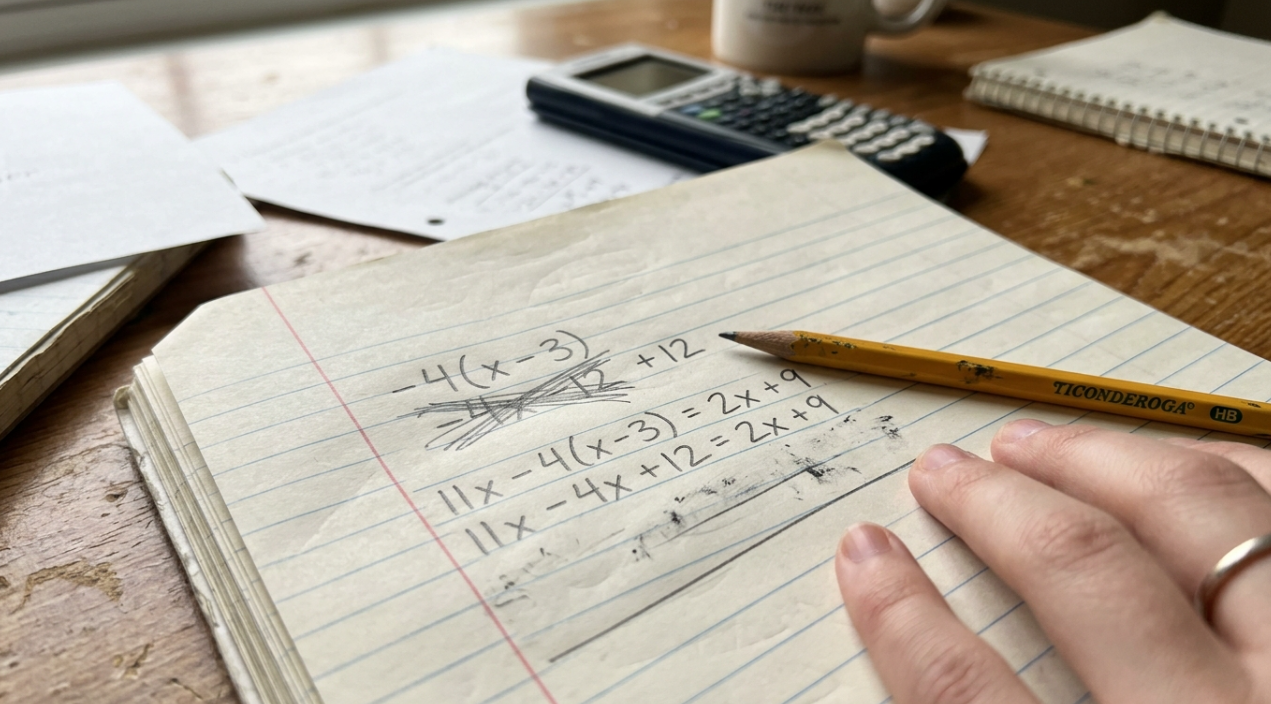
You need to subtract (3x - 4) from an expression.
You write:
-3x - 4
instead of:
-3x + 4
The second sign didn’t flip.
One wrong sign cascades through every subsequent step.
Why It Happens
Distribution of negatives requires changing the sign of every term inside the parentheses.
Under time pressure, the brain processes the first sign change and skips the second.
This is one of the most persistent SAT Math mistakes because it feels trivial but produces wrong answers that often match a trap choice.
The Fix
Write one algebraic step per line.
Put parentheses around every substituted negative value and around entire numerators or denominators.
Do not rely on memory to carry signs through multiple operations.
Clean writing isn’t cosmetic; it’s a form of error control.
For a refresher on the algebra concepts most likely to generate these errors, this SAT algebra study guide covers distribution and manipulation in depth.
4. Percent and Ratio Traps
What It Looks Like
A store raises prices by 20%, then lowers them by 20%.
You assume the price is back to the original.
It isn’t.
A $100 item goes to $120, then drops by 20% of 120 ($24), landing at $96, not $100.
Why It Happens
Percent problems trip students up because the base changes.
A 20% increase and a 20% decrease don’t cancel because they operate on different numbers.
Analysis of the August 2026 SAT found that the single most common percent error is “taking the two numbers and dividing the smaller by the larger because that feels like what a percentage should look like.”
Other common percent mistakes include:
Using the new value instead of the original as the denominator.
Treating 35% as 35 instead of 0.35.
Forgetting to add 100% when a problem says one value is “greater than” another.
The Fix
Before any calculation, write down:
“What is the base?”
Circle it.
Every percent must be taken of something specific.
For increase/decrease problems, convert to multipliers:
A 20% increase means multiplying by 1.20.
A 20% decrease means multiplying by 0.80.
If your percent and ratio fundamentals feel shaky, topic-specific problem sets let you isolate these question types until they become automatic.
5. Desmos Calculator Input Errors
What It Looks Like
You type:
(2x+1)/(x-3)
into Desmos but forget the parentheses around the denominator, so it graphs:
2x + 1/x - 3
instead.
The graph looks completely wrong, you panic, and you waste 45 seconds figuring out what happened.
Or you graph a trig function without realizing Desmos is set to radians while the problem uses degrees.
Why It Happens
Desmos is available for all 44 Math questions on the Digital SAT, which is powerful but introduces a new category of errors that didn’t exist on the paper test.
Common Desmos issues include:
Missing parentheses in expressions.
Confusing the multiply symbol with the variable x.
Typing 2^x when you mean 2x.
Not zooming the window to see relevant graph features.
Using the wrong angle mode.
Practitioners on Reddit and prep forums report that the single most common Desmos-related mistake is failing to adjust the zoom window.
When a graph’s key features, such as intersections, vertices, or asymptotes, are outside the default view, Desmos shows nothing useful and you’re left guessing.
The Fix
Build three Desmos habits:
Always wrap numerators and denominators in parentheses.
After graphing, zoom out or adjust the window to find relevant features.
Check degree vs. radian mode before any trig problem.
For a deeper walkthrough, these Desmos SAT tips cover the most common traps, and this page on Desmos-specific traps walks through the exact input errors that cost points.
For more detailed techniques, input checks, and examples, see Miyagi's Desmos SAT Guide, which covers common calculator mistakes and when Desmos is actually faster than solving by hand.
6. Skipping Steps and Mental Math Overconfidence
What It Looks Like
You glance at a problem, do two steps in your head, and select an answer.
It looks right.
It’s wrong by one sign, one factor, or one misplaced decimal.
Why It Happens
Here’s an uncomfortable truth from College Panda that resonates with a lot of frustrated students: “Most stupid mistakes aren’t a result of ‘stupid moments’ or carelessness. They’re a result of you not being good enough.”
That sounds harsh, but the point is useful.
What feels like a careless skip is often a mastery gap in disguise.
If you truly owned the concept, you’d see the trap before falling into it.
Skipping steps just makes the gap invisible.
The Fix
Write every step, even for problems that feel easy.
This costs maybe 10 seconds and saves you from the 30-second re-solve when you realize something went wrong.
Treat written work not as extra effort but as your audit trail.
When you can see every step, you can spot every error.
7. Misreading Word Problems and Ignoring Units
What It Looks Like
A word problem gives distances in meters and asks for the answer in centimeters.
You solve correctly, find 5 meters, and select 5.
The correct answer is 500.
Or a problem provides several equations and values but asks for a specific relationship between two of them, and you answer with a raw number instead.
Why It Happens
Under time pressure, students start calculating before they finish reading.
They grab numbers from the problem and begin manipulating them before understanding what’s actually being asked.
SAT word problems are designed to test whether you can translate real-world scenarios into math, not just crunch numbers.
The Fix
Read the entire problem once without touching your pencil.
On the second read:
Underline the actual question, usually the last sentence.
Circle any units.
Check whether your final answer uses the requested units.
If the problem says “in centimeters” and your answer is in meters, convert before selecting.
This two-pass reading habit takes 15 seconds and prevents an entire category of SAT Math mistakes.
The best way to improve this skill is to practice different SAT Math question types and review why each answer is correct. Try Miyagi's SAT Math practice questions and focus on the skills where wording causes the most mistakes.
8. Getting Stuck and Spending 4 Minutes on One Question
What It Looks Like
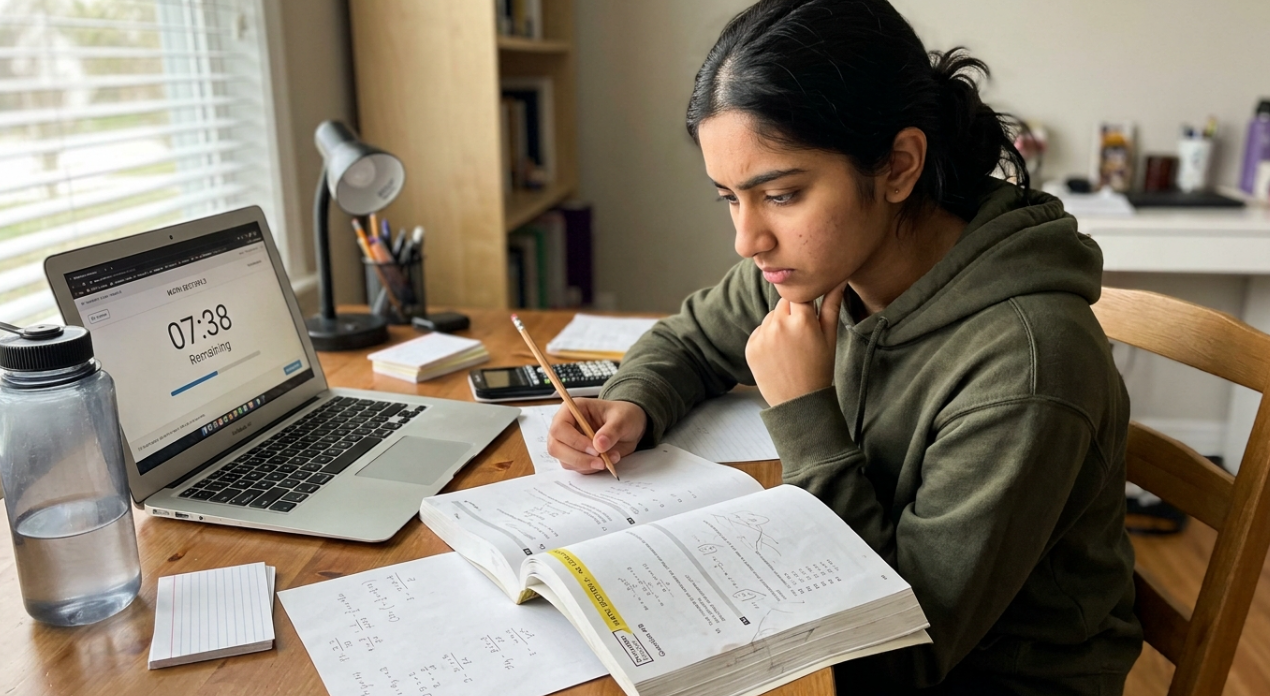
You’ve been staring at question 14 for three minutes.
You’ve tried two approaches and neither worked.
You keep pushing because leaving feels like failure.
Meanwhile, questions 15 through 22 sit untouched, and some of them are problems you could solve in 30 seconds.
Why It Happens
Persistence feels virtuous.
Skipping feels like giving up.
But the SAT doesn’t reward persistence on any single question. It rewards correct answers, period.
With 95 seconds average per question, spending four minutes on one means stealing time from two or three others.
The Fix
Set a personal cutoff:
If you don’t have a clear path to the answer within 90 seconds, flag the question, make your best guess, and move on.
There’s no wrong-answer penalty on the Digital SAT.
Come back after collecting every easier point.
Students who practice this under realistic timed conditions report that their scores jump simply because they stop leaving easy points on the table.
The easiest way to build better pacing is to practice under realistic timing. Miyagi's Digital SAT practice tests let you practice timed modules and review your performance afterward.
9. Grid-In Formatting Errors
What It Looks Like
You solve a problem and get 3 and 1/2.
You type:
3 1/2
into the grid-in box.
The system marks it wrong because it interprets 3 1/2 as 31/2 (fifteen and a half).
The correct entry was either:
7/2
3.5
Why It Happens
Grid-in questions accept specific formats, and students who don’t know the rules lose points on answers they actually got right.
Common formatting errors include:
Entering mixed numbers instead of improper fractions.
Adding percent signs or dollar signs.
Entering decimals that exceed the character limit.
The Fix
Memorize these three rules:
Never enter mixed numbers. Convert to improper fractions or decimals.
Never add units or symbols. Just enter the number.
If your decimal is long, truncate or round to fit.
These rules are simple, but you have to practice them under test conditions to make them automatic.
10. Falling for Deliberate Trap Answer Choices
What It Looks Like
A percent increase problem asks how much greater value A is than value B.
You calculate the difference and divide by A, the larger number, instead of B, the base.
Your answer, 25%, is one of the choices.
The correct answer, 33.3%, is also there.
You pick 25% because you see it first and it matches your calculation.
Why It Happens
The SAT places answers that reflect common mistakes among the choices on purpose.
As one test prep instructor put it, “The SAT is designed to catch you on this. They know you’re in a hurry, and they’ll put the answer you’re most likely to get by mistake as one of the options.”
For math questions, traps typically reflect:
Sign errors.
Wrong-variable solutions.
Incorrect bases in percent calculations.
Unit-conversion mistakes.
The Fix
After solving, pause for five seconds and ask:
“Is my answer suspiciously easy? Does it match what I’d get if I made the most obvious error?”
If your answer matches a trap pattern, such as the first variable you solved for, the percent calculated with the wrong base, or the value before a unit conversion, re-check your work.
Developing trap awareness is a skill, and it improves fast with practice.
The best way to recognize trap answers is to practice enough questions to see the same error patterns repeatedly. Use SAT Practice Mode to filter questions by domain and difficulty, then review the explanations behind the answers you miss.
11. Not Reviewing Mistakes After Practice Tests
What It Looks Like
You take a practice test on Saturday, score it, note your 1280, and start a new practice test on Sunday.
You never go back to analyze why you missed questions 7, 14, 22, and 31.
Three weeks later, you make the same errors on the real test.
Why It Happens
Taking tests feels productive.
Reviewing errors feels tedious.
But taking more tests does not automatically eliminate SAT Math mistakes.
Improvement happens during review, when you identify why an error occurred and build a specific response.
The Fix
This is the meta-mistake, the one that enables all the others.
The fix is an error log, and it’s worth its own section.
The Fix Behind All Fixes: The Error Log
The difference between students who plateau at 1300 and those who break through to 1500 often comes down to one habit: systematic mistake tracking.
Every time you miss or guess on a practice question, record four things:
Question # | Topic | Root Cause | Prevention Rule |
|---|---|---|---|
14 | Percent increase | Used wrong base (new value instead of original) | Always write “base = ___” before calculating % |
22 | Systems of equations | Solved for x, question asked for x + y | Read last sentence first, write target |
31 | Trig (Desmos) | Forgot to switch to degree mode | Check mode before every trig entry |
Use categories for root cause:
Concept gap
Translation error
Algebra slip
Calculator input
Timing
Trap answer
After three or four practice tests, patterns emerge.
Maybe 60% of your errors are algebra slips.
Maybe you consistently miss percent problems.
Those patterns tell you exactly where to focus your study time.
Practitioners on r/Sat frequently recommend this approach, and students who stick with it for even two weeks report noticing significant improvement.
You can maintain this log on paper, in a spreadsheet, or through prep platforms with built-in analytics that track your error patterns automatically.
Miyagi Labs’ AI tutor and question bank can help automate this tracking with 10,000+ expert-reviewed questions sorted by topic and difficulty.
For a complete Digital SAT study workflow built around diagnostics, targeted practice, and error review, see Miyagi's 6-step Digital SAT study guide.
The Uncomfortable Truth About “Careless” Mistakes
Most students describe their SAT Math mistakes as “careless” or “silly.”
That framing feels comforting but isn’t very useful.
If you keep making the same silly mistake, it’s not silly anymore.
It’s a pattern.
The College Panda makes this point bluntly: “The most effective thing you can do to reduce stupid mistakes is to get better through learning and practice.”
The implication is clear.
What feels like carelessness is usually incomplete mastery showing up under time pressure.
A student who truly owns distribution of negatives doesn’t forget to flip the second sign.
A student who deeply understands percent change doesn’t divide by the wrong base.
This doesn’t mean you’re bad at math.
It means the fix isn’t “slow down” or “be more careful.”
The fix is targeted practice on the specific concepts where your mastery breaks under pressure.
That’s what the error log reveals, and that’s what turns a 1300 into a 1500.
If you’re ready to identify and close those gaps systematically, a personalized Digital SAT prep plan built around your diagnostic results is the fastest path from “I keep making the same mistakes” to “I don’t make those mistakes anymore.”
Once you've identified your recurring mistakes, the next step is targeted practice. Start with a free SAT diagnostic to see which Math skills need the most work, then use targeted practice and timed tests to measure your progress.
Frequently Asked Questions
How many points do careless mistakes cost on the SAT?
Students typically lose 50 to 100+ points to avoidable errors.
At lower score ranges, each additional wrong answer can cost roughly 25 points.
Because the Digital SAT uses adaptive modules, mistakes in Module 1 can cap your maximum score, amplifying the damage well beyond a single question’s value.
How do I stop making silly mistakes on SAT Math?
Stop thinking of them as “silly.”
Track every error in a log, categorize the root cause, such as concept gap, input error, misread, or timing, and drill the specific topics where errors cluster.
General advice like “slow down” rarely works because the problem is usually incomplete mastery under pressure, not speed.
Does the Digital SAT penalize wrong answers?
No.
There is no wrong-answer penalty on the Digital SAT.
You should always answer every question, even if you’re guessing.
Leaving a question blank guarantees zero points; guessing gives you at least a 25% chance on multiple choice questions.
How does the adaptive module affect my Math score?
The Digital SAT Math section has two modules of 22 questions each.
Your performance on Module 1 determines whether you get a harder or easier Module 2.
Getting routed to the harder Module 2 unlocks the full 200 to 800 scoring range.
Getting routed to the easier Module 2 caps your maximum score around 560 to 600, even if you answer every Module 2 question correctly.
This is why Module 1 accuracy matters more than Module 2 accuracy.
What are the most common Desmos mistakes on the Digital SAT?
The top Desmos errors are:
Missing parentheses around numerators or denominators.
Confusing the multiply symbol with the variable x.
Using wrong exponent syntax, such as typing 2^x instead of 2x.
Failing to zoom the graph window to see relevant features.
Forgetting to check degree vs. radian mode for trigonometry problems.
How should I manage my time on SAT Math?
You have about 95 seconds per question on average.
Some questions should take 30 seconds, leaving more time for harder ones.
If you don’t have a clear approach within 90 seconds, flag the question, select your best guess, and move on.
Return to flagged questions after completing easier ones.
Never spend four minutes on a single problem while easier points wait.
Is it better to study more content or review my mistakes?
Review your mistakes.
Content knowledge matters, but most students scoring above 1100 already know the relevant math.
Their points are leaking through execution errors, not knowledge gaps.
An error log that tracks patterns across multiple practice tests will improve your score faster than learning new topics you’re unlikely to see.