
20 ACT Grammar Rules 2026: Complete Guide With Quick Fixes
Miyagi Labs ·
20 ACT Grammar Rules 2026: Complete Guide With Quick Fixes

TL;DR
The ACT English section tests roughly 20 core grammar rules, and knowing them cold is the fastest way to raise your score. The Enhanced ACT (2025 onward) cut the section to 50 questions in 35 minutes, removed idioms entirely, and now weights English at 33% of your composite instead of 25%. This glossary covers every active ACT grammar rule ranked by how often it appears, with correct/incorrect examples and quick fixes for each one.
The average ACT English score nationally is 18.4 out of 36. That number is low, and it tells you something important: most students walk into this section without a systematic understanding of what’s being tested. The ACT English section doesn’t test creative writing ability or vocabulary depth. It tests a finite, predictable set of grammar and rhetoric rules. Learn those rules, and you’ll outscore the majority of test-takers.
But here’s the catch. Most ACT grammar guides floating around the internet were written for the old 75-question format. They still teach idioms, still reference question types that no longer exist, and still assume English counts for only 25% of your composite. The Enhanced ACT changed all of that.
This glossary covers every grammar rule actively tested on the Enhanced ACT, ranked by frequency, with examples that mirror actual test questions. If you’re studying for an ACT in 2025 or 2026, this is the reference you need.
What Are the Most Important ACT Grammar Rules?
The most important ACT English grammar rules include sentence boundaries, comma usage, subject-verb agreement, pronoun agreement, verb tense consistency, modifier placement, parallel structure, and punctuation. Students should also understand relative pronouns, apostrophes, coordinating conjunctions, transitions, and concise writing.
To prepare effectively, learn how each rule works, recognize common errors, and practice correcting sentences under timed conditions. Start with sentence structure and punctuation, then review your mistakes to identify which skills need the most attention.
Ready to put these rules into practice? Start with a free ACT practice test to see which ones trip you up before you study.
How Grammar Is Tested on the Enhanced ACT
The Enhanced ACT English section looks different from what older prep books describe. Here’s the current format:
50 total questions (down from 75), with 35 minutes to complete them. That’s roughly 42 seconds per question.
Of those 50, 40 are scored and 10 are unscored field-test questions. You won’t know which are which.
The composite score is now the average of three sections (English, Math, Reading) instead of four. Science became optional. This means English carries 33% of your composite instead of the old 25%.
Every question falls into one of three reporting categories:
Category | % of Questions | What It Covers |
|---|---|---|
Conventions of Standard English (CSE) | 38–43% | Grammar, punctuation, sentence structure |
Production of Writing | 38–43% | Organization, transitions, relevance |
Knowledge of Language | 18–23% | Concision, style, tone |
The grammar rules in this glossary fall primarily under CSE, though some (like wordiness and transitions) overlap with the other categories.
Two Changes That Matter for Your Strategy
Every question now has an explicit stem. On the old ACT, some questions just gave you answer choices with no prompt. On the Enhanced ACT, every single question tells you what it’s testing. You’ll see stems like “Which choice makes the sentence grammatically acceptable?” or “Which choice is least redundant?” This is a gift. Use it.
NO CHANGE is correct more often than you’d think. Analysis of past tests shows NO CHANGE is the right answer between 26.6% and 37.5% of the time. If the underlined portion follows the rules and sounds right, don’t change it just because you feel like you should pick something.
ACT Grammar Rules: Frequency Table

Before diving into individual rules, here’s the big picture. This table shows approximately how often each grammar rule appears, based on analysis of recent tests. Use it to prioritize your study time.
Grammar Rule | % of Grammar Questions | ~Questions Per Test | Difficulty |
|---|---|---|---|
Sentence Formation (run-ons, fragments, comma splices) | ~20.5% | 6 | Medium |
Comma, Dash, and Colon Usage | ~17.7% | 5 | Medium |
Subject-Verb Agreement | 12–15% | 4 | Medium-Hard |
Pronoun Agreement and Case | 10–12% | 3 | Medium |
Verb Tense Consistency | 8–10% | 3 | Medium |
Modifier Placement | 5–8% | 2 | Hard |
Parallelism and Comparisons | 5–7% | 2 | Medium-Hard |
Wordiness/Redundancy | ~5% | 2–3 | Easy-Medium |
Transition Words | ~5% | 2 | Medium |
Source: Frequency data compiled from test-ninjas.com’s category breakdown and cross-referenced with multiple prep sources.
The top three categories alone (sentence formation, punctuation, and subject-verb agreement) account for roughly 40% of all CSE questions. If you’re short on time, start there.
Want to drill these specific rule categories with targeted questions? The ACT question bank lets you filter by skill so you can focus on your weakest areas.
ACT Grammar Rules Cheat Sheet
Use this table to review the major ACT English grammar concepts, the mistakes they address, and the fastest way to recognize them in a sentence.
Grammar Rule | What to Look For | Quick Fix |
|---|---|---|
Sentence boundaries | Run-ons, fragments, and comma splices | Check whether each independent clause is joined correctly. |
Comma usage | Missing, misplaced, or unnecessary commas | Identify the grammatical purpose of each comma. |
Semicolons | Incorrectly connected clauses | Make sure both sides can stand alone as sentences. |
Colons | Lists or explanations introduced incorrectly | Ensure the words before the colon form a complete sentence. |
Apostrophes | Possession versus contractions | Expand contractions such as “it's” to check their meaning. |
Subject-verb agreement | Singular and plural subjects paired with the wrong verb | Identify the main subject before choosing the verb. |
Pronoun agreement | Pronouns that do not match their antecedents | Check the noun each pronoun refers to. |
Relative pronouns | Incorrect use of who, which, and that | Check the noun being described and whether the clause is essential. |
Pronoun case | Incorrect subject or object pronouns | Determine the pronoun's role in its clause. |
Verb tense | Unjustified shifts in time | Check the surrounding verbs and time references. |
Modifiers | Descriptions placed next to the wrong word | Put the modifier next to what it describes. |
Parallel structure | Lists or comparisons with mismatched forms | Keep equivalent items grammatically consistent. |
Concision | Repeated ideas and unnecessary wording | Remove words that do not add meaning. |
FANBOYS conjunctions | Incorrectly joined words, phrases, or clauses | Use a comma before a coordinating conjunction when it joins two independent clauses. |
Transitions | Logical relationships between ideas | Match the transition to the intended relationship. |
Essential and nonessential clauses | Incorrect punctuation around descriptive clauses | Determine whether the information identifies the noun or adds extra detail. |
NO CHANGE | An original phrase that may already be correct | Apply the relevant rule before changing the wording. |
Study tip: Start with sentence boundaries and punctuation, then use your practice-test mistakes to decide which additional rules to review. This is a practical study order, not a verified ranking of question frequency.
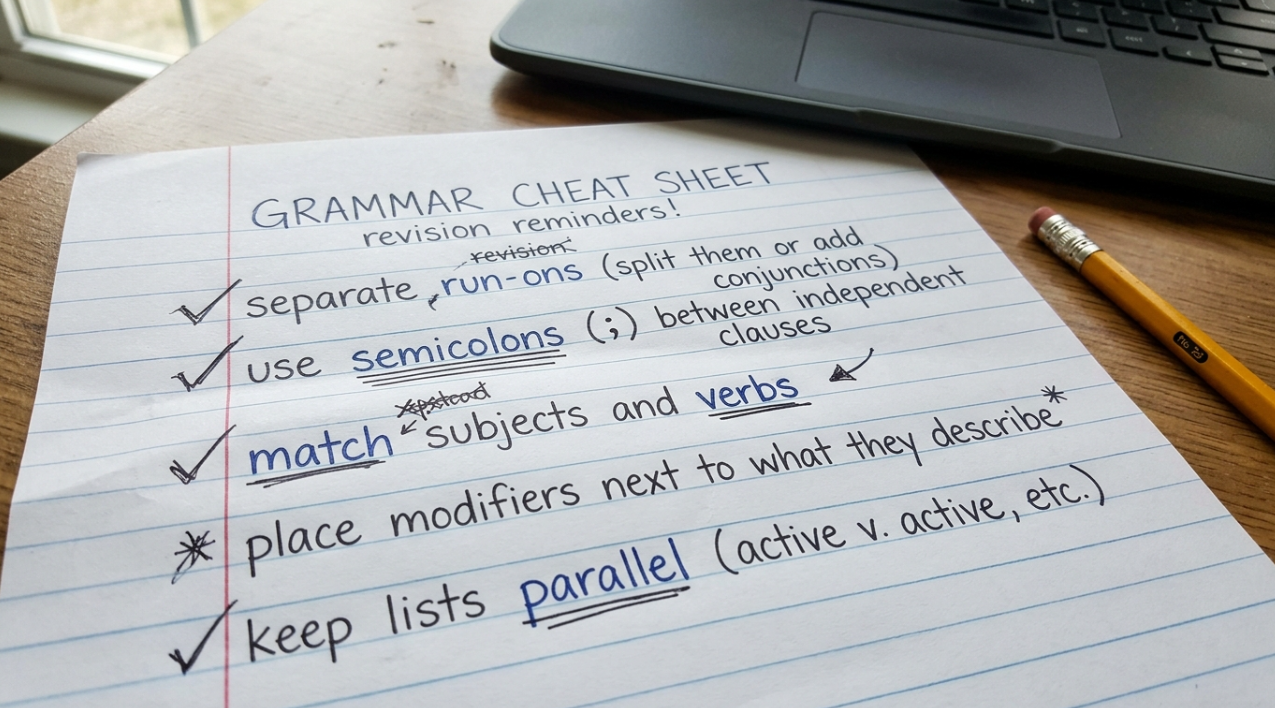
Glossary of ACT Grammar Rules
Each entry below follows the same format: what the rule is, how the ACT tests it, a correct/incorrect example pair, a quick fix, and how often it shows up.
Sentence Formation: Run-On Sentences
Definition: A run-on sentence improperly joins two independent clauses (complete sentences) without adequate punctuation or a conjunction.
How the ACT Tests It: You’ll see two complete thoughts crammed together with nothing between them, or joined only with a comma (which is actually a comma splice, covered next). The stem typically asks which choice “makes the sentence grammatically acceptable.”
Incorrect: The experiment failed the researchers started over.
Correct: The experiment failed. The researchers started over. (Also correct: semicolon, or comma + “so”)
Quick Fix: If you spot two complete sentences joined incorrectly, separate them with a period, semicolon, or comma + FANBOYS conjunction.
Frequency: Run-ons and comma splices combined are the single most tested grammar concept, appearing roughly 6 times per test.
Sentence Formation: Comma Splices
Definition: A comma splice occurs when two independent clauses are connected with only a comma. It’s the most common form of run-on that the ACT tests.
How the ACT Tests It: The underlined portion contains a comma sitting between two complete sentences. The answer choices offer various fixes: a period, semicolon, comma + conjunction, or subordination.
Incorrect: The museum was crowded, we decided to leave early.
Correct: The museum was crowded, so we decided to leave early.
Quick Fix: Two complete sentences cannot be joined by a comma alone. Add a FANBOYS conjunction after the comma, replace the comma with a semicolon, or make one clause dependent.
Frequency: Included in the ~20.5% sentence formation category.
Sentence Formation: Fragments
Definition: A fragment is a group of words that looks like a sentence but is missing a subject, a predicate verb, or a complete thought.
How the ACT Tests It: A dependent clause or participial phrase stands alone as if it were a sentence. The fix usually involves connecting it to the neighboring sentence.
Incorrect: Because the deadline had already passed.
Correct: Because the deadline had already passed, the committee rejected the proposal.
Quick Fix: A complete sentence needs three things: a subject, a verb, and a complete thought. If any is missing, attach the fragment to the sentence it belongs with.
Frequency: Part of the ~20.5% sentence formation category.
Comma Rules
Comma questions make up about 12% of the ACT English section, and experienced tutors consistently say they trip up even strong grammar students. The ACT recognizes exactly four legitimate jobs for a comma:
Job 1: After introductory elements.
After finishing the assignment, she went for a walk.
Job 2: Between items in a list of three or more.
The recipe calls for flour, sugar, and butter.
Job 3: Around nonessential information.
My brother, who lives in Denver, is visiting this weekend. (The clause “who lives in Denver” can be removed without changing the core meaning.)
Job 4: Before a FANBOYS conjunction joining two independent clauses.
The trail was steep, but the view was worth it.
The ACT’s Favorite Trap: The Unnecessary Comma. Practitioners on Reddit and experienced tutors repeat the same advice: “fewer commas is usually right.” The ACT tests unnecessary commas more than missing ones. A comma wedged between a subject and its verb is always wrong.
Incorrect: The captain of the soccer team, organized a fundraiser.
Correct: The captain of the soccer team organized a fundraiser.
Quick Fix: If you can’t name which of the four jobs a comma is doing, remove it.
Frequency: ~5 questions per test across all comma-related rules.
Semicolon Usage
Definition: A semicolon joins two independent clauses without a conjunction. Think of it as a “soft period.”
How the ACT Tests It: The test offers a semicolon as one answer choice among periods, commas, and comma-conjunction combos. The key test: both halves must be able to stand alone as complete sentences.
Incorrect: She enjoys hiking; and kayaking on weekends. (“and kayaking on weekends” is not an independent clause)
Correct: She enjoys hiking; her brother prefers kayaking.
Quick Fix: Swap in a period mentally. If both sides work as standalone sentences, the semicolon is valid.
Frequency: 1–2 questions per test, typically grouped with other punctuation rules.
Colon Usage
Definition: A colon follows a complete sentence to introduce a list, explanation, or elaboration.
How the ACT Tests It: Students often pick a colon when the words before it don’t form a complete sentence. That’s always wrong.
Incorrect: Her favorite activities include: reading, swimming, and cooking. (“Her favorite activities include” is not a complete sentence)
Correct: She has three favorite activities: reading, swimming, and cooking.
Quick Fix: Everything before the colon must be a complete, independent sentence. If it isn’t, the colon is wrong.
Frequency: 1–2 questions per test.
Apostrophes (Possession vs. Contraction)
Definition: Apostrophes show possession (the dog’s bone) or indicate a contraction (it’s = it is).
How the ACT Tests It: The test loves the its/it’s distinction. It appears on nearly every form. “Its” is possessive (no apostrophe, like “his” or “hers”). “It’s” always means “it is” or “it has.”
Incorrect: The company changed it’s logo.
Correct: The company changed its logo.
Quick Fix: Expand the contraction. If “it is” doesn’t work in the sentence, use “its” without the apostrophe.
Frequency: 1–2 questions per test.
Subject-Verb Agreement
Definition: A verb must agree in number with its subject. Singular subjects take singular verbs; plural subjects take plural verbs.
How the ACT Tests It: The ACT disguises the real subject by inserting prepositional phrases, relative clauses, or appositives between the subject and the verb. These intervening words are designed to make you match the verb to the wrong noun.
Incorrect: The stack of old newspapers were blocking the hallway. (“Stack” is the subject, not “newspapers”)
Correct: The stack of old newspapers was blocking the hallway.
Quick Fix: Cross out every prepositional phrase between the subject and verb. Phrases like “of the students,” “in the room,” and “with the tools” never affect the verb. Find the true subject, then match.
Frequency: 12–15% of grammar questions, roughly 4 per test.
Pronoun Agreement and Reference
Definition: A pronoun must agree with its antecedent (the noun it replaces) in number and person. A singular noun requires a singular pronoun; a plural noun requires a plural pronoun.
How the ACT Tests It: Watch for sentences where a plural pronoun (they, their) refers to a singular noun (each student, everyone, a person). Also watch for ambiguous pronoun references where “it” or “they” could refer to multiple nouns.
Incorrect: Every musician must bring their own instrument. (“Every musician” is singular)
Correct: Every musician must bring his or her own instrument. (Or restructure: All musicians must bring their own instruments.)
Quick Fix: Identify the antecedent. If it’s singular, the pronoun must be singular. If the reference is ambiguous, the answer will replace the pronoun with a specific noun.
Frequency: 10–12% of grammar questions, roughly 3 per test.
Relative Pronouns: Who, Which, and That
Definition: Relative pronouns introduce clauses that describe a noun. “Who” is for people. “Which” and “that” are for things. “Which” introduces nonrestrictive (nonessential) clauses and needs a comma. “That” introduces restrictive (essential) clauses and does not use a comma.
How the ACT Tests It: The test offers choices that swap who/which/that or add/remove commas before relative clauses. Getting 2–3 questions per test on relative pronouns is common.
Incorrect: The scientist that discovered the element won an award. (People require “who”)
Correct: The scientist who discovered the element won an award.
Incorrect: The policy, that was introduced last year, has been effective. (“That” shouldn’t have commas)
Correct: The policy that was introduced last year has been effective. (Essential clause, no commas) OR The policy, which was introduced last year, has been effective. (Nonessential clause, commas + which)
Quick Fix: People get “who.” Things get “which” (with commas) or “that” (no commas). If you can remove the clause without losing the sentence’s core meaning, use “which” with commas.
Frequency: 2–3 questions per test.
Pronoun Case: Who vs. Whom
Definition: “Who” is a subject pronoun (like he/she). “Whom” is an object pronoun (like him/her).
How the ACT Tests It: Usually in relative clauses. The test checks whether the pronoun acts as the subject or object of the clause it’s in.
Incorrect: The teacher whom organized the event thanked everyone. (“Whom” is an object pronoun, but here it’s the subject of “organized”)
Correct: The teacher who organized the event thanked everyone.
Quick Fix: Substitute “he” or “him” into the clause. If “he” works, use “who.” If “him” works, use “whom.”
Frequency: 1–2 questions per test, embedded within pronoun and relative pronoun questions.
Verb Tense Consistency
Definition: Verb tenses should remain consistent within a paragraph unless there’s a clear signal of a time shift (words like “previously,” “now,” “by next year”).
How the ACT Tests It: The passage establishes a tense (usually past or present), and one verb randomly switches. The stem asks you to choose the option that maintains consistent tense. The ACT tests knowledge of past, present, future, past perfect, present perfect, and future perfect tenses.
Incorrect: She walked into the lab and begins the experiment. (Shifts from past to present)
Correct: She walked into the lab and began the experiment.
Quick Fix: Look at the surrounding verbs. Match the tense unless a time-shift word justifies a change.
Frequency: 8–10% of grammar questions, roughly 3 per test. If you want a structured walkthrough of how ACT English practice handles tense questions, working through categorized problem sets is the fastest way to build instinct.
Modifier Placement (Misplaced and Dangling Modifiers)
Definition: A modifier is a word or phrase that describes another word. It must sit directly next to whatever it modifies. When it doesn’t, the sentence says something unintended (and often absurd).
How the ACT Tests It: Modifier errors are rated as the hardest grammar concept on the ACT because misplaced modifiers often sound perfectly natural in casual speech. The ACT exploits this.
Misplaced Modifier:
Incorrect: She served sandwiches to the children on paper plates. (Were the children on paper plates?)
Correct: She served sandwiches on paper plates to the children.
Dangling Modifier:
Incorrect: Walking to school, the rain soaked my jacket. (The rain wasn’t walking.)
Correct: Walking to school, I got soaked by the rain.
Quick Fix: After a comma following an introductory phrase, the very next noun must be the thing the phrase describes. If it isn’t, the modifier is dangling, and the ACT almost always fixes it by changing the subject.
Frequency: 5–8% of grammar questions, roughly 2 per test.
Parallelism (Parallel Structure)
Definition: Items in a list, comparison, or paired construction must match in grammatical form.
How the ACT Tests It: One item in a series or comparison breaks the pattern. The answer choices offer versions that restore parallel structure.
Incorrect: She enjoys swimming, biking, and to run. (Two gerunds and an infinitive)
Correct: She enjoys swimming, biking, and running.
Incorrect in Comparison: Swimming is more relaxing than to run.
Correct: Swimming is more relaxing than running.
Quick Fix: Check that every element in a list or comparison uses the same grammatical form (all gerunds, all infinitives, all nouns, etc.).
Frequency: 5–7% of grammar questions, roughly 2 per test.
Wordiness, Redundancy, and Concision
Definition: Wordiness means using more words than necessary. Redundancy means saying the same thing twice (“happy and joyful,” “completely finished,” “past history”).
How the ACT Tests It: The Enhanced ACT now uses an explicit stem for this: “Which choice is least redundant in context?” When you see that stem, the shortest answer that preserves the meaning is almost always correct.
Incorrect: In my own personal opinion, I believe that…
Correct: I believe that…
Quick Fix: If two words in a sentence say the same thing, cut one. Among answer choices that are all grammatically correct, the shortest one is often right on redundancy questions. But “shorter is better” only applies when the stem asks about redundancy or concision. For rhetoric questions, a longer answer might be correct because it adds relevant detail.
Frequency: 2–3 questions per test.
FANBOYS Conjunctions
Definition: FANBOYS is a mnemonic for the seven coordinating conjunctions: For, And, Nor, But, Or, Yet, So.
How the ACT Tests It: FANBOYS conjunctions appear in comma splice fixes (comma + FANBOYS = correct), sentence formation questions, and transition questions. When a FANBOYS conjunction joins two independent clauses, a comma must come before it. When it joins two words or phrases (not full clauses), no comma is needed.
Incorrect: The movie was long but it held my attention. (Two independent clauses joined by “but” need a comma)
Correct: The movie was long, but it held my attention.
Incorrect: She plays tennis, and soccer. (No comma needed because “soccer” isn’t an independent clause)
Correct: She plays tennis and soccer.
Quick Fix: Memorize the seven words. When FANBOYS joins two full sentences, put a comma before it. When it joins anything smaller, no comma.
Frequency: FANBOYS knowledge is embedded across sentence formation and comma questions. Understanding it is essential for at least 8–10 questions per test.
Transition Words
Definition: Transition words and phrases (however, therefore, furthermore, in contrast, for example) connect ideas between sentences or paragraphs. The ACT tests whether you pick the transition that logically fits the relationship between ideas.
How the ACT Tests It: The stem asks which transition best connects two sentences. You need to determine whether the relationship is contrast, cause-and-effect, continuation, or illustration, and then pick the word that matches.
Incorrect: The experiment failed. Therefore, the team revised their hypothesis and tried again. (“Therefore” implies a direct logical result, but revising after failure is more of a contrast/shift)
Correct: The experiment failed. Nevertheless, the team revised their hypothesis and tried again.
Quick Fix: Read the sentence before and after the transition. Determine the relationship. Contrast = however, nevertheless. Cause/effect = therefore, consequently. Addition = furthermore, moreover.
Frequency: ~2 questions per test. While partly a rhetoric skill, transitions overlap with the grammar-adjacent CSE questions.
Nonessential (Nonrestrictive) Clauses
Definition: A nonessential clause adds extra information that can be removed without changing the sentence’s core meaning. It must be set off by commas (or dashes) on both sides.
How the ACT Tests It: The test checks whether commas are correctly placed around a clause. If the clause is essential (it identifies which specific thing you’re talking about), no commas. If it’s extra, commas on both sides.
Essential: Students who study consistently score higher. (No commas. “Who study consistently” identifies which students.)
Nonessential: My sister, who studies consistently, scored a 34. (Commas. “Who studies consistently” is bonus info; you already know which sister.)
Quick Fix: Try removing the clause. If the sentence still makes complete sense and identifies the right noun, the clause is nonessential and needs commas on both sides. Not just one side, both.
Frequency: Overlaps with comma rules and relative pronoun questions. Expect 2–3 questions per test that involve this concept.
How to Approach NO CHANGE Questions
NO CHANGE means the original underlined wording is already correct. Do not reject it simply because you assume every question must contain an error.
Quick Fix: Read the sentence in context, identify the skill being tested, and check the original wording against the relevant grammar or rhetoric rule. Choose NO CHANGE when the original wording is correct and the alternatives introduce an error or weaken the sentence.
ACT Grammar Practice: Test Your Knowledge
Use these sample questions to check whether you can apply the grammar rules in context. These are original practice examples, not questions taken from an official ACT test.
Question 1: Subject-Verb Agreement
Choose the option that correctly completes the sentence.
The collection of historical documents ___ stored in the university library.
A. are
B. were
C. is
D. have been
Correct answer: C. is
Explanation: The subject is collection, which is singular. The phrase of historical documents describes the collection but does not change the subject's number.
Rule tested: Subject-verb agreement.
Question 2: Comma Splices
Which revision correctly fixes the sentence?
The storm passed, the outdoor event resumed.
A. The storm passed the outdoor event resumed.
B. The storm passed; the outdoor event resumed.
C. The storm passed, the outdoor event, resumed.
D. The storm passed and, the outdoor event resumed.
Correct answer: B. The storm passed; the outdoor event resumed.
Explanation: Both parts are independent clauses. A semicolon correctly joins them without a coordinating conjunction.
Rule tested: Sentence boundaries and semicolon usage.
Question 3: Parallel Structure
Which option completes the sentence most effectively?
The research team focused on collecting reliable data, analyzing the results, and ___ its findings.
A. the presentation of
B. presenting
C. to present
D. presented
Correct answer: B. presenting
Explanation: The sentence lists three actions: collecting, analyzing, and presenting. All three use the same grammatical form.
Rule tested: Parallel structure.
Question 4: Modifier Placement
Which revision makes the meaning clearest?
Walking through the museum, the paintings caught Maya's attention.
A. Walking through the museum, Maya noticed the paintings.
B. The paintings, walking through the museum, caught Maya's attention.
C. Maya, the paintings caught her attention while walking through the museum.
D. The museum walking through the paintings caught Maya's attention.
Correct answer: A. Walking through the museum, Maya noticed the paintings.
Explanation: The original introductory phrase incorrectly suggests that the paintings were walking through the museum. The revision makes Maya the person performing the action.
Rule tested: Dangling modifiers.
How to Use Your Results
0–2 correct: Review the explanations and study the corresponding grammar rules before attempting another set.
3 correct: Revisit the rules behind your missed questions and practice similar examples.
4 correct: Try a larger, timed set to check whether you can apply these rules consistently.
This short quiz is a learning aid, not a predictor of your ACT English score. Use a full practice test for a more complete assessment.
Retired Rules: What’s No Longer Tested
This section exists because most ACT grammar guides on the internet are outdated. A 20-year veteran tutor in New Jersey specifically calls out this problem: the highest-ranking guides still teach rules that the Enhanced ACT no longer tests. Don’t waste study hours on dead material.
Idioms (Removed)
Idiomatic language, the kind of question that asked whether you say “capable of” or “capable to,” is no longer tested on the Enhanced ACT. The Conventions of Standard English category continues to assess grammar and usage, but without relying on memorized idiomatic expressions. If your prep book has a list of 50+ idioms to memorize, skip it.
Negative-Framing Questions (Removed)
The old ACT included questions like “Which is NOT an acceptable alternative?” These have been phased out. Every question on the Enhanced ACT uses a positive, direct stem.
Paragraph Reordering (Reduced/Changed)
Questions asking you to reorder sentences within a paragraph or place a paragraph in the best location still exist but have been restructured with explicit stems. The style of question has changed enough that old-format practice is unreliable.
The 75-Question Format (Gone)
If you’re using a prep resource that references 75 questions in 45 minutes, it’s outdated. The current format is 50 questions in 35 minutes.
How to Use This Glossary to Study
Reading a list of grammar rules is step one. Turning that knowledge into points on test day requires practice.
The ACT Grammar Study Cycle
Follow this four-step cycle whenever you prepare for ACT English.
Test: Complete a set of ACT-style English questions under timed conditions.
Identify: Label every missed question by the grammar rule or editing skill it tests.
Review: Revisit the relevant explanation and write down why your answer was incorrect.
Retest: Complete a new set of similar questions to check whether you can apply the rule independently.
Repeat the cycle until you can recognize the error, explain the correct answer, and apply the rule without relying on a memorized example.
The key principle: Do not measure progress only by how many questions you complete. Track which errors you make, whether you understand the explanation, and whether the same mistake appears again.
Here’s a study method recommended by tutors and commonly discussed in ACT prep communities on Reddit:
1. Take a diagnostic or full-length practice test. Don’t study first. You need to see which rules you already know and which ones catch you.
2. Build an error log by rule category. Every time you miss a question, identify which rule from this glossary it tested. Write it down. After a full practice test, you’ll see clear patterns. Multiple community threads on r/ACT suggest this error log method as the single most effective study technique.
3. Study your weakest 3–5 rules. Use the glossary entries above. Read the definition, study the examples, understand the quick fix. Don’t try to learn all 20 rules at once.
4. Drill with targeted practice questions. Work through ACT practice questions filtered by the specific skills you missed. Doing 20 focused comma questions teaches you more than doing 100 random questions.
5. Retest and repeat. Take another practice test. Check your error log. The categories should shift as you improve. When a rule stops showing up in your error log, move on to the next one.
6. Use the explicit stems to your advantage. Every Enhanced ACT question tells you what it’s testing. Train yourself to read the stem first, identify the rule, then evaluate the choices. This turns each question from “what sounds right?” into “does this follow the rule?”
For a structured approach to all of this, the Miyagi Labs Classroom walks you through skills topic-by-topic with adaptive problem sets and mastery tracking.
You can also predict your ACT score after a practice test to see exactly where you stand and which sections offer the biggest point gains.
Frequently Asked Questions
How many grammar rules are on the ACT?
The Enhanced ACT tests approximately 20 core grammar rules, all falling under the Conventions of Standard English category (38–43% of the English section). The rest of the section covers Production of Writing and Knowledge of Language, which are more about rhetoric and style than strict grammar.
What is the most tested grammar rule on the ACT?
Sentence formation, specifically run-on sentences and comma splices, is the most frequently tested category at roughly 20.5% of grammar questions. That translates to about 6 questions per test. Comma rules and subject-verb agreement are the next most common.
Are idioms still tested on the Enhanced ACT?
No. Idiomatic language questions have been completely removed from the Enhanced ACT. If your study materials include lists of idioms like “opposed to” or “participate in,” those materials are outdated.
What is the NO CHANGE answer on the ACT?
NO CHANGE is the first answer choice on most ACT English questions. It means the original, underlined text is already correct and doesn’t need editing. It’s the right answer roughly 25–37% of the time, so don’t avoid it.
How many questions on ACT English are grammar?
On the Enhanced ACT, Conventions of Standard English (the grammar category) makes up 38–43% of the 50 questions. That means approximately 19–22 questions test grammar directly. The remaining questions cover transitions, organization, style, and concision.
What are FANBOYS conjunctions?
FANBOYS is a mnemonic for the seven coordinating conjunctions: For, And, Nor, But, Or, Yet, So. On the ACT, knowing these seven words is essential for answering comma splice questions, sentence formation questions, and comma placement questions correctly.
Is “shorter is better” always true on ACT English?
Only on redundancy and concision questions. When the stem asks “Which choice is least redundant?” the shortest grammatically correct answer is typically right. But for rhetoric questions asking about details, explanations, or support, a longer answer may be correct because it adds meaningful content. Context matters.
How has the Enhanced ACT changed grammar testing?
The biggest changes: English dropped from 75 to 50 questions, time went from 45 to 35 minutes, idioms were removed, every question now has an explicit stem telling you what skill it tests, and English now counts for 33% of your composite score instead of 25%. If you want to understand all the format changes, check out this breakdown of the ACT test format.
Knowing the rules is the foundation. Applying them under timed pressure is what actually raises your score. If you’re ready to move from studying to practicing, start with ACT prep that gives you a personalized study plan, targeted question sets, and a 24/7 AI tutor to explain every answer.