
15 ACT Math Strategies for the 2026 Digital ACT Exam
Miyagi Labs ·
15 ACT Math Strategies for the 2026 Digital ACT Exam

TL;DR
The 2026 digital ACT Math section gives students 50 minutes to work through 45 scored questions, with additional unscored field-test questions possible depending on the administration. The section now uses four answer choices and includes an embedded Desmos calculator. The most effective strategies are to master the current format, pace easier questions quickly, skip time-consuming problems, memorize essential formulas, use Desmos strategically, eliminate wrong answers, and review mistakes systematically. Whether you're starting around 18 or aiming for 36, the goal is not to solve every question the same way—it is to spend your limited time where it can earn the most points.
Why Your ACT Math Strategy Needs an Update
The national average ACT Math score is 18.9, and only 29% of test-takers meet the college readiness benchmark of 22. That means more than seven out of ten students are leaving points on the table.
Here’s the bigger issue: most ACT math strategies circulating online were written for a test that no longer exists. The Enhanced ACT, which rolled out in April 2025, changed the math section fundamentally. Fewer questions, tighter timing, fewer answer choices, and a Desmos graphing calculator built directly into the testing interface. If your strategy was built for the old format, it’s optimized for the wrong test.
These 15 strategies are built around the current format. They cover everything from pacing mechanics to calculator hacks to the specific study methods that practitioners on Reddit and ACT prep communities consistently report as effective.
Ready to find your starting point? Take an ACT diagnostic to identify exactly where your score gaps are before diving in.
What Are the Best ACT Math Strategies for 2026?
The best ACT Math strategies for 2026 are to master the current digital format, use a structured pacing system, memorize essential formulas, use Desmos strategically, skip and return when a question takes too long, eliminate wrong answers, and analyze every mistake after practice. Because the current ACT Math section has a tighter time limit and fewer answer choices than the previous version, students should focus on efficient problem-solving rather than trying to solve every question the same way.
What Changed on the ACT Math Section in 2026?
The current digital ACT is different from the traditional ACT many older prep guides still describe. Before using any ACT Math strategy, make sure you are preparing for the current format.
Feature | Previous ACT Math | Current Digital ACT Math |
|---|---|---|
Scored Math questions | 60 | 45 |
Time | 60 minutes | 50 minutes |
Answer choices | 5 | 4 |
Embedded calculator | No | Desmos graphing calculator |
Formula reference sheet | No | No |
Wrong-answer penalty | None | None |
The biggest strategic changes are speed, answer-choice elimination, and calculator use. You have less total time, fewer questions, and fewer answer choices, so guessing and process of elimination become slightly more valuable. At the same time, the built-in Desmos calculator creates new opportunities to solve certain equations, functions, graphs, and statistics problems efficiently.
What These Changes Mean for Your Strategy
The current ACT Math section rewards students who can quickly decide how to solve a problem—not just students who know how to perform the underlying mathematics.
For every question, ask:
Can I solve this directly?
Would Desmos be faster?
Can I eliminate one or more choices?
Should I plug in numbers or backsolve?
Am I spending too long on a problem I can return to later?
That decision-making process is just as important as memorizing formulas.
At-a-Glance: 15 ACT Math Strategies Ranked by Impact
# | Strategy | Best For | Time to Implement | Potential Point Impact |
|---|---|---|---|---|
1 | Know the current format | Everyone | 10 minutes | Foundation for all gains |
2 | Three-tier pacing | Everyone | 1-2 practice sessions | 2-4 points |
3 | Backsolving | Scorers 20-30 | Immediate | 1-3 points |
4 | Plugging in numbers | Scorers 20-30 | Immediate | 1-3 points |
5 | Desmos calculator hacks | Digital test-takers | 2-3 hours of practice | 2-3 points |
6 | Formula memorization | Everyone | 2-4 weeks | 3-5 points |
7 | Process of elimination | Everyone | Immediate | 1-2 points |
8 | Target weakest topics first | Everyone | Ongoing | 3-6 points |
9 | Error logging | Serious preppers | Ongoing | 2-4 points |
10 | Sketch diagrams | Scorers 22+ | Immediate | 1-2 points |
11 | Strategic skipping by target score | Below 26 | Immediate | 2-3 points |
12 | Never leave blanks | Everyone | Immediate | 1-2 points |
13 | Read the actual question | Everyone | 1 practice session | 2-3 points |
14 | Simulate test-day conditions | Everyone | Weekly | 1-3 points |
15 | Use AI tools for review | Serious preppers | Ongoing | Compounds other gains |
Now let’s break each one down.
1. Know the Current ACT Math Format
Best for: Every single student, regardless of score level.
You cannot strategize for a test you don’t understand. The Enhanced ACT Math section differs from the old version in almost every structural dimension.
Feature | Old ACT Math | Enhanced ACT (2026) |
|---|---|---|
Questions | 60 | 45 scored + 4 unscored field-test |
Time | 60 minutes | 50 minutes |
Answer choices | 5 (A-E) | 4 (A-D) |
Calculator | Handheld only | Built-in Desmos + handheld allowed |
Formula sheet | None | Still none |
Random guess odds | 20% | 25% |
The content breakdown has shifted too. Preparing for Higher Mathematics now accounts for 80% of scored questions (up from roughly 60%), broken into Algebra (17-20%), Functions (17-20%), Geometry (17-20%), Statistics & Probability (12-15%), and Number & Quantity (10-12%). The remaining 20% falls under Integrating Essential Skills, covering rates, percentages, area, and proportional reasoning.
The practical takeaway: the 2026 ACT is harder on average. There are fewer easy warm-up questions at the start because foundational skills occupy a smaller share. Plan accordingly.
Four of the 45 questions are unscored field-test items scattered randomly throughout the section. You can’t tell which ones they are, so treat every question as if it counts.
One more note on format context: in June 2026, ETS announced its acquisition of ACT, Inc. It’s too early to know how this will affect future test design, but it signals that changes may continue. Staying current on the format is not optional.
2. Master the Three-Tier Pacing System
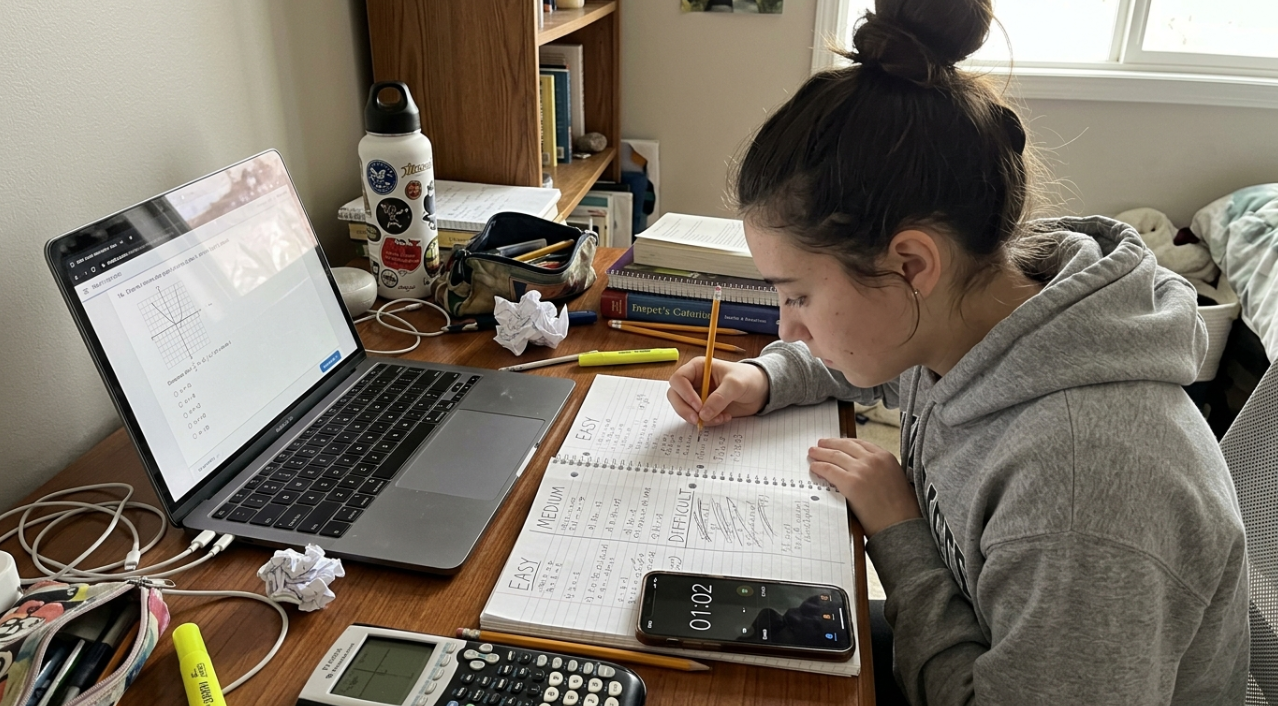
Best for: Everyone. This is the single biggest time-management upgrade most students can make.
How Much Time Do You Have Per ACT Math Question?
With 45 scored questions and 50 minutes, you have about 67 seconds per scored question on average. But that does not mean you should spend 67 seconds on every problem.
Question Type | Approximate Time Goal | What to Do |
|---|---|---|
Straightforward | 20–40 seconds | Solve and move on |
Medium | 45–75 seconds | Work carefully |
Difficult | 75–120+ seconds | Attempt if appropriate; flag if stuck |
Stalling | 60+ seconds with no progress | Guess, flag, and move on |
These are pacing targets, not rigid rules. A difficult question may deserve more than 90 seconds if you know exactly how to solve it. The warning sign is not the clock itself—it is spending time without making meaningful progress.
The standard advice of “about one minute per question” is technically true (50 minutes / 45 questions ≈ 67 seconds), but it hides the real strategy. ACT Math questions are arranged roughly in order of difficulty. The early questions should take far less time than the later ones, which means you need to bank time at the front.
Question Range | Difficulty | Target Time | Rule |
|---|---|---|---|
Q1-20 | Easier | ~30 seconds | Answer directly, don’t overthink |
Q21-35 | Medium | ~60-75 seconds | Work carefully, flag if stuck |
Q36-45 | Hard | ~90 seconds | Attempt if confident, strategic guess otherwise |
The key discipline: if any single question stalls you past 60 seconds, flag it, fill in your best guess, and move on. You can return to flagged questions if time allows. Spending three minutes on question 14 while leaving questions 38-45 completely blank is one of the most common ways students underperform relative to their actual knowledge.
Practitioners on Reddit consistently reinforce this. One student who scored a 36 noted that the most helpful thing was simply taking timed practice tests weekly, because it forced them to internalize the pacing rather than just theorize about it.
If you want to practice this pacing system, ACT practice tests under timed conditions are the fastest way to calibrate your internal clock.
3. Backsolving: Work from the Answer Choices
Best for: Students in the 20-30 range who know the math but get tangled in multi-step algebra.
The answer is already on the page. That’s the fundamental advantage of multiple-choice math. When you’re stuck on an equation, plug the answer choices back in and see which one works.
Here’s the efficient version: ACT answer choices are almost always listed in numerical order. Start with option B or C (the middle values). If the result is too small, eliminate it and everything below it. If it’s too large, eliminate it and everything above it. This lets you find the answer in two attempts instead of four.
When to use it:
Single-variable equations
Word problems with numerical answers
Any question where setting up the algebra feels more complicated than just testing values
When NOT to use it:
Questions asking “which expression is equivalent to…” (answers are expressions, not numbers)
Questions where the answer choices are very close together (rounding errors can mislead you)
Reddit’s ACT community endorses this heavily. One common recommendation is to plug in a simple number like 2 for the variable x when you’re unable to solve a question, then check which answer choice produces the same result.
4. Plugging In Numbers
Best for: Students who freeze on abstract, variable-heavy expressions.
This is backsolving’s cousin. When a question is loaded with variables and asks “which of the following is equivalent to…” or “which expression represents…”, replace the variables with easy, concrete numbers. Solve using your numbers, then check which answer choice yields that same result.
Good numbers to plug in: 2, 3, 5, 10
Numbers to avoid: 0 and 1 (too many special properties that can make multiple answers look correct)
For example, if a question asks which expression equals (x² - 4)/(x - 2), plug in x = 3. The original becomes (9 - 4)/(3 - 2) = 5. Then check each answer choice with x = 3. The one that gives you 5 is your answer.
This works because it turns an abstract algebraic manipulation into simple arithmetic. As one tutor put it, replacing variables with numbers reduces mental overload by making the problem concrete and manageable.
For more ACT practice questions that let you drill this technique on real problem types, targeted practice sets are more effective than just reading about the method.
5. Use Desmos Strategically (The Digital ACT Game-Changer)
Best for: Students taking the digital ACT who want to pick up 2-3 extra scaled-score points.
Starting with the December 2025 digital ACT, every student has access to a full Desmos graphing calculator built into the testing interface. This is one of the biggest changes to the ACT Math section in years, and no top-ranking article on ACT math strategies covers it in depth.
Desmos is genuinely useful on roughly 15% of ACT math questions, about 7 out of 45. That sounds modest, but if Desmos helps you get 3-4 of those right that you would have otherwise missed or spent too long on, that’s a 2-3 point improvement on your scaled score.
Best Desmos use cases:
Systems of equations: Graph both sides and click the intersection point. Usually faster than algebraic substitution or elimination.
Trig questions: But first, confirm you’re in the right mode. Open Graph Settings and check radians versus degrees before every trig problem. Wrong mode is a common score-killer.
Statistics: Under the functions menu, select “mean” or “median,” enter your numbers, and Desmos calculates automatically.
Function analysis: Graph a function to visually identify zeros, maxima, minima, or end behavior instead of computing them algebraically.
When NOT to use Desmos:
Basic arithmetic. If you need 3 × 17 or 15% of 240, navigating to Desmos takes longer than mental math or your handheld calculator. Don’t use a graphing calculator as an adding machine.
Simple linear equations you can solve in your head in 10 seconds.
ACT.org publishes tutorial videos showing how to use Desmos for factoring quadratics, evaluating functions, and solving systems. Watch them before test day.
If you’ve used Desmos for SAT prep, the ACT version is similar. Our Desmos calculator tips guide covers the core techniques that transfer between both tests.
6. Build Your Formula Vault (No Reference Sheet on the ACT)
Best for: Everyone, but especially students below 25 who are losing points on questions they’d know how to solve if they could just remember the formula.
Unlike the digital SAT, which provides a reference sheet of geometry formulas, the ACT expects you to walk in with every formula memorized. This makes knowing your formulas cold one of the easiest ways to protect your score.
Tier 1: Must-know (these appear on nearly every test)
Slope-intercept form: y = mx + b
Quadratic formula: x = (-b ± √(b² - 4ac)) / 2a
Pythagorean theorem: a² + b² = c²
Area of a circle: πr² / Circumference: 2πr
Area of a triangle: ½bh
SOHCAHTOA (sin = opp/hyp, cos = adj/hyp, tan = opp/adj)
Distance formula: √((x₂-x₁)² + (y₂-y₁)²)
Tier 2: Important (show up regularly)
Midpoint formula
Percent change: (new - old) / old × 100
Special right triangles: 30-60-90 (1, √3, 2) and 45-45-90 (1, 1, √2)
Volume of a cylinder: πr²h
Arc length and sector area
Tier 3: Nice-to-have (appear 1-2 times per test)
Law of sines / law of cosines
Permutations and combinations formulas
The study method that works: flashcards plus a daily 5-minute drill. Write each formula on one side of a card, the use case on the other. Shuffle and test yourself every morning. After two weeks, most students have these locked in. For a detailed breakdown of which formulas matter most, our SAT math formulas guide covers significant overlap with ACT requirements.
Without SOHCAHTOA memorized, for instance, you simply cannot answer trig questions. There’s no way around it and no way to derive these relationships during the test without burning valuable time.
7. Process of Elimination (Now Even More Powerful)
Best for: Every student, especially on questions where you’re not 100% sure of the answer.
The shift from 5 answer choices to 4 is a quiet gift. Your baseline random guess probability went from 20% to 25%. Eliminate even one answer and you’re at 33%. Eliminate two and you have a coin flip.
Quick POE techniques:
Check the sign. If the question involves a negative slope or a subtraction, any positive answer (or vice versa) is probably wrong.
Estimate magnitude. If you’re finding the area of a triangle with base 6 and height 4, the answer is 12. Any choice that says 24 or 48 confused area with perimeter or forgot the ½.
Identify impossible answers. A probability can’t be greater than 1. A length can’t be negative. A percentage can’t be 250% if the question describes a partial amount.
One tutoring practitioner explained it well: noticing whether a graph opens up or down and whether the y-intercept is positive or negative can help you eliminate all but one answer choice without plugging in a single point. That’s faster than brute-force calculation.
8. Target Your Weakest Topics First
Best for: Students with 3+ weeks of study time who want to maximize point gains per hour of effort.
Not all ACT math topics are created equal. Algebra and Functions collectively make up roughly 40% of the test (about 15 questions). If you’re weak in these areas, that’s where your study time should go first.
Priority framework:
High-frequency + high-error-rate: Study these first. If you miss half the algebra questions and there are 8 of them, that’s 4 points you can recover.
High-frequency + low-error-rate: Maintain these with occasional review.
Low-frequency + high-error-rate: Study after you’ve addressed the high-frequency gaps.
Low-frequency + low-error-rate: Don’t spend time here unless you’re aiming for 34+.
Practitioners on Reddit are direct about this: avoid studying entire sections daily. Practicing only the parts you struggle with is a more effective use of your time.
A diagnostic test is the fastest way to identify those weak spots. The ACT question bank lets you filter by topic so you can drill specific skill areas rather than grinding through random mixed sets.
9. Build an Error Log
Best for: Students who practice regularly but aren’t seeing score improvements.
Most students take practice tests, check their scores, feel bad or good about the result, and move on. That’s wasted information. Every missed question contains a lesson, but only if you extract it.
How to do it: In a notebook or spreadsheet, record every missed question with three pieces of information:
What type of question was it? (Algebra, geometry, trig, statistics, etc.)
Why did you miss it? (Didn’t know the concept, careless arithmetic, misread the question, ran out of time)
What will you do differently? (Memorize the formula, slow down on final step, re-read what the question asks)
After two or three practice tests, patterns emerge. Maybe you keep dropping negatives on distribution problems. Maybe you consistently misidentify what trig ratio to use. Those patterns become your targeted study plan.
Review the log weekly. One ACT prep coach described it as the single most underrated strategy because it turns passive practice into active learning. For a structured approach to this diagnostic-then-drill cycle, the Miyagi Labs methodology page explains how to turn error patterns into focused study sessions.
10. Sketch Diagrams for Geometry and Word Problems
Best for: Students scoring 22+ who are losing points on geometry or word problems they conceptually understand.
Many ACT geometry questions don’t include a figure. When they do, the figure might not be drawn to scale. Either way, drawing your own diagram and labeling every given value on it before computing is one of the simplest ways to avoid errors.
For geometry questions:
Draw the shape yourself, even if one is provided
Label all given measurements directly on the figure
Mark right angles, parallel lines, and equal segments
Write the formula you plan to use next to the figure
For word problems:
Translate the scenario into a visual (a table, a number line, a diagram)
Label what you know and circle what you’re solving for
This prevents the most common word-problem mistake: solving for the wrong quantity
The act of drawing forces you to slow down just enough to process the problem before jumping into calculations. It takes 10-15 seconds and prevents 30-60 second errors.
11. Skip and Return Strategically (Match Your Target Score)
Best for: Students below 26 who are trying to maximize every available point.
Not every student needs to answer every question. Your strategy should match your target score.
Current Score | Target | Strategy |
|---|---|---|
Below 20 | 22-24 | Skip the last 9 questions entirely. Focus all energy on getting Q1-36 correct. Guess on Q37-45. |
20-25 | 26-28 | Attempt all questions, but move quickly on the last 10. Flag and return if time permits. |
25-30 | 30-32 | Attempt every question. Save 3-5 minutes at the end for a review pass on flagged items. |
30+ | 34-36 | Attempt every question. Use saved time to double-check arithmetic on medium questions. |
For students scoring below 26, this is counterintuitive but mathematically sound: completely skipping the hardest 20% of questions and focusing all your energy on nailing the first 80% produces a higher score than rushing through everything. Those last 9 questions are designed for students aiming at 30+. If that’s not you, spending 8 minutes on them means 8 fewer minutes on questions you could actually get right.
Want to figure out where you stand? An ACT score predictor can estimate your current level and show exactly which score range to target.
12. Never Leave a Bubble Blank
Best for: Everyone. This is a zero-effort, guaranteed-upside strategy.
There is no penalty for wrong answers on the ACT. None. A wrong guess and a blank answer both score zero, but a random guess has a 25% chance of being right. Over 45 questions, that’s significant.
If you’re running out of time and have 5 unanswered questions, guessing randomly should net you about 1-2 correct answers. That’s 1-2 points you got for free.
Best practice: Pick a “default letter” for all pure guesses (say, C) and stick with it. This prevents the time waste of deliberating over which letter to guess and ensures statistical consistency.
13. Read the Actual Question (Not What You Expect It to Ask)
Best for: Students scoring 22-30 who are losing points on questions they actually know how to solve.
Misreading word problems is the most common reason students get wrong answers on problems they already have the skills to solve. ACT data shows that 45% of errors on easy and medium questions involve basic algebra and arithmetic, not advanced concepts. Many of these errors come from students solving the right equation but answering the wrong question.
The most common traps:
Solving for x when asked for 2x or x + 3. The question says “what is the value of 2x?” and you proudly bubble in the value of x.
Finding area when asked for perimeter (or diameter when asked for radius). Always circle the specific quantity the question asks for.
Dropping a negative sign. Especially in distribution: -3(x - 4) = -3x + 12, not -3x - 12.
“Which of the following is NOT…” Students scan for a true statement instead of a false one because they missed the “NOT.”
The fix: Before you solve anything, underline or circle what the question is actually asking. On the digital test, use the highlight tool. Make this a physical habit during every practice session. For more on these patterns, our guide on common SAT math mistakes covers the same error types that plague ACT test-takers.
14. Simulate Real Test Conditions During Practice

Best for: Every student within 4 weeks of test day.
Taking a practice test in bed at 11 PM with Spotify playing and your phone buzzing is not practice. It’s something, but it’s not the kind of practice that translates to test day performance.
What real simulation looks like:
45 questions, 50 minutes, strict timing
No pausing, no phone, no snack breaks mid-section
Use the Desmos testing interface (not the full desmos.com version, which has features the test version doesn’t)
Practice at roughly the same time of day as your actual test
Sit at a desk, not on a couch
A student who scored a perfect 36 shared that the most helpful thing was simply forcing themselves to take a full practice test weekly. Many of their friends spent thousands on test prep courses, and the single most valuable element of those courses, they reported, was that they forced you to take practice tests on a schedule.
You can replicate that structure for free. Full-length ACT practice exams under timed conditions build the stamina and pacing instincts that no amount of untimed studying can match.
15. Use AI Tools to Get Instant Explanations on Mistakes
Best for: Students who study independently and don’t have a tutor to explain missed questions.
When you miss a question during practice, the worst thing you can do is just read the correct answer and move on. You need to understand why the correct answer is correct and why your answer was wrong. Step-by-step explanations for every miss are what turn practice into learning.
AI tutoring tools can identify concept gaps faster than self-study alone. Instead of spending 20 minutes trying to figure out why answer C was right, you get an immediate breakdown of the solution path, what concept was being tested, and what similar problems look like.
This is particularly valuable when combined with the error log from Strategy 9. Review your misses, get explanations, categorize the errors, and you have a self-improving study system.
Bonus: Score-Specific Game Plans
Different scores call for different ACT math strategies. Here’s how to prioritize based on where you are now:
Current Score | Key Focus | Top Strategies to Prioritize |
|---|---|---|
Below 20 | Foundation gaps: formulas, basic algebra, IES skills | Formula vault (#6), skip hard questions (#11), never leave blanks (#12), target weakest topics (#8) |
20-25 | Targeted drilling and technique | Error log (#9), backsolving (#3), three-tier pacing (#2), plugging in (#4) |
25-30 | Eliminating careless errors | Read the question (#13), POE (#7), sketch diagrams (#10), simulate test conditions (#14) |
30+ | Edge-case topics and tool mastery | Desmos hacks (#5), trig and stats fluency, use saved time for review passes |
Students near 25 often lose points they’ve already earned in their heads: dropped negatives, misread questions, arithmetic that goes sideways on the final step. Treating those misses as seriously as content gaps is what separates a 25 from a 29.
For students below 20, the path to 22 (the college readiness benchmark) is almost entirely about locking in foundational formulas and not wasting time on questions designed for 30+ scorers. That benchmark is achievable for almost anyone willing to put in focused, strategic work.
Start Putting These Strategies to Work
Knowing ACT math strategies is step one. Executing them under timed pressure is the actual skill that raises your score. The bridge between reading about strategies and deploying them is structured practice with feedback.
Start your ACT prep with Miyagi Labs, which includes a diagnostic to identify your weak spots, a question bank filtered by topic and difficulty, full-length timed practice exams, and a 24/7 AI tutor that explains every missed question step by step.
FAQ
How many questions are on the ACT Math section?
The Enhanced ACT Math section has 45 scored questions plus 4 unscored field-test questions (49 total), and you have 50 minutes to complete them. The field-test questions are indistinguishable from scored ones, so treat every question as if it counts.
Is there a formula sheet on the ACT?
No. Unlike the digital SAT, the ACT does not provide any formula reference sheet. You need to memorize all relevant formulas before test day, including the quadratic formula, SOHCAHTOA, area and volume formulas, and special right triangle ratios.
Can you use a Desmos calculator on the ACT?
Yes, on the digital ACT. Starting with the December 2025 administration, a full Desmos graphing calculator is built into the testing interface. It’s useful on roughly 15% of questions and can potentially lift your scaled score by 2-3 points if used strategically.
What math topics are most tested on the ACT?
Algebra and Functions together make up approximately 40% of the test (about 15 questions combined). Geometry accounts for another 17-20%. Statistics & Probability and Number & Quantity round out the Preparing for Higher Mathematics category, which collectively represents 80% of scored questions.
Is there a penalty for guessing on the ACT?
No. There is no penalty for wrong answers. A wrong guess scores the same as a blank (zero), but a random guess has a 25% chance of being correct. Always fill in every question before time is called.
What is a good ACT Math score?
The national average is 18.9 and the college readiness benchmark is 22. For competitive colleges, you’ll generally want 28 or above. For highly selective schools, aim for 33+. For a deeper breakdown, check out our guide on what is a good ACT score.
How should I study differently for the Enhanced ACT vs. the old ACT?
The Enhanced format has fewer questions (45 vs. 60), slightly less time (50 vs. 60 minutes), 4 answer choices instead of 5, and a higher proportion of advanced questions (80% Preparing for Higher Math vs. the old 60%). This means fewer easy warm-up questions and a greater emphasis on algebra, functions, and geometry. Your study plan should weight these topics accordingly, and you should learn the Desmos interface before test day.
How long should I study for the ACT Math section?
It depends on your starting point and target score. Students aiming to improve by 3-5 points typically need 4-8 weeks of focused, strategic practice. Our ACT study plan guide breaks down timelines by score goal and starting level.