
15 ACT Mistakes to Avoid in 2026 (and How to Fix Them)
Miyagi Labs ·
15 ACT Mistakes to Avoid in 2026 (and How to Fix Them)

TL;DR
Most ACT points are lost to avoidable mistakes, not gaps in knowledge. The biggest culprits fall into three categories: prep mistakes (no plan, no practice tests, no error review), test-day mistakes (rushing, leaving blanks, misreading questions), and section-specific errors (comma over-insertion in English, sign errors in Math, misreading graphs in Science). This guide covers 15 of the most common ACT mistakes with concrete fixes and a mistake review system you can start using today.
At-a-Glance: 15 Common ACT Mistakes and How to Fix Them
# | ACT mistake | Category | How to fix it |
|---|---|---|---|
1 | Studying without a plan | Preparation | Take a diagnostic test and build a targeted schedule. |
2 | Skipping full-length practice tests | Preparation | Practice under timed, realistic conditions. |
3 | Cramming instead of spacing practice | Preparation | Use shorter, consistent study sessions. |
4 | Never reviewing wrong answers | Preparation | Track errors and identify their root causes. |
5 | Using the same strategy for every section | Preparation | Develop a strategy for each section. |
6 | Rushing through questions | Test day | Read carefully while monitoring your pace. |
7 | Getting stuck on difficult questions | Test day | Move on strategically and return if time allows. |
8 | Leaving answers blank | Test day | Answer every question when time expires, since there is no wrong-answer penalty. |
9 | Misreading the full question | Test day | Identify exactly what the question asks before answering. |
10 | Losing track of answer choices | Test day | Match each answer to the correct question number. |
11 | Adding unnecessary commas | English | Apply punctuation rules instead of relying on pauses in speech. |
12 | Automatically rejecting “NO CHANGE” | English | Evaluate the original sentence against the grammar rules. |
13 | Making sign errors or misusing a calculator | Math | Write out steps and verify signs, units, and calculations. |
14 | Misreading graphs and axis labels | Science | Check labels, units, scales, and trends before interpreting data. |
15 | Re-reading entire passages unnecessarily | Reading | Locate relevant details with targeted re-reading. |
The impact of each mistake depends on the student's current skills, the questions missed, and the scoring rules for the test being taken. The goal is to identify and correct recurring errors rather than assume that each mistake has a fixed point cost.
Preparing for the ACT involves more than learning grammar rules, practicing algebra, and memorizing formulas. Students also need to manage their time, interpret questions accurately, and understand why they get practice questions wrong.
Many common ACT mistakes are preventable. Rushing through questions, spending too long on difficult problems, skipping practice tests, and repeating errors without reviewing them can all undermine a student's performance.
In this guide, you'll learn how to recognize 15 common ACT mistakes, correct them with practical strategies, and build a review system that helps you prepare more effectively for test day.
What Are the Most Common ACT Mistakes?
The most common ACT mistakes include studying without a plan, skipping timed practice tests, failing to review wrong answers, rushing through questions, getting stuck on difficult problems, leaving answers blank, misreading instructions, and making avoidable errors in English, Math, Reading, and Science.
To avoid these mistakes, take a diagnostic test, practice under realistic conditions, track recurring errors, and use a specific correction strategy for each problem. Check the current ACT format before setting your study schedule so your practice materials match the test you'll take.
If you want to start by identifying which mistakes are actually hurting your score, take an ACT diagnostic before reading further. It makes everything below more concrete.
Part 1: ACT Prep Mistakes (Before Test Day)
These are the mistakes you make weeks or months before the test. They’re the easiest to fix and often the most expensive in terms of points.
1. Prepping Without a Study Plan
Diving into prep without a strategy is one of the most common ACT mistakes students make. Randomly solving questions, hopping between topics, working through a prep book front to back without prioritizing, all of it creates the illusion of progress without the substance.
The ACT includes 215 questions to complete in under three hours. You can’t prepare for that kind of volume by winging it.
The fix: Take a diagnostic test first. Identify your two or three weakest skill areas. Then build a study calendar that works backward from your test date, spending the most time on the highest-impact areas. If you’re unsure whether the ACT is even the right test for you, read this guide on SAT vs ACT differences before committing.
2. Skipping Full-Length Practice Tests

Many students focus exclusively on content review but never simulate the actual test experience. The ACT is a sprint. It demands stamina, pacing, and the ability to maintain focus across four sections without meaningful breaks. Without full-length practice, students walk into test day having never dealt with the fatigue that hits in Science after already grinding through English, Math, and Reading.
The fix: Take at least 3-4 full-length timed practice tests before the real thing. Treat them like dress rehearsals: same time of day, same snack breaks, same pencils. You can find free options in this roundup of best free ACT prep resources, or take timed ACT practice tests with section-by-section breakdowns.
3. Cramming Instead of Spacing Practice
The night-before study marathon is a tradition as old as standardized testing. It’s also counterproductive. When you are sleep-deprived and tired, your higher brain functions start to shut down. Tired students misread questions, make calculation errors, and struggle to generate solutions under pressure.
The ACT averages less than one minute per question. That pace demands sharpness, not exhaustion.
The fix: Start 8-12 weeks before your test date. Study in focused daily sessions of 45-90 minutes rather than marathon weekend cram sessions. For a week-by-week breakdown, see this ACT study plan guide.
4. Never Reviewing Wrong Answers
This might be the most damaging prep mistake of all. Many students practice dozens of questions but never properly review them. They check the answer, see they got it wrong, maybe glance at the explanation, and move on. They miss the entire point of practice.
Simply getting the right answer isn’t sufficient. Understanding the reasoning behind the answer is what drives improvement.
A popular approach on Reddit’s r/ACT community is the “5 Whys” method, borrowed from engineering. For every wrong answer, you ask “why?” iteratively until you reach the root cause. Why did I pick B? Because I thought the graph showed an increase. Why did I think that? Because I read the wrong axis. Why did I read the wrong axis? Because I didn’t check the labels first. Now you have something to actually fix.
The fix: Keep an error log. Categorize each wrong answer as “content gap” (didn’t know the concept), “process error” (knew it but executed wrong), “careless error” (misread or rushed), or “time error” (ran out of time). Drill the pattern, not just the individual question.
5. Not Having a Section-Specific Strategy
The ACT has four distinct sections, and each one rewards a different approach. The pacing strategy that works for English (about 45 seconds per question) will fail you in Science. The reading approach that works for Reading passages won’t help with Science passages. Students who use one generic test-taking method across all sections leave points on the table.
The fix: Develop a plan for each section. Know your pacing targets, your reading strategy, and the common trap patterns before test day. The ACT test format guide breaks down what each section demands.
Part 2: General Test-Day Mistakes (All Sections)
These ACT mistakes happen during the actual exam. They affect every section and often account for the gap between a student’s practice scores and their real score.
1. Rushing Through Questions
Time management is one of the toughest aspects of the ACT. With less than a minute per question on average, students naturally feel pressure to go fast. But rushing is a surefire way to make careless errors and leave valuable points on the table.
One of the best things students can do is slow down. That sounds contradictory on a timed test, but there’s a difference between moving efficiently and moving recklessly.
The fix: Set per-question pacing targets by section. For Math: about 50 seconds for straightforward questions, about 90 seconds for harder ones. Flag anything that takes longer than 90 seconds and come back to it. For English: about 35-45 seconds per question. Practice with a timer until these rhythms become instinctive.
2. Getting Stuck on Hard Questions
Many students let one or two difficult questions drain 2-3 minutes. That’s 2-3 minutes they could have spent answering three or four easier questions correctly. The ACT rewards breadth over depth. Getting three easy questions right is always worth more than agonizing over one hard question.
As one test prep practitioner put it: the most damaging ACT mistakes are not obscure content gaps. They are repeated decisions, like spending too long on one item.
The fix: Mark difficult questions, bubble your best guess, and move on. Come back with remaining time. The hard questions are worth exactly the same as the easy ones.
3. Leaving Answers Blank
There is no penalty for guessing on the ACT. None. A wrong answer counts the same as a blank answer: zero points. But a random guess gives you a 20-25% chance of getting the right answer, which is infinitely better than zero.
The fix: Always bubble something. If you’re running out of time, fill in your best guess for every remaining question. Pick one letter as your default guess letter and stick with it.
4. Not Reading the Full Question
A student sees familiar content and starts solving before noticing that the question asks for the value of 2x (not x), the sentence that best supports a specific claim (not a general one), or the experiment that would weaken a hypothesis (not strengthen it).
Those NOT and EXCEPT questions are particularly dangerous. Make sure to read questions closely and circle or underline the NOT or EXCEPT so you don’t miss it.
The fix: Before you start solving, underline what the question actually asks. This takes two seconds and prevents the kind of ACT mistake that costs the most frustration.
5. Misaligning Answer Bubbles
This one is preventable and potentially catastrophic. If you skip questions in the test booklet but forget to skip them on the answer sheet, every subsequent answer shifts to the wrong line. By the time you notice, you may have misbubbled a dozen answers.
The fix: If you skip questions, make a clear notation in your booklet. Check that your question number and answer sheet number match every time you turn a page or finish a passage. Transfer answers one passage or one page at a time.
Part 3: Section-Specific ACT Mistakes
These are the errors unique to particular sections. Fixing even one or two of these can move your score by multiple points.
1. ACT English: Over-Inserting Commas
Comma questions trip up more students than any other English question type on the ACT. The reason is straightforward: many students believe you should put a comma anywhere you’d naturally pause when speaking. But spoken English and written punctuation rules are different things entirely.
Comma questions are easier to approach when you identify the grammatical role of each part of a sentence. Commas can separate items in a series, set off nonessential information, follow certain introductory elements, and join independent clauses when paired with a coordinating conjunction.
However, commas should not separate a subject from its verb or a verb from its object. Rather than adding a comma wherever you would naturally pause while speaking, determine how the sentence is constructed and apply the relevant punctuation rule.
The fix: Before selecting an answer, identify the subject and verb, check whether the surrounding information is essential, and determine whether the sentence contains independent clauses. Then choose the punctuation that makes the sentence grammatically correct and clear. Practice them with ACT question bank drills until the patterns become automatic.
2. ACT English: Ruling Out “NO CHANGE”
Students instinctively assume the underlined portion must contain an error. Otherwise, why would they be asking about it? This bias causes them to “fix” sentences that were already correct.
Here’s a fact most students don’t know: NO CHANGE is the correct answer slightly more than 25% of the time. That means if you’re picking it less than one out of every four questions, you’re probably over-correcting.
The fix: Treat NO CHANGE like any other answer choice. Read the original sentence on its merits. If it follows grammar rules and reads clearly, pick A and move on.
3. ACT Math: Negative Sign Errors and Calculator Over-Reliance
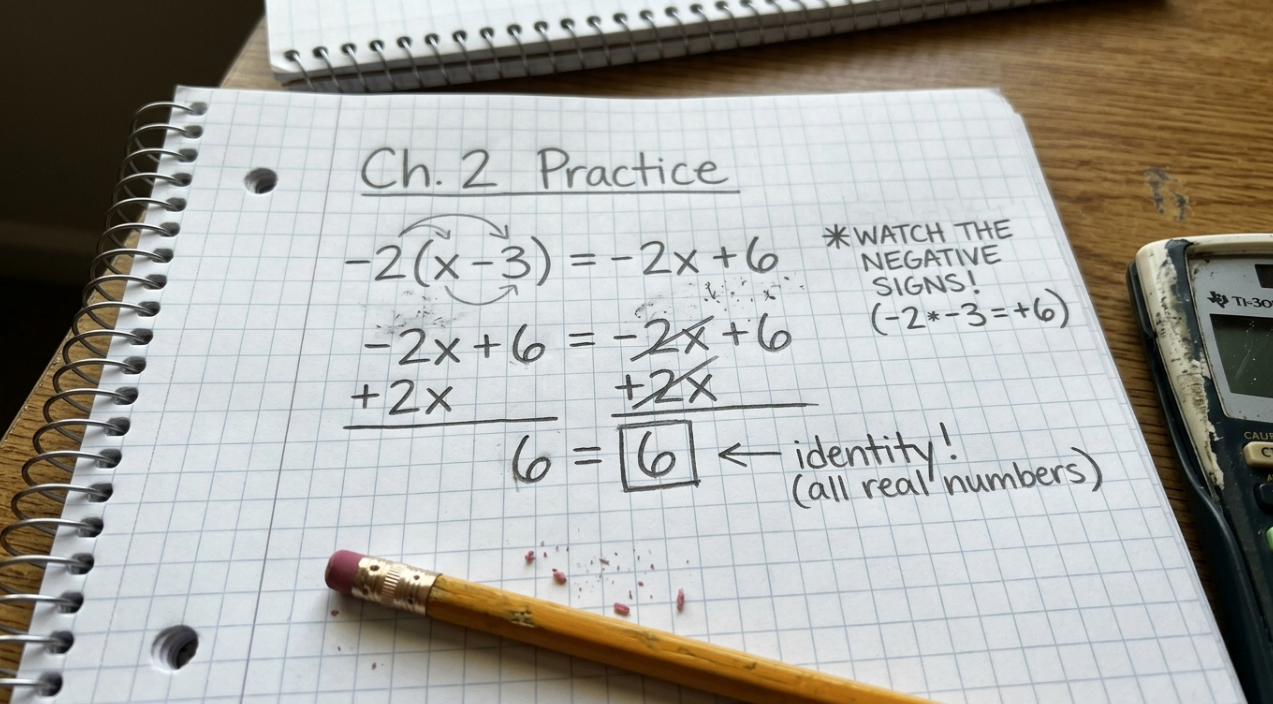
Distributing -2(x - 3) as -2x - 6 instead of the correct -2x + 6 is the kind of mistake that costs 2-4 questions per test. It’s not a knowledge gap. The student knows how distribution works. It’s a process error, a failure to track signs carefully through each step.
Students also commonly overlook units of measurement, fractions, decimals, exponents, and roots. As you read each question, highlight these details. And don’t let your calculator become a crutch. Modeling the problem on paper first, then using the calculator for computation, prevents the kind of mindless button-pressing that leads to wrong answers.
The fix: Write out every step, including signs. Don’t do sign operations in your head. Circle what the question asks for before you start computing. For essential formulas, review this ACT math formulas guide.
4. ACT Science: Misreading Graphs and Axis Labels
The ACT Science section doesn’t test deep scientific knowledge. It tests whether you can read data accurately and draw correct conclusions. That makes graph-reading errors especially costly.
Students often misread the labels on the x-axis or y-axis, leading them to make incorrect conclusions about the data. One practitioner from Green Test Prep frames this well: if you pick the wrong answer, it’s not a “silly mistake.” It is a fundamental error in your process that needs to be corrected. Students who dismiss errors as “careless” never fix them.
A practical technique: always stop reading when you encounter the figure or table name in a question, circle the figure name, and then circle that same figure name where it appears in the passage. This prevents your eyes from wandering to the wrong chart.
The fix: Before answering any graph question, read the axis labels. Draw arrows showing “increase” or “decrease” on each axis. Get the direction of the data right before looking at answer choices. Practice interpreting data with ACT practice questions.
5. ACT Reading: Re-Reading the Entire Passage
Re-reading entire passages and spending too long on one item are among the most damaging repeated decisions students make on ACT Reading. The section gives you 35 minutes for four passages with 10 questions each. That’s less than 9 minutes per passage, including reading time. You simply cannot afford to read a passage twice.
The fix: Skim once to understand structure, tone, and where key ideas live. Then use the questions to guide targeted re-reads of specific paragraphs. Most Reading questions point you to a particular section. Go there directly instead of re-reading from the top.
Part 4: How to Build an ACT Mistake Review System
Knowing the 15 mistakes above is useful. But the real score gains come from systematically identifying which mistakes you personally make and eliminating them one by one. Here’s a framework.
Step 1: Create an Error Log
After every practice test, go through each wrong answer and record it in a simple spreadsheet or notebook. For each one, note:
The question number and section
What you answered and what the correct answer was
Why you got it wrong
ACT Mistake Log Template
Use this table after every practice test or timed section. Record the errors you make, why they happened, and what you will do differently next time.
Section | Question type | What went wrong? | Error category | Prevention rule | Follow-up practice |
|---|---|---|---|---|---|
English | Punctuation | Added a comma between a subject and its verb | Content gap | Check whether the comma separates a grammatically valid element | Complete 10 punctuation questions |
Math | Algebra | Distributed a negative sign incorrectly | Process error | Write the sign of each term before simplifying | Solve 10 distribution problems |
Reading | Evidence | Chose an answer without checking the passage | Process error | Locate textual evidence before selecting an answer | Practice evidence-based questions |
Science | Graph interpretation | Read the wrong axis | Careless or process error | Check the figure title, axes, labels, and units first | Complete 10 graph-based questions |
Any section | Timing | Ran out of time before reaching the final questions | Time error | Set checkpoints and practice moving on from difficult questions | Complete a timed section |
How to use the log: Review your entries before the next practice session. Look for recurring patterns, choose one or two priorities, and complete targeted practice. Revisit the same skill in a later session to see whether the error happens less often.
The objective is not to eliminate every mistake immediately. It is to turn each mistake into a specific action you can practice and measure.
Which ACT Mistakes Should You Fix First?
Not every mistake deserves the same amount of study time. Prioritize errors based on how frequently they occur, whether you understand the underlying concept, and whether the problem is costing you time across multiple questions.
Use this framework to choose your next study priority.
Error pattern | Recommended priority | What to do next |
|---|---|---|
The same concept is missed repeatedly | High | Review the underlying rule or concept, then practice similar questions. |
You understand the concept but repeatedly make calculation errors | High | Slow down during practice and write out each step. |
You frequently run out of time in one section | High | Practice timed sections and monitor pacing checkpoints. |
You occasionally misread a question | Medium | Use a consistent routine to identify what the question asks. |
You miss an unfamiliar question type once | Depends on the pattern | Review the explanation and check whether the issue repeats before dedicating a full session to it. |
Start with recurring errors that are relatively easy to correct. Once those become less frequent, shift your attention to more difficult content gaps and timing problems.
After several practice sessions, compare your error logs. If a mistake continues to appear, change your correction strategy rather than simply repeating the same drill.
Step 2: Categorize Each Error
Sort every wrong answer into one of four buckets:
Content Gap: You didn’t know the concept or rule being tested.
Process Error: You knew the concept but executed incorrectly (wrong formula, missed a step, confused two similar rules).
Careless Error: You misread the question, bubbled wrong, or made an arithmetic slip.
Time Error: You ran out of time and guessed or rushed.
Step 3: Prioritize Your Fixes
Each category requires a different remedy:
Content gaps need targeted study. Watch a lesson, learn the rule, then drill it.
Process errors need deliberate practice. Do 10-15 problems of the same type, writing out every step.
Careless errors need a pre-answer checklist. Before bubbling, re-read what the question asked. Check your signs. Verify you answered the right question.
Time errors need pacing practice. Do timed section drills until your speed improves.
Step 4: Attach a Prevention Rule to Each Error
The fix is to attach a prevention rule and a short drill to each error, not merely record that the answer was wrong. For example: “Every time I see a distribution problem, I will write the sign of each term before multiplying.” Or: “Before answering any Science question, I will read and circle the axis labels.”
The ACT score predictor can help you see where your points are being lost so you know which error categories to prioritize.
Final Thoughts
Most ACT score improvement comes from eliminating mistakes, not learning new material. The students who gain 4-6 composite points aren’t suddenly learning trigonometry or memorizing obscure grammar rules. They’re fixing their pacing, catching their sign errors, reading questions more carefully, and reviewing their wrong answers with a real system.
The 15 ACT mistakes in this article cover the full spectrum: what goes wrong before test day, what goes wrong during the test, and what goes wrong in specific sections. Fix even half of them and your score will reflect the knowledge you already have.
To see how students have improved their ACT scores by fixing these exact patterns, check out real student results. And if you want a personalized plan that identifies your specific weak spots, start with a free ACT diagnostic to find which mistakes are costing you the most points.
FAQ
Is there a penalty for guessing on the ACT?
No. There is no penalty for wrong answers on the ACT. A blank answer and a wrong answer both count as zero points, so you should always bubble something. Even a random guess gives you a 20-25% chance of picking the correct answer.
How do I stop making careless errors on the ACT?
Start by reframing them. Most “careless” errors are actually process errors, meaning you have a repeatable flaw in how you approach certain question types. Keep an error log after every practice test, categorize your wrong answers, and attach a specific prevention rule to each pattern. Underlining what the question asks, writing out every step in Math, and checking axis labels in Science are simple habits that eliminate most so-called careless mistakes.
What are the most common ACT English mistakes?
Over-inserting commas tops the list. Students add commas based on where they’d pause when speaking rather than following punctuation rules. Other frequent errors include choosing wordy answer choices over concise ones, incorrectly ruling out the NO CHANGE option, and missing comma splice or run-on sentence questions.
How many questions are on the ACT, and how much time do I get per question?
The ACT has 215 questions spread across four sections, all completed in under three hours. That works out to less than one minute per question on average. The Reading and Science sections are the tightest on time, with roughly 52 seconds per question in Reading and about 50 seconds per question in Science.
What’s the best way to review ACT practice test mistakes?
Use an error log system. After each practice test, record every wrong answer and categorize it as a content gap, process error, careless error, or time error. Then prioritize: content gaps need study, process errors need drills, careless errors need a pre-answer checklist, and time errors need pacing practice. Practitioners on Reddit’s r/ACT community recommend the “5 Whys” technique, asking why you got the answer wrong iteratively until you reach the root cause.
Should I spend extra time on hard ACT questions?
Generally, no. Every question on the ACT is worth the same number of points. Spending 3 minutes on one hard question means losing time you could use to answer 2-3 easier ones correctly. Mark the hard question, bubble your best guess, and come back if time allows.
Has the ACT format changed recently?
Yes. The enhanced ACT English section now features 50 questions across 6 passages, which is a change from the previous format. Make sure any prep materials you’re using reflect the current test structure. Check the full breakdown in this ACT test format guide.