
How to Study for the SHSAT (2026): 6-Step Prep Plan
Miyagi Labs ·
How to Study for the SHSAT (2026): 6-Step Prep Plan

TL;DR
The SHSAT is now a computer-adaptive test starting fall 2026, with 50 ELA questions and 50 Math questions in 180 minutes. To study for the SHSAT effectively, take a diagnostic first, build weak ELA and math skills through targeted drills, keep an error log of every mistake, and practice on the official digital platform before test day. Old advice about skipping questions and coming back no longer applies because students must answer each item before moving forward.
About 26,100 eighth graders took the SHSAT in the most recent admissions cycle, and roughly 4,000 received an offer to a testing Specialized High School based on their exam score. That means fewer than one in six test takers got in. The competition is real, but the path to a strong score is not mysterious. It comes down to a structured study system, honest self-assessment, and consistent practice with the right materials.
This guide covers everything you need to know about how to study for the SHSAT in 2026, including what the test actually looks like now, the key terms you will encounter during prep, a step-by-step study plan, and specific strategies for both ELA and Math. It is written for the new computer-adaptive format, which changes several classic pieces of SHSAT advice.
If you are preparing for standardized tests and want a structured, diagnostic-based approach to studying, explore guided test prep tools that walk you through the process step by step.
How Do You Study for the SHSAT?
The best way to study for the SHSAT is to take a diagnostic test, identify your weakest ELA and Math skills, practice those skills with targeted questions, and review every mistake in an error log. Use official SHSAT practice materials to learn the digital testing interface, build reading comprehension and math fluency, and complete timed practice tests as your exam approaches. Adjust your weekly study plan based on your results instead of simply completing more questions.
Follow these six steps:
Take a diagnostic test to establish your starting point.
Identify skill gaps in reading comprehension, grammar, and Math.
Practice weak areas with short, focused question sets.
Review every mistake and record the reason for it.
Complete timed digital practice using official materials.
Adjust your weekly plan based on your latest results.
SHSAT Study Plan at a Glance
Step | What to Do | Main Goal | When to Repeat |
|---|---|---|---|
1. Diagnose | Take an official-style practice test | Find strengths and weaknesses | At the start of prep |
2. Build skills | Review weak math concepts and ELA rules | Fix knowledge gaps | Throughout prep |
3. Drill | Complete focused question sets | Improve accuracy | Several times per week |
4. Review | Record missed and guessed questions | Understand recurring errors | After every practice session |
5. Simulate | Take timed digital practice tests | Build test-day readiness | Periodically, with more emphasis near test day |
6. Adjust | Review results and revise your schedule | Direct effort toward the biggest weaknesses | Every week |
The key rule: Do not measure preparation only by how many questions you complete. Measure it by which mistakes you stop making and whether your accuracy improves on new questions.
What the SHSAT Is and Who Takes It
The Specialized High Schools Admissions Test is the sole factor for admission to eight of New York City’s nine Specialized High Schools. LaGuardia is the exception because it uses auditions. The eight testing schools are Stuyvesant, Bronx Science, Brooklyn Tech, Brooklyn Latin, HSMSE at City College, High School of American Studies at Lehman, Queens High School for the Sciences at York College, and Staten Island Tech. Your SHSAT composite score, combined with your school preference list, determines whether you receive an offer.
Current NYC residents in 8th grade, or entering 9th grade for the first time, are eligible to take the exam. Students seeking September 2027 admission will take the test in fall 2026.

What Skills Does the SHSAT Test?
The SHSAT measures English Language Arts (ELA) and Mathematics skills through a computer-based exam. Its two sections cover reading comprehension, revising and editing, and grade-level mathematics.
Section | Questions | Main Skills |
|---|---|---|
English Language Arts (ELA) | 50 | Reading comprehension, text evidence, revising, editing, grammar, and writing conventions |
Mathematics | 50 | Ratios, number operations, expressions, equations, inequalities, statistics, probability, and geometry |
Total | 100 | Both subjects contribute to the reported composite score |
Students receive three hours of standard testing time. The test adapts question difficulty based on responses, but all students answer the same number of questions and are assessed on the same grade-level standards. Students with approved extended-time accommodations should follow their assigned testing arrangements.
For official details, consult the NYC SHSAT overview.
Key dates for the 2026-2027 cycle
SHSAT registration opens: October 6, 2026
Registration deadline: October 30, 2026
SHSAT School Day: November 18, 2026
Weekend testing: November 14, 15, and 21, 2026
High school offer release: March 3, 2027
Missing the registration deadline means missing the test entirely. Parents should mark October 30 now.
The 2026 Adaptive SHSAT: What Changed and Why It Matters
Starting fall 2026, the SHSAT is a computer-adaptive test. The exam adjusts question difficulty based on the student’s ongoing responses. Everyone still answers the same number of questions (50 ELA and 50 Math), and the standard testing time is still 180 minutes.
But the navigation rules are different from the old paper test, and this changes how you should study for the SHSAT.
How to Handle Difficult Questions on the Adaptive SHSAT
The adaptive SHSAT adjusts question difficulty as you progress, using your pattern of correct and incorrect responses. A difficult question is not a reason to panic, and one incorrect answer does not mean you have failed the test.
Use a consistent decision-making routine:
Read the question carefully and identify what it asks.
Eliminate answer choices that you can rule out.
Solve the problem or locate supporting evidence in the passage.
Check your work if time permits.
Make your best attempt before advancing.
Do not rush through questions simply to finish early. At the same time, avoid spending too long on one difficult item. Practice balancing accuracy and pace within the digital interface, because you generally cannot return to an item after moving forward, except where the platform allows revisions within an unsubmitted passage set.
The goal is to make the best decision you can with the information available, not to guess what difficulty level the adaptive system will present next.
How to Practice for the Digital SHSAT
Use official NYC SHSAT practice tests and the Student Readiness Tool to learn the actual digital interface, item types, navigation, and available tools. Third-party workbooks and practice platforms can provide additional questions, but their scoring systems and adaptive behavior may not reproduce the official exam.
When comparing practice results, focus on your accuracy by skill, your ability to explain answers, and your pacing. Do not assume that a third-party score translates directly into an official SHSAT score.
Start with the official SHSAT preparation resources and use the official SHSAT Portal to become familiar with the digital testing experience.
SHSAT Glossary: Terms That Shape Your Study Plan
Many students see unfamiliar terms during SHSAT prep and either ignore them or panic. Understanding these terms is not just vocabulary work; each one tells you something about what to do differently.
Composite score
The total SHSAT score, created by adding your scaled ELA and Math subtest scores. This is the number used to rank students for offers. A lopsided profile (strong math, weak ELA) can hold back your composite even if one section is excellent.
Scaled score
A transformed score that places your performance on a reporting scale. Raw correct counts alone do not determine your score because the adaptive system also accounts for item difficulty. The pattern of correct and incorrect responses relative to question difficulty generates the final performance score.
Understanding how scoring works on standardized tests helps you set realistic targets. For a broader look at how scores translate across exams, see how SAT score calculations work.
Cutoff score
The lowest composite score that received an offer to a given Specialized High School in a specific year. Cutoffs shift annually based on the applicant pool, available seats, and preference lists. Do not treat any published cutoff as a guarantee. Study to maximize your composite rather than targeting a specific number.
Diagnostic test
A starting assessment used to identify your strengths, weaknesses, pacing issues, and content gaps. A diagnostic is not a final judgment. It tells you what to study first. The official SHSAT guide recommends reviewing practice-test summary reports, reading answer explanations, and checking for patterns in mistakes.
If you want to understand how diagnostics drive effective test prep, learn how diagnostic tests identify exactly where your points are hiding.
Technology-enhanced items (TEI)
Digital question types beyond traditional multiple choice, including interactive and fill-in formats. Paper-only practice does not train you for these. You need time in the official online environment to get comfortable with the equation editor, fill-in fields, and other interactive elements.
Discovery program
An alternate pathway for students who score just below the offer cutoff and attend certain underrepresented middle schools. About 800 additional students were approved for Discovery in the most recent admissions cycle. It is not a backup plan you can count on, but it exists.
Reading stamina
Not an official SHSAT term, but a critical concept. Reading stamina is your ability to maintain comprehension and accuracy through multiple long or complex passages without losing focus. Practitioners on Reddit report that many students underestimate how mentally draining the ELA section feels on test day, especially when passages are harder or longer than expected.
The Study Loop: How to Study for the SHSAT Step by Step
The best SHSAT prep follows a loop, not a straight line. You cycle through six stages repeatedly, getting sharper each time.
Step 1: Take a diagnostic
Start with an official-style practice test or a structured assessment. Record your results by subskill:
ELA: reading comprehension accuracy, revising/editing Part A, revising/editing Part B
Math: ratios, expressions, equations, geometry, statistics/probability, word problems
Pacing: unfinished questions, rushed guesses, time per passage or math section
Mistake types: content gap, misread, setup error, calculation error, evidence error, grammar rule gap
Do not just glance at your total score. The diagnostic is useful only if you break down where you lost points.
Step 2: Build missing skills
If your diagnostic reveals weak ratios or grammar gaps, fix those directly before taking another full test. Jumping straight into more practice tests without building skills is like running a race without tying your shoes.
For math, this means memorizing formulas (the test does not provide them), practicing word-problem translation, and working through multi-step problems slowly before adding time pressure. For ELA, it means learning specific grammar rules, practicing paragraph summaries, and tracking evidence in reading passages.
Step 3: Drill by weakness
Use short, targeted sets:
10 to 15 math questions from one weak topic
1 to 2 reading passages with deep review
10 grammar or revising questions focused on a specific rule
More questions only help if you review why you missed them. Practitioners on Reddit repeatedly describe students taking dozens of practice tests without knowing how to break a score plateau.
Step 4: Keep an error log
For every missed or guessed question, write down:
What did I choose?
What is the correct answer?
Why is the correct answer right?
Why is my answer wrong?
What pattern does this reveal?
What will I do differently next time?
This aligns with official guidance to review explanations and find error patterns. It also aligns with learning science: a widely cited review by Dunlosky et al. found that practice testing and distributed practice are among the highest-utility study techniques across ages and content areas.
Step 5: Take timed practice tests
The official NYC SHSAT Portal offers four full-length practice tests for grade 8 students, with both timed and untimed versions and the choice to start with ELA first or Math first. The timed version auto-submits when time expires and cannot be paused, so it simulates real test pressure.
Save or print your summary report after each practice test. The portal identifies which items you got right and wrong, and the official guide recommends using this data to target your next study sessions.
Step 6: Adjust weekly
Each week, update your focus areas:
Weakest math topic
Weakest ELA question type
Average pacing issue
Most common careless mistake
Next full-test date
Official practice tests remaining
This loop, not random question grinding, is what produces score improvement. It mirrors the kind of structured study methodology that research supports for any standardized test.
How to Study for SHSAT ELA
Many students treat SHSAT prep as mostly math. That is a mistake. Practitioners on Reddit consistently identify ELA as the hidden problem. One student in an r/SHSAT thread described scoring 95%+ in math but only in the 30s to 40s in ELA. Another accepted student said their biggest regret was underestimating how stressful the ELA passages would feel on test day and recommended reading heavily over the summer, including harder texts.
The ELA section has 50 questions covering Reading Comprehension and Revising/Editing (Parts A and B).
Reading Comprehension
Train this routine for every passage:
Read the question stems first to know what to look for.
Read the passage with a purpose, marking central ideas, shifts, and claims.
Predict an answer before looking at the options.
Eliminate answers that are too broad, too narrow, unsupported, or based on outside knowledge.
Match your final answer to exact text evidence.
The official guide explicitly warns students to base answers on the text and related graphics, not on outside knowledge. This matters more than most students realize.
Poetry
Poetry passages are a recurring pain point. Students on Reddit call them out as particularly difficult, especially under time pressure.
For poetry, identify the speaker, the situation, and any emotional shifts. Paraphrase each stanza in your own words. Track repeated images and key words. Do not overinterpret. Choose the answer the poem supports, not the one that sounds deep.
Revising/Editing Part A
These are passage-based questions about improving writing quality: development, organization, transitions, support, clarity, and logic. Practice finding the main claim, checking whether each sentence supports it, and identifying unnecessary or missing information.
Revising/Editing Part B
These questions test grammar, punctuation, sentence construction, and clarity. Learn rules in categories: punctuation, verb tense, pronoun agreement, modifiers, parallelism, sentence combining, and concision. Drill one rule at a time, then mix them.
Revising/Editing Part B is often the fastest path to ELA improvement because the rules are concrete and learnable. Students who have prepared for other standardized tests will find overlap here. If you are also preparing for the SAT, the grammar rules guide covers many of the same conventions.
Building reading stamina
Reading stamina is trainable. Start reading longer nonfiction articles, science writing, historical texts, and literary fiction months before the test. Do not just read passively. After each article or chapter, write a one-sentence summary. This builds the comprehension muscle the SHSAT tests.
How to Study for SHSAT Math
The Math section has 50 questions covering ratios and proportional relationships, the number system, expressions, equations, inequalities, statistics, probability, and geometry. Grade 8 forms test standards through grade 7, while grade 9 forms test standards through grade 8.
Formulas are not provided
The official guide states that definitions, explanations, formulas, and mathematical terms will not be given on the exam. You need to memorize area, volume, percent, ratio, probability, and equation formulas before test day. There is no formula sheet.
No calculator allowed
Calculators are not permitted. Practice fraction arithmetic, percent conversions, mental estimation, long division, and reducing ratios by hand. If you have been relying on a calculator in school, start doing homework problems without one immediately.
For students who will eventually take the SAT (which does allow a calculator), the SHSAT’s no-calculator policy requires a different kind of math fluency. Understanding math formula preparation for standardized tests can help you build a strong foundation.
Math problem-solving routine
For each question:
Read it carefully and underline the actual ask.
Translate words into equations, diagrams, tables, or ratios.
Solve on scratch paper (NYCPS provides scratch paper on test day).
Check units and reasonableness.
If your answer is not in the choices, reread and look for equivalent forms.
Make a best guess if stuck, then move on.
The official guide recommends solving before looking at answer options, drawing diagrams, and taking multi-step problems one step at a time.
What Materials Should You Use?
The source stack, in order
1. Official NYC SHSAT Portal. Best for digital format practice, on-screen tools, and timed simulation. Use this for benchmark tests, not daily drilling.
2. NYC Guide to the SHSAT. Best for understanding official rules, sample questions, answer explanations, and test-day requirements.
3. Older official SHSAT handbooks. Useful for content practice, but be aware that the old paper navigation and question counts (57 per section) no longer match the current format.
4. Third-party workbooks and apps. Useful for extra volume and explanations, but calibrate them against official materials. Not every third-party adaptive test accurately simulates the real exam.
5. Khan Academy and school materials. Good for filling underlying math and grammar gaps, but not SHSAT-specific format training.
Do not burn your official tests early
A recurring concern on Reddit: parents and students worry about “using up” official DOE practice tests during lessons, making benchmark scores less meaningful because the material feels familiar. The smart approach is to use third-party materials for daily practice and preserve at least one or two official digital tests for true benchmarking closer to test day.
As one practitioner put it, one thoroughly reviewed workbook beats five half-finished ones. The quality of your review matters more than the quantity of material you touch.
Study Schedule by Time Remaining
6 to 12 months out
Focus on content building and reading stamina.
2 days per week: math content and drills
2 days per week: ELA reading and revising drills
1 day: mixed practice
1 day: error log review
Daily: 20 to 30 minutes of nonfiction or literary reading
Take a diagnostic early, then a full practice test every 4 to 6 weeks.
3 months out
Shift from skill-building to performance.
1 timed half-length or full-length practice every 1 to 2 weeks
3 targeted drill sessions per week (from your error log)
1 ELA passage-review session
1 math mixed-set session
1 platform and tool practice block
If you need help turning your weak areas into a concrete weekly schedule, tools like a study plan generator can automate much of that process for standardized test prep.
Sample Weekly SHSAT Study Schedule
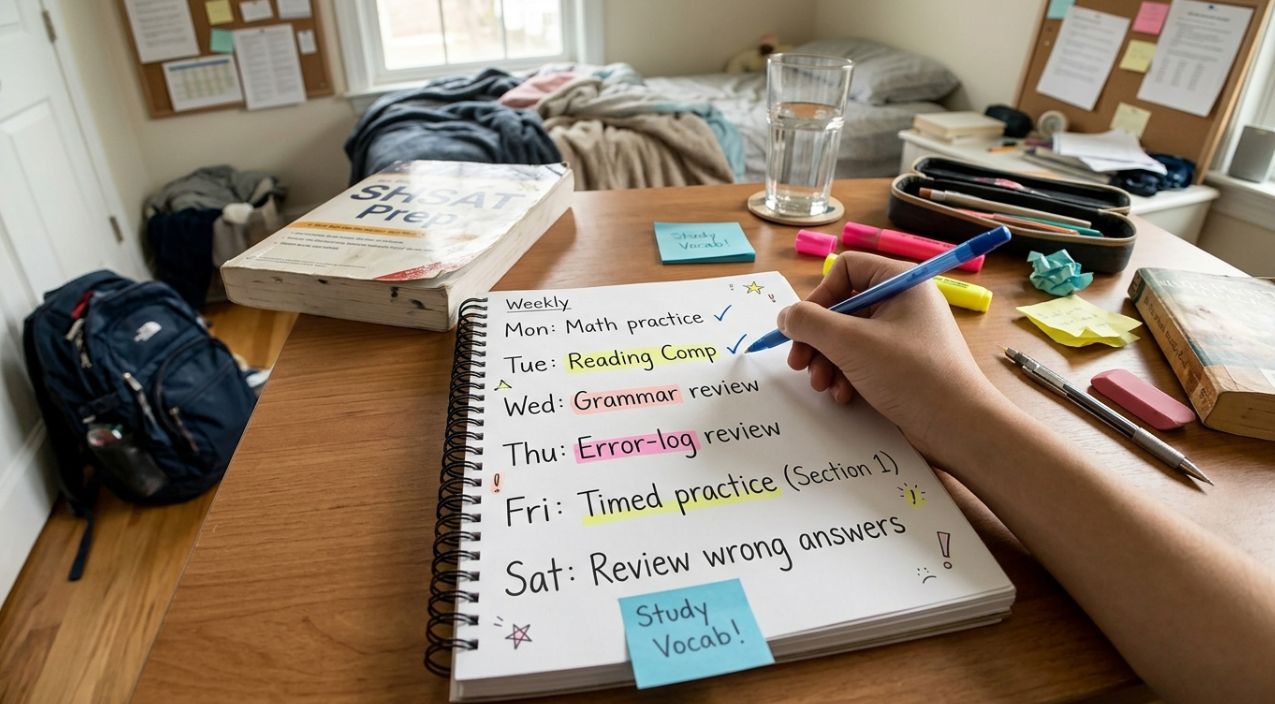
A useful SHSAT study schedule balances ELA, Math, targeted practice, and mistake review. Adjust the length of each session to fit schoolwork, your starting skill level, and the time remaining before the exam.
Day | Study Focus | Suggested Session |
|---|---|---|
Monday | Math: weakest topic | Review one concept, then solve 10–15 targeted questions |
Tuesday | ELA: reading comprehension | Complete one passage set and explain the evidence behind each answer |
Wednesday | Math: mixed practice | Solve multi-step problems and review calculation or setup errors |
Thursday | ELA: revising and editing | Practice grammar, punctuation, organization, or sentence revision |
Friday | Error-log review | Redo missed questions and identify recurring mistakes |
Saturday | Timed or mixed practice | Complete a timed section or a full practice test when scheduled |
Sunday | Review and planning | Analyze results, plan next week's priorities, or take a rest day |
How to use the schedule: If Math accuracy is already strong but ELA remains weak, shift an additional session toward reading comprehension or revising and editing. If you repeatedly miss geometry questions, prioritize geometry before adding more general practice.
After a full-length test, reserve enough time to review the results before taking another one. A test should inform your next study sessions rather than simply add to your practice-test count.
The most effective schedule is one you can follow consistently and adjust based on evidence from your own performance.
1 month out
Sharpen weak areas and test-day execution.
1 timed full-length practice test per week
2 days reviewing that test
2 days of targeted drills
1 day of official tool practice
1 lighter review or rest day
Do not change all your materials in the final month. Stick with what is working and focus on error patterns and pacing.
1 week out
Reduce mistakes. Do not attempt to learn everything from scratch.
Review formulas, grammar rules, and your error log
Take one final timed practice only if you have time to review it afterward
Practice the official digital interface one more time
Prepare test-day logistics (admission ticket, directions, what to bring)
Sleep. Do not cram until midnight. Fatigue causes more mistakes than ignorance does.
The SHSAT Error Log: A Framework for Real Improvement
Most guides say “review your mistakes.” That is too vague. Use this error taxonomy to categorize every missed or guessed question:
Error type | What it means | How to fix it |
|---|---|---|
Content gap | Did not know the concept | Learn the topic, then drill it |
Recognition error | Knew the concept but did not identify it in the question | Mixed practice and question-type tagging |
Misread | Missed “except,” “best,” units, or key details | Slow down the first 10 seconds of each question |
Evidence error | Chose an ELA answer not supported by the text | Require line or paragraph proof before selecting |
Setup error | Translated the word problem incorrectly | Write variables and relationships before solving |
Calculation error | Arithmetic mistake | Show all work on scratch paper and estimate first |
Pacing error | Ran out of time or rushed through sections | Timed drills and passage time budgets |
Platform error | Misused digital tools or the equation editor | Practice with the Student Readiness Tool |
Stamina error | Accuracy drops late in the test | Full-length simulations and a consistent sleep routine |
After every missed question, spend 30 seconds identifying the tested skill, 60 seconds explaining why the correct answer is right, and 90 seconds explaining why your answer was tempting but wrong. If you cannot do all three, the question goes back into the error log for a redo next week.
The SHSAT Error Log: A Framework for Real Improvement
An SHSAT error log turns missed questions into specific study tasks. Record both incorrect answers and questions you guessed correctly, because a correct guess may still reveal a skill gap.
Use this table after each practice session.
Error Type | What It Means | How to Fix It |
|---|---|---|
Content gap | You did not know the concept or rule | Review the concept and solve similar questions |
Recognition error | You knew the concept but did not recognize when to use it | Practice identifying question types in mixed sets |
Misread | You missed a keyword, condition, unit, or instruction | Underline what the question asks before solving |
Evidence error | Your ELA answer was not supported by the passage | Find specific text evidence for each answer |
Setup error | You translated a Math word problem incorrectly | Write the variables, relationships, or equation before calculating |
Calculation error | Your method was correct but your arithmetic was wrong | Show each step and estimate whether the result is reasonable |
Pacing error | You spent too long on a question or rushed the answer | Practice timed sets and monitor time per passage or problem |
Platform error | You struggled with navigation or digital tools | Practice with the official Student Readiness Tool |
Stamina error | Your accuracy dropped as the session continued | Build up to longer practice sessions and maintain a consistent routine |
How to Review Each Mistake
For every missed or uncertain question, record:
The question topic and the answer you selected.
The correct answer and why it is correct.
The specific reason your original approach failed.
The skill or rule you need to review.
The date you will attempt a similar question again.
Redo the question after a delay without looking at the explanation. If you can solve it independently and explain your reasoning, you are more likely to have learned the underlying skill.
The goal is not to create a long list of mistakes. It is to identify recurring patterns and eliminate them one by one.
Common Mistakes to Avoid When Studying for the SHSAT
Taking full tests without reviewing them. A practice test you do not review is a wasted three hours. The learning happens in the review, not in the taking.
Studying only math. ELA is where many students plateau. If your math is already strong, spending all your time on math produces diminishing returns while your ELA score stays flat.
Ignoring the digital interface. If your first time using the on-screen tools is test day, you will waste time and mental energy figuring out the platform instead of solving problems.
Relying on old skip-and-return strategies. The adaptive format usually does not allow you to go back. Train yourself to make a decision, check it, and move forward.
Rushing to finish with time remaining. A 2026 Reddit thread describes students finishing early but making “silly mistakes.” Replies warn against rushing and emphasize strengthening your process. In an adaptive test, careless misses are especially painful because the next question may adapt based on your error.
Not saving practice-test summary reports. The official portal generates a report identifying correct and incorrect items. Print it or save it. That report is your study plan for the next two weeks.
Frequently Asked Questions
How early should I start studying for the SHSAT?
Six to twelve months is ideal for building content knowledge and reading stamina. Three months is workable if you are already strong in grade-level ELA and math. One month is tight but can still help if you focus exclusively on weak areas and timed practice.
Can I use a calculator on the SHSAT?
No. Calculators are not permitted. Practice all arithmetic by hand, including fractions, percents, and multi-step calculations.
Should I save official practice tests until later in my prep?
Yes. Use third-party materials for daily practice and volume. Save at least one or two official digital practice tests for benchmarking closer to test day so your score reflects genuine readiness, not familiarity with the questions.
How do I improve my SHSAT reading comprehension if my score is stuck?
Focus on three things. First, build reading stamina by reading harder nonfiction and literary texts daily. Second, practice eliminating wrong answer choices by requiring text evidence for every answer. Third, review every missed reading question using the error log to identify whether the problem is a misread, an evidence error, or a content gap.
Is the SHSAT harder now that it is adaptive?
The difficulty adjusts to the student, so everyone faces a different mix of questions. The test is not necessarily “harder,” but it requires a different strategy. You cannot skip freely and return, you should not panic-guess, and you need to be comfortable with the digital platform. Students who prepare for these specific changes will not find it harder.
What is a good SHSAT score?
Cutoff scores vary by school, year, applicant pool, and available seats. Stuyvesant historically has the highest cutoff, while Brooklyn Latin and Staten Island Tech tend to have lower ones. Do not target a specific number. Instead, maximize your composite score and rank your preferred schools honestly.
Can 9th graders take the SHSAT?
Yes, if they are entering 9th grade for the first time and are current NYC residents. The 9th-grade math form is based on standards through grade 8, which means slightly more advanced content than the 8th-grade form.
How many practice tests should I take?
Quality matters more than quantity. A student who takes four practice tests and deeply reviews each one will outperform a student who speeds through ten without analysis. Plan for one full-length timed practice every one to two weeks during active prep, with thorough error review between tests.
Putting It All Together
Figuring out how to study for the SHSAT is not about finding a secret trick or a magic workbook. It is about running a disciplined loop: diagnose your weaknesses, build the skills you are missing, drill those skills until they stick, review every mistake honestly, simulate the real test digitally, and adjust your plan based on what the data tells you. The students who follow this process, week after week, are the ones who see their scores climb.
The 2026 adaptive format makes this discipline even more important. You cannot rely on going back to fix mistakes or skipping questions you find hard. Every question counts in real time.
Whether you are months away or weeks away, start where you are, use the loop, and keep your error log honest.
If you want a guided, diagnostic-based system to organize your standardized test prep, start with Miyagi Labs and see how structured practice can help you study smarter.