
SAT Words in Context: 2026 Glossary, Tips & Practice
Miyagi Labs ·
SAT Words in Context: 2026 Glossary, Tips & Practice

TL;DR
SAT Words in Context questions ask you to pick the most logical and precise word to complete a short passage. They fall under the Craft and Structure domain, which makes up about 28% of the Reading and Writing section. These are logic puzzles disguised as vocabulary questions, and mastering them requires understanding context clue types, connotation, and roughly 200 to 300 high-frequency academic words. This glossary covers every term you’ll encounter while studying for this question type.
SAT Words in Context: Quick Answer
SAT Words in Context questions test whether you can determine the meaning or choose the most logical and precise word or phrase based on the surrounding passage. They are part of the Craft and Structure domain of the Digital SAT Reading and Writing section, which represents approximately 28% of the section, or about 13–15 questions across the test.
The most effective approach is to read the entire passage, identify the relationship between ideas, predict what the missing word should mean, and then compare your prediction with the answer choices. Vocabulary knowledge helps, but the SAT specifically tests the ability to understand and use high-utility academic words and phrases in context.
For 2026, focus on five skills: context clues, precise meaning, connotation, secondary meanings, and elimination of choices that do not fit the passage's logic or tone.
What Are SAT Words in Context Questions?
SAT Words in Context questions ask you to determine the meaning of a high-utility academic word or phrase as it is used in a passage, or to select the word or phrase that most logically and precisely completes the text. College Board classifies these questions under the Craft and Structure domain of the Reading and Writing section.
The Craft and Structure domain accounts for approximately 28% of Reading and Writing questions, or 13–15 questions across the section. It also includes Text Structure and Purpose and Cross-Text Connections.
The key point is that Words in Context is not simply a vocabulary-memory test. College Board describes the skill as using comprehension and reasoning to determine or select an appropriate high-utility academic word or phrase in context.
That means you should not ask only, “Do I know this word?” Instead, ask:
What meaning does this passage require, and which answer choice expresses that meaning most precisely?
Practice SAT questions to see these concepts in action.
Section A: The Question Type, Key Terms Defined
Words in Context
The question type name used by the College Board for items that ask you to choose a word or phrase that best completes a passage. Every question provides a mini-passage (typically 25 to 150 words) containing enough information to determine the correct answer through reasoning, not memorization alone.
Craft and Structure
The SAT domain that includes Words in Context questions, along with text structure and purpose questions and cross-text connection questions. The Digital SAT Reading and Writing section has four domains: Craft and Structure (28%), Information and Ideas (26%), Standard English Conventions (26%), and Expression of Ideas (20%). Craft and Structure is the biggest slice.
Fill-in-the-Blank Format
The more common of the two SAT words in context formats. A word is removed from the passage and replaced with a blank. The question asks which choice “most logically and precisely” completes the text. The majority of Words in Context questions use this format.
Underlined-Word Format
The less common format. You’re given a passage adapted from a novel or play, and one word is underlined. The question asks which answer choice is “closest in meaning” to the underlined word as used in that specific passage. This format tends to appear with literary texts rather than informational ones.
Mini-Passage
The short excerpt each question is built around. On the Digital SAT, every Reading and Writing question, including Words in Context, is paired with its own passage rather than a long shared passage. These excerpts are typically one to two sentences and always contain the context clues needed to identify the correct answer.
Module 1 vs. Module 2
The Digital SAT Reading and Writing section is split into two modules. Module 1 is the same difficulty for everyone. Based on your Module 1 performance, the test routes you to either an easier or harder Module 2. Words in Context questions appear in both modules, but the difficulty level can change dramatically between them.
Module 2 Hard
If you score well on Module 1, you enter the harder version of Module 2. Here, SAT words in context questions use subtler context clues, less common word meanings, and vocabulary that requires finer distinctions between answer choices. Practitioners on Reddit report that these questions feel more like logic tests than vocabulary tests. After the November 2025 US Digital SAT, multiple test-takers in r/Sat threads described Module 2 Hard as requiring sharper reasoning, not just bigger vocabulary.
This escalation matters because it’s where the test separates strong scores from top scores. If you’re aiming above 700 on Reading and Writing, your study plan needs to specifically prepare for this jump in difficulty.
“Most Logical and Precise”
The exact phrasing from the question stem, and it tells you everything about what the SAT is actually testing. “Logical” means the word must fit the passage’s meaning and reasoning. “Precise” means a close synonym isn’t good enough if a more exact one exists. This phrase is worth memorizing because it defines the standard against which every answer should be judged.
Section B: Skills and Strategies, Essential Terms for Preparation
Context Clue
Any information in the surrounding text that helps reveal a word’s meaning. The SAT deliberately builds every Words in Context passage around context clues. You are never expected to answer based on vocabulary knowledge alone. There are five main types of context clues, each defined below.
Definition/Restatement Clue
The meaning of the unknown word is stated directly in the sentence. Example: “A pediatrician, a physician specializing in children’s health, examined the young boy.” The definition of “pediatrician” is embedded right there. These are the most straightforward clues and tend to appear in science-oriented passages.
Synonym Clue
A word with a similar meaning appears nearby in the text. Example: “She was elated, or very pleased, when she won the award.” The phrase “very pleased” clarifies “elated.” Look for appositives, parenthetical phrases, or coordinating conjunctions that pair two related terms.
Antonym/Contrast Clue
The passage provides an opposite meaning, and the contrast reveals what the target word must mean. Signal words like “although,” “however,” “unlike,” and “but” flag these clues. If the passage says someone was “not hostile but rather ______,” the blank must mean something close to friendly or welcoming.
Example Clue
The author provides illustrative instances that point toward the word’s meaning. Phrases like “such as,” “for example,” and “including” often introduce these clues. The examples don’t define the word directly but create enough context to narrow down its meaning.
Cause-and-Effect Clue
The passage explains the reason for or result of something, and this logical relationship reveals the word’s meaning. Words like “because,” “since,” “therefore,” “thus,” and “consequently” signal these clues. If a passage says “because the evidence was overwhelming, the committee ______ the proposal,” you can reason forward from cause to effect.
Inference Clue
Sometimes no single word or phrase defines the target word. Instead, you must deduce meaning from the overall logic and tone of the passage. These are the hardest clues to spot and the ones that dominate Module 2 Hard. Science passages typically use clearer, more explicit clues, while literature passages rely more heavily on inference.
Connotation
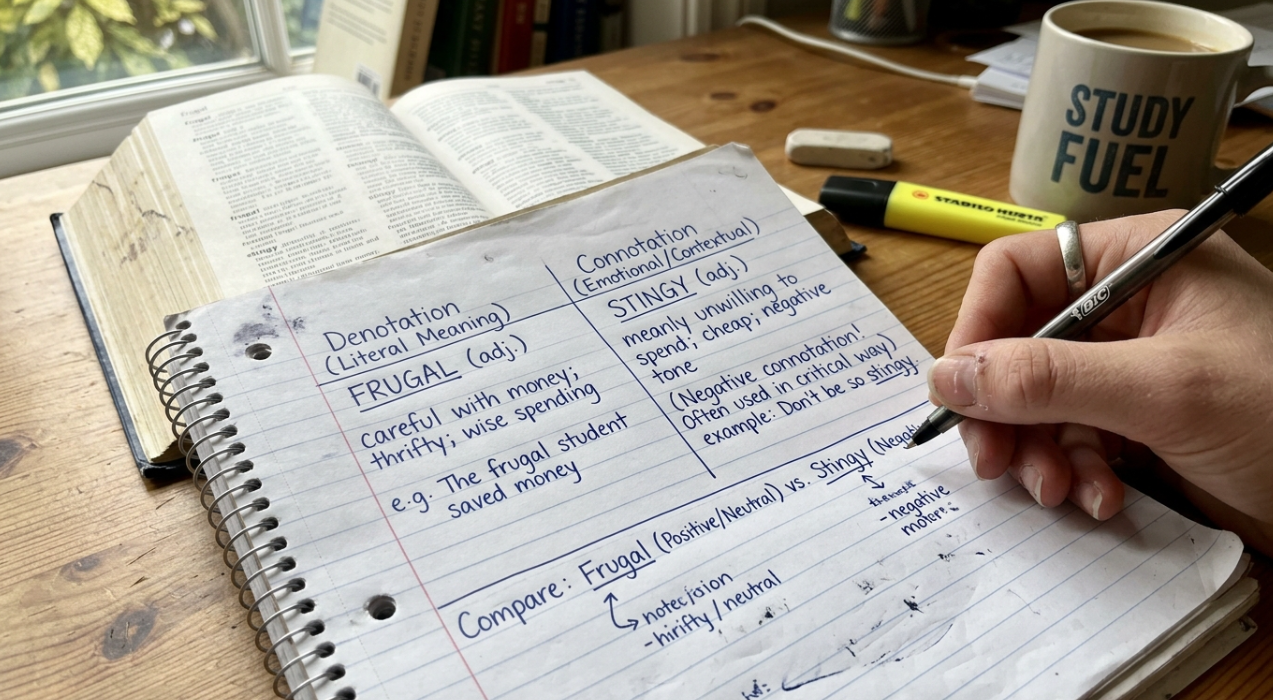
The emotional or tonal shade of a word, beyond its dictionary definition. A word can be positive, negative, or neutral in connotation. “Stingy” and “frugal” both describe careful spending, but “stingy” carries a negative judgment while “frugal” is more neutral. The SAT tests connotation constantly. If the passage describes a scientist’s work admiringly, the correct word will have a positive or neutral connotation, even if a negative-connotation synonym technically fits the definition.
This is one of the most undercovered concepts in SAT prep. Many students choose answers based solely on denotation and lose points because they ignore tone. Practitioners on prep forums call this “connotation blindness,” and it’s a major reason students plateau in the 600 to 700 range.
Denotation
The literal dictionary definition of a word. On SAT words in context questions, denotation alone is rarely enough to identify the correct answer. Two choices might share the same denotation but differ in connotation, and the SAT will punish you for ignoring that difference.
Signal Words
Transition-type words that flag the relationship between ideas in a passage. They’re your roadmap to understanding context clues. Common signal words include:
Contrast: however, although, despite, whereas, nevertheless, but
Agreement/Addition: moreover, furthermore, similarly, indeed
Cause/Effect: because, therefore, consequently, thus, since
Example: such as, for instance, specifically, including
Don’t confuse signal words with the separate “Transitions” question type on the SAT. Words in Context questions fill a content word (noun, verb, adjective, adverb), while Transitions questions fill a connecting phrase.
Precision
The SAT’s core scoring criterion for Words in Context. The test doesn’t just want a word that works. It wants the word that works best. Two answer choices might both be acceptable in casual conversation, but one will be more precise in the given context. This is why “close enough” thinking consistently produces wrong answers on this question type.
Predict-Then-Match
The single most effective strategy for SAT words in context questions, recommended by virtually every experienced tutor. Before looking at the answer choices, read the passage and decide in your own words what the blank should mean. Then scan the choices for the closest match.
Why does this matter so much? Because every wrong answer choice is written to sound plausible in isolation. Some even sound more sophisticated than the correct answer. Multiple tutors on Substack and in SAT prep communities emphasize the same warning: if you let the choices set your expectations instead of the sentence, you’re vulnerable to whichever option simply sounds fanciest.
A tutor shared a case study about a student struggling to break 700. The student wasn’t reading the full passage. She was reading only up to the blank, then trying words until something “made sense.” Once she started predicting before looking at choices and reading the entire passage first, her accuracy jumped.
If you want to drill this strategy, focus on covering the answer choices with your hand (or mentally committing to a prediction) before reading them.
Secondary/Multiple Meanings
Familiar words used in unfamiliar senses. This is the test’s favorite trap. “Address” doesn’t always mean a location; it can mean to deal with or speak to. “Check” can mean to restrain. “Novel” can mean new or unusual. “Temper” can mean to moderate. “Flag” can mean to weaken or signal.
The SAT loves testing whether you can move past a word’s most common definition to recognize its meaning in an academic or literary context. Students miss these questions not because they’ve never seen the word, but because they default to the primary definition and never consider alternatives.
Section C: High-Frequency SAT Vocabulary Categories
You can’t vocabulary-quiz your way to a perfect Words in Context score, but you also can’t ignore vocabulary entirely. The reality is that the Digital SAT draws from roughly 200 to 300 high-frequency academic words that appear across test after test. After every SAT administration, communities on r/Sat compile the hardest words students encountered, creating a crowd-sourced record of what the test actually uses. The categories below reflect patterns drawn from official tests and practitioner analysis.
Each category includes example words with brief definitions and a sample sentence showing academic usage.
Argument and Evidence Words
These words describe how ideas are supported, challenged, or proven. They appear frequently in passages about research findings and scholarly debates.
Substantiate: to provide evidence for. The researcher substantiated her hypothesis with three independent experiments.
Corroborate: to confirm or support with additional evidence. A second study corroborated the original findings.
Buttress: to strengthen or reinforce. The new data buttressed the existing theory.
Bolster: to support or prop up. Recent surveys bolstered the argument for policy reform.
Refute: to prove wrong. The critic refuted the claim by presenting contradictory data.
Repudiate: to reject or deny. The committee repudiated the proposal on ethical grounds.
Undermine: to weaken or damage. The flawed methodology undermined the study’s credibility.
Tone and Attitude Words
These describe how an author feels about a subject. The SAT frequently asks you to identify tone, making these words essential.
Skeptical: doubtful, questioning. The reviewer was skeptical of the study’s small sample size.
Laudatory: expressing praise. The profile struck a laudatory tone, celebrating the artist’s contributions.
Dispassionate: calm, impartial. The historian offered a dispassionate account of the conflict.
Sardonic: mocking, cynically humorous. The essayist’s sardonic commentary targeted political hypocrisy.
Ambivalent: having mixed feelings. The committee was ambivalent about the proposed changes.
Indifferent: lacking interest or concern. The public remained indifferent to the policy debate.
Precision and Scope Words
These describe how thorough, limited, or definitive something is. They appear in passages about research scope and conclusions.
Comprehensive: covering everything. The report provided a comprehensive analysis of market trends.
Cursory: hasty and superficial. A cursory review revealed several formatting errors.
Negligible: so small as to be meaningless. The difference between the two groups was negligible.
Tentative: uncertain, provisional. The findings were tentative and required further study.
Definitive: decisive, conclusive. The experiment provided definitive proof of the compound’s effectiveness.
Exhaustive: thorough to the point of completeness. The bibliography was exhaustive, covering every relevant source.
Change and Degree Words
These describe how things increase, decrease, or shift. Common in science and social science passages.
Exacerbate: to make worse. The drought exacerbated existing food shortages.
Mitigate: to make less severe. The new regulations were designed to mitigate environmental damage.
Diminish: to reduce or lessen. Public interest in the project diminished over time.
Amplify: to increase or make louder/stronger. Social media amplified the reach of the campaign.
Proliferate: to spread or multiply rapidly. New research labs proliferated across the region.
Curtail: to reduce or restrict. Budget cuts curtailed the department’s research activities.
Similarity and Difference Words
These describe relationships between ideas, findings, or positions. They’re common in cross-text analysis.
Analogous: comparable, similar in certain respects. The process was analogous to photosynthesis in plants.
Divergent: differing, moving apart. The two economists held divergent views on inflation.
Congruent: in agreement, matching. The experimental results were congruent with the predictions.
Disparate: fundamentally different. The study examined disparate communities across three continents.
Nuanced: characterized by subtle distinctions. The author’s argument was more nuanced than the summary suggested.
Commonly Trapped Multiple-Meaning Words
These are the words the SAT uses specifically to exploit the default-meaning trap. Know their secondary meanings.
Address: to deal with or speak to (not just a location)
Temper: to moderate or soften (not just anger)
Check: to restrain or hold back (not just to verify)
Conduct: to carry out or direct (not just behavior)
Yield: to produce or give way (not just road signs)
Novel: new, original, unusual (not just a book)
Flag: to weaken, or to signal/mark for attention (not just a banner)
For a structured approach to drilling these words, SAT problem sets let you practice vocabulary in context rather than in isolation.
Section D: Common Mistakes on SAT Words in Context Questions
Understanding why students get these questions wrong is just as important as learning the right strategies. These five errors account for the vast majority of lost points.
The “Sounds Right” Fallacy
Choosing the answer that flows best when read aloud rather than the one that’s logically and precisely correct. Experienced SAT tutors hammer this point repeatedly: the SAT isn’t testing your ear. It’s testing your brain. The test doesn’t care what “sounds good” or “feels right” to you personally. Students who mentally insert each answer choice and pick the one that seems smoothest consistently underperform compared to those who predict first.
Partial-Read Error
Reading only the text before the blank and ignoring everything after it. Critical context clues often appear in the second half of a sentence. If the passage says “Although the initial results were promising, the researchers remained ______ about drawing broad conclusions,” the word “although” and the phrase “drawing broad conclusions” are both essential clues. Reading only “the initial results were promising” would lead you toward a positive word, which is exactly wrong.
Default-Meaning Trap
Defaulting to a word’s most familiar definition when the passage uses a secondary meaning. This is the SAT’s most reliable trick. If “address” appears in a passage about a scientist working on a problem, the answer isn’t about locations. If “check” appears in a passage about restraining growth, it’s not about verification. The test specifically selects words where the common meaning is wrong.
Connotation Blindness
Choosing an answer based on denotation alone while ignoring whether its connotation matches the passage’s tone. If a passage describes an artist’s work with admiration, “meticulous” (neutral to positive) fits but “obsessive” (negative) doesn’t, even though both relate to extreme attention to detail.
Sophistication Bias
Picking the fanciest-sounding word rather than the most precise one. The correct answer on the SAT is often simpler than students expect. A straightforward word that exactly matches the context will beat an impressive-sounding word that only approximately fits. This bias is especially dangerous for high-scoring students on Module 2 Hard, where the temptation to choose the most “academic” option is strongest.
Recognizing these patterns in your own work is one of the fastest ways to improve your SAT score. If you’re consistently missing Words in Context questions, track which of these five errors you’re making most often.
How SAT Words in Context Differs from the Old SAT
If you’re using older prep materials or getting advice from someone who took the SAT years ago, the vocabulary section has changed significantly. Previous iterations of the SAT tested high-level vocabulary through formats like analogies that focused solely on word knowledge. The current Digital SAT is less concerned with the difficulty of the word itself and more concerned with whether you can select the correct word based on context clues.
There are also fewer vocabulary questions than on older versions. The shift is from “do you know obscure words?” to “can you reason about word meaning in context?” This is why rote memorization of massive word lists is less effective than it used to be. You still need vocabulary, roughly 200 to 300 high-frequency academic words, but you need to understand them deeply (including connotation, secondary meanings, and typical usage contexts) rather than superficially.
Putting It All Together: A Step-by-Step Approach
Here’s how every term in this glossary connects in practice:
Read the entire mini-passage. Don’t stop at the blank. Context clues can appear anywhere.
Identify the context clue type. Is it definition/restatement? Contrast? Cause-and-effect? Knowing the type speeds up your reasoning.
Note signal words. “However,” “because,” “although,” and similar words tell you the logical relationship between ideas.
Predict your own word. Before looking at choices, decide in plain language what the blank needs to mean.
Check connotation. Does the passage’s tone require a positive, negative, or neutral word?
Match, don’t “sounds right” it. Find the choice closest to your prediction. If two seem close, the more precise one wins.
Watch for secondary meanings. If a familiar word appears among the choices, consider whether the test is using its less common definition.
This process takes about 30 to 45 seconds per question once you’ve practiced it. Speed comes from familiarity with context clue types and vocabulary categories, not from rushing.
Take a full-length SAT practice test to apply these strategies under realistic timing conditions.
Frequently Asked Questions
How many Words in Context questions are on the Digital SAT?
You’ll see approximately 2 to 8 per module, and they always appear first in each module. The broader Craft and Structure domain, which includes Words in Context along with text structure and cross-text questions, accounts for about 28% of the Reading and Writing section, or roughly 13 to 15 questions total across both modules.
Do I need to memorize vocabulary for the Digital SAT?
Yes, but the scope is narrower than you might think. Success on SAT words in context questions isn’t about knowing a thousand obscure words. It’s about deeply understanding 200 to 300 high-frequency academic words the test uses repeatedly. Study them by function (argument words, tone words, change words) rather than through alphabetical lists.
What’s the difference between Words in Context and Transitions questions?
Words in Context questions ask you to fill in a content word: a noun, verb, adjective, or adverb that carries meaning. Transitions questions ask you to fill in a connecting word or phrase (like “however,” “for example,” or “consequently”) that establishes a logical relationship between ideas. Both appear in the Craft and Structure domain, but they test different skills.
Are the questions harder in Module 2?
It depends on which Module 2 you get. If you perform well on Module 1, the test routes you to Module 2 Hard, where vocabulary is more subtle and context clues require more inference. If you struggle on Module 1, you get an easier Module 2. This adaptive structure means strong students face progressively harder SAT words in context questions as the test goes on.
What’s the best strategy for Words in Context questions?
Predict-then-match. Read the full passage, form your own word for the blank, and only then look at the answer choices. This prevents the “sounds right” fallacy and sophistication bias that trip up most students. Every experienced tutor recommends this approach.
How is the Digital SAT vocabulary section different from older versions?
The old SAT used question formats like analogies that tested vocabulary knowledge directly. The Digital SAT wraps vocabulary in short passages and tests your ability to reason from context. The words themselves tend to be less obscure, but the reasoning required is more precise. You can learn more about the current test structure in this guide to the Digital SAT format.
Can I improve my Words in Context score quickly?
This question type is one of the most improvable on the test. Learning the five context clue types and practicing the predict-then-match method can produce noticeable score gains in a few weeks. Pair strategy work with targeted vocabulary study using the thematic categories above, and you’ll cover both sides of the equation. Use a score predictor to track whether your vocabulary gap is actually closing.
Where do students collect real SAT vocabulary after each test?
After every SAT administration, students on r/Sat compile threads listing the hardest words they encountered. These crowd-sourced lists have become a valuable real-world data source for identifying which words the College Board actually tests. Several popular vocabulary resources, including The Complete Digital SAT Vocabulary Resource, draw directly from this Reddit data. It’s worth checking these threads to see which words are appearing on current tests.