
ACT Reading Strategies 2026: 15 Proven Ways to Score Higher
Miyagi Labs ·
15 ACT Reading Strategies for 2026 to Improve Your Score

TL;DR
ACT Reading now gives you 40 minutes for 36 questions (27 scored), so older advice about 35 minutes and 40 questions is outdated. The biggest score gains come from choosing a reading method that matches your speed and memory, proving every answer with text evidence, skipping time-sink questions early, and reviewing mistakes by question type. Test three reading approaches (passage-first, questions-first, hybrid) on separate practice passages and keep whichever gives you the best accuracy per minute.
What Are the Best ACT Reading Strategies?
The best ACT Reading strategies are to read actively, map each passage's main ideas, use text evidence to verify answers, eliminate trap choices, and manage your time carefully. Start by testing passage-first, questions-first, and hybrid reading methods to find the approach that gives you the best balance of speed and accuracy. During practice, review every incorrect answer by question type and track which mistakes cost you the most points.
The enhanced ACT Reading section gives you 40 minutes to answer 36 questions, including 27 scored questions and 9 embedded field-test questions. Because you cannot identify the unscored questions, answer every question as carefully as possible and use a pacing plan that leaves time to revisit difficult items.
Quick ACT Reading Format Update for 2026
Before applying any ACT Reading strategies, make sure your practice materials match the format you will take. The enhanced ACT Reading section gives students 40 minutes to answer 36 questions, including 27 scored questions and 9 embedded field-test questions. The field-test questions do not count toward your score, and you cannot identify them during the test.
The section measures three reporting categories:
Reporting category | Approximate share | Skills tested |
|---|---|---|
Key Ideas and Details | 44–52% | Main ideas, details, relationships, and inferences |
Craft and Structure | 26–33% | Vocabulary in context, text structure, author purpose, and perspective |
Integration of Knowledge and Ideas | 19–26% | Claims, evidence, reasoning, and connections across texts |
Some ACT Reading passages may include a graph, figure, or table. When this happens, you may need to combine information from the visual with evidence from the passage.
Practical takeaway: Use official practice materials that match your upcoming ACT format. Older tests can still help you develop comprehension and evidence-based reasoning, but adjust your pacing drills to the timing and structure of your actual test.
For the complete section-by-section breakdown, read our ACT test format guide.
ACT Reading Strategies at a Glance
Strategy | Best for | Main benefit | Potential drawback |
|---|---|---|---|
Passage-first reading | Students who retain context well | Builds a clear understanding of the passage | Can take too long if you over-read |
Questions-first reading | Fast readers who scan efficiently | Helps locate relevant details | May weaken understanding of tone and main ideas |
Hybrid passage mapping | Students who need a balance of speed and context | Creates a quick map of the passage | Requires practice to avoid excessive notes |
Passage prioritization | Students with uneven passage strengths | Lets you begin with a more comfortable passage | Choosing an order can waste time if you hesitate |
Text-evidence checking | Students who struggle between two answers | Reduces unsupported guesses | Can slow down easy questions |
Trap-answer elimination | Students who frequently choose plausible distractors | Helps identify distorted or irrelevant answers | Requires careful reading of every option |
Strategic skipping | Students who run out of time | Protects time for other questions | Difficult questions may remain unanswered if you never return |
Mistake logging | Students who have plateaued | Reveals recurring weaknesses | Only works when reviews are specific and consistent |
How to choose: Test different approaches on comparable practice passages. Track accuracy, time spent, and the types of errors you make. Choose the method that helps you answer correctly without repeatedly running out of time.
Want to know where you currently stand? Take a free ACT practice test to establish your baseline before applying these strategies.
The 15 Best ACT Reading Strategies
1. Know the Current Format Before You Practice
Best for: everyone starting ACT Reading prep.
The current section is 40 minutes with 36 total questions and 27 scored.
The blueprint uses 3 operational passages plus 1 field-test passage, 9 questions each.
Your practical time budget is roughly 10 minutes per visible passage unit, not the 8:45 you’ll see in older guides.
Tradeoffs: Older official practice tests remain useful for question style, but you need to adjust pacing expectations. Don’t practice under 35-minute timing if you’re preparing for a 40-minute test.
Practitioners on Reddit consistently point out that students who practice with the wrong timing develop pacing habits that don’t transfer to test day.
2. Choose Your Reading Method: Passage-First, Questions-First, or Hybrid
Best for: students confused by contradictory advice.
This is the most debated topic in ACT Reading strategy. Kaplan says always read the passage first. Princeton Review recommends reading questions first. Practitioners on Reddit who scored 34+ report success with all three methods. The honest answer: there is no single best method.
The three options:
Passage-first: Read the entire passage (3-4 minutes), then answer all 9 questions. Works if you retain structure and tone after one read.
Questions-first: Scan questions, note line references and keywords, then read while hunting for answers. Works if you’re a fast scanner who gets bored reading without purpose.
Hybrid mapping: Spend 60-120 seconds marking paragraph topics, shifts, and author tone, then answer while referring back. Works for most students because it balances speed and comprehension.
How to choose: Do three timed passages, one with each method. Track time, accuracy, rereads, and confidence. Repeat the test twice. The method with the best accuracy per minute wins.
Tradeoffs: Passage-first can burn time if you over-read. Questions-first can cause you to miss main idea and tone questions. Hybrid requires practice to avoid over-annotating.
One student on Reddit shared that they jumped from a 20 to a 33 after switching from question-hunting to reading the entire passage first, because they stopped rereading constantly. The best ACT reading strategy is the one that gives you the highest accuracy per minute.
3. Start With Your Strongest Passage Type
Best for: students who freeze when passage 1 is hard.
ACT Reading passages cover literary narrative, social science, humanities, and natural science. You don’t have to answer them in printed order. Starting with a passage type you’re comfortable with builds confidence and banks time for harder passages.
A consistent 35+ scorer on Reddit recommends ordering passages from easiest to hardest based on personal strengths. Another student who improved to a 35 said the order 4-1-2-3 worked best for them because it put their comfort zone first.
Tradeoffs: Don’t spend more than 10-15 seconds choosing your order. Pick your lead passage quickly, based on passage type or a fast glance at the topic, and move.
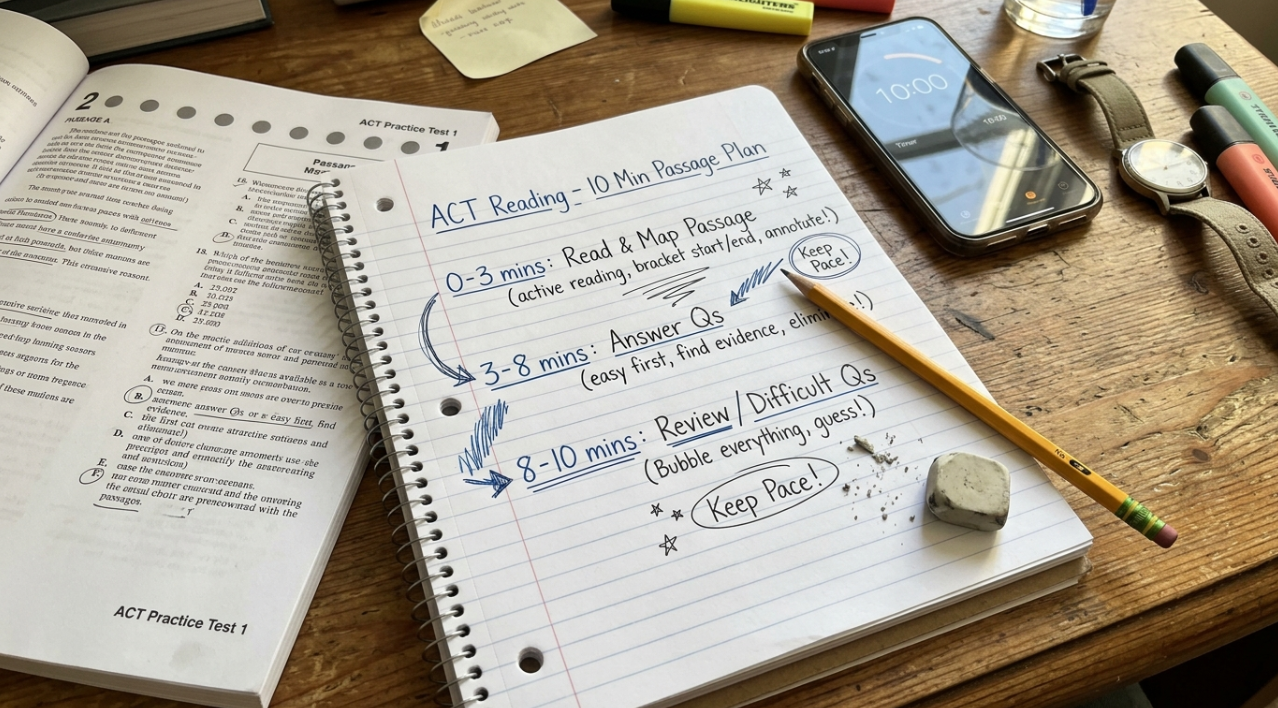
4. Use a 10-Minute Passage Budget
Best for: students who consistently run out of time.
With 40 minutes and 4 visible passage units, budget roughly 10 minutes per passage. Inside that budget:
2-4 minutes to read or map
5-7 minutes for questions
Final seconds to guess on anything marked
Don’t divide 40 by 36 and stress about 66 seconds per question. Some questions take 15 seconds (a direct detail with a line reference). Some inference or function questions take 90 seconds. Manage the clock by passage, not by individual question.
Tradeoffs: Rigid timing creates anxiety. Use the 10-minute mark as a ceiling, not a countdown. If you finish a passage in 8 minutes, bank the extra time for a harder one.
ACT’s own 2026 design research found that speededness problems in Reading often happen at the item-answering level, not the passage-reading level. Your question-answering habits matter more than raw reading speed.
5. Map the Passage Instead of Memorizing It
Best for: students who reread paragraphs too often.
You are not trying to memorize the passage. You are building a map so you can retrieve evidence fast. SuperTutorTV describes ACT Reading as “passage management,” and the framing is useful: mark paragraph function, shifts, contrast words, and claims, then use that map to find proof during questions.
Quick passage map:
P1: topic/setup
P2: evidence or example
P3: shift or counterpoint
P4: conclusion
Tone: positive, skeptical, neutral, critical
Main claim: one sentence
Tradeoffs: Over-annotation wastes more time than it saves. If your margins look like a coloring book, you’re doing too much. The map should help you relocate information, not replace actually understanding the passage.
6. Prove Every Answer With Text Evidence
Best for: accuracy on hard questions.
This is the single most important ACT reading strategy for moving from a mid-20s score to a 30+. ACT states that students should refer to the passages when answering, because answers may be stated directly or require conclusions drawn from the text.
High scorers on Reddit take this further. One 36 scorer recommends “evidence linking”: when stuck between two answers, find the exact text evidence for each option and compare which has stronger support. If an answer cannot be matched directly to the text, it is wrong.
The proof test:
Find evidence for answer A.
Find evidence for answer B.
Compare which evidence is more direct.
Reject the answer that requires a story, assumption, or emotional guess.
On ACT Reading, “could be true” is not enough. The right answer has to be provable.
Tradeoffs: Don’t spend 90 seconds proving easy questions. Use the proof test when you’re genuinely stuck between two options.
Example: How to Use Text Evidence to Choose the Right Answer
Imagine an ACT-style passage contains this statement:
Although the town's new public garden attracted fewer visitors during its first month than organizers had expected, attendance increased steadily after local schools began arranging student visits.
Question: What does the passage suggest about the garden's attendance?
A. The garden was immediately popular with residents.
B. The garden attracted more visitors after school visits began.
C. The garden failed because organizers misjudged public interest.
D. The garden became popular only because admission was free.
Correct answer: B.
Why B is correct: The passage directly states that attendance increased steadily after local schools began arranging visits. The answer restates that relationship without adding unsupported details.
Why the other answers are wrong:
A: The passage says attendance was initially lower than expected.
C: The passage does not say the garden failed.
D: The passage never mentions admission fees.
The strategy to remember: A correct ACT Reading answer must fit the question and be supported by the passage. Eliminate choices that add assumptions, exaggerate the author's point, or contradict the text.
This is an illustrative practice question, not an official ACT question.
To practice this skill with instant feedback, try drilling by question type in Miyagi’s ACT question bank.
7. Predict Before Reading Answer Choices
Best for: avoiding trap answers on line-reference and function questions.
Before looking at A through D, form a rough prediction. Read the question, go back to the passage, and decide what the answer should be. Then find the match among the choices.
This works especially well for:
Line-reference questions (“In lines 22-25, the author suggests…”)
Vocabulary-in-context questions
Function questions (“The author includes the anecdote primarily to…”)
Tradeoffs: Predicting is hard on broad “main idea” questions. If you can’t form a prediction in 10 seconds, skip this step and go straight to elimination.
8. Learn the Five Common Trap Answers
Best for: students who consistently narrow to two choices, then pick wrong.
Wrong answers on ACT Reading are not random. They follow predictable patterns:
Too broad: makes a claim bigger than the passage supports.
Too narrow: technically true for one small detail but doesn’t match the question’s scope.
Opposite: reverses the author’s position or tone.
True but irrelevant: accurate based on the passage but doesn’t answer what the question asks.
Extreme language: uses “always,” “never,” or “solely” when the passage is more measured.
Wrong answers usually borrow real words from the passage. The trap is almost always a distortion of something real, not a random invention.
Tradeoffs: Don’t eliminate an answer just because it contains a strong word. Sometimes “always” is genuinely supported by the text. Verify against the passage every time.
9. Answer Concrete Questions Before Global Questions
Best for: students who waste time on main idea questions early.
Inside each passage, detail questions with line references are usually faster to answer than big-picture questions about purpose, tone, or theme. If you’re short on time or unsure of the passage’s main point, start with specific questions and let them build your understanding.
Suggested order within a passage:
Line-reference and direct detail questions
Vocabulary-in-context
Function and inference
Main idea and purpose (last)
A tutor writing for The Critical Reader argues that big-picture, Roman numeral, and open-ended inference questions are the most common time sinks, and students who struggle with timing should save them for last.
Tradeoffs: Don’t jump around so much that you lose your place. This is a light reorder, not chaos.
10. Skip Time-Sink Questions Sooner Than Feels Comfortable
Best for: students who miss easy late questions because they burned time on hard early ones.
If you don’t know where the evidence is after about 45-60 seconds, pick your best answer, mark it, and move on. There is no wrong-answer penalty on the ACT, so a guess costs nothing. But spending 2 minutes on one question can cost you 2-3 easier questions later.
ACT’s own design research confirms this pattern: students in focus groups reported rushing the final Reading passage after spending too long on earlier ones.
Tradeoffs: Skipping feels wrong. Practice it during timed drills until it becomes automatic. Skipping is not quitting. It is protecting the next three points.
11. Use the Paired-Passage Split Method
Best for: dual-passage question sets.
ACT Reading sometimes presents two shorter passages together with questions about each individually and questions comparing both. The mistake students make is trying to hold both passages in memory at once.
Step-by-step:
Read Passage A.
Answer A-only questions.
Read Passage B.
Answer B-only questions.
Answer comparison questions last.
Common trap: answer choices that are true for Passage A but not for Passage B, or vice versa.
Tradeoffs: This approach adds a few seconds of sorting, but it prevents the confusion that comes from blending two authors’ perspectives.
12. Treat Graph and Table Questions as Evidence Questions
Best for: the current ACT Reading format.
Since 2021, one ACT Reading passage may include a graph, figure, or table, with questions asking you to integrate visual data with the text. Most prep guides under-cover this.
Quick routine:
Read the graph title, axes, labels, and units.
Identify the main trend before looking at answer choices.
Match the graph to the author’s claim in the text.
Eliminate answers that are graph-true but passage-false, or passage-true but graph-false.
Tradeoffs: Don’t spend so much time analyzing the visual that you neglect the surrounding passage text. The graph is evidence, not a standalone section.
13. Force Interest to Stay Focused
Best for: attention control during boring passages.
This sounds like motivational advice. It isn’t. ACT Reading punishes passive reading because passive readers don’t retain structure, tone, or argument. If you zone out during a humanities passage about 19th-century pottery, you’ll reread paragraphs and burn time.
A 36 scorer on Reddit says they intentionally treat every passage as interesting so they remember it better. The top-ranking 35+ scorer guide says boredom is one of the worst things that can happen on ACT Reading and recommends finding something in the passage to connect to.
Micro-tactics:
Ask: “What is the author trying to prove?”
Ask: “Why would someone care about this?”
Turn the topic into a mini argument in your head.
Mark attitude words that reveal tone.
Tradeoffs: This is a mindset shift that takes practice. Don’t expect it to click on day one.
14. Build Reading Stamina With ACT-Specific Practice
Best for: long-term improvement.
General reading (essays, science articles, historical criticism, fiction) builds the comprehension muscles you need. But general reading alone will not teach you to find evidence under time pressure, spot trap answers, or manage a 40-minute clock. You need both.
Split your prep by timeline:
Months out: Read widely. Prioritize topics you normally avoid.
Weeks out: Shift to official-style ACT passages, timed drills, and mistake review.
Days out: Light practice and pattern review. No heavy new reading.
ACT Reading does not test outside facts or isolated vocabulary, so background knowledge helps with comfort but answers must always come from the passage. For a broader prep framework, see our ACT study guide.
15. Review Mistakes by Question Type, Not Just by Score
Best for: sustained improvement.
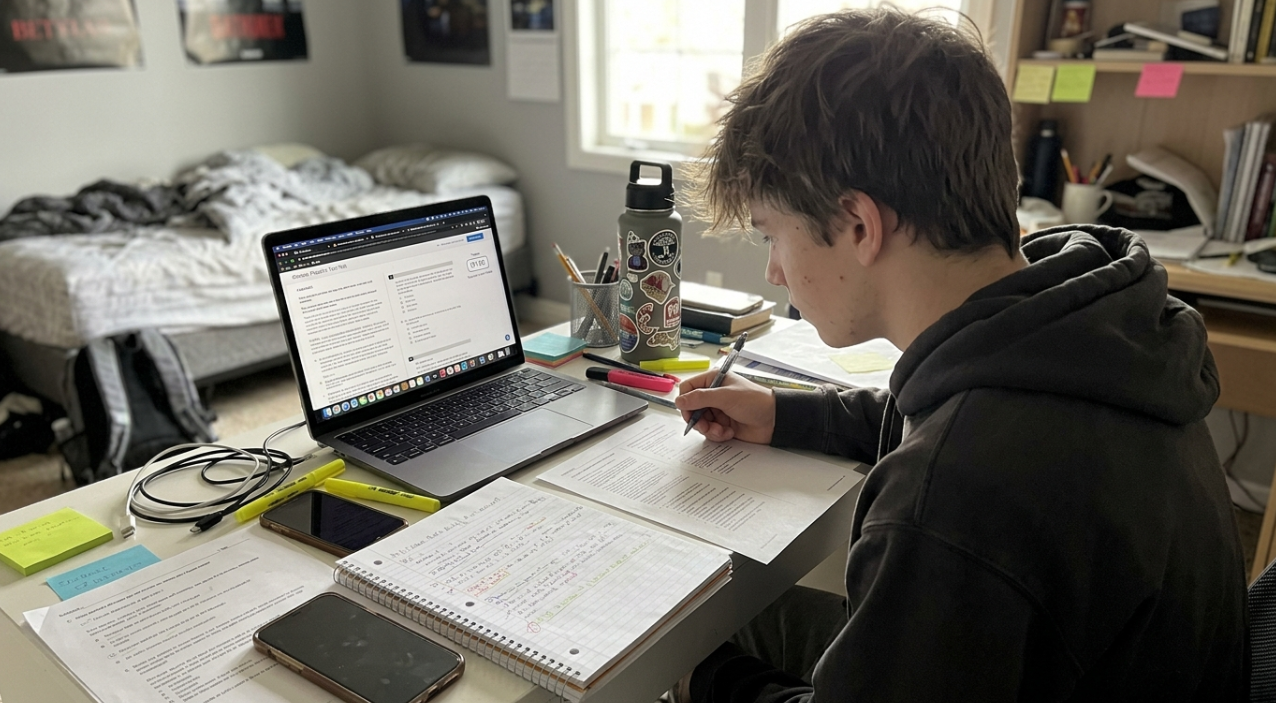
Taking practice test after practice test without reviewing mistakes is the least efficient way to improve. The students who gain the most points are the ones who categorize every wrong answer and find patterns.
Wrong-answer log columns:
Passage type
Question type (detail, inference, vocabulary, function, main idea, graph)
Reporting category (Key Ideas and Details, Craft and Structure, Integration of Knowledge and Ideas)
Why you picked the wrong answer
What made the right answer right
Trap type (too broad, opposite, true but irrelevant, etc.)
After 2-3 practice sections, patterns emerge. Maybe you consistently miss vocabulary-in-context questions. Maybe inference questions eat your time. Maybe you’re fine on literary narrative but collapse on social science. Those patterns tell you exactly what to drill next.
See where your weakest skills are with Miyagi’s ACT score predictor, which breaks down performance by section and skill area.
Which ACT Reading Strategy Fits You?
Different students need different ACT reading strategies. Here is a quick decision guide:
Your situation | Start with these strategies |
|---|---|
Slow reader, always running out of time | #4 (passage budget), #10 (skip faster), #5 (map instead of memorize) |
Fast but careless, miss detail questions | #6 (prove with evidence), #7 (predict first), #8 (trap answers) |
Scoring in the low-to-mid 20s | #2 (choose reading method), #6 (evidence), #15 (review mistakes) |
Strong reader aiming for 34-36 | #6 (evidence linking), #8 (trap taxonomy), #9 (question order) |
Freeze when the first passage is hard | #3 (start with strongest), #13 (force interest) |
Always stuck between two answers | #6 (evidence linking), #8 (trap answers), #7 (predict) |
How to Improve Your ACT Reading Score
Improving your ACT Reading score starts with identifying why you miss questions. Reading faster is not always the answer. Some students need better comprehension, while others need more accurate answer selection or stronger time management.
Follow these steps:
Establish your baseline. Complete a timed practice section using materials that match your ACT format.
Classify your mistakes. Separate comprehension errors, evidence errors, careless mistakes, and timing problems.
Practice one weak skill at a time. Focus on the question types and reading habits responsible for your most frequent errors.
Review every incorrect answer. Explain why your choice was wrong and what makes the correct answer better supported.
Repeat timed practice. Check whether your accuracy improves without sacrificing pacing.
If you repeatedly miss inference questions, for example, practice identifying the evidence that supports an inference. If you understand the passage but run out of time, focus on passage mapping, question prioritization, and moving past difficult items.
The goal is not simply to complete more practice tests. It is to make fewer of the same mistakes each time.
7-Day ACT Reading Practice Plan
A good ACT Reading practice plan should measure more than your total score. Track accuracy, time spent, question types missed, and the reasons behind incorrect answers. This seven-day plan helps you identify the habits that are costing you points and choose what to practice next.
Day | Main task | What to record |
|---|---|---|
1 | Complete a timed diagnostic | Baseline score, completion time, and missed questions |
2 | Review incorrect answers | Top two error patterns |
3 | Test passage-first, questions-first, and hybrid methods | Accuracy and time for each method |
4 | Practice finding text evidence | Whether you can justify each answer with the passage |
5 | Identify trap answers | Most common distractor types |
6 | Complete another timed section | Changes in accuracy, timing, and unanswered questions |
7 | Review your results | One strength to maintain and two skills to improve |
How to measure progress: Compare Day 6 with Day 1. Look for better accuracy, fewer repeated mistakes, and more consistent pacing. A single week may not produce a large score increase, but it can reveal which practice habits are working.
For a longer plan covering every ACT section, see our ACT study plan.
For a longer prep timeline with daily tasks across all four ACT sections, see our ACT study plan.
Common ACT Reading Mistakes to Avoid
Practicing with old timing. If you’re running 35-minute sections, you’re building the wrong pacing habits.
Over-annotating. Marking every other sentence isn’t annotation; it’s just highlighting the entire passage.
Choosing answers that “sound smart.” The right answer isn’t the most sophisticated one. It’s the most provable one.
Rereading whole paragraphs. If this keeps happening, your initial read or map wasn’t active enough.
Trying to identify the unscored passage. You can’t, and the attempt wastes mental energy.
Ignoring graph and table questions. They count toward Integration of Knowledge and Ideas and trip up students who only practiced with text-only passages.
Never reviewing mistakes. Retaking tests without analysis is like running laps without knowing which ones were slow.
FAQ
How many questions are on ACT Reading now?
ACT Reading has 36 total questions, of which 27 are scored. The remaining 9 are embedded field-test items that don’t affect your score, but you can’t tell which ones they are. For a full breakdown of every section, see our guide to ACT question counts.
Is ACT Reading 35 or 40 minutes?
40 minutes. The 35-minute format is the legacy version. Many older prep articles haven’t updated yet.
Should I read the passage or questions first on ACT Reading?
There is no universal answer. Passage-first is safer for students who need full context. Questions-first works for fast scanners. Hybrid mapping works for most students. High scorers on Reddit report success with all three. Test each method on practice passages and keep whichever gives you the best accuracy per minute.
How long should I spend on each ACT Reading passage?
About 10 minutes per passage unit. That breaks down to roughly 2-4 minutes reading or mapping and 5-7 minutes answering questions. Use 10 minutes as a ceiling, not a rigid countdown.
How do I stop running out of time on ACT Reading?
Use a passage budget, skip questions after 45-60 seconds without clear evidence, answer concrete detail questions before global ones, and manage the clock by passage rather than by individual question. ACT’s own design research found that time problems in Reading usually come from answering items, not from reading speed alone.
Are ACT Reading answers always in the passage?
ACT says answers may be plainly stated or require drawing conclusions, comparisons, or generalizations from the text. The safest rule: every correct answer must be supported by passage evidence. You never need outside facts to answer correctly.
How do I get a 34-36 on ACT Reading?
High scorers consistently emphasize three things: evidence linking (finding exact proof for each answer option), trap-answer recognition, and aggressive time management. The final points at the top of the scale usually come from avoiding subtle traps, not from better reading comprehension.
What is the hardest question type on ACT Reading?
The hardest ACT Reading question type depends on your strengths. Some students struggle with inference questions because they must draw conclusions from textual evidence, while others find main idea, author-purpose, vocabulary-in-context, or paired-passage questions more difficult. Review your practice mistakes to identify the question types that consistently reduce your accuracy.
Can I improve my ACT Reading score by practicing every day?
Regular practice can help you improve reading comprehension, answer accuracy, and time management, especially when you review your mistakes. Instead of completing passages without analysis, alternate timed practice with focused drills. Track your results over multiple sessions to identify which strategies are working.
Ready to put these ACT reading strategies into practice? Start with a diagnostic, drill your weak question types, and track improvement with Miyagi’s ACT prep.