
Hardest SAT Math Questions in 2026: Digital SAT Guide
Miyagi Labs ·
Hardest SAT Math Questions in 2026: Digital SAT Guide

TL;DR
The hardest SAT math questions appear at positions 18–22 in the adaptive Module 2 (harder path) and typically combine multiple concepts like algebra and geometry in a single problem. Only 1–2% of test-takers earn a perfect 800 on SAT Math, and the difficulty has increased noticeably since the digital SAT launched in March 2024. This guide breaks down the adaptive module system, the eight toughest topic categories, when Desmos helps (and when it doesn’t), and exactly how to practice for these questions.
The digital SAT doesn’t save its hardest math questions for some hidden bonus round. They’re baked into the test’s adaptive structure, and understanding where they live, what topics they cover, and why they trip up even strong math students is the difference between a 700 and an 800.
Most guides just throw 15 or 25 practice problems at you and call it a day. That’s useful, but it skips the bigger picture. Before you can beat the hardest questions, you need to understand the system that generates them.
Ready to start practicing? Explore the SAT question bank to filter problems by difficulty and topic.
What the Digital SAT Math Section Actually Looks Like
The Digital SAT Math section contains 44 questions across two 35-minute adaptive modules. Within each module, questions are arranged from easiest to hardest, so the final five or six questions in any module are the ones that will test your limits.
The College Board organizes math content into four domains:
Domain | Weight |
|---|---|
Algebra | 35% |
Advanced Math | 35% |
Problem Solving and Data Analysis | 15% |
Geometry and Trigonometry | 15% |
Both Algebra and Advanced Math dominate, making up 70% of the section combined. This matters because the hardest SAT math questions overwhelmingly come from these two domains (or combine them with geometry/trig for maximum difficulty).
Scoring runs from 200 to 800. The average math score for the class of 2025 was roughly 508. Only about 7% of students score in the 1400–1600 total range, and roughly 1–2% of test-takers earn a perfect 800 on math. A 760 math score puts you at the 96th percentile. Missing just 5–7 questions typically drops you to around 700.
For a deeper look at the section structure, see this digital SAT format breakdown.
What Makes an SAT Math Question “Hard”
Difficulty on the SAT isn’t about encountering calculus or topics you’ve never seen. It’s about familiar math applied in unfamiliar ways. An experienced SAT tutor on the Mathchops Substack put it well: students hear “quadratic equations” and assume they already know it, but maybe their school never covered discriminants or completing the square in the specific ways the SAT tests them. Most SAT math prep, this tutor argues, consists of filling in gaps rather than learning entirely new math.
Here’s what actually makes questions hard:
Multi-concept fusion. The hardest questions combine Algebra, Advanced Math, and Geometry/Trigonometry in a single problem. You might need to set up a system of equations from a geometry diagram, then apply quadratic reasoning to solve it. Each individual step is manageable, but chaining three concepts together under time pressure is where students break down.
Word-problem translation. On the hardest problems, setting up the equation correctly is harder than solving it. The difficulty is in reading a real-world scenario and figuring out what math it represents. Once you have the right equation, the algebra might be straightforward, but getting there requires careful interpretation.
Unusual framing of familiar concepts. The SAT won’t just ask you to complete the square. It’ll bury completing the square inside a word problem about projectile motion, then ask about the meaning of the vertex in context. Same math, completely different presentation.
Time pressure at module’s end. Questions 18–22 are not just harder conceptually; they arrive when you’ve already spent 25+ minutes on the module. Fatigue and clock anxiety compound the difficulty.
The “old math, hard application” principle. As the same Mathchops tutor noted, a strong student could score 700+ on the SAT after just Algebra and Geometry coursework. Even an 800 isn’t out of the question, because the SAT tests creative application of basic math, not advanced topics. The difficulty comes from how concepts are combined, not from what those concepts are.
The Adaptive Module System and Where Hard Questions Hide
This is the single most misunderstood aspect of the digital SAT, and almost no competitor guide explains it properly.
How the Routing Works
Module 1 is the same difficulty for everyone: a medium-level mix of 22 questions. Your performance here determines which Module 2 you receive.
If you answer roughly 70% or more of Module 1 correctly (about 13+ out of 22), you get routed to Module 2b, the harder path. If you fall below that threshold, you’re sent to Module 2a, an easier set.
Getting the harder module is a good thing. It unlocks a higher scoring ceiling, meaning you can achieve scores in the 700–800 range. Students on the easier Module 2a path have a capped maximum score.
Where the Hardest Questions Sit
Within each module, questions progress from easy to hard. The hardest SAT math questions cluster at positions 18–22 of the harder Module 2b. These are the questions that separate 750+ scorers from everyone else.
This means the absolute hardest problems on the entire SAT math section come at the very end of Module 2b, when you’re roughly 60 minutes into the math section. Understanding this placement helps with pacing: don’t burn too much time on early questions, because you need reserves for the end.
Curious where you’d land? Try a SAT score predictor to estimate your range based on current performance.
The 8 Hardest SAT Math Topic Categories
Each category below includes what it is, why it’s hard on the SAT, and whether Desmos can help. These are the topics that consistently appear in the harder Module 2 path and at the tail end of each module.
1. Quadratics and Vertex Form
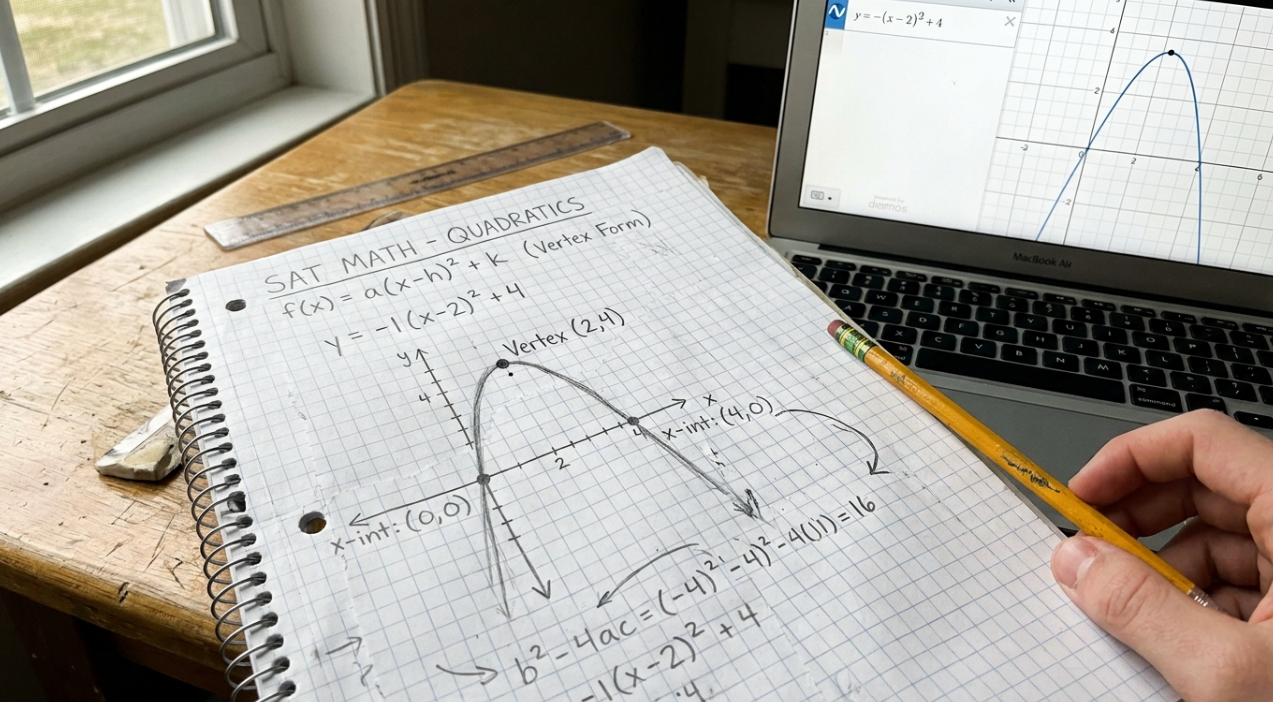
What it is: Quadratic equations (ax² + bx + c = 0), vertex form (a(x - h)² + k), and the discriminant (b² - 4ac).
Why it’s hard: The digital SAT leans heavily on quadratics for its hardest material. You’ll need to convert between standard form, factored form, and vertex form fluently. Discriminant questions ask how many solutions an equation has without actually solving it. Completing the square shows up both as a standalone skill and buried inside circle equation problems.
Hard-module specifics: Practitioners who analyze SAT data report that discriminant questions, completing the square, and vertex form conversions appear significantly more often on the harder Module 2 path.
Desmos tip: Graph the parabola, click the x-intercepts for roots, and read the vertex directly. This is one of the fastest Desmos techniques, saving 30–60 seconds per problem. See the Desmos vertex lesson for a walkthrough.
2. Nonlinear Systems of Equations
What it is: Systems where at least one equation is nonlinear (typically a parabola intersecting a line, or two curves intersecting).
Why it’s hard: You’re often asked how many intersection points exist, or for which values of a constant the system has exactly one solution. This requires combining algebraic substitution with discriminant reasoning. It’s a classic multi-concept fusion question.
Desmos tip: Graph both equations and count intersection points visually. For “how many solutions” questions with a parameter, use Desmos sliders to sweep through values and watch intersections appear and disappear. The slider sweep lesson covers this technique.
3. Polynomial Manipulation
What it is: Factor by grouping, polynomial long division, synthetic division, and finding zeros of polynomials.
Why it’s hard: The SAT might give you a cubic and ask which expression is a factor, or present a polynomial division problem where the remainder reveals a key relationship. Factor by grouping, in particular, is a technique many Algebra 2 classes rush through, leaving students with shaky fundamentals.
Hard-module specifics: Factor by grouping appears much more frequently in the harder module compared to the easier path.
Desmos tip: Graph the polynomial and read zeros directly. But when the question asks about algebraic structure (like “which of the following is equivalent to…”), Desmos offers limited help. You need the algebra.
4. Circle Equations
What it is: The standard form of a circle equation, (x - h)² + (y - k)² = r², and converting from expanded form by completing the square.
Why it’s hard: Students see x² + y² + 6x - 4y + 4 = 0 and don’t recognize it as a circle. You need to complete the square in both x and y simultaneously to extract the center and radius. This is essentially a quadratics problem dressed up as geometry.
Desmos tip: Desmos can graph implicit equations. Type the expanded form directly and it will draw the circle, letting you read center and radius visually. Check the Desmos circle lesson for this approach.
5. Trigonometry (SOHCAHTOA and Radians)
What it is: Right-triangle trigonometry, unit circle values, radian measure, and the complementary angle identity (sin(x) = cos(90° - x)).
Why it’s hard: Geometry and Trigonometry make up only 15% of the section, so students sometimes deprioritize these topics. But when trig questions appear at the hard end of Module 2b, they’re dense. The complementary angle identity, in particular, is a frequently tested concept that trips up students who only learned SOHCAHTOA.
Desmos tip: Desmos handles trig functions and radians natively. You can graph sin and cos curves to find intersection points. But the conceptual setup (knowing which identity to apply) is where the difficulty lives, and no calculator helps with that.
For a full list of formulas you need, check this SAT math formulas guide.
6. Complex Multi-Step Word Problems
What it is: Problems that describe a real-world scenario (business profits, mixture concentrations, distance-rate-time situations) and require you to build an equation from scratch before solving.
Why it’s hard: As many tutors emphasize, the setup is the hard part. The math after setup is often basic algebra. But students lose points because they misidentify what the variable represents, or they don’t catch that the problem asks for a specific thing like the rate per hour rather than the total.
Desmos tip: Limited. These problems test reading comprehension and mathematical modeling. Once you have the equation, Desmos can solve it, but the bottleneck is getting to the equation.
7. Exponential and Rational Functions
What it is: Exponential growth/decay models (y = a · bˣ), rational expressions (fractions with polynomials), and asymptote behavior.
Why it’s hard: Exponential questions on the hard module often require understanding what different components of the function represent in context (what does the base mean? what does the coefficient mean?). Rational functions test simplification and domain restrictions, both areas where careless errors compound.
Desmos tip: Graphing exponential and rational functions instantly reveals asymptotes and behavior. Very useful for “which graph represents” or “what happens as x approaches infinity” questions.
8. Advanced Data Analysis
What it is: Scatterplot regression, conditional probability, weighted averages, and the average-sum trick (average × count = sum).
Why it’s hard: These problems combine statistical reasoning with algebraic manipulation. A question might give you a scatterplot and ask which equation best models it, then follow up with an interpretation question about the slope in context.
Hard-module specifics: The average-sum trick appears more often on the harder Module 2 path. If a group of 10 scores averages 80, the total is 800. If one score is removed and the average changes, what was the removed score? This type of reasoning catches students who rely on formulas without understanding what averages actually mean.
Desmos tip: Desmos regression using the tilde (~) operator can fit a line or curve to data points. This is one of the most underutilized Desmos features on the SAT. Learn it in the Desmos regression lesson.
How Desmos Can (and Can’t) Help on Hard Questions
College Board’s Bluebook app includes a built-in Desmos graphing calculator for every math question. But here’s the nuance that most prep articles miss: many of the hardest SAT math questions are designed so that a calculator provides limited help.
Where Desmos Saves You
Graphing intersections: For systems of equations, graph both and click intersection points. Instant answer.
Finding zeros and vertices: Type the quadratic, read the roots and vertex from the graph.
Regression: Use the tilde operator to fit scatterplot data. Saves enormous time compared to hand calculation.
Sliders for parameter questions: “For how many values of k does the system have exactly one solution?” Use a slider for k and watch the graph change.
Testing answer choices: Plug each option into the function and see which one works.
Each of these techniques saves 30–90 seconds per problem, according to practitioners who teach SAT Desmos strategies.
Where Desmos Falls Short
Setup-dependent problems: If the difficulty is in translating a word problem into an equation, Desmos can’t help until you have something to type.
Conceptual reasoning: Questions about what a coefficient means in context, or why an equation has no solution, require understanding, not computation.
Algebraic equivalence: “Which expression is equivalent to…” problems need algebraic manipulation. You can verify an answer with Desmos, but the solving step is mental.
The real skill isn’t “use Desmos on everything.” It’s recognizing when a visual or numerical approach is faster than hand algebra, and when it isn’t.
Digital SAT Math Difficulty Has Increased Since 2024
The March 2024 digital SAT was a wake-up call. It was the first fully digital and adaptive SAT administered in the United States, and students across the country reported that the math questions, especially in Module 2, were far more difficult than official practice materials had suggested.
This wasn’t just anecdotal. TikTok creators with perfect scores, Reddit users with 800s, and college counselors all confirmed the difficulty spike. One test prep analyst noted that the adaptive algorithm seemed calibrated to challenge even the strongest students in ways that felt qualitatively different from the paper SAT or practice tests.
College Board responded by releasing harder practice tests (Tests 7–10) in early 2025. Multiple prep providers subsequently increased the difficulty of their own practice materials to match. Piqosity, for example, publicly announced they updated their scoring methodology after analyzing actual student results against the new practice tests.
The threshold for routing to the harder Module 2 has also reportedly tightened, now requiring approximately 70% accuracy in Module 1, up from around 60% in earlier administrations.
What this means for you: if you’re studying with older practice materials or easy question banks, you’re not seeing what the real test looks like. The hardest SAT math questions on recent administrations are harder than what most students practiced with. Study accordingly.
For a broader analysis, read our guide on whether the digital SAT is harder than its paper predecessor.
How to Practice the Hardest SAT Math Questions
Knowing what makes questions hard is step one. Here’s how to actually get better at them.
Start With a Diagnostic
Don’t guess at your weak spots. Take a diagnostic test that identifies which domains and skill areas need work. You might think you’re weak at trig but discover that polynomial manipulation is where you’re actually bleeding points. A diagnostic prevents wasted study hours.
Use Official Sources First
College Board’s Bluebook practice tests and the Educator Question Bank are the gold standard for question quality. Practitioners on Reddit consistently emphasize that official questions have a specific “feel” that third-party questions sometimes miss. Start here, then supplement.
Practice by Difficulty Tier, Not Just Topic
Most students practice by topic: “today I’ll do quadratics.” That’s fine early on, but to prepare for the hardest SAT math questions, you need to practice at the difficulty level you’ll face on test day. Filter for hard questions specifically. A question bank with difficulty filters makes this straightforward.
Review Mistakes Systematically
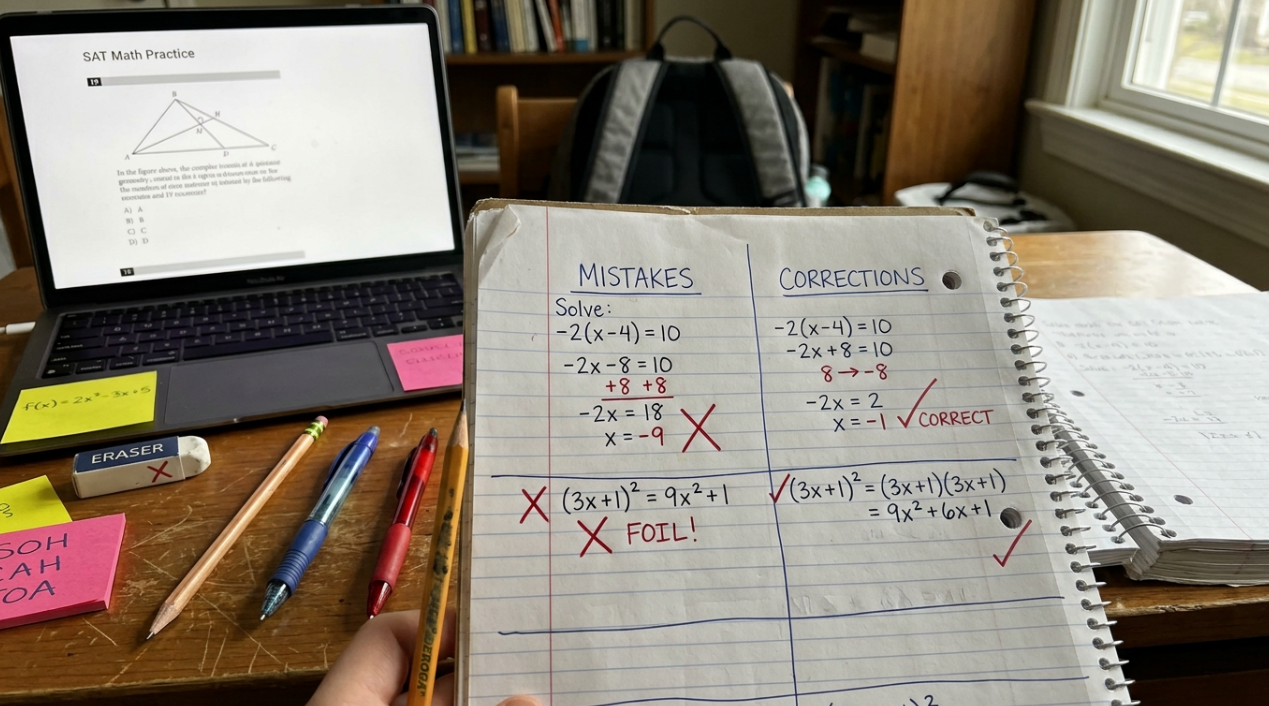
Every wrong answer falls into one of three categories:
Concept error: You didn’t know the math. Solution: study the concept and do more problems in that topic.
Entry error: You knew the math but made a careless mistake (sign error, misread the question). Solution: slow down on setup, double-check your work.
Time error: You knew how to solve it but ran out of time. Solution: learn faster methods (often Desmos) and practice pacing.
Treating all mistakes the same is one of the biggest study errors students make. Categorizing them focuses your practice where it actually matters.
Simulate Real Test Conditions
Taking untimed practice problems is not the same as facing question 21 of Module 2b with four minutes left on the clock. Take full-length practice exams under timed conditions regularly. This builds stamina and teaches you when to skip a question and come back.
Set Expectations Realistically
One veteran tutor frames it this way: on most tests, roughly 90% of the material is predictable, under 5% is essentially unpredictable, and the rest falls somewhere in between. You cannot prepare for every possible hard question. The goal is to nail the predictable 90%, handle most of the in-between, and make peace with the small slice that surprises everyone.
Scoring Context: How Much Do the Hardest Questions Matter?
Missing the hardest SAT math questions doesn’t destroy your score, but it caps it. Here’s a rough breakdown based on available scoring data:
Questions Missed | Approximate Score Range |
|---|---|
0 | 800 |
1–2 | 770–790 |
3–4 | 740–770 |
5–7 | ~700 |
10+ | Below 680 |
These numbers shift slightly between administrations because of the equating curve, but the pattern holds. If you’re aiming for 750+, you can afford to miss about 3–4 questions total across both modules. That means the hardest 4–5 questions at the end of Module 2b become the battleground.
For students targeting 650–700, the highest-value strategy is not grinding the hardest questions. It’s eliminating mistakes on medium-difficulty problems. The hardest questions matter most for students already in the 720+ range who want to push higher.
For more scoring benchmarks, see the SAT score chart with percentile breakdowns.
Wherever you are in your prep, the path forward starts with knowing exactly where you stand. Take a diagnostic, identify your gaps, and start practicing at the difficulty level that actually matches the test.
Start practicing SAT math with problems filtered by difficulty, topic, and domain.
FAQ
How many questions can I miss and still score 750+ on SAT Math?
Roughly 3–4 across the entire math section, assuming you’re routed to the harder Module 2. The exact number depends on the test’s equating curve, which varies by administration. Getting every easy and medium question right is more important than getting every hard question right.
Is the SAT math section harder than the ACT math section?
They test different things. The SAT goes deeper on fewer topics (especially quadratics, systems, and data interpretation) and uses an adaptive format that escalates difficulty. The ACT covers a broader range of topics, including some that the SAT skips (matrices, logarithm properties), but has less depth per topic. Most students find one or the other more natural based on their math background. Taking a practice test for each is the fastest way to decide.
Should I use Desmos on every hard question?
No. Use Desmos when the problem involves graphing, finding intersections, checking zeros, or sweeping through parameter values. Skip it when the difficulty is in setting up the problem or understanding what’s being asked. The skill is knowing when a visual approach beats hand algebra, not defaulting to the calculator every time.
What’s the fastest way to improve on hard SAT math questions?
Diagnose first. Most students have 2–3 specific topic gaps (not a general “math” weakness) that account for the majority of their missed points. Fill those gaps with targeted practice, then take timed full-length tests to build endurance. Reviewing mistakes by category (concept, entry, or time error) accelerates improvement more than doing hundreds of random problems.
Do the hardest questions always come from Advanced Math?
Not always, but disproportionately yes. Advanced Math and Algebra together make up 70% of the section. The hardest individual questions often fuse Advanced Math with Geometry/Trig, like a system of equations involving a circle, or a quadratic embedded in a trig problem. Pure Data Analysis questions can also be brutally hard when they combine probability with multi-step reasoning.
How has SAT math difficulty changed since the digital format launched?
Students and tutors widely reported that the March 2024 digital SAT was significantly harder than practice materials suggested, particularly in Module 2. College Board has since released harder official practice tests (Tests 7–10), and third-party prep providers have adjusted their difficulty levels upward. The trend is toward harder math, not easier.
What score do I need to “unlock” the harder Module 2?
You need approximately 70% accuracy on Module 1 (roughly 15–16 correct out of 22). This threshold has reportedly increased from about 60% in earlier administrations. Being routed to the harder module is desirable because it raises your score ceiling.
Can I get a 700+ without mastering the hardest question types?
Yes. A 700 typically allows missing 5–7 questions. If you nail every easy and medium question and get a few hard ones right through smart elimination or Desmos shortcuts, 700+ is achievable without full mastery of every hard topic. But pushing past 750 requires consistent performance on hard questions, which means targeted practice on the topics listed in this guide.