
SAT Algebra 2026: Complete Study Guide to Linear Math
Miyagi Labs ·
SAT Algebra 2026: Complete Guide to Linear Equations, Functions & Systems

TL;DR
SAT Algebra accounts for approximately 35% of SAT Math, or about 13–15 questions. College Board defines the Algebra domain around five skills:
Linear equations in one variable
Linear equations in two variables
Linear functions
Systems of two linear equations in two variables
Linear inequalities in one or two variables
The most important SAT Algebra skills are solving and creating equations, interpreting slope and intercepts, translating word problems into mathematical models, solving systems, determining the number of solutions, and connecting equations with graphs and tables.
For the SAT, Algebra primarily means linear relationships. Quadratics, polynomials, exponentials, radicals, rational equations, and other nonlinear topics are generally classified under Advanced Math, not Algebra.
This guide covers the official SAT Algebra topics, formulas, question types, common mistakes, Desmos strategies, and a practical study plan.
SAT Algebra Topics: The 5 Official Skills
College Board divides SAT Algebra into five official skill areas. Together, they focus on linear equations, functions, systems, and inequalities.
SAT Algebra Skill | What You Need to Know | Common Question Types | What to Practice |
|---|---|---|---|
Linear equations in one variable | Solve equations, manipulate expressions, identify constants and variables | Solve for x, find an unknown constant, determine the number of solutions | Multi-step equations, distribution, combining like terms |
Linear equations in two variables | Understand equations, slope, intercepts, and representations | Find slope, identify intercepts, match equations to graphs | Slope, intercepts, standard form, graph/table interpretation |
Linear functions | Model and interpret linear relationships | Evaluate functions, interpret slope/intercept, compare representations | Function notation, rate of change, tables, graphs |
Systems of linear equations | Solve two equations simultaneously | Find intersections, determine number of solutions, solve for a parameter | Substitution, elimination, graphing, Desmos |
Linear inequalities | Solve and represent inequalities | Number lines, shaded regions, constraints, inequality modeling | Sign changes, compound inequalities, two-variable graphs |
Bottom line: If you are studying specifically for SAT Algebra, these five areas should be your core checklist. College Board's Student Question Bank also organizes Algebra practice around these same five skills.
What Is SAT Algebra?
SAT Algebra is the College Board Math domain focused on linear equations, linear functions, systems of linear equations, and linear inequalities. It represents approximately 35% of the SAT Math section, or about 13–15 questions.
The five official Algebra skills are:
Linear equations in one variable
Linear equations in two variables
Linear functions
Systems of two linear equations in two variables
Linear inequalities in one or two variables
The key distinction is that College Board uses Algebra primarily for linear relationships. Nonlinear topics such as quadratic, polynomial, exponential, rational, radical, and absolute-value equations are included in the separate Advanced Math domain.
For SAT preparation, think of Algebra as:
SAT Algebra = equations + linear functions + systems + inequalities + interpreting representations.
You may need to move between an equation, graph, table, function, and word problem rather than simply solve for a variable. College Board specifically describes Algebra questions as requiring students to create, solve, interpret, and connect different representations of linear relationships.
SAT Math Section Quick-Reference Table
Domain | Percentage of Math Score | Approximate Question Count | Representative Topics |
|---|---|---|---|
Algebra | ~35% | 13–15 | Linear equations, inequalities, systems, functions |
Advanced Math | ~35% | 13–15 | Quadratics, polynomials, exponentials, radicals, absolute value |
Problem-Solving & Data Analysis | ~15% | 5–7 | Ratios, percentages, probability, statistics, data interpretation |
Geometry & Trigonometry | ~15% | 5–7 | Area, volume, right triangles, circles, trig functions |
A key takeaway: Algebra and Advanced Math together account for about 70% of your scored Math questions. If you’re strong in both, you’ve covered the vast majority of what the test asks.
The full Math section contains 44 questions split into two modules of 22 questions each, with 35 minutes per module.
SAT Algebra Question Types
SAT Algebra questions can test the same underlying skill in several different formats. Instead of memorizing one question pattern, practice recognizing what the question is asking you to do.
1. Solve a Linear Equation
You may be given an equation such as:
3x + 7 = 25
The task is to solve for x, simplify an expression, or determine an unknown constant.
2. Interpret a Linear Equation
The SAT may give you an equation in context and ask what a coefficient or constant represents.
For example, in:
C = 25x + 100
the 25 may represent a rate or cost per unit, while 100 may represent an initial value.
3. Find or Interpret Slope
You may need to calculate slope from two points, a table, an equation, or a graph.
The key formula is:
m = (y₂ − y₁) / (x₂ − x₁)
4. Identify a Linear Function
The question may give you a function, table, graph, or word problem and ask you to identify the corresponding linear representation.
5. Solve a System of Equations
You may need to find the point where two linear equations intersect or determine whether a system has one solution, no solution, or infinitely many solutions.
6. Determine the Number of Solutions
Some questions ask which value of a constant makes a system have no solution or infinitely many solutions.
For two lines:
Different slopes → one solution
Same slope, different intercepts → no solution
Same line → infinitely many solutions
7. Solve or Interpret an Inequality
You may need to solve a one-variable inequality, interpret a number-line graph, or determine which point satisfies a two-variable inequality.
8. Translate a Word Problem
The SAT frequently places algebra in a real-world context. You may need to convert information about cost, distance, time, population, production, or another quantity into an equation or inequality.
9. Connect Multiple Representations
A question may provide a graph and ask which equation matches it, provide a table and ask for the function, or give an equation and ask what it means in context.
Best practice: Before calculating, identify the task. Ask whether the question wants you to solve, model, interpret, compare, graph, or determine the number of solutions.
SAT Algebra Glossary
The SAT Algebra domain contains five official skill areas: linear equations in one variable, linear equations in two variables, linear functions, systems of two linear equations in two variables, and linear inequalities in one or two variables.
The glossary below explains the terminology you need to recognize these question types quickly and includes examples of how each concept can appear on the SAT.
A. Linear Equations in One Variable
Variable — A letter (usually x) that represents an unknown quantity.
Example: In 3x + 5 = 20, the variable is x.
Coefficient — The number multiplied by a variable.
Example: In 7x, the coefficient is 7. The SAT often buries coefficients in word problems, asking you to identify what a number “represents.”
Constant — A fixed number with no variable attached.
Example: In 2x + 9 = 15, both 9 and 15 are constants.
Like terms — Terms with the same variable raised to the same power. You can combine them.
Example: 3x + 5x = 8x. The SAT tests this through multi-step equations where combining like terms is the necessary first move.
Distributing — Multiplying a value across terms inside parentheses.
Example: 4(x + 3) = 4x + 12. Sign errors during distribution are one of the most common SAT algebra mistakes.
Isolating a variable — Rearranging an equation so one variable stands alone on one side.
Example: Given 2x + 6 = 14, subtract 6, then divide by 2 to get x = 4.
SAT context: Many questions give you a formula and ask you to “solve for” a specific variable, even when there are multiple letters in the equation.
No solution — When simplifying leads to a false statement like 0 = 5, the equation has no value of x that works.
SAT context: This is a classic trap. Students confuse “no solution” with “the solution is zero.” They are completely different things.
Infinitely many solutions (identity) — When simplifying leads to a true statement like 0 = 0 or 3 = 3, every value of x works.
SAT context: Questions about “no solution” and “infinitely many solutions” often ask you to find the value of a constant that makes one condition or the other true.
You can also practice solving equations with Desmos, which is a fast verification method on test day.
B. Linear Equations in Two Variables
Slope (rate of change) — How much y changes for each one-unit increase in x. Calculated as (y₂ - y₁) / (x₂ - x₁).
SAT context: The SAT almost always asks you to interpret slope in a real-world context. “The slope represents the additional cost per mile,” for instance. Knowing the formula isn’t enough; you need to translate it into words.
Y-intercept — The value of y when x = 0. Visually, where the line crosses the y-axis.
SAT context: In word problems, the y-intercept is typically a starting value, initial fee, or base amount.
Slope-intercept form — y = mx + b, where m is the slope and b is the y-intercept.
This is the most common form on the SAT. If a question hands you a different form, converting to slope-intercept is often the fastest path.
Point-slope form — y - y₁ = m(x - x₁). Useful when you know the slope and one point.
SAT context: Less common than slope-intercept, but appears when a question gives you a rate of change and a specific data point.
Standard form — Ax + By = C, where A, B, and C are integers.
SAT context: Systems of equations are sometimes easier to solve with elimination when both equations are in standard form.
Parallel lines — Lines with the same slope but different y-intercepts. They never intersect.
Example: y = 3x + 2 and y = 3x - 5 are parallel.
SAT context: If a system of two linear equations has no solution, the lines are parallel.
Perpendicular lines — Lines whose slopes are negative reciprocals of each other.
Example: If one line has slope 2, a perpendicular line has slope -1/2.
C. Systems of Two Linear Equations in Two Variables
System of equations — Two or more equations with the same variables, considered together. You’re looking for values that satisfy both simultaneously.
Example: x + y = 10 and 2x - y = 5.
Substitution method — Solve one equation for one variable, then plug that expression into the other equation.
Best when: one variable is already isolated or easy to isolate.
Elimination method — Add or subtract the equations (sometimes after multiplying one by a constant) to cancel out a variable.
Best when: both equations are in standard form.
Graphical solution — The point where two lines cross on a graph. The x and y coordinates of the intersection are the solution.
SAT context: This is where Desmos becomes extremely powerful on the Digital SAT. Graph both equations, click the intersection point, and you have the answer. Practitioners report this cuts a 90-second algebraic substitution down to about 15 seconds.
One solution — The lines intersect at exactly one point. The system has different slopes.
No solution — The lines are parallel (same slope, different intercept). No point satisfies both equations.
Infinitely many solutions — The equations describe the same line. Every point on that line is a solution.
SAT tip: Questions about the number of solutions to a system are common and often come in the form of “For what value of k does the system have no solution?” Your job is to set the slopes equal while keeping the intercepts different.
For a step-by-step walkthrough of the Desmos intersection trick, check out the systems of equations Desmos lesson.
D. Linear Inequalities in One or Two Variables
Inequality symbols — < (less than), > (greater than), ≤ (less than or equal to), ≥ (greater than or equal to).
SAT context: Pay attention to whether the symbol includes “or equal to,” since that determines open vs. closed circles on number lines and dashed vs. solid boundary lines on graphs.
Compound inequality — Two inequalities joined together, like 2 < x ≤ 7.
SAT context: Word problems about real-world constraints (“the temperature must be between 60 and 80 degrees”) translate directly into compound inequalities.
Graphing on a number line — A visual representation of which values satisfy an inequality.
Open circle means the endpoint is not included (<, >). Closed circle means it is (≤, ≥).
Two-variable inequality graphing — Graph the boundary line, then shade the region that satisfies the inequality.
Solid line for ≤ or ≥. Dashed line for < or >.
SAT context: You may be asked which point lies in the solution region, or which inequality corresponds to a given graph. The Desmos inequality region lesson shows how to visualize these instantly.
Flipping the inequality sign — When you multiply or divide both sides by a negative number, the direction of the inequality reverses.
Example: -2x > 6 becomes x < -3 after dividing by -2.
This is probably the most-tested mechanical rule in SAT algebra inequalities, and forgetting to flip is one of the most common errors.
Real-world constraint modeling — Using inequalities to represent limits like budgets, capacities, or minimum requirements.
Example: A student can spend at most $50 on books. If each book costs $8, the inequality 8n ≤ 50 models the constraint.
SAT context: These questions test whether you can translate English into math. Practitioners on prep forums consistently say that setting up the inequality correctly is harder than solving it.
E. Linear Functions
Function notation: f(x) — A way of naming a function and specifying its input. f(x) = 2x + 3 means “the function f takes an input x and outputs 2x + 3.”
SAT context: Don’t overthink it. f(x) is just another way of writing y.
Evaluating a function — Plugging a specific value into the function.
Example: If f(x) = 2x + 3, then f(4) = 2(4) + 3 = 11.
Domain and range (linear context) — Domain is the set of possible input values; range is the set of possible output values. For most linear functions on the SAT, both are all real numbers unless the problem restricts them with a real-world context.
Writing linear functions from word problems — Translating a scenario into f(x) = mx + b form.
Example: A plumber charges $50 for a house call plus $30 per hour. The function is f(h) = 30h + 50.
SAT context: Getting this translation right is the whole battle. As one PrepScholar analysis notes, “Setting up the right equation from a word problem is often where students lose points, not in the calculation itself.”
Interpreting slope as rate and intercept as starting value — On the SAT, you are frequently asked what a specific number in an equation “means” in context.
Example: In C(t) = 15t + 200, the 15 represents the cost per unit of time, and 200 represents the initial cost.
SAT Algebra Formulas You Should Know
You do not need a huge formula sheet for SAT Algebra. Most questions test whether you can recognize and use linear relationships rather than memorize complicated formulas.
Concept | Formula / Rule | What It Helps You Find |
|---|---|---|
Slope | m = (y₂ − y₁) / (x₂ − x₁) | Rate of change |
Slope-intercept form | y = mx + b | Slope and y-intercept |
Point-slope form | y − y₁ = m(x − x₁) | Equation from a point and slope |
Standard form | Ax + By = C | Linear equations and systems |
Function form | f(x) = mx + b | Linear function models |
Inequality rule | Reverse the inequality when multiplying or dividing by a negative | Solving inequalities |
System solution | The point satisfying both equations | Intersection of two lines |
The Most Important Rule to Remember
When solving an inequality, reverse the inequality symbol whenever you multiply or divide both sides by a negative number.
For example:
-2x > 6
Divide by -2:
x < -3
The sign changes from > to < because you divided by a negative number.
What You Do Not Need to Memorize
The SAT provides a reference sheet during the Math section, so your preparation should focus less on memorizing every formula and more on recognizing when and how to use the formulas provided.
Algebra vs. Advanced Math: Where the Line Is Drawn

This is the single biggest source of confusion for students planning their SAT math study. Here’s the cleanest breakdown:
SAT Algebra (Linear) | SAT Advanced Math (Nonlinear) |
|---|---|
Linear equations in one variable | Quadratic equations and functions |
Linear equations in two variables | Polynomial expressions and equations |
Systems of two linear equations | Exponential functions and equations |
Linear inequalities | Radical and rational equations |
Linear functions | Absolute value functions |
Slope and intercept interpretation | Nonlinear systems of equations |
The rule of thumb: if every variable in the expression has an exponent of 1 (or is in the denominator of a constant, not another variable), it’s Algebra. The moment you see x², √x, aˣ, or |x|, you’ve crossed into Advanced Math territory.
This matters for study prioritization. A student who thinks “I need to review SAT algebra” and then spends hours on quadratics is technically working on the wrong domain. Both are important (each is worth 35%), but knowing which is which helps you diagnose your weak spots accurately.
As one SAT content creator explains, “What the College Board calls ‘Advanced Math’ can really be simplified to ‘non-linear expressions.’” That single sentence clarifies the boundary better than most textbooks.
From a high school course perspective, SAT Algebra maps roughly to Algebra 1 and parts of Algebra 2, while Advanced Math draws from Algebra 2 and Pre-Calculus. One practitioner observation worth noting: a very strong student could score 700+ on the SAT after completing just Algebra and Geometry. The test rewards depth in fundamentals over breadth in advanced topics.
How SAT Algebra Appears on Test Day
SAT Algebra questions aren’t grouped into their own section. They’re mixed throughout both Math modules alongside questions from all four domains. Here’s what that looks like in practice.
The adaptive format matters. Your performance on Module 1 determines whether you receive an easier or harder Module 2. Students who do well on Module 1 get routed to a harder Module 2, which unlocks higher score ranges. Students who struggle on Module 1 receive an easier Module 2 but are effectively capped on their maximum possible score. This means avoiding careless mistakes on the straightforward algebra questions in Module 1 is critical. Those “easy” questions are gatekeepers.
For a detailed breakdown of how adaptive scoring works, see this guide on Digital SAT scoring and modules.
Question types: Roughly 75% of Math questions are multiple choice (pick 1 of 4 options), and 25% are student-produced response (SPR), where you type in your own answer with no choices to guide you. SPR questions appear across all domains, including Algebra. For SPR, double-check your arithmetic since there are no answer choices to sanity-check against.
Calculator policy: A calculator is allowed for all 44 questions. The Desmos graphing calculator is built into the test software and available to every student. You can also bring an approved external calculator (TI-84, TI-89, etc.). There is no “no-calculator” section anymore. Learn more about what calculators are allowed.
Students on Reddit’s r/Sat consistently report that SAT algebra questions feel “easy” in isolation but become tricky under time pressure and when wrapped in word problems. The challenge is translation speed, not algebraic manipulation.
Desmos Tips for SAT Algebra Questions
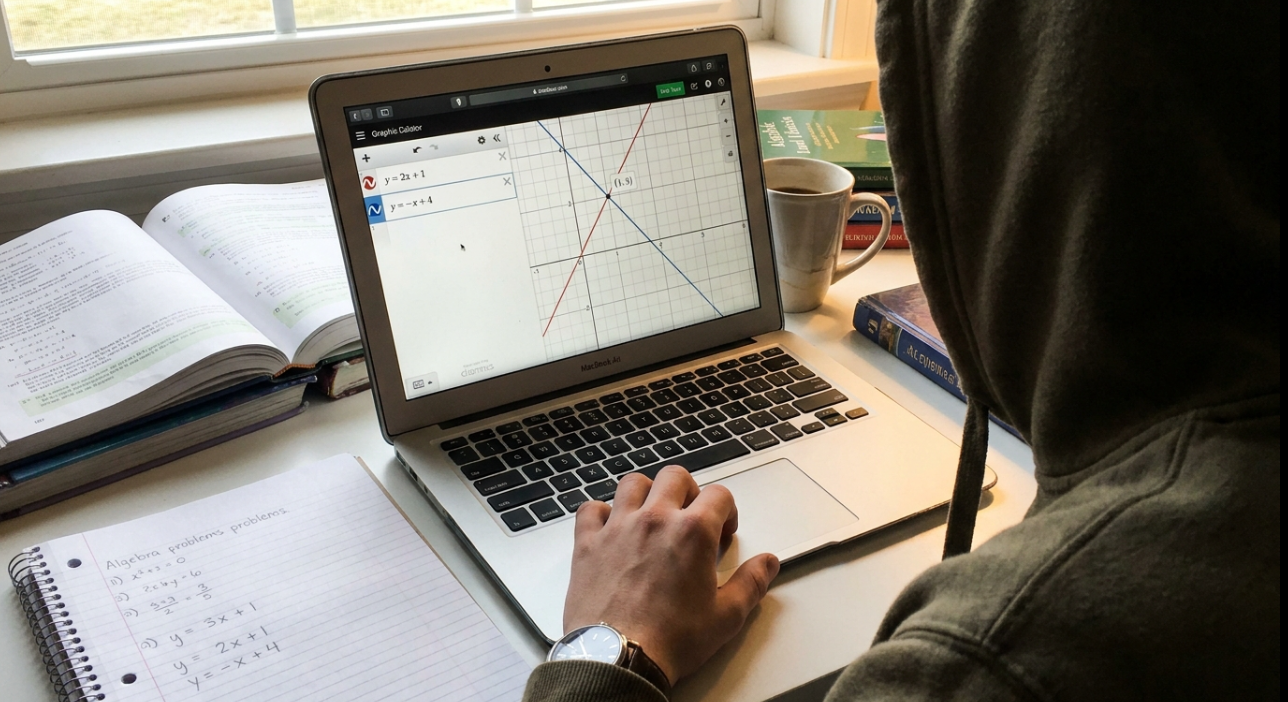
The built-in Desmos graphing calculator is one of the biggest advantages the Digital SAT gives you, and it’s especially powerful for algebra. Practitioners estimate that about 15% of all SAT math questions can be solved or verified using Desmos, and it dramatically cuts solution time.
Systems of equations: Graph both equations. Click the intersection point. That’s your answer. A problem that takes 90 seconds with substitution takes about 15 seconds this way.A. Linear Equations in One Variable
Inequalities: Graph the inequality to instantly see the shaded region. Useful for “which point is in the solution set” questions.
Function evaluation: Type the function into Desmos, then use the table feature or just click on the graph at the input value you need.
Answer verification: Solved a problem algebraically? Plug your answer into Desmos to check. This is especially valuable for SPR questions where there are no answer choices to cross-reference.
For a full walkthrough of Desmos strategies across every question type, see the Desmos SAT tips guide.
One SAT tutor put it this way: “The students who score 750+ on SAT math aren’t necessarily better at algebra than everyone else. They’re better at routing problems: they’ve practiced enough to instantly recognize which technique to deploy and how fast to deploy it.” Desmos is a routing shortcut for a meaningful chunk of algebra questions.
Common SAT Algebra Mistakes
Knowing where students typically lose points is almost as valuable as knowing the content itself. Here are the errors that come up again and again.
1. Word problem translation failures. The hardest part of most SAT algebra questions isn’t the math. It’s converting the English into an equation or inequality. A solid diagnostic habit, recommended by test prep practitioners: before you solve, ask yourself, “Is this question asking me to solve, write an equation, compare two models, interpret a slope, or identify the number of solutions?” That one habit prevents the most common SAT Algebra mistakes.
2. Sign errors when distributing negatives. Distributing -3(x - 4) as -3x - 12 instead of -3x + 12. This costs more points than almost any other mechanical error.
3. Confusing “no solution” with “solution is zero.” If x = 0, that’s a valid solution. “No solution” means no value of x works at all.
4. Forgetting to flip the inequality sign. When multiplying or dividing by a negative, the inequality direction reverses. Students know this rule but forget it under pressure.
5. Misreading what the question asks for. You solve for x, but the question asks for 2x + 1, or for y, or for x + y. Always re-read the question after solving.
6. Misreading slope from a graph vs. a table. On a graph, students sometimes count grid lines incorrectly. From a table, they sometimes pick non-consecutive rows and forget to account for the change in x.
For strategies on avoiding careless errors across all sections, see common SAT test day mistakes.
How to Study SAT Algebra Effectively
SAT algebra is the domain where effort converts to points most reliably. The content is fundamental, the question patterns are predictable, and speed gains compound across the whole test. Here’s how to approach it.
Start with a diagnostic. Don’t study blindly. Identify which of the four sub-skill categories (linear equations in one variable, two variables, systems, inequalities, or functions) need the most work. A 10-minute diagnostic saves hours of wasted practice.
Drill by sub-skill, not randomly. Mixing question types is good for later-stage practice, but early on, focused drilling builds fluency faster. If you’re weak on systems of equations, do 20 systems problems in a row before moving on.
Drill SAT algebra by sub-skill using a question bank that lets you filter by domain and difficulty level.
Use timed practice to build speed. Algebra should be your fastest domain. If you can finish algebra questions quickly and accurately, you bank time for harder Advanced Math and Geometry questions later in the module. Target under 60 seconds per straightforward algebra question.
Use Desmos as a verification tool, not a crutch. Solve problems by hand, then check with Desmos. This builds algebraic fluency while also training your Desmos skills for questions where the calculator approach is genuinely faster.
Review every missed question with a written reason. Don’t just look at the correct answer. Write down why you got it wrong. Was it a setup error? Arithmetic? Misread the question? Conceptual gap? Patterns in your errors reveal what to study next.
Simulate test conditions. Once your sub-skills are solid, take full-length SAT practice exams under realistic timing. The adaptive format means you need to practice performing under Module 1 pressure, knowing that your accuracy there determines your Module 2 difficulty.
Frequently Asked Questions
How many algebra questions are on the SAT?
The Algebra domain accounts for approximately 35% of the Math section, which translates to 13 to 15 scored questions out of 40 operational items. The total Math section has 44 questions, but 4 are unscored pretest items used by College Board for future test development.
What is Heart of Algebra?
“Heart of Algebra” was the name College Board used for the Algebra domain on the pre-2024 SAT. When the Digital SAT launched, they shortened it to just “Algebra.” The underlying content, linear equations, inequalities, systems, and functions, is the same.
Is Algebra 2 on the SAT?
Partially. SAT Algebra covers material from Algebra 1 and some Algebra 2 topics (particularly systems of equations and linear functions). However, the more advanced Algebra 2 content, like quadratics, polynomials, and exponential functions, falls under the SAT’s “Advanced Math” domain, not “Algebra.”
What’s the difference between SAT Algebra and SAT Advanced Math?
The simplest rule: linear topics are Algebra, nonlinear topics are Advanced Math. If every variable has an exponent of 1, it’s Algebra. If you see x², √x, exponential expressions, or absolute values, it’s Advanced Math. Both domains are worth 35% of the Math score.
Can I use a calculator on SAT algebra questions?
Yes. The Digital SAT allows calculator use on all 44 Math questions. The Desmos graphing calculator is built into the test software, and you can also bring an approved handheld calculator. There is no separate no-calculator section.
How should I study SAT algebra if I’m short on time?
Focus on two things: word problem translation (converting English into equations) and systems of equations (learn the Desmos intersection trick). These cover the highest-frequency, highest-point-value question types in the domain. Even a few hours of targeted practice here can move your score.
Are SAT algebra questions hard?
Most SAT algebra questions test fundamental skills. The difficulty comes from time pressure, word problem phrasing, and the occasional “number of solutions” conceptual question. Students who have solid Algebra 1 foundations and practice translating word problems typically find this the most approachable domain on the test.
Does SAT algebra include graphing?
Yes. You’ll encounter questions about graphing linear equations, interpreting graphs of linear functions, graphing linear inequalities (with shading), and identifying solutions to systems from graphs. The built-in Desmos calculator makes graphing-based questions particularly fast if you know how to use it.