
How Many Questions Are on the SAT? 2026 Format & Timing
Miyagi Labs ·
How Many Questions Are on the SAT? 2026 Format & Timing

TL;DR
The Digital SAT has 98 questions total: 54 Reading and Writing questions and 44 Math questions. The test is divided into four separately timed modules and takes 2 hours and 14 minutes of testing time, plus a 10 minute break. Eight questions are unscored pretest questions, leaving 90 operational questions that contribute to scoring. However, the SAT does not use a simple percentage correct system: scores are calculated using an adaptive scoring model that considers the difficulty and characteristics of the questions you answer.
Take a free SAT practice test to see these 98 questions in action before reading further.
How Many Questions Are on the SAT?
The Digital SAT has 98 questions total: 54 Reading and Writing questions and 44 Math questions. Each section is divided into two modules, giving you 27 Reading and Writing questions per module and 22 Math questions per module. You have 64 minutes for Reading and Writing and 70 minutes for Math, for 2 hours and 14 minutes of testing time overall.
That number has stayed consistent across every Digital SAT administration since the format launched in March 2024. College Board has not announced any changes to the question count for the 2025 or 2026 testing years.
SAT Question Count by Section and Module
The Digital SAT splits into two main sections (Reading and Writing, then Math), and each section contains two equal length modules. Here's how the 98 questions distribute:
| Section | Module 1 | Module 2 | Total Questions | Time | Time Per Question |
|---|---|---|---|---|---|
| Reading and Writing | 27 | 27 | 54 | 64 min | ~71 sec |
| Math | 22 | 22 | 44 | 70 min | ~95 sec |
| Total | 49 | 49 | 98 | 134 min | N/A |
Each SAT section has two separately timed modules. Reading and Writing gives you 32 minutes per module, while Math gives you 35 minutes per module. You cannot transfer unused time from one module to another, and you cannot return to a previous module after its time expires.
How Many Questions Are on SAT Math?
The SAT Math section has 44 questions, divided evenly between two 35 minute modules. Each Math module contains 22 questions. Approximately 75% of Math questions use four option multiple choice, while about 25% use student produced response, where you enter the answer yourself.
| SAT Math Detail | Number |
|---|---|
| Total Math questions | 44 |
| Module 1 | 22 |
| Module 2 | 22 |
| Multiple choice | Approximately 33 |
| Student produced response | Approximately 11 |
| Total time | 70 minutes |
| Time per question | About 95 seconds |
The Math section covers four major areas: Algebra, Advanced Math, Problem Solving and Data Analysis, and Geometry and Trigonometry. College Board's current specifications list approximately 13 to 15 questions each for Algebra and Advanced Math and 5 to 7 questions each for the other two domains. For a complete list of what formulas you need to know versus what's provided on the reference sheet, see this SAT math formulas guide.
How Many Reading and Writing Questions Are on the SAT?

The SAT Reading and Writing section has 54 questions, divided evenly between two 32 minute modules. Each module contains 27 questions. The questions are multiple choice and cover four content domains: Craft and Structure, Information and Ideas, Standard English Conventions, and Expression of Ideas.
| SAT Reading and Writing Detail | Number |
|---|---|
| Total questions | 54 |
| Module 1 | 27 |
| Module 2 | 27 |
| Time | 64 minutes |
| Time per question | About 71 seconds |
| Question format | Four option multiple choice |
Because the section is timed separately by module, students should think in terms of 27 questions in 32 minutes rather than trying to manage all 54 questions at once.
How Many SAT Questions Actually Count Toward Your Score?
Of the 98 questions on the Digital SAT, 8 are unscored pretest questions. That means 90 operational questions contribute to the assessment. Each of the four modules contains two pretest questions that do not affect your score.
| Section | Module | Operational Questions | Pretest Questions | Total |
|---|---|---|---|---|
| Reading and Writing | 1 | 25 | 2 | 27 |
| Reading and Writing | 2 | 25 | 2 | 27 |
| Math | 1 | 20 | 2 | 22 |
| Math | 2 | 20 | 2 | 22 |
| Total | All | 90 | 8 | 98 |
The important catch is that you cannot identify the pretest questions while taking the SAT. They are designed to look like regular test questions, so you should treat all 98 questions as if they count.
Also, do not think of the SAT as a simple 90 question percentage test. College Board uses an adaptive scoring model based on Item Response Theory, so two students who answer the same number of questions correctly can receive different section scores depending on the questions they answered.
One practical takeaway worth remembering: if you're stuck on a particularly strange question, there's a real chance it's one of the 8 pretest items. Flag it, move on, and come back if time allows. Understanding how the Digital SAT is scored will help you make smarter decisions about where to spend your time.
Can You Tell Which SAT Questions Are Experimental?
No. The 8 pretest questions are embedded throughout the SAT and are not identified for students. They are designed to look like operational questions so College Board can collect performance data on potential future test questions.
For that reason, do not skip a question because it seems unusually difficult, unfamiliar, or strangely worded. It could be an unscored pretest item, but there is no reliable way to know. The safest strategy is to give every question your best effort.
Practitioners on Reddit report that some experimental questions feel noticeably "off" in style or topic, but tutors consistently warn students against using that instinct to justify skipping them. The risk of leaving a scored question blank far outweighs the time saved.
What Types of Questions Appear on the SAT?
Knowing how many questions are on the SAT matters more when you understand what those questions look like.
Reading and Writing: All 54 questions are standard multiple choice with four answer options. Each question is paired with a short passage (typically one paragraph), which is a significant change from the old SAT's long multi paragraph reading passages. The shorter passages mean you spend less time reading and more time analyzing, which changes the skill being tested.
Math: The 44 Math questions come in two formats. Roughly 75% (about 33 questions) are traditional multiple choice with four options. The remaining 25% (about 11 questions) are student produced response, or SPR, where you type in a numeric answer rather than selecting from choices. SPR questions demand more precision because there are no answer choices to eliminate or back solve from.
Both sections use rights only scoring. Every correct answer earns one point. Wrong answers and blank answers both earn zero. There is no guessing penalty, so you should always answer every single question, even if you're guessing blindly. A random guess has a 25% chance of being correct on multiple choice items. Leaving it blank has a 0% chance.
Want to get a feel for both question formats? Try free SAT practice questions to see the difference between multiple choice and student produced response firsthand.
How SAT Questions Break Down by Topic
Beyond counting how many questions are on the SAT in each section, it helps to know which topics those questions test. College Board publishes domain weights as percentages, and translating those into approximate question counts gives you a much clearer picture of where to focus.
Reading and Writing Domains (54 questions total)
| Domain | Weight | Approximate Questions |
|---|---|---|
| Craft and Structure | ~28% | 15 to 16 |
| Information and Ideas | ~26% | 13 to 14 |
| Standard English Conventions | ~26% | 13 to 14 |
| Expression of Ideas | ~20% | 10 to 11 |
Craft and Structure questions test vocabulary in context and how authors structure arguments. Standard English Conventions covers grammar, punctuation, and sentence structure, the most "learnable" domain for many students. If you want to improve your Reading and Writing score quickly, grammar rules are the place to start because they follow predictable patterns.
Math Domains (44 questions total)
| Domain | Weight | Approximate Questions |
|---|---|---|
| Algebra | ~35% | 13 to 15 |
| Advanced Math | ~35% | 13 to 15 |
| Problem Solving and Data Analysis | ~15% | 6 to 7 |
| Geometry and Trigonometry | ~15% | 6 to 7 |
Algebra and Advanced Math together account for about 70% of the Math section. If you're looking for the highest impact study strategy, those two domains are where the points live. For a focused breakdown of algebra concepts, the SAT algebra study guide covers exactly what you need. Geometry and Trigonometry questions, while fewer, tend to be the ones students skip entirely in prep and then regret on test day.
For targeted practice on any of these domains, the SAT problem sets let you drill specific topic areas rather than grinding through full tests.
How the Adaptive System Affects Your Questions
The Digital SAT uses a multistage adaptive testing design. This is the feature that confuses students the most, so here's a clean explanation.
Each section (Reading and Writing, Math) has two modules. Module 1 is the same difficulty mix for everyone, a spread of easy, medium, and hard questions. Your performance on Module 1 determines whether Module 2 is generally harder or generally easier.
A strong performance on Module 1 can route you to a second module with a higher difficulty mix, while a weaker performance can route you to a lower difficulty mix. The total number of questions stays at 98 regardless of which module you receive. Only the difficulty changes.
This is why Module 1 matters: it helps determine the difficulty mix you will see in Module 2. However, you should not deliberately try to miss questions to manipulate your route. According to College Board's test specifications, the scoring algorithm accounts for the difficulty of each question, so getting routed to the easier module caps your potential score ceiling.
Practitioners in SAT tutoring communities consistently emphasize that Module 1 is the highest leverage moment of the entire test. A student who rushes Module 1 and gets sloppy gets punished twice: lower direct points from careless errors, and a capped second module they can never catch up from. The strategic implication is clear. Slow down slightly on Module 1 and prioritize accuracy over speed.
What Happens When Module 2 Gets Harder?
Students routed to the harder Module 2 will see more questions rated medium and hard difficulty. This feels intimidating, but it's actually good news. Getting harder questions means the scoring algorithm can give you credit at higher score levels. A student who gets 75% correct on a hard Module 2 will typically outscore a student who gets 90% correct on an easy Module 2.
The important thing to understand is that you are not competing against the questions. You are being measured by them. Harder questions unlock higher scores. If Module 2 feels noticeably more difficult, take it as a signal that you performed well on Module 1.
If you're unsure where your Module 1 performance would land you, start with a diagnostic to identify your current level before building a study plan.
Digital SAT vs. Old Paper SAT: Question Count Comparison
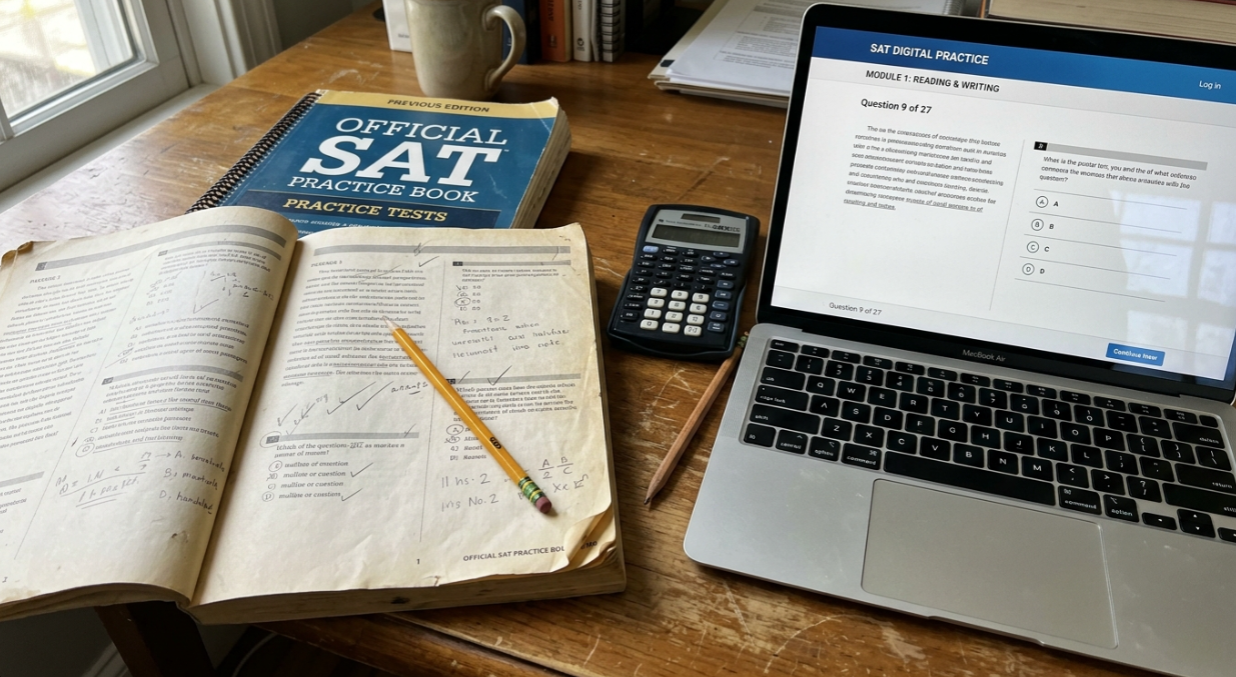
Parents, tutors, and students who took the SAT before 2024 often reference the old format. The differences are substantial.
| Feature | Paper SAT (pre 2024) | Digital SAT (2024 to present) |
|---|---|---|
| Total questions | 154 | 98 |
| Sections | 4 (Reading, Writing, Math No Calc, Math with Calc) | 2 (Reading & Writing, Math) |
| Test duration | 3 hours | 2 hours 14 minutes |
| Adaptive | No | Yes (module level) |
| Calculator | One math section only | Allowed throughout (built in Desmos) |
| Reading passages | Long, multi paragraph | Short, one per question |
The SAT went from 154 questions to 98, a reduction of 56 questions and 46 minutes. This wasn't about making the test easier. Adaptive testing technology allows College Board to measure the same skills more efficiently. Each question now carries more scoring weight, and the adaptive routing provides precise measurement without needing as many items. For a deeper look at whether the new format is actually easier or harder, see this analysis on whether the Digital SAT is harder.
One change worth highlighting: a calculator is now permitted on every math question, with a built in Desmos graphing calculator available in the test interface. The old "No Calculator" math section is gone entirely. Learning to use Desmos effectively can save significant time, especially on systems of equations and graphing problems. The Desmos SAT tips guide walks through specific techniques.
How Much Time Do You Have Per SAT Question?
The average SAT time per question is about 71 seconds in Reading and Writing and 95 seconds in Math. These are averages, not strict limits. Some questions will take less time, allowing you to spend longer on more difficult problems.
| Section | Questions | Time | Average Time Per Question |
|---|---|---|---|
| Reading and Writing | 54 | 64 minutes | ~71 seconds |
| Math | 44 | 70 minutes | ~95 seconds |
Because the modules are separately timed, you should also think in smaller blocks:
- Reading and Writing: 27 questions in 32 minutes per module
- Math: 22 questions in 35 minutes per module
A useful pacing strategy is to avoid treating the average as a target for every question. Easy questions should generally take less than the average, giving you more time for questions that require deeper reading, calculations, or multiple steps.
Pacing: How to Use Your Time Across 98 Questions
Knowing the SAT question count per section lets you calculate exactly how much time you have per question. Here are the benchmarks:
| Section | Questions | Time | Seconds Per Question | Recommended Ceiling |
|---|---|---|---|---|
| Reading & Writing | 54 (27 per module) | 64 min (32 per module) | ~71 seconds | 60 to 75 seconds |
| Math | 44 (22 per module) | 70 min (35 per module) | ~95 seconds | 90 to 100 seconds |
For Reading and Writing, 71 seconds per question is tight. These questions are passage based, so you're reading and answering within that window. Students who struggle with pacing often report that the grammar focused Standard English Conventions questions go faster, while Craft and Structure items take longer.
Math gives you more breathing room at 95 seconds per question, but the student produced response questions and multi step Advanced Math problems can easily eat 2 to 3 minutes each. Budget less time on straightforward Algebra questions to bank time for the harder items.
The Two Pass Strategy
Many high scoring students use a two pass approach within each module. On the first pass, answer every question you can solve quickly and confidently, flagging anything that requires extended thought. On the second pass, return to flagged questions with whatever time remains. This prevents getting stuck on one hard question and running out of time for three easy ones you never reached.
The Digital SAT's built in flagging tool makes this especially practical. Unlike the old paper test where flipping back through pages was clunky, the digital interface lets you jump to any flagged question instantly.
Building a consistent SAT study routine with timed practice is the best way to internalize these pacing rhythms before test day.
Common Test Day Mistakes Related to Question Count and Timing
Understanding the structure on paper is different from executing under pressure. These are the most common mistakes students make that directly relate to the 98 question format:
Spending too long on Module 1 questions you can't solve. Because Module 1 determines your Module 2 difficulty, students sometimes obsess over getting every Module 1 question right. This backfires when it leads to running out of time and leaving easy questions at the end unanswered. Accuracy matters, but not at the cost of leaving questions blank.
Forgetting that time doesn't carry over. If you finish a module with 3 minutes to spare, that time disappears. It does not add to the next module. Use leftover time to review flagged questions within the current module.
Not answering every question. With no guessing penalty, every blank answer is a wasted opportunity. Even a random guess on a four option multiple choice question gives you a 25% chance. Over 98 questions, students who leave blanks are giving away expected points for no reason.
Misjudging the break. There is a 10 minute break between the Reading and Writing section and the Math section. Some students use this poorly by checking their phones for score predictions or stressing about Module 1. Use it to eat a snack, drink water, and mentally reset. For more on avoiding these pitfalls, check out the SAT test day mistakes guide.
Can You Go Back to SAT Questions?
Yes, you can move between questions and change your answers while a module is still active. You can also flag questions to revisit later in that same module.
However, once a module's time expires and the test moves forward, you cannot return to that module. Because each module is separately timed, unused time does not carry over to the next module.
This means strategic flagging is important. If a question is taking more than 90 seconds in Reading and Writing or more than 2 minutes in Math, flag it and move on. You can return to it after you've attempted every other question in that module.
How the 98 Question Count Connects to Score Ranges
Students often want to know exactly how many questions they need to get right for a specific score. The adaptive system makes this less straightforward than a simple conversion chart, but general patterns are worth understanding.
College Board publishes score range tables that show the relationship between raw scores and scaled scores. Because different test forms have slightly different difficulty levels, the exact conversion varies. Here are rough benchmarks based on publicly available practice test data:
- 1400+: Typically requires missing no more than about 8 to 10 scored questions total across both sections, while being routed to harder Module 2s
- 1200 to 1300: Generally allows for missing roughly 15 to 25 scored questions total, depending on difficulty routing
- 1000 to 1100: A student might miss 30 to 40 scored questions and still land in this range
These numbers are approximate. The key insight is that because the test is adaptive, the difficulty of the questions you answer matters as much as how many you get right. Two students who each answer 75 out of 90 scored questions correctly can end up with scores 50 to 100 points apart if one was routed to harder questions.
For a detailed look at what different score levels mean for college admissions, see the SAT score chart and percentiles guide.
2026 to 2027 SAT Test Dates
If you are planning to take the SAT during the 2026 to 2027 testing year, College Board currently lists eight SAT Weekend administrations:
| SAT Test Date | Testing Year |
|---|---|
| August 22, 2026 | Fall 2026 |
| September 12, 2026 | Fall 2026 |
| October 3, 2026 | Fall 2026 |
| November 7, 2026 | Fall 2026 |
| December 5, 2026 | Fall 2026 |
| March 6, 2027 | Spring 2027 |
| May 1, 2027 | Spring 2027 |
| June 5, 2027 | Spring 2027 |
College Board notes that these dates apply to both U.S. and international SAT Weekend testing. Registration deadlines vary by test date, so check the official SAT dates and deadlines before planning your test attempt.
Frequently Asked Questions
Does every SAT administration have the same number of questions?
Yes. Every Digital SAT has exactly 98 questions: 54 Reading and Writing and 44 Math, arranged in four modules. The adaptive system changes the difficulty of Module 2, not the question count.
Can I skip questions and go back to them?
You can move freely within a single module, flagging questions to revisit before time runs out. You cannot go back to a previous module once it's finished.
Is there a penalty for guessing on the SAT?
No. The SAT uses rights only scoring. Wrong answers are worth exactly the same as blank answers: zero points. Always guess if you can't solve the problem.
How many questions do I need to get right for a 1500?
The exact number depends on the difficulty of your specific test form and which adaptive module you're routed to. As a rough benchmark, you'll need to get the vast majority of your 90 scored questions correct. A score predictor can give you a more precise estimate based on your practice performance.
How many SAT Math questions are multiple choice vs. fill in?
About 33 of the 44 Math questions (75%) are standard four option multiple choice. The remaining 11 or so (25%) are student produced response questions where you type in a numeric answer.
What's the scoring range for the SAT?
Total scores range from 400 to 1600. Each section (Reading and Writing, Math) is scored on a scale of 200 to 800, and those two section scores are added together. For context on where different scores land, check out this guide to good SAT scores.
How long should I study for the SAT?
That depends on your starting score and target. Most students benefit from 2 to 4 months of focused preparation. Read more about how long to study for the SAT for specific hour recommendations based on your score gap.
Can I use a calculator on the entire Math section?
Yes. Unlike the old paper SAT, which had a no calculator math section, the Digital SAT allows calculator use on all 44 Math questions. A Desmos graphing calculator is built into the testing interface, or you can bring your own approved calculator.
How many questions do I need to get right for a 1500?
There is no fixed number of correct answers that guarantees a 1500 on the Digital SAT. The SAT uses an adaptive scoring model that considers the difficulty and characteristics of the questions you answer, so two students with the same number of correct answers can receive different scores.
For that reason, do not use a simple "X out of 90" formula to predict a 1500. The most reliable way to estimate your performance is to take an official full length adaptive practice test in Bluebook under realistic testing conditions and review your section scores and missed questions.
Is the Digital SAT easier because it has fewer questions?
Not necessarily. The Digital SAT has fewer questions and less testing time than the old SAT, but it uses multistage adaptive testing and Item Response Theory to measure students' skills with fewer items. The difficulty and structure of the test are therefore different from the old paper SAT rather than simply being a shorter version of it.
How many questions are on each SAT module?
The Reading and Writing modules each contain 27 questions, while the Math modules each contain 22 questions. That means the SAT has 49 questions in its first two modules and 49 questions in its second two modules, for 98 questions total. Each module is separately timed.
Are SAT questions multiple choice?
Most SAT questions are multiple choice. All Reading and Writing questions use four option multiple choice. In Math, approximately 75% of questions are four option multiple choice and approximately 25% are student produced response questions, where you enter the answer yourself.
Can you use a calculator on all SAT Math questions?
Yes. The Digital SAT allows calculator use throughout the entire Math section. The Bluebook testing application also includes a built in Desmos calculator, and students may use an approved personal calculator if they prefer. The old separate "No Calculator" Math section no longer applies to the Digital SAT.
Now that you know exactly how many questions are on the SAT and how those 98 items break down, the next step is finding out where you stand. Take a full length SAT practice exam to get a baseline score and identify which of those domains need the most work.